

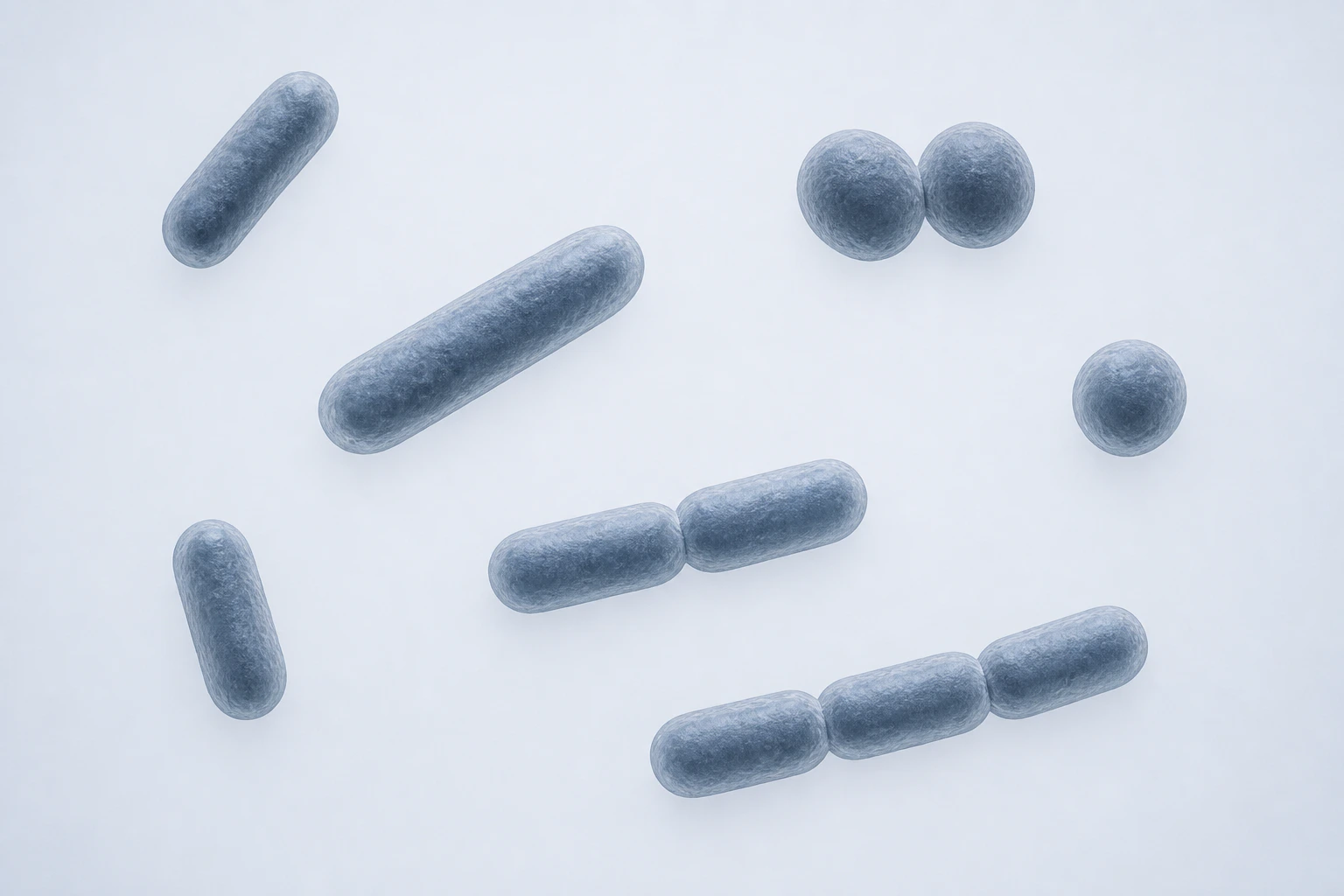
Selected descendant morphology diversity within Bacillota, historically called Firmicutes, shown as eleven rod or coccoid bodies in seven groupings. This phylum-level scientific reconstruction is representative, non-exhaustive, non-diagnostic, and never a universal phylum form or a micrograph.
Scientific media record1 verified identifier
- Subject
- Bacillotataxon · phylum
- Identifiers
- NCBITaxon:1239
- Review
- Editorial review completeIdentifiers authority-verified · Accessibility validated · · firmicutes|firmicutes-microbial-community-v1.webp
- Digital source
- Trained-algorithmic mediaCreated with a trained generative algorithm and reviewed by WikiBiome for subject identity, scientific framing, identifiers, provenance, and accessibility.
- Scientific basis
- Bacillota — NCBI TaxonomyBacillota — LPSNNames of prokaryotic phylaFirmicutes historical phylum-name record
- License
- CC BY-SA 4.0Created
Firmicutes (recently reclassified as Bacillota) is the dominant bacterial phylum in the Western adult gut, comprising the core community of short-chain fatty acid (SCFA) producers that maintain intestinal barrier integrity, regulate immune function, and influence systemic metabolism. Together with Bacteroidetes (Bacteroidota), Firmicutes typically account for >90% of the gut microbiota.
What distinguishes Firmicutes in the WikiBiome context is a critical vulnerability: virtually all major Butyrate-producing Firmicutes depend on Iron-Sulfur Clusters for their core metabolic enzymes.
This shared iron (Fe)-S dependency makes butyrate production the primary casualty of heavy metal exposure—toxic metals (cadmium (Cd), lead (Pb), copper (Cu), nickel (Ni)) that damage iron-S clusters selectively deplete exactly the organisms most important for gut health.
Evidence map2 cited passagesInspect provenance +
| Metal | Effect on Firmicutes | Specific Targets | |-------|---------------------|-----------------| | Nickel | Depletes key SCFA producers | lactobacillus, lachnospiraceae, blautia—Ni disrupts Fe-S clusters and F/B ratio | | Cadmium | Depletes SCFA-producing genera | blautia, Clostridium XIVb, Intestinimonas | | Lead | Increases Firmicutes at phylum lev
High-fiber and mediterranean diet interventions consistently increase SCFA-producing Firmicutes, normalizing the F/B ratio and restoring butyrate production.
Contents
1. Key Genera with WikiBiome Entity Pages2. The Fe-S Cluster Vulnerability3. Metal Interactions4. The Firmicutes/Bacteroidetes Ratio5. Ecological Roles6. Cross-ReferencesKey Genera with WikiBiome Entity Pages#
SCFA Producers (Core Beneficial Community)#
| Genus/Family | Notable Species | Primary Function | Metal Vulnerability |
|---|---|---|---|
| Faecalibacterium prausnitzii | F. prausnitzii | Premier butyrate producer; anti-inflammatory | iron (Fe)-S clusters in butyrate synthesis |
| Roseburia | R. intestinalis | Butyrate via butyryl-CoA:acetate CoA-transferase | iron-S clusters; vulnerable to cadmium (Cd)/lead (Pb) |
| Lachnospiraceae | Family | Butyrate production; "universal Dysbiosis sentinel" | iron-S clusters for butyrate synthesis |
| Blautia | B. obeum | Acetogenesis via Wood-Ljungdahl pathway | iron-S clusters in acetogenic enzymes |
| Coprococcus | C. eutactus | Butyrate and propionate | iron-S dependent |
| Eubacterium | E. rectale | Butyrate production | iron-S clusters |
| Anaerostipes | A. caccae | Butyrate from lactate conversion | iron-S in butyryl-CoA dehydrogenase |
| Ruminococcus | R. bromii | Resistant starch degradation; keystone | iron-S clusters in ferredoxins |
Other Notable Members#
| Genus | Notable Species | Primary Function |
|---|---|---|
| Lactobacillus | Multiple species | Lactic acid production; probiotic; manganese (Mn)-SOD |
| Clostridium | Multiple species | iron (Fe)-S dependent anaerobic fermentation |
| Clostridioides difficile | C. difficile | Opportunistic pathogen; toxin-mediated colitis |
| Enterococcus | E. faecalis, E. faecium | Commensal/opportunistic; manganese-SOD for oxidative defense |
| Staphylococcus aureus | S. aureus | Pathobiont; cambialistic SOD (SodM) |
| Streptococcus | Multiple species | Oral/respiratory; calcium (Ca)-dependent |
| Veillonella | Multiple species | Lactate utilization; cross-feeding |
| Dialister | D. invisus | Associated with antidepressant response |
| Dorea | Multiple species | Oral and gut |
| Phascolarctobacterium | P. succinatutens | Propionate from succinate; biotin-dependent (NOT iron-S) |
| Flavonifractor | F. plautii | Flavonoid degradation; iron-S cluster enoate reductase |
| Hungatella | H. hathewayi | TMA production from choline/carnitine; iron-S dependent |
The Fe-S Cluster Vulnerability#
The defining ecological vulnerability of beneficial Firmicutes is their near-universal dependence on Iron-Sulfur Clusters for butyrate production. The butyrate synthesis pathway requires multiple iron (Fe)-S-containing enzymes. Butyryl-CoA dehydrogenase—contains [4Fe-4S] centers.
Ferredoxins—[4Fe-4S] electron carriers essential for anaerobic metabolism. Pyruvate:ferredoxin oxidoreductase—channels carbon from glycolysis into fermentation.
When toxic metals damage these iron-S clusters (cadmium displaces iron, copper targets thiolate ligands, nickel blocks ISC repair), butyrate production collapses. This is the mechanistic chain: environmental metal exposure → iron-S damage → SCFA producer depletion → barrier dysfunction → Metal-Driven Inflammation.
The exception: Phascolarctobacterium uses a biotin-dependent pathway instead of iron-S enzymes, making it resilient to metal-driven dysbiosis—consistent with Primitive 1 (metals as selective pressures).
Metal Interactions#
| Metal | Effect on Firmicutes | Specific Targets |
|---|---|---|
| Nickel | Depletes key SCFA producers | Lactobacillus, Lachnospiraceae, Blautia—nickel (Ni) disrupts iron (Fe)-S clusters and F/B ratio[1]The influence of nickel on intestinal microbiota disturbancesSwierc J, Drzymala S, Wozniak D et al. · 2022Open reference 1 ↓ |
| Cadmium | Depletes SCFA-producing genera | Blautia, Clostridium XIVb, Intestinimonas[2]Toxic and Essential Metals: Metabolic Interactions with the Gut Microbiota and Health ImplicationsQinheng Zhu, Boyan Chen, Fu Zhang et al. · 2024Open reference 2 ↓ |
| Lead | Increases Firmicutes at phylum level | But genus-level effects vary; lead (Pb)-induced dysbiosis disrupts SCFA production[3]Interaction of Heavy Metal Lead with Gut Microbiota: Implications for Autism Spectrum DisorderTizabi Y, Bennani S, El Kouhen N et al. · 2023Open reference 3 ↓ |
| Iron excess | Displaces Lactobacillus | Enriches Enterobacteriaceae at expense of Firmicutes SCFA producers |
| Iron deficiency | Reduces Lactobacillus and Bacillota overall | Low iron depletes both Firmicutes commensals and pathobionts |
| Zinc excess (long-term) | Suppresses SCFA-producing genera | [4]Chen 2021 — Effect of Long-Term and Short-Term Imbalanced Zn Manipulation on Gut Microbiota and Screening for Microbial Markers Sensitive to Zinc StatusLingjun Chen, Zhonghang Wang, Peng Wang et al. · 2021Open reference 4 ↓ |
The Firmicutes/Bacteroidetes Ratio#
The F/B ratio was the first widely reported microbiome metric (Ley et al., 2006). While still commonly measured, it is now recognized as overly simplistic because phylum-level changes obscure functionally important genus-level shifts.
An elevated F/B could reflect beneficial Firmicutes expansion (e.g., more fiber-fermenting Lachnospiraceae) or harmful expansion (e.g., more pathogenic Clostridia).
| F/B Direction | Conditions |
|---|---|
| Elevated F/B | Obesity, Endometriosis (stages 3/4), Autism Spectrum Disorder (some cohorts), IBS, hypertension, Hashimoto's Thyroiditis |
| Decreased F/B | IBD, Graves' Disease, Pancreatic Cancer |
| Firmicutes SCFA producers specifically depleted | Crohn's Disease, Ulcerative Colitis, Parkinson's Disease, depression, Schizophrenia |
The most clinically meaningful signal is not the F/B ratio itself but the depletion of specific SCFA-producing genera—particularly Faecalibacterium prausnitzii, whose loss is "the single most consistent marker" across IBD, CRC, metabolic disease, and neurodegeneration.
Ecological Roles#
Butyrate Production and Barrier Maintenance#
Firmicutes SCFA producers are the primary source of butyrate in the colon. Butyrate. Fuels colonocyte energy metabolism (preferred substrate over glucose).
Maintains epithelial tight junctions and barrier integrity. Induces regulatory T cells (Treg) via HDAC inhibition.
Creates the oxygen gradient that maintains anaerobic conditions favoring commensals.
Cross-Feeding Networks#
Firmicutes participate in complex metabolic cross-feeding. Ruminococcus degrades resistant starch → releases sugars for other fermenters. Veillonella consumes lactate produced by Lactobacillus → produces propionate. Anaerostipes converts lactate to butyrate, linking lactic acid bacteria to butyrate output.
Fiber Response#
High-fiber and Mediterranean Diet interventions consistently increase SCFA-producing Firmicutes, normalizing the F/B ratio and restoring butyrate production.[5]Effects of a high-fiber diet on gut microbiota and the risk of cardiovascular disease: a systematic reviewMutahar Ahmad Mehmood, Ayush Suri · 2020Open reference 5 ↓
Cross-References#
- Bacteroidetes (Bacteroidota)—Partner phylum in the F/B ratio
- Proteobacteria (Pseudomonadota)—Phylum that expands when Firmicutes SCFA producers decline
- Iron-Sulfur Clusters—The shared metabolic vulnerability of butyrate producers
- Short-Chain Fatty Acids (SCFAs)—Primary output of Firmicutes fermentation
- butyrate—Key metabolite produced by Firmicutes
- dysbiosis—Firmicutes depletion as dysbiosis marker
- Gut Microbiome—Firmicutes as dominant phylum
References 11
Numbered by first appearance in the article, then reconciled with its declared source list.
- 1
Swierc J, Drzymala S, Wozniak D et al. (2022). The influence of nickel on intestinal microbiota disturbances. Pomeranian Journal of Life Sciences.
- 2
★Qinheng Zhu, Boyan Chen, Fu Zhang et al. (2024). Toxic and Essential Metals: Metabolic Interactions with the Gut Microbiota and Health Implications. Frontiers in Nutrition.
- 3
★Tizabi Y, Bennani S, El Kouhen N et al. (2023). Interaction of Heavy Metal Lead with Gut Microbiota: Implications for Autism Spectrum Disorder. Biomolecules.
- 4
Lingjun Chen, Zhonghang Wang, Peng Wang et al. (2021). Chen 2021 — Effect of Long-Term and Short-Term Imbalanced Zn Manipulation on Gut Microbiota and Screening for Microbial Markers Sensitive to Zinc Status. Microbiology Spectrum.
- 5
Mutahar Ahmad Mehmood, Ayush Suri (2020). Effects of a high-fiber diet on gut microbiota and the risk of cardiovascular disease: a systematic review. iScientist.
- 6
Francesco Strati, Duccio Cavalieri, Davide Albanese et al. (2017). Strati 2017 — New Evidences on the Altered Gut Microbiota in Autism Spectrum Disorders. Microbiome.
- 7
Ming Yuan, Dong Li, Zhe Zhang et al. (2018). Yuan 2018 — Endometriosis Induces Gut Microbiota Alterations in Mice. Human Reproduction.
- 8
Heba M. Ismail, Carmella Evans-Molina (2022). Ismail 2022 — Does the Gut Microbiome Play a Role in Obesity in Type 1 Diabetes? Unanswered Questions and Review. Frontiers in Cellular and Infection Microbiology.
- 9
Shan J, Ni Z, Cheng W et al. (2021). Gut microbiota imbalance and its correlations with hormone and inflammatory factors in patients with stage 3/4 endometriosis. Archives of Gynecology and Obstetrics.
- 10
Weijie Zhang, Wan Qu, Hua Wang et al. (2021). Zhang 2021 — Antidepressants Fluoxetine and Amitriptyline Induce Alterations in Intestinal Microbiota and Gut Microbiome Function in Rats. Translational Psychiatry.
- 11
Bao K, Lin H, Guo S (2025). Gut Microbiota and Thyroid Diseases: A Comprehensive Review of Mechanisms and Clinical Implications. X-Disciplinarity.
Article network
Mentioned here 18
Pages linking here 9
Connect the evidence
Publicly readable discussion by ORCID-authenticated researchers. Questions, interpretation, methods, corrections, and new evidence stay attached to this record.
No discussion yet. Start with a precise question or a source-backed observation.
Activity and accepted changes
Accepted researcher context, editorial status, public discussion, and upstream Git revisions are shown together. Pending, declined, and withdrawn proposals remain private.
- published revision
Backfill inflammation concept links
Karen Pendergrass · +1 −1
Inspect exact Git diff ↗ - published revision
Complete corpus-wide Dysbiosis linking
Karen Pendergrass · +2 −2
Inspect exact Git diff ↗ - published revision
Complete Tight junctions contextual coverage
Karen Pendergrass · +1 −1
Inspect exact Git diff ↗ - published revision
massive wiki expansion: 149 stubs fixed, 100+ new pages, Rule 15 scan, keystone papers
WikiBiome Deploy Bot · +38 −38
Inspect exact Git diff ↗ - published revision
pre-overnight checkpoint 2026-04-18
WikiBiome Deploy Bot · +123 −0
Inspect exact Git diff ↗