
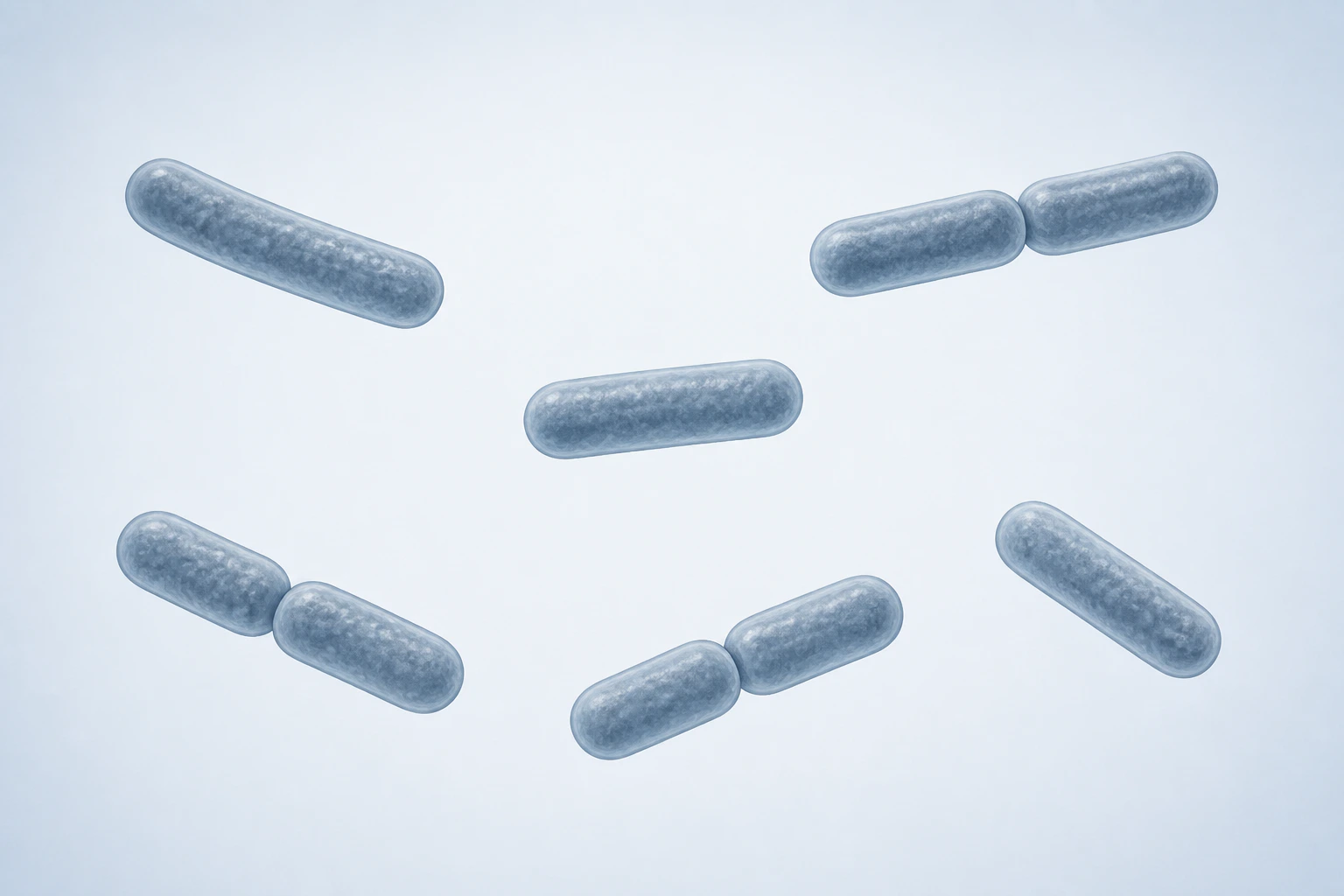
Selected type-species-anchored Eubacterium uniform-to-pleomorphic rod forms, shown as nine bodies in three single and three paired groupings. This reconstruction is representative, non-diagnostic, and not a micrograph.
Scientific media record1 verified identifier
- Subject
- Eubacteriumtaxon · genus
- Identifiers
- NCBITaxon:1730
- Review
- Editorial review completeIdentifiers authority-verified · Accessibility validated · · eubacterium|eubacterium-morphology-v1.webp
- Digital source
- Trained-algorithmic mediaCreated with a trained generative algorithm and reviewed by WikiBiome for subject identity, scientific framing, identifiers, provenance, and accessibility.
- Scientific basis
- Eubacterium — NCBI TaxonomyEubacterium — LPSNEubacterium genus treatmentEubacterium limosum type strain — BacDiveEubacterium limosum type-strain genome description
- License
- CC BY-SA 4.0Created
A genus of Gram-positive, obligate anaerobic bacteria within the Firmicutes phylum that includes several of the most important Butyrate producers in the human colon. Key species are E. rectale, E. hallii (now reclassified as Anaerobutyricum hallii), and E. limosum.
Consistently depleted in inflammatory and cardiometabolic diseases, Eubacterium species are part of the core SCFA-producing guild alongside Faecalibacterium prausnitzii and Roseburia.
Evidence map4 cited passagesInspect provenance +
Depleted in cardiovascular disease: part of the butyrate-producing guild lost in CVD patients.
Cardiovascular disease: E. rectale depleted in CVD patients; its loss reduces butyrate-mediated cardioprotective effects, ].
IBD: consistently reduced in both Crohn's disease and ulcerative colitis; inversely correlated with inflammatory markers. Polyphenol interventions can partially restore Eubacterium abundance.
Colorectal cancer: depleted in CRC; butyrate loss diminishes HDAC-mediated tumor suppression.
Contents
1. Butyrate Production2. Disease Associations3. Metal Dependencies4. Key Metabolites5. ConnectionsButyrate Production#
E. rectale#
One of the most abundant butyrate producers in the healthy human colon, often ranking alongside F. prausnitzii in absolute abundance. Ferments dietary fiber (resistant starch, xylan) via the butyryl-CoA:acetate CoA-transferase pathway. Butyrate output supports colonocyte energy metabolism, tight junction integrity, and anti-inflammatory HDAC inhibition.
Depleted in Cardiovascular Disease: part of the butyrate-producing guild lost in CVD patients.[1]The potential links between human gut microbiota and cardiovascular health and disease - is there a gut-cardiovascular axis?Catia Almeida, J. Guilherme Goncalves-Nobre, Diogo Alpuim Costa et al. · 2023Open reference 1 ↓
E. hallii (Anaerobutyricum hallii)#
Reclassified but still widely referenced by its original name. Unique metabolic versatility: converts lactate, acetate, and 1,2-propanediol to butyrate and propionate, acting as a metabolic cross-feeder that recycles fermentation intermediates.
This lactate-to-butyrate conversion is critical during rapid fermentation when lactate accumulates and could otherwise acidify the colonic environment to harmful levels. Produces vitamin B12 (cobalamin), linking its metabolism to Cobalt availability.
E. limosum#
Converts dietary fiber to butyrate; also metabolizes methanol and betaine. Possesses demethylating activity that may affect epigenetic regulation in the colonic epithelium.
Disease Associations#
Cardiovascular disease: E. rectale depleted in CVD patients; its loss reduces butyrate-mediated cardioprotective effects.[1]The potential links between human gut microbiota and cardiovascular health and disease - is there a gut-cardiovascular axis?Catia Almeida, J. Guilherme Goncalves-Nobre, Diogo Alpuim Costa et al. · 2023Open reference 1 ↓[2]Alterations in the gut microbiome and metabolism with coronary artery disease severityHonghong Liu, Xi Chen, Xiaomin Hu et al. · 2019Open reference 2 ↓
IBD: consistently reduced in both Crohn's disease and ulcerative colitis; inversely correlated with inflammatory markers. Polyphenol interventions can partially restore Eubacterium abundance.[3]Synergic Interactions between Polyphenols and Gut Microbiota in Mitigating Inflammatory Bowel DiseasesLi H, Christman LM, Li R et al. · 2020Open reference 3 ↓
Colorectal cancer: depleted in CRC; butyrate loss diminishes HDAC-mediated tumor suppression.[4]Multi-omic profiling reveals associations between the gut microbiome, host genome and transcriptome in patients with colorectal cancerShaomin Zou, Chao Yang, Jieping Zhang et al. · 2024Open reference 4 ↓ Type 2 diabetes: reduced; metformin treatment partially restores abundance.
Metal Dependencies#
Iron-sulfur clusters in ferredoxins and butyrate synthesis enzymes are essential for anaerobic metabolism. Butyrate production pathway depends on intact iron (Fe)-S cluster function, making Eubacterium vulnerable to Iron perturbation and heavy metal displacement.
Cobalt is required for B12 synthesis in E. hallii, linking its metabolic capacity to trace metal availability in the Gut-Metal-Microbiome Interactions. Heavy metal exposure Cadmium, Lead depletes Eubacterium alongside other SCFA producers, reducing the colonic butyrate pool.
Key Metabolites#
Butyrate—primary output from E. rectale and E. hallii; HDAC inhibitor, anti-inflammatory, colonocyte fuel. Propionate—produced by E. hallii from 1,2-propanediol; improves insulin sensitivity and reduces hepatic lipogenesis. Vitamin B12—synthesized by E. hallii; essential coenzyme for methylation reactions.
Lactate recycling—E. hallii prevents harmful lactate accumulation by converting it to butyrate.
Connections#
- Faecalibacterium prausnitzii—co-dominant butyrate producer; co-depleted across disease states
- Roseburia—complementary SCFA producer within the butyrate-producing guild
- Lachnospiraceae—taxonomic relationship; shares depletion pattern
- Cardiovascular Disease—E. rectale depletion reduces cardioprotective butyrate
- Colorectal Cancer—butyrate loss diminishes anti-tumorigenic HDAC inhibition
- Crohn's Disease—depleted; polyphenol interventions may partially restore
- Iron—iron (Fe)-S clusters essential for butyrate synthesis enzymes
- Cobalt—B12 synthesis in E. hallii depends on cobalt availability
- Dysbiosis—depletion is a consistent feature of disease-associated dysbiosis
- Metal-Driven Inflammation—butyrate/HDAC/GPR109A anti-inflammatory axis
- Gut-Metal-Microbiome Interactions—metal sensitivity links environmental exposure to SCFA production loss
References 5
Numbered by first appearance in the article, then reconciled with its declared source list.
- 1
Catia Almeida, J. Guilherme Goncalves-Nobre, Diogo Alpuim Costa et al. (2023). The potential links between human gut microbiota and cardiovascular health and disease - is there a gut-cardiovascular axis?. Frontiers in Gastroenterology.
- 2
Honghong Liu, Xi Chen, Xiaomin Hu et al. (2019). Alterations in the gut microbiome and metabolism with coronary artery disease severity. Microbiome.
- 3
Li H, Christman LM, Li R et al. (2020). Synergic Interactions between Polyphenols and Gut Microbiota in Mitigating Inflammatory Bowel Diseases. Food & Function.
- 4
Shaomin Zou, Chao Yang, Jieping Zhang et al. (2024). Multi-omic profiling reveals associations between the gut microbiome, host genome and transcriptome in patients with colorectal cancer. Journal of Translational Medicine.
- 5
Dorothea Katharina Hoffelner, Tim Hendrikx (2025). Emerging therapy targets to modulate microbiome-mediated effects evident in cardiovascular disease. Frontiers in Cardiovascular Medicine.
Article network
Mentioned here 15
Pages linking here 6
Connect the evidence
Publicly readable discussion by ORCID-authenticated researchers. Questions, interpretation, methods, corrections, and new evidence stay attached to this record.
No discussion yet. Start with a precise question or a source-backed observation.
Activity and accepted changes
Accepted researcher context, editorial status, public discussion, and upstream Git revisions are shown together. Pending, declined, and withdrawn proposals remain private.
- published revision
Complete Tight junctions contextual coverage
Karen Pendergrass · +1 −1
Inspect exact Git diff ↗ - published revision
massive wiki expansion: 149 stubs fixed, 100+ new pages, Rule 15 scan, keystone papers
WikiBiome Deploy Bot · +11 −11
Inspect exact Git diff ↗ - published revision
nightly maintenance: 94 stub demotions, 181 source_count fixes, 22 auto-discovered stubs, 5 adversarial audits, 3 boundary fixes, 3 evidence-level corrections
WikiBiome Deploy Bot · +1 −0
Inspect exact Git diff ↗ - published revision
Citation integrity pass: 38 citations added, 24 parenthesized citations fixed
WikiBiome Deploy Bot · +1 −1
Inspect exact Git diff ↗ - published revision
WikiBiome update — 2026-04-15 17:23
WikiBiome Deploy Bot · +0 −1
Inspect exact Git diff ↗ - published revision
wiki: bulk entity upgrades, new article pages, and site regeneration
WikiBiome Deploy Bot · +6 −0
Inspect exact Git diff ↗ - published revision
WikiBiome update — integrity fixes, metallomic diet pages, cross-condition analyses
WikiBiome Deploy Bot · +12 −5
Inspect exact Git diff ↗ - published revision
WikiBiome update — 2026-04-10 13:49
WikiBiome Deploy Bot · +67 −0
Inspect exact Git diff ↗