

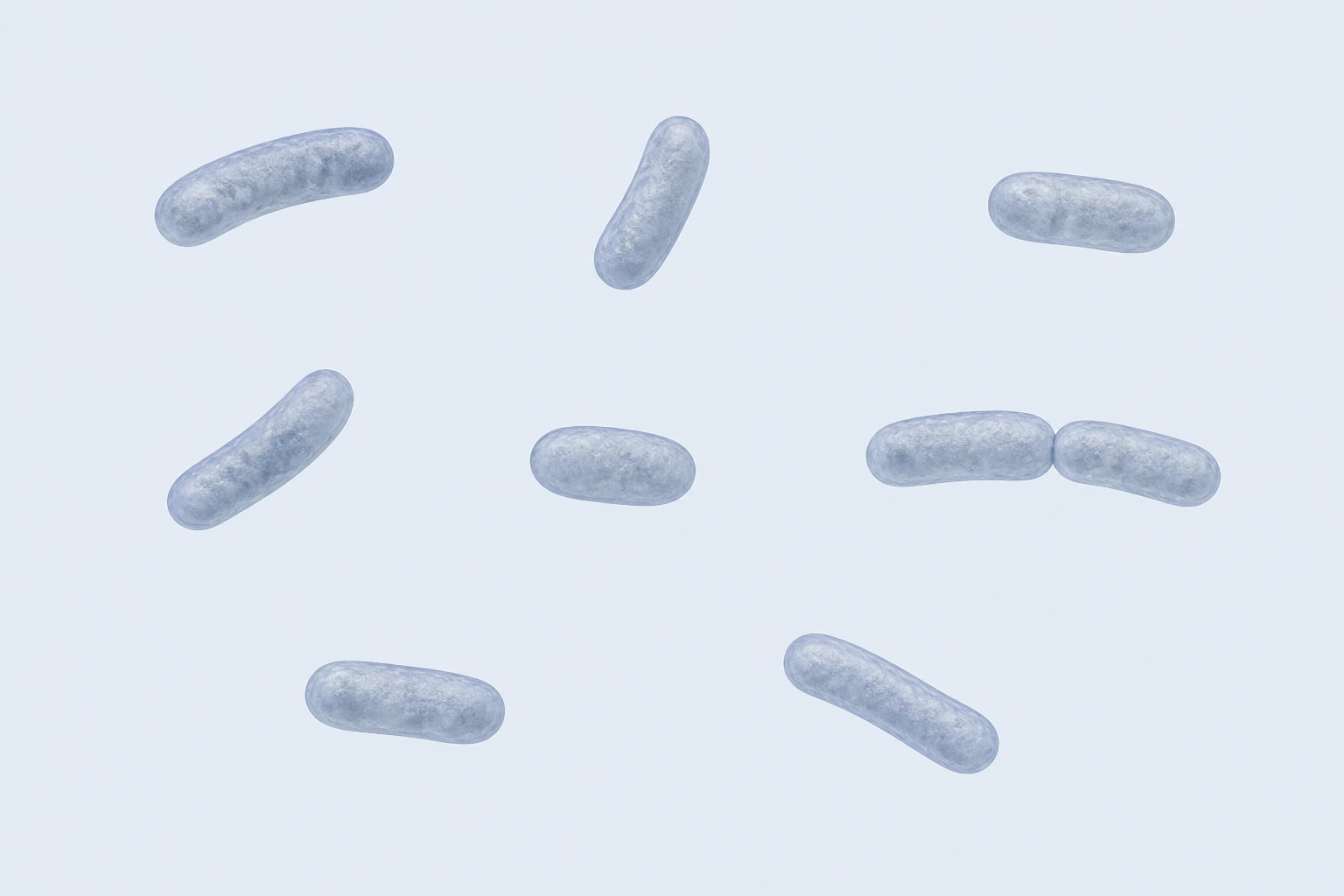
Representative Bilophila short-rod morphology, shown as eight bodies in seven groupings. This genus-level reconstruction is non-diagnostic and is not a micrograph.
Scientific media record1 verified identifier
- Subject
- Bilophilataxon · genus
- Identifiers
- NCBITaxon:35832
- Review
- Editorial review completeIdentifiers authority-verified · Accessibility validated · · bilophila|bilophila-morphology-v1.webp
- Digital source
- Trained-algorithmic mediaCreated with a trained generative algorithm and reviewed by WikiBiome for subject identity, scientific framing, identifiers, provenance, and accessibility.
- License
- CC BY-SA 4.0Created
Bilophila wadsworthia is a Gram-negative, obligate anaerobic, sulfite-reducing bacterium that has emerged as a key pathobiont linking high-fat diets, taurine metabolism, hydrogen sulfide production, and inflammatory disease.
Its unique metabolic niche—using taurine-conjugated bile acids as an electron acceptor—positions it at the intersection of dietary fat intake, Bile Acid Metabolism, and gut Metal-Driven Inflammation.
Evidence map7 cited passagesInspect provenance +
Significantly more abundant in uninvolved colonic mucosa of CRC cases versus controls among African American/Black individuals.
Enriched in MS progressors (patients with worsening disability) and significantly stratifies disease progression risk in Kaplan-Meier analysis.
Correlated with altered lipid metabolites (traumatic acid) in viral myocarditis models.
Hypertension MR studies show decreased Bilophila in hypertensive individuals.
Arsenic exposure increases Bilophila abundance and perturbs bile acid homeostasis.
Altered in autism spectrum disorder gut mycobiome-bacteriome interaction studies.
Decreased in Huntington's disease.
Metabolic Specialization#
Taurine to H2S Pathway#
B. wadsworthia metabolizes taurine (from taurine-conjugated bile acids) via taurine dehydrogenase, producing hydrogen sulfide (H2S) as an end product. H2S is genotoxic, inhibits Butyrate oxidation in colonocytes, and disrupts the mucus barrier. Taurine-conjugated bile acids increase with high-saturated-fat diets, providing the metabolic substrate that fuels B. wadsworthia expansion.
Hydrogen Utilization#
Uses H2 as an energy source via Hydrogenase enzymes, positioning it within the gut hydrogen economy. H2 consumption by B. wadsworthia can shift the thermodynamics of fermentation by other gut bacteria, influencing overall community metabolism.
Iron and Molybdenum Dependencies#
The dissimilatory sulfite reductase (DsrAB) that generates H2S contains iron-sulfur clusters, making B. wadsworthia dependent on Iron availability. Taurine dehydrogenase requires a Molybdenum cofactor, linking its pathogenic metabolism to trace metal availability.
Disease Associations#
Colorectal Cancer#
Significantly more abundant in uninvolved colonic mucosa of CRC cases versus controls among African American/Black individuals.[1]Design of the Building Research in CRC Prevention (BRIDGE-CRC) Trial: A 6-Month, Parallel Group Mediterranean Diet and Weight Loss Randomized Controlled Lifestyle Intervention Targeting the Bile Acid-Gut Microbiome Axis to Reduce Colorectal Cancer Risk Among African American/Black Adults with ObesityAndrew McLeod, Patricia Wolf, Robert S. Chapkin et al. · 2023Open reference 1 ↓ H2S production dampens butyrate metabolism in colonocytes, creating a pro-tumorigenic environment.
Mediterranean diet intervention aims to reduce B. wadsworthia abundance by shifting bile acid conjugation patterns away from taurine.
Multiple Sclerosis#
Enriched in MS progressors (patients with worsening disability) and significantly stratifies disease progression risk in Kaplan-Meier analysis.[2]Identification of commensal gut microbiota signatures as predictors of clinical severity and disease progression in multiple sclerosisTheresa L. Montgomery, Qin Wang, Ali Mirza et al. · 2024Open reference 2 ↓ As a sulfate-reducing bacterium producing H2S, it may drive Oxidative Stress and inflammation in the Gut-Brain Axis.
May thrive in metal-rich environments, connecting MS progression to environmental metal exposure.
Cardiovascular Disease#
Correlated with altered lipid metabolites (traumatic acid) in viral myocarditis models.[3]Altered colonic microflora and its metabolic profile in mice with acute viral myocarditis induced by coxsackievirus B3Yimin Xue, Shirong Lin, Mingguang Chen et al. · 2024Open reference 3 ↓ Hypertension MR studies show decreased Bilophila in hypertensive individuals.[4]Causality of gut microbiome and hypertension: A bidirectional mendelian randomization studyYihui Li, Ru Fu, Ruixuan Li et al. · 2023Open reference 4 ↓
IBD#
Enriched in Inflammatory Bowel Disease (IBD), where its H2S production exacerbates mucosal inflammation. Taurine-rich diets (high in animal protein) promote B. wadsworthia expansion and colitis in susceptible hosts.
Other Conditions#
Arsenic exposure increases Bilophila abundance and perturbs bile acid homeostasis.[5]Toxic and Essential Metals: Metabolic Interactions with the Gut Microbiota and Health ImplicationsQinheng Zhu, Boyan Chen, Fu Zhang et al. · 2024Open reference 5 ↓ Altered in Autism Spectrum Disorder gut mycobiome-bacteriome interaction studies.[6]Strati 2017 — New Evidences on the Altered Gut Microbiota in Autism Spectrum DisordersFrancesco Strati, Duccio Cavalieri, Davide Albanese et al. · 2017Open reference 6 ↓ Decreased in Huntington's disease.[7]Effects of gut microbiota on neurodegenerative diseasesKhatoon S, Kalam N, Rashid S et al. · 2023Open reference 7 ↓
Dietary Modulation#
The abundance of B. wadsworthia is highly responsive to diet. Increased by: high-saturated-fat diets, high-taurine diets (animal protein), Western-style diets. Decreased by: Mediterranean diet, plant-based diets, high-fiber diets that shift bile acid profiles toward glycine conjugation.
Connections#
- metabolizes taurine-conjugated bile acids to H2S
- Iron—iron (Fe)-S cluster dependency in sulfite reductase
- Colorectal Cancer—enriched in CRC; H2S impairs colonocyte butyrate oxidation
- Multiple Sclerosis—enriched in MS progressors; stratifies disease progression risk
- Inflammatory Bowel Disease (IBD)—H2S-mediated mucosal damage exacerbates colitis
- Cardiovascular Disease—altered in CVD and hypertension contexts
- oxidative stress—H2S and sulfide-mediated oxidative damage
- Arsenic—arsenic (As) exposure increases Bilophila abundance
- Hydrogenase—uses H2 as energy source via hydrogenase enzymes
References 7
Numbered by first appearance in the article, then reconciled with its declared source list.
- 1
Andrew McLeod, Patricia Wolf, Robert S. Chapkin et al. (2023). Design of the Building Research in CRC Prevention (BRIDGE-CRC) Trial: A 6-Month, Parallel Group Mediterranean Diet and Weight Loss Randomized Controlled Lifestyle Intervention Targeting the Bile Acid-Gut Microbiome Axis to Reduce Colorectal Cancer Risk Among African American/Black Adults with Obesity. Trials.
- 2
Theresa L. Montgomery, Qin Wang, Ali Mirza et al. (2024). Identification of commensal gut microbiota signatures as predictors of clinical severity and disease progression in multiple sclerosis. Scientific Reports.
- 3
Yimin Xue, Shirong Lin, Mingguang Chen et al. (2024). Altered colonic microflora and its metabolic profile in mice with acute viral myocarditis induced by coxsackievirus B3. Virology Journal.
- 4
Yihui Li, Ru Fu, Ruixuan Li et al. (2023). Causality of gut microbiome and hypertension: A bidirectional mendelian randomization study. Frontiers in Cardiovascular Medicine.
- 5
★Qinheng Zhu, Boyan Chen, Fu Zhang et al. (2024). Toxic and Essential Metals: Metabolic Interactions with the Gut Microbiota and Health Implications. Frontiers in Nutrition.
- 6
Francesco Strati, Duccio Cavalieri, Davide Albanese et al. (2017). Strati 2017 — New Evidences on the Altered Gut Microbiota in Autism Spectrum Disorders. Microbiome.
- 7
Khatoon S, Kalam N, Rashid S et al. (2023). Effects of gut microbiota on neurodegenerative diseases. Frontiers in Aging Neuroscience.
Article network
Mentioned here 14
Pages linking here 5
Connect the evidence
Publicly readable discussion by ORCID-authenticated researchers. Questions, interpretation, methods, corrections, and new evidence stay attached to this record.
No discussion yet. Start with a precise question or a source-backed observation.
Activity and accepted changes
Accepted researcher context, editorial status, public discussion, and upstream Git revisions are shown together. Pending, declined, and withdrawn proposals remain private.
- published revision
Backfill oxidative stress concept links
Karen Pendergrass · +1 −1
Inspect exact Git diff ↗ - published revision
Backfill inflammation concept links
Karen Pendergrass · +2 −2
Inspect exact Git diff ↗ - published revision
Complete Hydrogenase contextual coverage
Karen Pendergrass · +2 −2
Inspect exact Git diff ↗ - published revision
massive wiki expansion: 149 stubs fixed, 100+ new pages, Rule 15 scan, keystone papers
WikiBiome Deploy Bot · +5 −5
Inspect exact Git diff ↗ - published revision
nightly maintenance: 94 stub demotions, 181 source_count fixes, 22 auto-discovered stubs, 5 adversarial audits, 3 boundary fixes, 3 evidence-level corrections
WikiBiome Deploy Bot · +1 −0
Inspect exact Git diff ↗ - published revision
pre-overnight checkpoint 2026-04-18
WikiBiome Deploy Bot · +1 −1
Inspect exact Git diff ↗ - published revision
WikiBiome update — 2026-04-15 17:23
WikiBiome Deploy Bot · +1 −1
Inspect exact Git diff ↗ - published revision
wiki: bulk entity upgrades, new article pages, and site regeneration
WikiBiome Deploy Bot · +6 −0
Inspect exact Git diff ↗ - published revision
WikiBiome update — integrity fixes, metallomic diet pages, cross-condition analyses
WikiBiome Deploy Bot · +9 −7
Inspect exact Git diff ↗ - published revision
WikiBiome update — 2026-04-10 13:49
WikiBiome Deploy Bot · +73 −0
Inspect exact Git diff ↗