

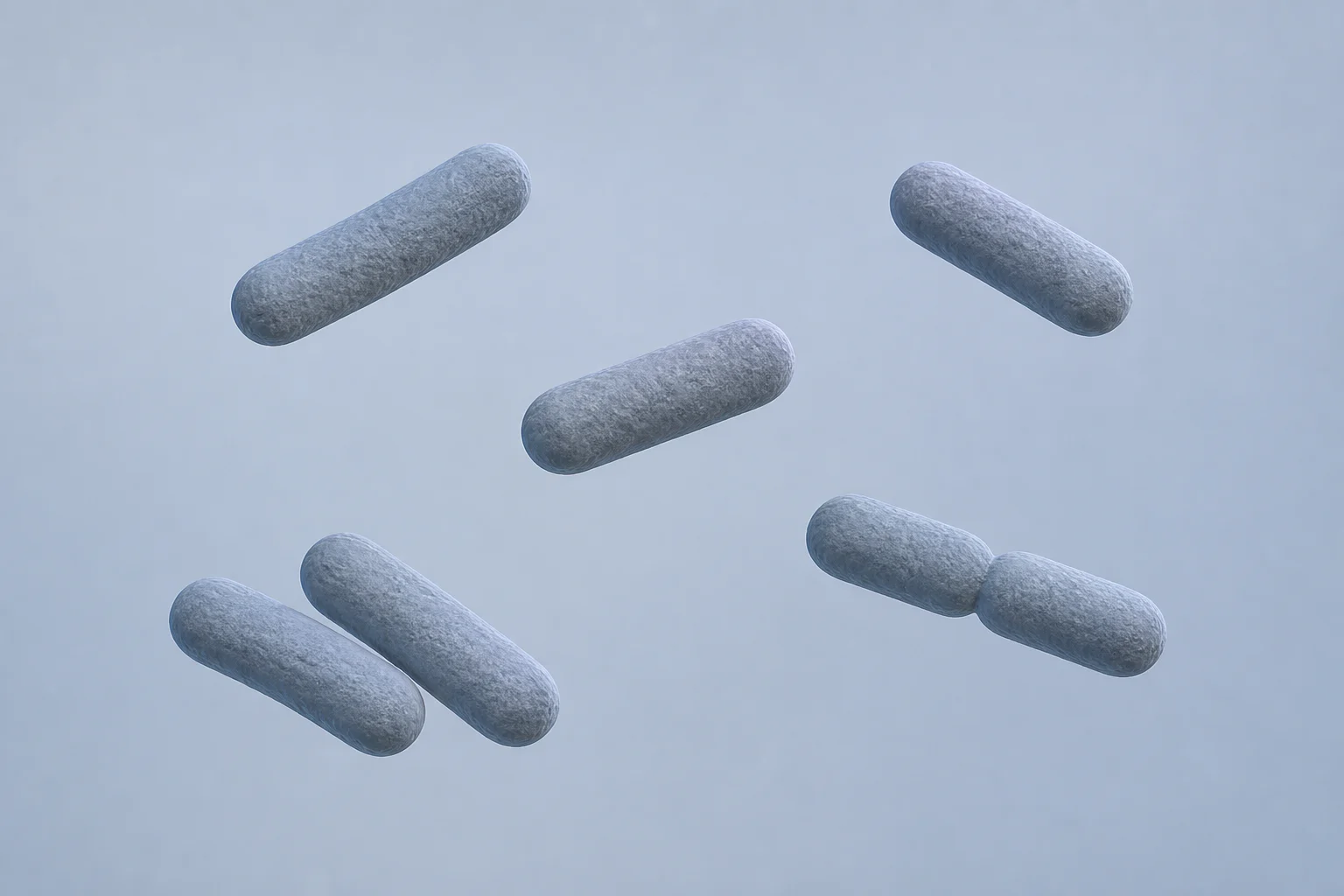
Representative Anaerostipes rod morphology. The original A. caccae description reports Gram-variable, obligately anaerobic, asporogenous cells; this reconstruction is genus-level and not diagnostic.
Scientific media record1 verified identifier
- Subject
- Anaerostipestaxon · genus
- Identifiers
- NCBITaxon:207244
- Review
- Editorial review completeIdentifiers authority-verified · Accessibility validated · · anaerostipes|anaerostipes-morphology-v1.webp
- Digital source
- Trained-algorithmic mediaCreated with a trained generative algorithm and reviewed by WikiBiome for subject identity, scientific framing, identifiers, provenance, and accessibility.
- License
- CC BY-SA 4.0Created
A genus of Gram-positive obligate anaerobes in the family Lachnospiraceae (Clostridium cluster XIVa) that occupy a critical metabolic relay position in gut ecosystem stability: converting lactate to Butyrate.
Anaerostipes is one of the most consistently depleted genera across inflammatory and metabolic disease states, with loss cascading into lactate accumulation, pH disruption, and pathogen expansion through mechanisms that extend into fungal immunology and neurological function.
Evidence map16 cited passagesInspect provenance +
Both species are among the most common lactate-utilizing genera in the human gut, making Anaerostipes an essential functional node in the fermentation network.
Anaerostipes converts lactate to butyrate via the butyryl-CoA:acetate CoA-transferase pathway.
Produces indole-3-lactic acid (ILA) from tryptophan.
In Graves' orbitopathy (GO), Anaerostipes is significantly downregulated alongside other Firmicutes, corresponding to decreased serum levels of IPA, ILA, and IAA. The correlation between Anaerostipes depletion and reduced ILA levels supports the tryptophan metabolism contribution as functionally relevant.
Heavy metal exposure—particularly cadmium and lead—disrupts Fe-S cluster assembly and selectively depletes butyrate-producing Lachnospiraceae members.
Depleted in CKD alongside Blautia, Coprococcus, Lachnospira, and Roseburia as part of the Lachnospiraceae decline that begins at stage 3b. Butyrate deficit contributes to uremic toxin accumulation and systemic inflammation characteristic of CKD dysbiosis.
Listed among the depleted taxa in MS gut microbiome characterization, alongside Faecalibacterium and multiple Clostridia cluster IV/XIVa species. The loss of butyrate producers in MS parallels reduced gut-brain axis regulatory capacity.
Anaerostipes and Firmicutes broadly are significantly downregulated in Graves' orbitopathy patients, with corresponding decreases in serum ILA, IPA, and IAA. This links Anaerostipes depletion to both butyrate deficiency and tryptophan metabolite depletion in the context of thyroid autoimmunity.
Anaerostipes is depleted in constipated ASD children, contributing to the broader SCFA deficit in ASD gut dysbiosis. The lactate accumulation from Anaerostipes loss may contribute to the intestinal discomfort and constipation common in ASD.
Butyrate-producing Lachnospiraceae are enriched in healthy controls compared to SCZ patients, with Anaerostipes among the protective taxa enriched in controls in schizophrenia microbiome profiling.
In Mendelian randomization analysis of gut microbiota and gastroesophageal reflux disease, Anaerostipes shows an increased GERD risk (OR=1.09, p=0.017). This counter-intuitive finding—a butyrate producer associated with increased GERD risk—may reflect the distinct immune environment of the upper GI tract where SCFA-mediated effects differ from those in t
candida albicans exploits elevated lactate to mask its beta-glucan cell wall component, evading immune recognition by Dectin-1 receptors. This beta-glucan masking is a key virulence strategy that depends on the metabolic disruption caused by Anaerostipes loss.
—prevalence data, cross-feeding, Candida beta-glucan masking
—Anaerostipes depletion with ILA/IPA decrease in GO
—depletion in MS
—CKD Lachnospiraceae depletion pattern
Contents
1. Classification and Prevalence2. The Lactate-to-Butyrate Relay—Core Ecological Function3. Tryptophan Metabolism—ILA Production4. Metal Dependencies and Heavy Metal Vulnerability5. Disease Depletion—Broad and Consistent6. GERD—An Unexpected Risk Association7. The Candida Connection—Lactate Accumulation and Immune Evasion8. Ecological Interactions9. What Wikipedia Doesn't Cover10. Cross-ReferencesClassification and Prevalence#
Anaerostipes belongs to the Lachnospiraceae family (Clostridium cluster XIVa), closely related to Roseburia, Coprococcus, and Butyrivibrio. Two species dominate:
- A. caccae: present in ~66% of healthy adults
- A. hadrus: present in ~80% of healthy adults; the more prevalent species and primary lactate utilizer in most individuals
Both species are among the most common lactate-utilizing genera in the human gut,[1]Louis et al. 2022 — Microbial Lactate Utilisation and the Stability of the Gut MicrobiomeLouis P, et al. · 2022Open reference 1 ↓ making Anaerostipes an essential functional node in the fermentation network.
The Lactate-to-Butyrate Relay—Core Ecological Function#
The defining ecological role of Anaerostipes is the metabolic relay between primary lactate producers and the butyrate-dependent gut.
Lactobacillus and Bifidobacterium ferment dietary carbohydrates to lactate as their primary end product. Anaerostipes converts lactate to butyrate via the butyryl-CoA:acetate CoA-transferase pathway.[1]Louis et al. 2022 — Microbial Lactate Utilisation and the Stability of the Gut MicrobiomeLouis P, et al. · 2022Open reference 1 ↓ This relay simultaneously.
Removes accumulated lactate (which at high concentrations inhibits lactate-producer growth, drops gut pH, and favors acid-tolerant pathogens). Produces butyrate (the primary colonocyte energy source; key anti-inflammatory signaling molecule via HDAC inhibition and GPR109a activation).
This cross-feeding relationship is mutualistic: lactate-producers benefit from lactate removal, while Anaerostipes gains an energy source that other anaerobes cannot readily utilize.
Tryptophan Metabolism—ILA Production#
Beyond butyrate production, Anaerostipes contributes to the gut's tryptophan metabolite pool. Produces indole-3-lactic acid (ILA) from tryptophan.[2]Microbiota-derived tryptophan metabolites in vascular inflammation and cardiovascular diseaseNadja Paeslack, Maximilian Mimmler, Stefanie Becker et al. · 2022Open reference 2 ↓ ILA is an aryl hydrocarbon receptor (AhR) ligand with anti-inflammatory properties; it modulates mucosal immunity and gut barrier integrity through AhR-ARNT signaling.
Depleted Anaerostipes reduces ILA availability, potentially impairing AhR-mediated immune regulation alongside the more recognized SCFA deficit.
In Graves' orbitopathy (GO), Anaerostipes is significantly downregulated alongside other Firmicutes, corresponding to decreased serum levels of IPA, ILA, and IAA.[3]Tryptophan metabolites exert potential therapeutic activity in Graves' orbitopathy by ameliorating orbital fibroblasts inflammation and proliferationYang W, Xu X, Xie R et al. · 2025Open reference 3 ↓ The correlation between Anaerostipes depletion and reduced ILA levels supports the tryptophan metabolism contribution as functionally relevant.
Metal Dependencies and Heavy Metal Vulnerability#
Iron-sulfur (iron (Fe)-S) clusters in butyryl-CoA dehydrogenase are essential for the butyrate production pathway.
Heavy metal exposure—particularly Cadmium and Lead—disrupts iron-S cluster assembly and selectively depletes butyrate-producing Lachnospiraceae members.[4]Heavy Metal Exposure Causes Changes in the Metabolic Health-Associated Gut Microbiome and MetabolitesXuanji Li, Asker Daniel Brejnrod, Madeleine Ernst et al. · 2019Open reference 4 ↓
The selective sensitivity of Anaerostipes to metal stress (relative to acid-tolerant pathogens) means that environmental heavy metal burden can shift gut ecology away from the protective lactate-to-butyrate relay toward a pathogen-favorable, acidic, lactate-rich state.
Disease Depletion—Broad and Consistent#
Anaerostipes is depleted across a remarkably broad range of diseases, always with convergent downstream consequences (lactate accumulation, butyrate deficiency):
Chronic Kidney Disease#
Depleted in CKD alongside Blautia, Coprococcus, Lachnospira, and Roseburia as part of the Lachnospiraceae decline that begins at stage 3b.[5]Yasuno et al. 2024 — Dysbiosis of Gut Microbiota in CKDYasuno, Nakahama, Kurogi et al. · 2024Open reference 5 ↓ Butyrate deficit contributes to uremic toxin accumulation and systemic Metal-Driven Inflammation characteristic of CKD Dysbiosis.
Multiple Sclerosis#
Listed among the depleted taxa in MS Gut Microbiome characterization, alongside Faecalibacterium and multiple Clostridia cluster IV/XIVa species.[6]Dysbiosis in the Gut Microbiota of Patients with Multiple Sclerosis, with a Striking Depletion of Species Belonging to Clostridia XIVa and IV ClustersSachiko Miyake, Sangwan Kim, Wataru Suda et al. · 2015Open reference 6 ↓ The loss of butyrate producers in MS parallels reduced gut-brain axis regulatory capacity.
Graves' Disease Orbitopathy#
Anaerostipes and Firmicutes broadly are significantly downregulated in Graves' orbitopathy patients, with corresponding decreases in serum ILA, IPA, and IAA.[3]Tryptophan metabolites exert potential therapeutic activity in Graves' orbitopathy by ameliorating orbital fibroblasts inflammation and proliferationYang W, Xu X, Xie R et al. · 2025Open reference 3 ↓ This links Anaerostipes depletion to both butyrate deficiency and tryptophan metabolite depletion in the context of thyroid autoimmunity.
Autism Spectrum Disorder (Constipation-Predominant)#
Anaerostipes is depleted in constipated ASD children, contributing to the broader SCFA deficit in ASD gut dysbiosis.[7]He 2023 — Altered Gut Microbiota and Short-Chain Fatty Acids in Chinese Children with Constipated Autism Spectrum DisorderJianquan He, Xiuhua Gong, Bing Hu et al. · 2023Open reference 7 ↓ The lactate accumulation from Anaerostipes loss may contribute to the intestinal discomfort and constipation common in ASD.
Type 1 Diabetes#
Reduced Anaerostipes is part of the broader loss of butyrate-producing Lachnospiraceae that precedes T1D onset, impacting mucosal immune regulation in the critical period of pancreatic beta cell autoimmunity.
Long COVID#
Persistent Anaerostipes depletion documented in post-COVID gut microbiome studies, potentially contributing to ongoing gut barrier dysfunction and systemic inflammation in long COVID.
Schizophrenia#
Butyrate-producing Lachnospiraceae are enriched in healthy controls compared to SCZ patients, with Anaerostipes among the protective taxa enriched in controls in schizophrenia microbiome profiling.[8]Functional Associations of the Gut Microbiome with Dopamine, Serotonin, and BDNF in Schizophrenia: A Pilot StudyGhorbani M, Joseph GBS, Tew MM et al. · 2024Open reference 8 ↓
GERD—An Unexpected Risk Association#
In Mendelian randomization analysis of gut microbiota and gastroesophageal reflux disease, Anaerostipes shows an increased GERD risk (OR=1.09, p=0.017).[9]Causal relationship between gut microbiota and risk of gastroesophageal reflux disease: a genetic correlation and bidirectional Mendelian randomization studyWang K, Wang S, Chen Y et al. · 2024Open reference 9 ↓
This counter-intuitive finding—a butyrate producer associated with increased GERD risk—may reflect the distinct immune environment of the upper GI tract where SCFA-mediated effects differ from those in the colon, or may represent reverse causation.
The Candida Connection—Lactate Accumulation and Immune Evasion#
The depletion of Anaerostipes has a specific and underappreciated consequence for fungal pathogenesis. When lactate accumulates due to loss of lactate-utilizing bacteria, gut pH drops and the metabolic environment favors acid-tolerant organisms.
Candida albicans exploits elevated lactate to mask its beta-glucan cell wall component, evading immune recognition by Dectin-1 receptors. This beta-glucan masking is a key virulence strategy that depends on the metabolic disruption caused by Anaerostipes loss.[1]Louis et al. 2022 — Microbial Lactate Utilisation and the Stability of the Gut MicrobiomeLouis P, et al. · 2022Open reference 1 ↓
The cascade: Anaerostipes depletion → lactate accumulation → Candida beta-glucan masking → Dectin-1 immune evasion → fungal overgrowth → further dysbiosis. This mechanism establishes Anaerostipes as an indirect gatekeeper of anti-fungal innate immunity through metabolic ecosystem maintenance.
Ecological Interactions#
Upstream: Lactobacillus, Bifidobacterium, and other lactate producers provide the substrate. Downstream: Butyrate produced by Anaerostipes feeds colonocytes directly and supports Faecalibacterium prausnitzii through complementary fermentation.
Disruption cascade: Loss of Anaerostipes → lactate buildup → pH drop → favors acid-tolerant Enterobacteriaceae, Candida, and other opportunists → further SCFA producer displacement → self-reinforcing dysbiosis.
What Wikipedia Doesn't Cover#
Wikipedia has no Anaerostipes entry.
This page provides: prevalence data for A. caccae and A. hadrus in healthy adults; the lactate-to-butyrate relay mechanism with Candida immune evasion consequences; ILA production as a tryptophan-AhR metabolism link; heavy metal vulnerability of iron (Fe)-S cluster enzymes; and the unexplained GERD risk association (an open question for the field).
Cross-References#
- butyrate—primary product from lactate conversion
- Candida albicans—enabled by lactate accumulation from Anaerostipes loss; beta-glucan masking
- Bifidobacterium—upstream lactate producer in the cross-feeding chain
- Lactobacillus—upstream lactate producer
- Lachnospiraceae—family; shared depletion-in-disease pattern
- Faecalibacterium prausnitzii—complementary butyrate producer; co-depleted in many conditions
- Multiple Sclerosis—depleted in MS gut microbiome
- Chronic Kidney Disease—depleted as part of Lachnospiraceae decline from CKD stage 3b
- Graves' Disease—depleted in GO alongside Firmicutes; ILA reduction
- Autism Spectrum Disorder—depleted in constipation-predominant ASD
- Iron—iron (Fe)-S clusters essential for butyryl-CoA dehydrogenase
- Cadmium—heavy metal stress depletes butyrate-producing Lachnospiraceae
- Lead—heavy metal exposure reduces SCFA-producer abundance
- dysbiosis—depletion is a convergent marker across diverse inflammatory and metabolic diseases
- Short-Chain Fatty Acids (SCFAs)—key butyrate producer via lactate relay
References 9
Numbered by first appearance in the article, then reconciled with its declared source list.
- 1
Louis P, et al. (2022). Louis et al. 2022 — Microbial Lactate Utilisation and the Stability of the Gut Microbiome. Gut Microbiome.
- 2
Nadja Paeslack, Maximilian Mimmler, Stefanie Becker et al. (2022). Microbiota-derived tryptophan metabolites in vascular inflammation and cardiovascular disease. Amino Acids.
- 3
Yang W, Xu X, Xie R et al. (2025). Tryptophan metabolites exert potential therapeutic activity in Graves' orbitopathy by ameliorating orbital fibroblasts inflammation and proliferation. Journal of Endocrinological Investigation.
- 4
Xuanji Li, Asker Daniel Brejnrod, Madeleine Ernst et al. (2019). Heavy Metal Exposure Causes Changes in the Metabolic Health-Associated Gut Microbiome and Metabolites. Environment International.
- 5
Yasuno, Nakahama, Kurogi et al. (2024). Yasuno et al. 2024 — Dysbiosis of Gut Microbiota in CKD. Internal Medicine.
- 6
Sachiko Miyake, Sangwan Kim, Wataru Suda et al. (2015). Dysbiosis in the Gut Microbiota of Patients with Multiple Sclerosis, with a Striking Depletion of Species Belonging to Clostridia XIVa and IV Clusters. PLoS ONE.
- 7
Jianquan He, Xiuhua Gong, Bing Hu et al. (2023). He 2023 — Altered Gut Microbiota and Short-Chain Fatty Acids in Chinese Children with Constipated Autism Spectrum Disorder. Scientific Reports.
- 8
Ghorbani M, Joseph GBS, Tew MM et al. (2024). Functional Associations of the Gut Microbiome with Dopamine, Serotonin, and BDNF in Schizophrenia: A Pilot Study. Egyptian Journal of Neurology, Psychiatry and Neurosurgery.
- 9
Wang K, Wang S, Chen Y et al. (2024). Causal relationship between gut microbiota and risk of gastroesophageal reflux disease: a genetic correlation and bidirectional Mendelian randomization study. Frontiers in Immunology.
Article network
Mentioned here 17
Pages linking here 15
Connect the evidence
Publicly readable discussion by ORCID-authenticated researchers. Questions, interpretation, methods, corrections, and new evidence stay attached to this record.
No discussion yet. Start with a precise question or a source-backed observation.
Activity and accepted changes
Accepted researcher context, editorial status, public discussion, and upstream Git revisions are shown together. Pending, declined, and withdrawn proposals remain private.
- published revision
Backfill gut microbiome concept links
Karen Pendergrass · +1 −1
Inspect exact Git diff ↗ - published revision
Backfill inflammation concept links
Karen Pendergrass · +1 −1
Inspect exact Git diff ↗ - published revision
Complete corpus-wide Dysbiosis linking
Karen Pendergrass · +2 −2
Inspect exact Git diff ↗ - published revision
massive wiki expansion: 149 stubs fixed, 100+ new pages, Rule 15 scan, keystone papers
WikiBiome Deploy Bot · +16 −16
Inspect exact Git diff ↗ - published revision
Deepen schizophrenia/CKD entities + 8 microbe entities; add 6 source pages
WikiBiome Deploy Bot · +107 −32
Inspect exact Git diff ↗ - published revision
Health check gap fill: 15 missing pages identified and created
WikiBiome Deploy Bot · +60 −0
Inspect exact Git diff ↗