
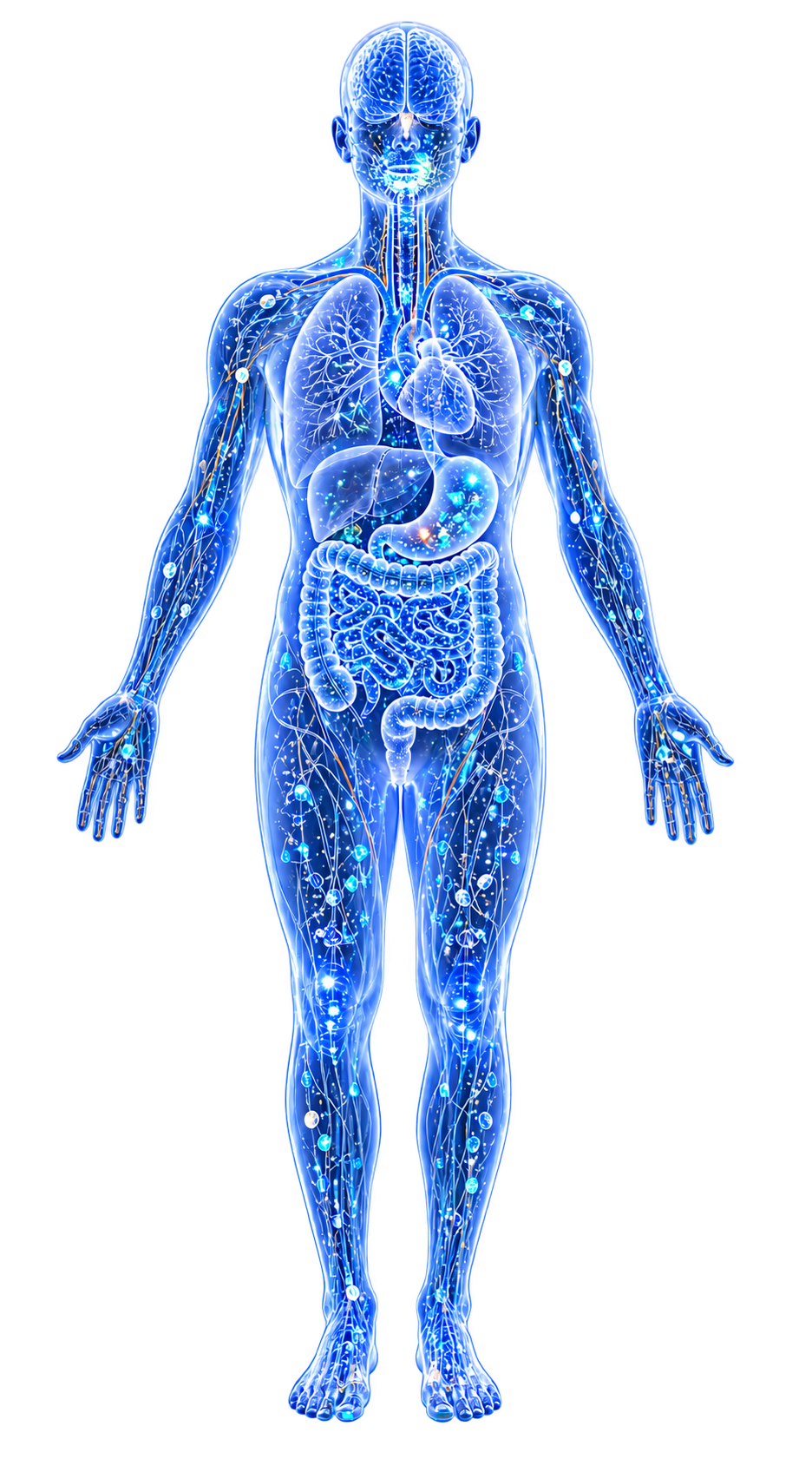
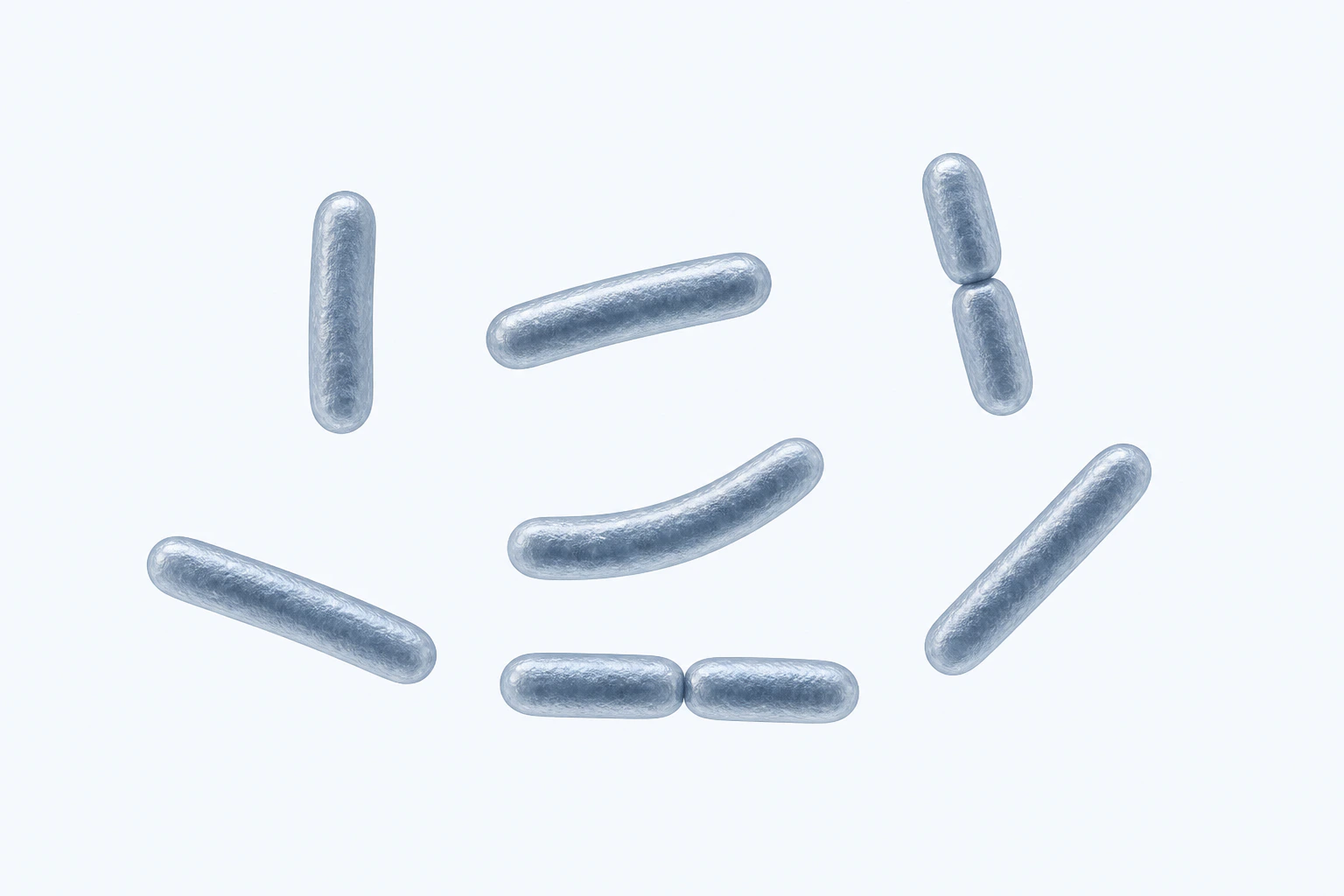
Type-species-anchored rods from the current, post-2020 Lactobacillus circumscription, shown as nine bodies in five single and two paired groupings. This genus-level reconstruction is representative, non-diagnostic, not a micrograph, and does not represent every organism historically called a lactobacillus.
Scientific media record1 verified identifier
- Subject
- Lactobacillustaxon · genus
- Identifiers
- NCBITaxon:1578
- Review
- Editorial review completeIdentifiers authority-verified · Accessibility validated · · lactobacillus|lactobacillus-morphology-v1.webp
- Digital source
- Trained-algorithmic mediaCreated with a trained generative algorithm and reviewed by WikiBiome for subject identity, scientific framing, identifiers, provenance, and accessibility.
- Scientific basis
- Lactobacillus — NCBI TaxonomyLactobacillus — LPSNLactobacillus delbrueckii — LPSNA taxonomic note on the genus LactobacillusPost-2020 Lactobacillus taxonomic revision
- License
- CC BY-SA 4.0Created
A genus of Gram-positive, facultatively anaerobic lactic acid bacteria (LAB) that are among the most extensively studied probiotics.
In the Metallomics context, Lactobacillus species are critical for two reasons: they actively detoxify Heavy Metals through binding and sequestration, and they are preferentially depleted by heavy metal exposure—making their loss a key driver of metal-induced Dysbiosis.
Evidence map12 cited passagesInspect provenance +
Identified as the most protective strain against cadmium toxicity because it possesses both strong Cd-binding ability AND antioxidative capacity—dual functionality is critical.
L. plantarum CCFM8661 also effective for Cd and lead detoxification.
L. plantarum TW1-1: reduces chromium accumulation and reverses Cr-exposure effects.
Nickel: occupational Ni exposure decreases Lactobacillus and Lachnospiraceae.
Metal-driven Crohn's: the ZIP8 A391T variant that alters colonic metal homeostasis reduces Lactobacillus (and Ligilactobacillus) in the colonic lumen.
Inversely correlated with EAE severity (Spearman rho = -0.67).
L. murinus supplementation mitigates high-salt diet-induced EAE exacerbation.
Lactobacillus is a key protective genus against necrotizing enterocolitis. Its acid production lowers gut pH, inhibiting the Proteobacteria (urease-positive pathogens) that drive NEC.
Probiotic Lactobacillus supplementation is one of the most evidence-supported interventions for NEC prevention; meta-analyses in very low birth weight preterm infants show significant reductions in NEC incidence.
Lactobacillus depletion is consistently reported alongside reduced SCFA output in preterm infants who develop NEC.
L. rhamnosus and related strains modulate autoimmunity in T1D models and are investigated as preventive probiotics in children at genetic risk.
Lactobacillus depletion is among the earliest dysbiotic signals preceding clinical T1D onset.
Contents
1. Metal Detoxification Capacity2. Depletion by Heavy Metals3. Role in Neuroinflammatory Disease4. The Anti-Pathogen Metal Dynamic5. ConnectionsMetal Detoxification Capacity#
L. plantarum CCFM8610—The Model Metal-Detoxifying Probiotic#
Identified as the most protective strain against Cadmium toxicity because it possesses both strong cadmium (Cd)-binding ability AND antioxidative capacity—dual functionality is critical.[1]Oral Administration of Probiotics Inhibits Absorption of the Heavy Metal Cadmium by Protecting the Intestinal BarrierZhai Q, Wang G, Zhao J et al. · 2016Open reference 1 ↓
In vivo (8-week mouse model): increased fecal cadmium excretion, decreased cadmium accumulation in liver and kidneys, maintained intestinal barrier integrity. Four-part protective mechanism. Intestinal metal sequestration: cell wall binding of cadmium ions in the gut lumen.
Oxidative Stress alleviation: counteracted cadmium-induced ROS. Tight junction protection: preserved ZO-1, ZO-2, occludin, claudin-1 expression. Immune modulation: maintained secretory IgA and balanced cytokine profiles.
L. plantarum CCFM8661 also effective for cadmium and Lead detoxification.[2]Gut Microbiota: A Target for Heavy Metal Toxicity and a Probiotic Protective StrategyHui Duan, Leilei Yu, Fengwei Tian et al. · 2020Open reference 2 ↓
Other Metal-Detoxifying Species#
L. brevis 23017: protects against mercury toxicity via MAPK and NF-kB pathway regulation. L. plantarum TW1-1: reduces chromium accumulation and reverses chromium (Cr)-exposure effects.[3]Potential Application of Living Microorganisms in the Detoxification of Heavy MetalsRunqiu Chen, Huaijun Tu, Tingtao Chen · 2022Open reference 3 ↓ L. rhamnosus GG: binds cadmium (Cd) and lead (Pb) in vitro; reduces metal bioavailability in the gut lumen.
Metal binding occurs primarily at the cell surface via peptidoglycan, teichoic acids, and S-layer proteins rich in carboxyl, phosphoryl, and hydroxyl groups.
Depletion by Heavy Metals#
Lactobacillus abundance is consistently reduced by heavy metal exposure across multiple metals.
Nickel: occupational nickel (Ni) exposure decreases Lactobacillus and Lachnospiraceae.[4]Toxic and Essential Metals: Metabolic Interactions with the Gut Microbiota and Health ImplicationsQinheng Zhu, Boyan Chen, Fu Zhang et al. · 2024Open reference 4 ↓ Iron excess: iron supplementation in infants increases Enterobacteriaceae at the expense of Lactobacillus—directly relevant to NEC risk. Cadmium: dose-dependent depletion across multiple animal models.
Lead: reduced alongside other SCFA-producing commensals.
Metal-driven Crohn's: the ZIP8 A391T variant that alters colonic metal homeostasis reduces Lactobacillus (and Ligilactobacillus) in the colonic lumen.[5]ZIP8 A391T Crohn's Disease-Linked Risk Variant Induces Colonic Metal Ion Dyshomeostasis, Microbiome Compositional Shifts, and InflammationYang JC, Zhao M, Chernikova D et al. · 2024Open reference 5 ↓
Role in Neuroinflammatory Disease#
Multiple Sclerosis#
Inversely correlated with EAE severity (Spearman rho = -0.67).[6]Variations in diet cause alterations in microbiota and metabolites that follow changes in disease severity in a multiple sclerosis modelLibbey JE, Sanchez JM, Doty DJ et al. · 2018Open reference 6 ↓ L. paracasei therapeutic treatment significantly reduced both disease incidence (9/13 vs. 15/15) and clinical scores in EAE mice. L. murinus supplementation mitigates high-salt diet-induced EAE exacerbation.[7]Feeding the gut microbiome: impact on multiple sclerosisMatteo Bronzini, Alessandro Maglione, Rachele Rosso et al. · 2023Open reference 7 ↓
Decreased in MS patients; dietary and probiotic interventions that increase Lactobacillus are associated with clinical improvement.
NEC Protection#
Lactobacillus is a key protective genus against necrotizing enterocolitis. Its acid production lowers gut pH, inhibiting the Proteobacteria (Urease-positive pathogens) that drive NEC.[8]Nickel as a Catalytic Driver of Necrotizing Enterocolitis: Dietary Nickel, Microbial Metallomics, and the Activation of Nickel-Dependent Virulence Pathways in the Preterm GutKaren Pendergrass · 2026Open reference 8 ↓
Critically, Lactobacillus does not rely on nickel (Ni)-dependent virulence enzymes—it thrives in a nickel-poor environment and creates conditions hostile to nickel-enzyme-dependent pathogens.
Probiotic Lactobacillus supplementation is one of the most evidence-supported interventions for NEC prevention; meta-analyses in very low birth weight preterm infants show significant reductions in NEC incidence.[9]Zhou 2023 — Probiotics Prevent NEC in VLBW (Network Meta-Analysis)Zhou et al. · 2023Open reference 9 ↓
Lactobacillus depletion is consistently reported alongside reduced SCFA output in preterm infants who develop NEC.[10]Liu 2022 — Gut microbiota and SCFAs as early predictive biomarkers for neonatal NEC (pilot)Xiao-Chen Liu, Ting-Ting Du, Xiong Gao et al. · 2022Open reference 10 ↓[11]Torrazza 2013 — Intestinal Microbial Ecology and Environmental Factors Affecting NECTorrazza RM, Ukhanova M, Wang X et al. · 2013Open reference 11 ↓
Type 1 Diabetes#
L. rhamnosus and related strains modulate autoimmunity in T1D models and are investigated as preventive probiotics in children at genetic risk.[12]Belteky 2023 — Infant Gut Microbiome Composition Correlated with Type 1 Diabetes Acquisition: The ABIS StudyMalin Belteky, Patricia L. Milletich, Angelica P. Ahrens et al. · 2023Open reference 12 ↓
Lactobacillus depletion is among the earliest dysbiotic signals preceding clinical T1D onset.[13]de Goffau 2014 — Aberrant Gut Microbiota Composition at the Onset of Type 1 Diabetes in Young ChildrenMarcus C. de Goffau, Susana Fuentes, Bartholomeus van den Bogert et al. · 2014Open reference 13 ↓
The Anti-Pathogen Metal Dynamic#
Lactobacillus occupies a unique ecological position: it does not depend on nickel for virulence (no urease, no [NiFe] Hydrogenase, no nickel (Ni)-GloI) while it actively opposes nickel-dependent pathogens by producing acid (lowering pH, inhibiting urease function) and competing for gut niches.
Dietary nickel excess that fuels pathogens simultaneously depletes the Lactobacillus populations that would normally keep those pathogens in check.
Connections#
- Gut-Metal-Microbiome Interactions—central to metal-microbiome bidirectional interactions
- Cadmium—L. plantarum CCFM8610 model for cadmium (Cd) protection
- Lead—detoxification via cell surface binding
- Nickel—not nickel (Ni)-dependent; benefits from nickel-poor environment
- Iron—depleted by iron supplementation; competes with siderophore-producing pathogens
- Urease—opposes urease-positive pathogens via acid production
- Multiple Sclerosis—inversely correlated with disease severity
- Faecalibacterium prausnitzii—complementary SCFA producer; co-depleted under metal stress
- Akkermansia muciniphila—complementary barrier-protective commensal
- dysbiosis—its depletion is a hallmark of metal-induced dysbiosis
- Metal-Driven Inflammation—anti-inflammatory via immune modulation and barrier protection
References 14
Numbered by first appearance in the article, then reconciled with its declared source list.
- 1
★Zhai Q, Wang G, Zhao J et al. (2016). Oral Administration of Probiotics Inhibits Absorption of the Heavy Metal Cadmium by Protecting the Intestinal Barrier. Appl Environ Microbiol.
- 2
★Hui Duan, Leilei Yu, Fengwei Tian et al. (2020). Gut Microbiota: A Target for Heavy Metal Toxicity and a Probiotic Protective Strategy. Science of the Total Environment.
- 3
Runqiu Chen, Huaijun Tu, Tingtao Chen (2022). Potential Application of Living Microorganisms in the Detoxification of Heavy Metals. Foods.
- 4
★Qinheng Zhu, Boyan Chen, Fu Zhang et al. (2024). Toxic and Essential Metals: Metabolic Interactions with the Gut Microbiota and Health Implications. Frontiers in Nutrition.
- 5
★Yang JC, Zhao M, Chernikova D et al. (2024). ZIP8 A391T Crohn's Disease-Linked Risk Variant Induces Colonic Metal Ion Dyshomeostasis, Microbiome Compositional Shifts, and Inflammation. Digestive Diseases and Sciences.
- 6
Libbey JE, Sanchez JM, Doty DJ et al. (2018). Variations in diet cause alterations in microbiota and metabolites that follow changes in disease severity in a multiple sclerosis model. Beneficial Microbes.
- 7
Matteo Bronzini, Alessandro Maglione, Rachele Rosso et al. (2023). Feeding the gut microbiome: impact on multiple sclerosis. Frontiers in Immunology.
- 8
Karen Pendergrass (2026). Nickel as a Catalytic Driver of Necrotizing Enterocolitis: Dietary Nickel, Microbial Metallomics, and the Activation of Nickel-Dependent Virulence Pathways in the Preterm Gut. Zenodo Preprint.
- 9
Zhou et al. (2023). Zhou 2023 — Probiotics Prevent NEC in VLBW (Network Meta-Analysis). Frontiers in Pediatrics.
- 10
Xiao-Chen Liu, Ting-Ting Du, Xiong Gao et al. (2022). Liu 2022 — Gut microbiota and SCFAs as early predictive biomarkers for neonatal NEC (pilot). Frontiers in Microbiology.
- 11
Torrazza RM, Ukhanova M, Wang X et al. (2013). Torrazza 2013 — Intestinal Microbial Ecology and Environmental Factors Affecting NEC. PLoS ONE.
- 12
Malin Belteky, Patricia L. Milletich, Angelica P. Ahrens et al. (2023). Belteky 2023 — Infant Gut Microbiome Composition Correlated with Type 1 Diabetes Acquisition: The ABIS Study. Diabetologia.
- 13
Marcus C. de Goffau, Susana Fuentes, Bartholomeus van den Bogert et al. (2014). de Goffau 2014 — Aberrant Gut Microbiota Composition at the Onset of Type 1 Diabetes in Young Children. Diabetologia.
- 14
★Liliana Anchidin-Norocel, Oana C. Iatcu, Andrei Lobiuc et al. (2025). Heavy Metal-Gut Microbiota Interactions: Probiotics Modulation and Biosensors Detection. Biosensors.
Article network
Mentioned here 16
Pages linking here 93
Connect the evidence
Publicly readable discussion by ORCID-authenticated researchers. Questions, interpretation, methods, corrections, and new evidence stay attached to this record.
No discussion yet. Start with a precise question or a source-backed observation.
Activity and accepted changes
Accepted researcher context, editorial status, public discussion, and upstream Git revisions are shown together. Pending, declined, and withdrawn proposals remain private.
- published revision
Strengthen Metallomics and link high-leverage contexts
Karen Pendergrass · +1 −1
Inspect exact Git diff ↗ - published revision
Backfill heavy metals concept links
Karen Pendergrass · +1 −1
Inspect exact Git diff ↗ - published revision
Backfill oxidative stress concept links
Karen Pendergrass · +1 −1
Inspect exact Git diff ↗ - published revision
Complete corpus-wide Dysbiosis linking
Karen Pendergrass · +1 −1
Inspect exact Git diff ↗ - published revision
Complete Hydrogenase contextual coverage
Karen Pendergrass · +1 −1
Inspect exact Git diff ↗ - published revision
Complete Tight junctions contextual coverage
Karen Pendergrass · +1 −1
Inspect exact Git diff ↗ - published revision
Complete reviewed Urease contextual coverage
Karen Pendergrass · +2 −2
Inspect exact Git diff ↗ - published revision
massive wiki expansion: 149 stubs fixed, 100+ new pages, Rule 15 scan, keystone papers
WikiBiome Deploy Bot · +21 −21
Inspect exact Git diff ↗ - published revision
nightly maintenance: 94 stub demotions, 181 source_count fixes, 22 auto-discovered stubs, 5 adversarial audits, 3 boundary fixes, 3 evidence-level corrections
WikiBiome Deploy Bot · +1 −0
Inspect exact Git diff ↗ - published revision
11 new sources for Hashimotos/MS/CVD + 10 microbe entity citation pass
WikiBiome Deploy Bot · +7 −1
Inspect exact Git diff ↗ - published revision
WikiBiome update — 2026-04-15 17:23
WikiBiome Deploy Bot · +4 −5
Inspect exact Git diff ↗ - published revision
wiki: bulk entity upgrades, new article pages, and site regeneration
WikiBiome Deploy Bot · +6 −0
Inspect exact Git diff ↗ - published revision
WikiBiome update — integrity fixes, metallomic diet pages, cross-condition analyses
WikiBiome Deploy Bot · +15 −8
Inspect exact Git diff ↗ - published revision
WikiBiome v7 — interactive microbiome metallomics encyclopedia
Karen Pendergrass · +78 −0
Inspect exact Git diff ↗