
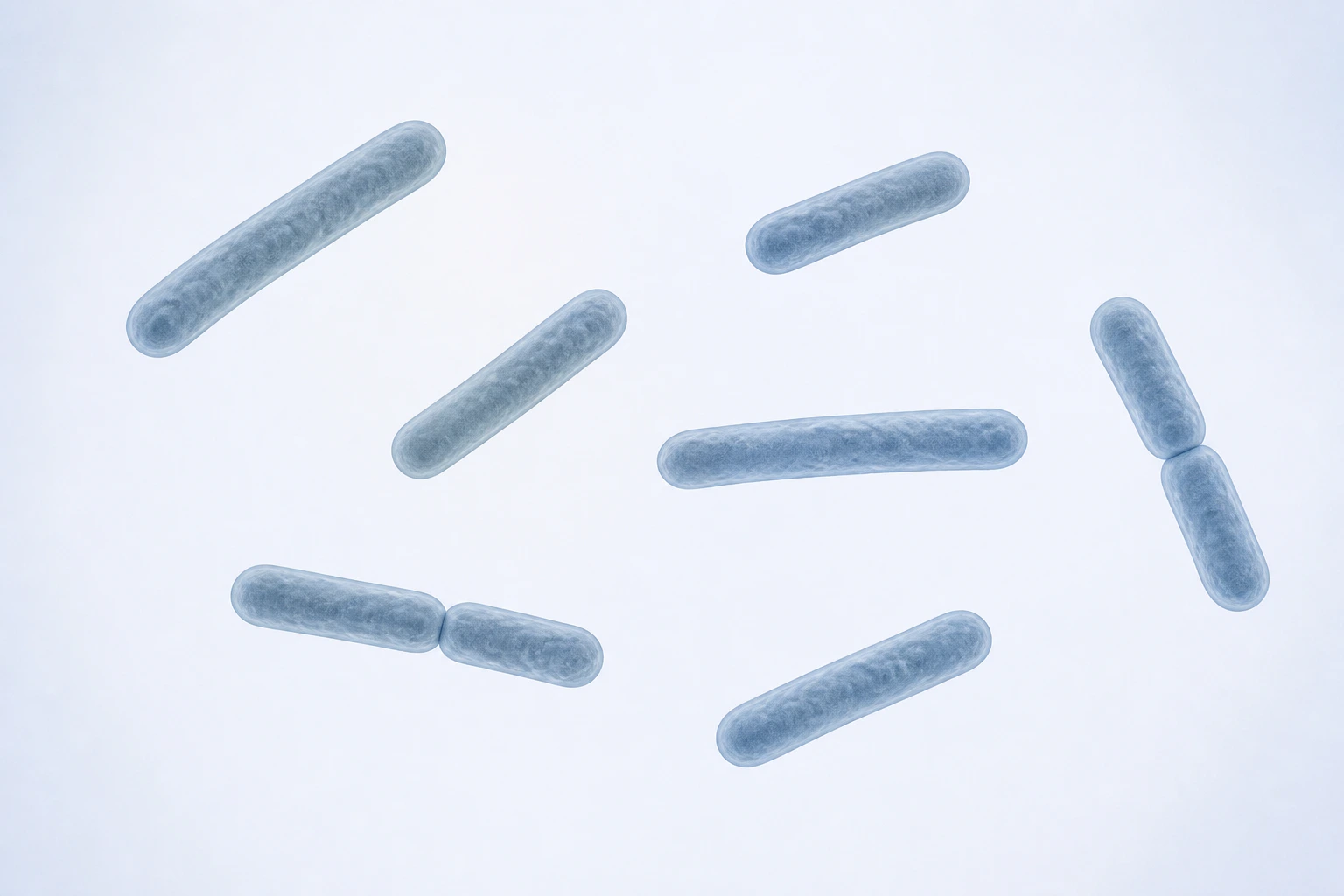
Representative Faecalibacterium prausnitzii straight rods, shown as nine bodies in five single and two paired groupings. This scientific reconstruction is non-diagnostic, does not claim a species-exclusive silhouette, and is not a micrograph.
Scientific media record1 verified identifier
- Subject
- Faecalibacterium prausnitziitaxon · species
- Identifiers
- NCBITaxon:853
- Review
- Editorial review completeIdentifiers authority-verified · Accessibility validated · · faecalibacterium-prausnitzii|faecalibacterium-prausnitzii-morphology-v1.webp
- Digital source
- Trained-algorithmic mediaCreated with a trained generative algorithm and reviewed by WikiBiome for subject identity, scientific framing, identifiers, provenance, and accessibility.
- Scientific basis
- Faecalibacterium prausnitzii — NCBI TaxonomyFaecalibacterium prausnitzii — LPSNFaecalibacterium gen. nov.Faecalibacterium gen. nov. primary descriptionFaecalibacterium prausnitzii type strain — BacDiveFaecalibacterium prausnitzii microscopy review
- License
- CC BY-SA 4.0Created
The most abundant bacterium in the healthy human colon (5-15% of total fecal microbiota), F. prausnitzii is the premier Butyrate producer in the gut and a cornerstone of anti-inflammatory intestinal homeostasis.
Its depletion is one of the most consistent microbiome signatures across diseases linked to metal dyshomeostasis, and it has been directly demonstrated to protect against arsenic toxicity.
Evidence map13 cited passagesInspect provenance +
The landmark Coryell et al. (2018) study demonstrated that F. prausnitzii is sufficient for at least partial protection against acute arsenic toxicity.
Depleted by cadmium and lead exposure in multiple mouse models.
Classified as a next-generation probiotic for metal detoxification alongside akkermansia muciniphila.
Multiple sclerosis: decreased in MS patients; negatively associated with TNF-alpha levels.
Parkinson's disease: reduced abundance linked to decreased butyrate and increased gut permeability, potentially facilitating alpha-synuclein propagation via the gut brain axis.
Chronic kidney disease: depleted, contributing to uremic toxin accumulation; butyrate-producing taxa are reduced with disease progression.
Type 2 diabetes: inversely correlated with HbA1c and fasting glucose; fiber interventions that restore F. prausnitzii improve glycemic control.
Autism spectrum disorder: reduced; butyrate-producer depletion is a recurring ASD signature and Faecalibacterium hominis-derived indole signaling via AhR is under active study.
Schizophrenia: altered SCFA producers including F. prausnitzii are linked to ultra-high-risk state and symptom severity.
Graves' disease: negatively correlated with FT3, FT4, and TRAb but positively correlated with TSH; berberine supplementation increased F. prausnitzii alongside thyroid function recovery.
Obesity: inversely correlated with BMI and metabolic inflammation.
Colorectal cancer: reduced; butyrate loss may diminish anti-tumorigenic HDAC inhibition.
Post-COVID / Long COVID: depletion of SCFA producers including F. prausnitzii associated with altered immune response.
Contents
1. Butyrate Production and Barrier Protection2. Protection Against Metal Toxicity3. Depletion Across Disease States4. The Metal-Dysbiosis-Disease Cycle5. ConnectionsButyrate Production and Barrier Protection#
Produces butyrate as its primary fermentation end-product. Butyrate is the preferred energy source for colonocytes and the most potent SCFA for. Strengthening tight junction protein expression (ZO-1, occludin, claudin-1).
Suppressing NF-kB-mediated Metal-Driven Inflammation via HDAC inhibition and GPR109A signaling.
Promoting regulatory T cell (Treg) differentiation—critical for immune tolerance. Maintaining epithelial oxygen consumption, preserving the anaerobic luminal environment that favors beneficial obligate anaerobes over facultative pathobionts. Butyrate production depends on iron-sulfur cluster enzymes in the butyrate synthesis pathway, connecting this commensal's function indirectly to Iron availability.
Protection Against Metal Toxicity#
Arsenic#
The landmark Coryell et al. (2018) study demonstrated that F. prausnitzii is sufficient for at least partial protection against acute arsenic toxicity.[1]The gut microbiome is required for full protection against acute arsenic toxicity in mouse modelsCoryell M, McAlpine M, Pinkham NV et al. · 2018Open reference 1 ↓
Germ-free mice mono-associated with E. coli alone died rapidly from arsenic exposure; bi-colonization with E. coli + F. prausnitzii significantly extended survival. F. prausnitzii abundance was consistently associated with survival across human stool transplant experiments.
The Gut Microbiome is required for full arsenic protection; antibiotic-treated mice accumulate more arsenic in organs and excrete less in feces.
Cadmium and Lead#
Depleted by cadmium and lead exposure in multiple mouse models.[2]Gut Microbiota: A Target for Heavy Metal Toxicity and a Probiotic Protective StrategyHui Duan, Leilei Yu, Fengwei Tian et al. · 2020Open reference 2 ↓ Its loss under cadmium (Cd)/lead (Pb) exposure reduces butyrate production, compromising barrier integrity and increasing systemic metal absorption—a vicious cycle.
Classified as a next-generation probiotic for metal detoxification alongside Akkermansia muciniphila.[2]Gut Microbiota: A Target for Heavy Metal Toxicity and a Probiotic Protective StrategyHui Duan, Leilei Yu, Fengwei Tian et al. · 2020Open reference 2 ↓
Mechanism#
Protective mechanisms likely include: maintenance of anaerobic barrier conditions, butyrate-mediated tight junction support, anti-inflammatory signaling that limits metal-induced epithelial damage, and possible arsenic biotransformation by associated microbiome members.
Depletion Across Disease States#
F. prausnitzii depletion is among the most reproducible microbiome findings in disease. IBD (Crohn's disease): dramatically reduced; inversely correlated with disease severity and relapse risk. The strongest single-organism biomarker for Crohn's remission.
Multiple sclerosis: decreased in MS patients; negatively associated with TNF-alpha levels.[3]Feeding the gut microbiome: impact on multiple sclerosisMatteo Bronzini, Alessandro Maglione, Rachele Rosso et al. · 2023Open reference 3 ↓[4]Serum Short-Chain Fatty Acids and Associations With Inflammation in Newly Diagnosed Patients With Multiple Sclerosis and Healthy ControlsAnna Olsson, Stefan Gustavsen, Thao Duy Nguyen et al. · 2021Open reference 4 ↓[5]Short-chain fatty acids and intestinal inflammation in multiple sclerosis: modulation of female susceptibility by microbial products?Anouck Becker, Mosab Abuazab, Andreas Schwiertz et al. · 2021Open reference 5 ↓
Parkinson's disease: reduced abundance linked to decreased butyrate and increased gut permeability, potentially facilitating alpha-synuclein propagation via the Gut-Brain Axis.[6]Microbial Metallomics and Parkinson's Disease: A Unified Metal-Driven Framework Linking Ferroptosis, Dysbiosis, and alpha-Synuclein PathologyKaren Pendergrass · 2025Open reference 6 ↓[7]Aho 2021 -- Relationships of Gut Microbiota, Short-Chain Fatty Acids, Inflammation, and the Gut Barrier in Parkinson's DiseaseVelma T E Aho, Madelyn C Houser, Pedro A B Pereira et al. · 2021Open reference 7 ↓[8]Tan 2022 -- The Role of Short-Chain Fatty Acids in Health and DiseaseJing Tan, Craig McKenzie, Maria Potamitis et al. · 2023Open reference 8 ↓
Chronic kidney disease: depleted, contributing to uremic toxin accumulation; butyrate-producing taxa are reduced with disease progression.[9]Gao 2021 — Butyrate Producing Microbiota Are Reduced in Chronic Kidney DiseasesBei Gao, Adarsh Jose, Norma Alonzo-Palma et al. · 2021Open reference 9 ↓[10]Gut Microbial Metabolites SCFAs and Chronic Kidney DiseaseMeng He, Wenqian Wei, Yichen Zhang et al. · 2024Open reference 10 ↓
Type 2 diabetes: inversely correlated with HbA1c and fasting glucose; fiber interventions that restore F. prausnitzii improve glycemic control.[11]Salamone 2021 — The Relationship between Gut Microbiota, Short-Chain Fatty Acids and Type 2 Diabetes: The Role of Dietary FibreDominic Salamone, Angela Albarosa Rivellese, Claudia Vetrani · 2021Open reference 11 ↓[12]SCFA 2020 — Dietary Fiber and Short-Chain Fatty Acids in Type 2 DiabetesVarious · 2020Open reference 12 ↓
Autism spectrum disorder: reduced; butyrate-producer depletion is a recurring ASD signature and Faecalibacterium hominis-derived indole signaling via AhR is under active study.[13]Yu 2025 — The Gut Commensal Faecalibacterium hominis Attenuates Indole-AhR Signaling and Restores ASD-Like Behaviors with BTBR MiceYou Yu, Yujing Wang, Jie Zhang et al. · 2025Open reference 13 ↓[14]Liu 2019 — Altered Gut Microbiota and SCFAs in Chinese ASD ChildrenSimeng Liu, Enyao Li, Zhenyu Sun et al. · 2019Open reference 14 ↓
Schizophrenia: altered SCFA producers including F. prausnitzii are linked to ultra-high-risk state and symptom severity.[15]Peng 2022 -- Short-chain fatty acids in patients with schizophrenia and ultra-high risk populationHuiqing Peng, Lijun Ouyang, David Li et al. · 2022Open reference 15 ↓[16]Yu 2024 -- A cross-section study of the comparison of plasma inflammatory cytokines and short-chain fatty acid in patients with depression and schizophreniaHuan Yu, Rui Li, Xue-jun Liang et al. · 2024Open reference 16 ↓
Graves' disease: negatively correlated with FT3, FT4, and TRAb but positively correlated with TSH; berberine supplementation increased F. prausnitzii alongside thyroid function recovery.[17]Han et al. 2022 — The Potential Prebiotic Berberine Combined With Methimazole Improved the Therapeutic Effect of Graves' Disease Patients Through Regulating the Intestinal MicrobiomeHan Z, Cen C, Ou Q et al. · 2022Open reference 17 ↓
Obesity: inversely correlated with BMI and metabolic inflammation.[18]Heavy Metals, Microbial Metallomics, and the US Obesity Epidemic: A Mechanistic Examination of a Population-Level Metabolic DisruptionKaren Pendergrass · 2026Open reference 18 ↓ Colorectal cancer: reduced; butyrate loss may diminish anti-tumorigenic HDAC inhibition.[19]Short-chain fatty acids in cancer pathogenesisMark A. Feitelson, Alla Arzumanyan, Arvin Medhat et al. · 2023Open reference 19 ↓[20]Participation of short-chain fatty acids and their receptors in gut inflammation and colon cancerMaria Daniella Carretta, John Quiroga, Rodrigo Lopez et al. · 2021Open reference 20 ↓
Post-COVID / Long COVID: depletion of SCFA producers including F. prausnitzii associated with altered immune response.[21]Didenko et al 2025 — Intestinal Microbiota and Short-Chain Fatty Acids in Patients with Post-COVID Immune ResponseV.I. Didenko, I.A. Klenina, O.M. Tatarchuk et al. · 2025Open reference 21 ↓
The Metal-Dysbiosis-Disease Cycle#
F. prausnitzii sits at the center of a recurring pattern across this wiki's disease pages: environmental metal exposure (arsenic (As), cadmium (Cd), lead (Pb), nickel (Ni)) depletes F. prausnitzii and other SCFA producers, reducing butyrate, compromising barrier integrity, increasing systemic metal absorption, and driving the chronic inflammation that underlies diverse diseases.
Restoring F. prausnitzii through probiotic supplementation or dietary intervention is a logical intervention point in this cycle.
Connections#
- Gut-Metal-Microbiome Interactions—central commensal in the metal-microbiome bidirectional axis
- Akkermansia muciniphila—metabolic cross-feeding partner; co-depleted in disease
- Arsenic—directly protective against arsenic toxicity (Coryell 2018)
- Cadmium—depleted by cadmium (Cd) exposure; loss amplifies toxicity
- Lead—depleted by lead (Pb) exposure
- Iron—iron (Fe)-S cluster enzymes in butyrate pathway; iron perturbation may affect function
- inflammation—anti-inflammatory via butyrate/HDAC/GPR109A axis
- Dysbiosis—its depletion is the most consistent dysbiosis marker
- Lactobacillus—complementary SCFA producer; co-depleted under metal stress
- Gut-Brain Axis—butyrate loss linked to neuroinflammation in PD and MS
References 23
Numbered by first appearance in the article, then reconciled with its declared source list.
- 1
Coryell M, McAlpine M, Pinkham NV et al. (2018). The gut microbiome is required for full protection against acute arsenic toxicity in mouse models. Nature Communications.
- 2
★Hui Duan, Leilei Yu, Fengwei Tian et al. (2020). Gut Microbiota: A Target for Heavy Metal Toxicity and a Probiotic Protective Strategy. Science of the Total Environment.
- 3
Matteo Bronzini, Alessandro Maglione, Rachele Rosso et al. (2023). Feeding the gut microbiome: impact on multiple sclerosis. Frontiers in Immunology.
- 4
Anna Olsson, Stefan Gustavsen, Thao Duy Nguyen et al. (2021). Serum Short-Chain Fatty Acids and Associations With Inflammation in Newly Diagnosed Patients With Multiple Sclerosis and Healthy Controls. Frontiers in Immunology.
- 5
Anouck Becker, Mosab Abuazab, Andreas Schwiertz et al. (2021). Short-chain fatty acids and intestinal inflammation in multiple sclerosis: modulation of female susceptibility by microbial products?. Autoimmunity Highlights.
- 6
★Karen Pendergrass (2025). Microbial Metallomics and Parkinson's Disease: A Unified Metal-Driven Framework Linking Ferroptosis, Dysbiosis, and alpha-Synuclein Pathology. Conference Presentation.
- 7
Velma T E Aho, Madelyn C Houser, Pedro A B Pereira et al. (2021). Aho 2021 -- Relationships of Gut Microbiota, Short-Chain Fatty Acids, Inflammation, and the Gut Barrier in Parkinson's Disease. Molecular Neurodegeneration.
- 8
Jing Tan, Craig McKenzie, Maria Potamitis et al. (2023). Tan 2022 -- The Role of Short-Chain Fatty Acids in Health and Disease. Neuroscience Bulletin.
- 9
Bei Gao, Adarsh Jose, Norma Alonzo-Palma et al. (2021). Gao 2021 — Butyrate Producing Microbiota Are Reduced in Chronic Kidney Diseases. Scientific Reports.
- 10
Meng He, Wenqian Wei, Yichen Zhang et al. (2024). Gut Microbial Metabolites SCFAs and Chronic Kidney Disease. Journal of Translational Medicine.
- 11
Dominic Salamone, Angela Albarosa Rivellese, Claudia Vetrani (2021). Salamone 2021 — The Relationship between Gut Microbiota, Short-Chain Fatty Acids and Type 2 Diabetes: The Role of Dietary Fibre. Acta Diabetologica.
- 12
Various (2020). SCFA 2020 — Dietary Fiber and Short-Chain Fatty Acids in Type 2 Diabetes. European Journal of Nutrition.
- 13
You Yu, Yujing Wang, Jie Zhang et al. (2025). Yu 2025 — The Gut Commensal Faecalibacterium hominis Attenuates Indole-AhR Signaling and Restores ASD-Like Behaviors with BTBR Mice. Frontiers in Microbiology.
- 14
Simeng Liu, Enyao Li, Zhenyu Sun et al. (2019). Liu 2019 — Altered Gut Microbiota and SCFAs in Chinese ASD Children. Scientific Reports.
- 15
Huiqing Peng, Lijun Ouyang, David Li et al. (2022). Peng 2022 -- Short-chain fatty acids in patients with schizophrenia and ultra-high risk population. Frontiers in Psychiatry.
- 16
Huan Yu, Rui Li, Xue-jun Liang et al. (2024). Yu 2024 -- A cross-section study of the comparison of plasma inflammatory cytokines and short-chain fatty acid in patients with depression and schizophrenia. BMC Psychiatry.
- 17
Han Z, Cen C, Ou Q et al. (2022). Han et al. 2022 — The Potential Prebiotic Berberine Combined With Methimazole Improved the Therapeutic Effect of Graves' Disease Patients Through Regulating the Intestinal Microbiome. Frontiers in Immunology.
- 18
★Karen Pendergrass (2026). Heavy Metals, Microbial Metallomics, and the US Obesity Epidemic: A Mechanistic Examination of a Population-Level Metabolic Disruption. Zenodo Preprint.
- 19
Mark A. Feitelson, Alla Arzumanyan, Arvin Medhat et al. (2023). Short-chain fatty acids in cancer pathogenesis. Cancer and Metastasis Reviews.
- 20
Maria Daniella Carretta, John Quiroga, Rodrigo Lopez et al. (2021). Participation of short-chain fatty acids and their receptors in gut inflammation and colon cancer. Frontiers in Physiology.
- 21
V.I. Didenko, I.A. Klenina, O.M. Tatarchuk et al. (2025). Didenko et al 2025 — Intestinal Microbiota and Short-Chain Fatty Acids in Patients with Post-COVID Immune Response. Gastroenterology.
- 22
★Sweta Ghosh, Syam P. Nukavarpu, Venkatakrishna Rao Jala (2024). Effects of Heavy Metals on Gut Barrier Integrity and Gut Microbiota. Microbiota and Host.
- 23
★Qinheng Zhu, Boyan Chen, Fu Zhang et al. (2024). Toxic and Essential Metals: Metabolic Interactions with the Gut Microbiota and Health Implications. Frontiers in Nutrition.
Article network
Mentioned here 13
Pages linking here 165
Connect the evidence
Publicly readable discussion by ORCID-authenticated researchers. Questions, interpretation, methods, corrections, and new evidence stay attached to this record.
No discussion yet. Start with a precise question or a source-backed observation.
Activity and accepted changes
Accepted researcher context, editorial status, public discussion, and upstream Git revisions are shown together. Pending, declined, and withdrawn proposals remain private.
- published revision
Backfill gut microbiome concept links
Karen Pendergrass · +1 −1
Inspect exact Git diff ↗ - published revision
Backfill inflammation concept links
Karen Pendergrass · +1 −1
Inspect exact Git diff ↗ - published revision
Complete Tight junctions contextual coverage
Karen Pendergrass · +1 −1
Inspect exact Git diff ↗ - published revision
massive wiki expansion: 149 stubs fixed, 100+ new pages, Rule 15 scan, keystone papers
WikiBiome Deploy Bot · +15 −15
Inspect exact Git diff ↗ - published revision
Fix duplicate YAML frontmatter keys and deploy updated content
WikiBiome Deploy Bot · +5 −4
Inspect exact Git diff ↗ - published revision
nightly maintenance: 94 stub demotions, 181 source_count fixes, 22 auto-discovered stubs, 5 adversarial audits, 3 boundary fixes, 3 evidence-level corrections
WikiBiome Deploy Bot · +1 −0
Inspect exact Git diff ↗ - published revision
11 new sources for Hashimotos/MS/CVD + 10 microbe entity citation pass
WikiBiome Deploy Bot · +8 −4
Inspect exact Git diff ↗ - published revision
WikiBiome update — 2026-04-15 17:23
WikiBiome Deploy Bot · +4 −5
Inspect exact Git diff ↗ - published revision
wiki: bulk entity upgrades, new article pages, and site regeneration
WikiBiome Deploy Bot · +6 −0
Inspect exact Git diff ↗ - published revision
WikiBiome update — integrity fixes, metallomic diet pages, cross-condition analyses
WikiBiome Deploy Bot · +14 −6
Inspect exact Git diff ↗ - published revision
WikiBiome v7 — interactive microbiome metallomics encyclopedia
Karen Pendergrass · +71 −0
Inspect exact Git diff ↗