
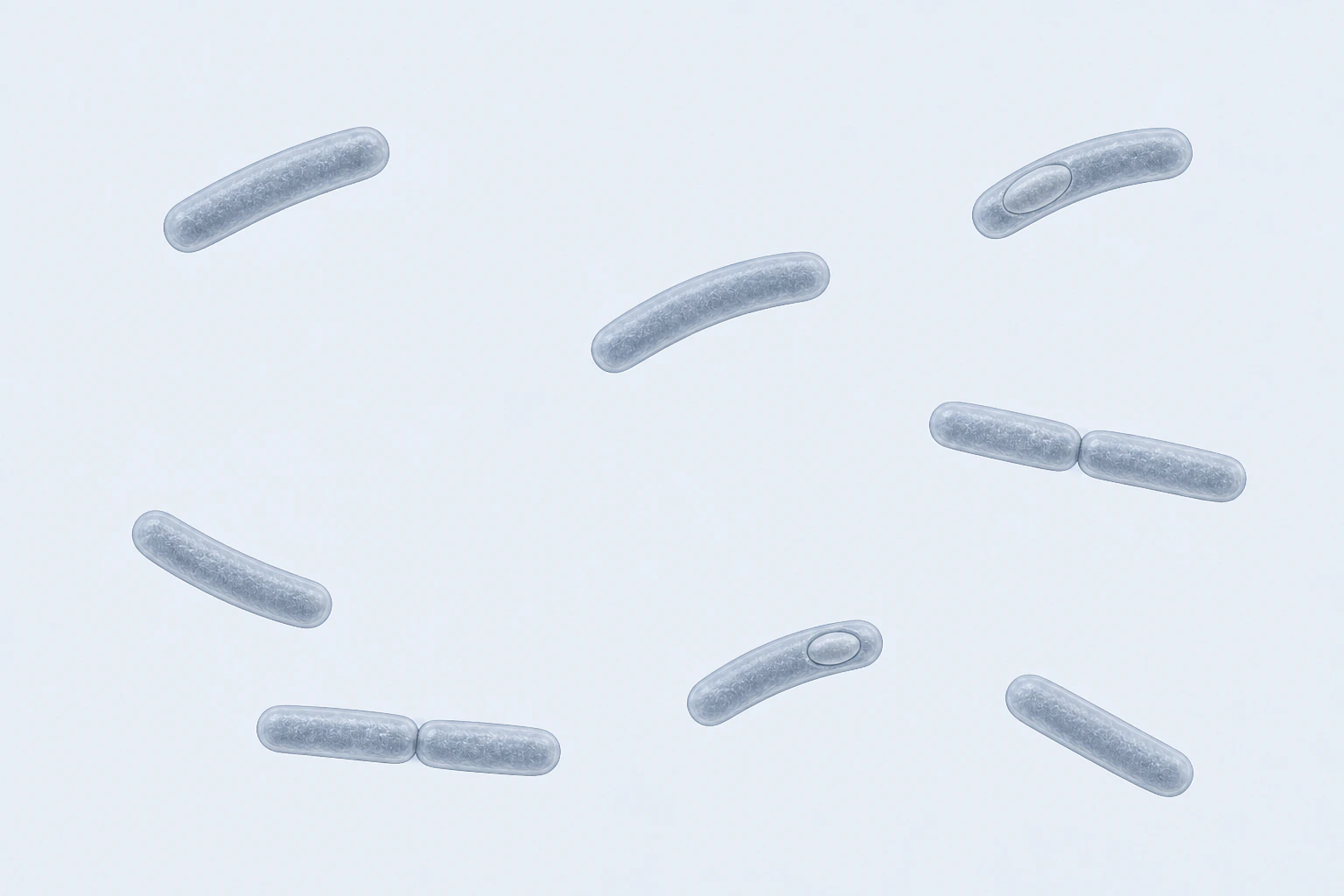
Representative Clostridioides difficile rod forms, shown as ten bodies in eight single or paired groupings, with two restrained subterminal internal endospores. Spores do not permit visual diagnosis; this is an educational reconstruction, not a micrograph or lifecycle image.
Scientific media record1 verified identifier
- Subject
- Clostridioides difficiletaxon · species
- Identifiers
- NCBITaxon:1496
- Review
- Editorial review completeIdentifiers authority-verified · Accessibility validated · · clostridioides-difficile|clostridioides-difficile-morphology-v1.webp
- Digital source
- Trained-algorithmic mediaCreated with a trained generative algorithm and reviewed by WikiBiome for subject identity, scientific framing, identifiers, provenance, and accessibility.
- Scientific basis
- Clostridioides difficile — NCBI TaxonomyClostridioides difficile — LPSNReclassification as Clostridioides difficileClostridioides difficile type strain — BacDiveClostridium difficile spore biologyClostridium difficile morphology and cultural characteristics
- License
- CC BY-SA 4.0Created
Clostridioides difficile is the current NCBI name for NCBITaxon:1496 and the correct, medically recommended combination recorded by LPSN. Both records retain Clostridium difficile as a validly published homotypic synonym of the same organism rather than a separate species.[1]NCBI Taxonomy — Clostridioides difficile (NCBITaxon:1496)Author information pendingOpen reference 1 ↓[2]LPSN — Clostridioides difficile (Hall and O'Toole 1935) Lawson et al. 2016Author information pendingOpen reference 2 ↓
It is a Gram-positive, spore-forming, obligate anaerobic bacterium that is the leading cause of antibiotic-associated diarrhea and pseudomembranous colitis in healthcare settings. In the Metallomics framework, C. difficile sits at the intersection of metal-antibiotic co-selection, post-Dysbiosis opportunism, and Zinc-dependent toxin activity.
Evidence map7 cited passagesInspect provenance +
Clostridioides difficile is the current NCBI name for NCBITaxon:1496 and the correct, medically recommended combination recorded by LPSN. Both records retain Clostridium difficile as a validly published homotypic synonym of the same organism rather than a separate species.
Lawson and colleagues proposed the genus Clostridioides in 2016 after 16S rRNA, phenotypic, chemotaxonomic, and phylogenetic analyses placed the organism with C. mangenotii in Peptostreptococcaceae, far from Clostridium butyricum and Clostridium sensu stricto. Their new combination made Clostridioides difficile the type species of the genus.
The retired duplicate carried six source associations that use the historical combination in their original contexts: two autism-focused reviews, a silver-antibiotic review, a microbial-folate narrative, a perioperative-neuroinflammation review discussing FMT, and a metallome review. Those associations are retained for traceability; they are not treated as t
Clostridia (including C. difficile) are predicted to possess Ni-dependent glyoxalase based on the biochemical characterization of C. acetobutylicum Ni-GloI, which was co-crystallized with nickel—providing direct structural evidence.
C. difficile produces two large clostridial toxins, TcdA and TcdB, which are glucosyltransferases that inactivate Rho GTPases in colonocytes.
Heavy metal exposure and antibiotic use drive co-selection of resistance determinants, often co-located on mobile genetic elements.
Cadmium exposure decreases Clostridium cocleatum, a beneficial commensal that degrades mucin and protects against C. difficile colonization.
Contents
1. Nomenclature and Historical-Label Boundary2. Metal-Dependent Virulence3. Post-Antibiotic Niche Exploitation4. Iron Competition5. Clinical Significance6. ConnectionsNomenclature and Historical-Label Boundary#
Lawson and colleagues proposed the genus Clostridioides in 2016 after 16S rRNA, phenotypic, chemotaxonomic, and phylogenetic analyses placed the organism with C. mangenotii in Peptostreptococcaceae, far from Clostridium butyricum and Clostridium sensu stricto. Their new combination made Clostridioides difficile the type species of the genus.[3]Lawson et al. 2016 — Reclassification of Clostridium difficile as Clostridioides difficilePaul A. Lawson, Diane M. Citron, Kerin L. Tyrrell et al. · 2016Open reference 3 ↓
Clinical practice and older literature continue to use “C. diff” and Clostridium difficile. WikiBiome preserves that wording when it is the name printed by a source, but current titles, metadata, taxonomy, and internal links use Clostridioides difficile.
Canonicalizing the route does not silently change a historical study label, strain description, or reported conclusion.
The retired duplicate carried six source associations that use the historical combination in their original contexts: two autism-focused reviews, a silver-antibiotic review, a microbial-folate narrative, a perioperative-neuroinflammation review discussing FMT, and a metallome review.[4]Risk factors in autism spectrum disorders: the role of genetic, epigenetic, immune and environmental interactionsCristina Rusu, Cristina Preda, Adriana Sireteanu et al. · 2015Open reference 4 ↓[5]Environmental factors in the development of autism spectrum disordersL.A. Sealey, B.W. Hughes, A.N. Sriskanda et al. · 2016Open reference 5 ↓[6]Barras 2018 — Silver and Antibiotic, New Facts to an Old StoryFrederic Barras, Laurent Aussel, Benjamin Ezraty · 2018Open reference 6 ↓[7]Cai 2022 — Gut Microbiota Supports Male Reproduction via Nutrition, Immunity, and SignalingHui Cai, Xuanhong Cao, Dezhe Qin et al. · 2022Open reference 7 ↓[8]Zhou 2025 — Role of Gut Microbiota in Neuroinflammation: A Focus on Perioperative Neurocognitive DisordersQun Zhou, Tuo Chen, Xiaoying Wang et al. · 2025Open reference 8 ↓[9]The Metallome as a Link Between the 'Omes' in Autism Spectrum DisordersJanelle E. Stanton, Sigita Malijauskaite, Kieran McGourty et al. · 2021Open reference 9 ↓
Those associations are retained for traceability; they are not treated as taxonomic authority or as support for claims beyond what each source states.
Metal-Dependent Virulence#
Predicted Ni-Glyoxalase I#
Clostridia (including C. difficile) are predicted to possess nickel (Ni)-dependent Glyoxalase I based on the biochemical characterization of C. acetobutylicum nickel-GloI, which was co-crystallized with nickel—providing direct structural evidence.[10]Role of Nickel in Microbial PathogenesisRobert J. Maier, Stéphane L. Benoit · 2019Open reference 10 ↓
nickel-GloI would detoxify methylglyoxal during the rapid vegetative growth that follows spore germination in the antibiotic-depleted gut. This nickel dependency means that environmental nickel availability may influence C. difficile growth competitiveness in the post-antibiotic gut niche.
Zinc and Toxin Biology#
C. difficile produces two large clostridial toxins, TcdA and TcdB, which are glucosyltransferases that inactivate Rho GTPases in colonocytes.[10]Role of Nickel in Microbial PathogenesisRobert J. Maier, Stéphane L. Benoit · 2019Open reference 10 ↓
TcdA/TcdB contain a zinc-dependent metalloprotease domain responsible for autocatalytic processing: the toxin cleaves itself inside the host cell to release the catalytic glucosyltransferase domain into the cytoplasm.
Zinc availability may therefore modulate toxin processing efficiency.
Some evidence suggests that zinc supplementation may inhibit C. difficile toxin activity through interference with the metalloprotease domain, though this remains an active area of investigation.
Host Calprotectin (S100A8/A9)—which sequesters zinc at infection sites—is markedly elevated in C. difficile colitis and serves as a clinical biomarker for disease severity.
Post-Antibiotic Niche Exploitation#
The Dysbiosis Gateway#
C. difficile infection (CDI) classically follows antibiotic treatment that depletes competing commensals, particularly SCFA-producing organisms like Faecalibacterium prausnitzii, Lactobacillus, and Bifidobacterium.
The depleted gut loses its colonization resistance: the combination of reduced SCFA production, elevated pH, increased availability of nutrients (including metals), and loss of competitive exclusion creates a permissive niche.
Bile acid metabolism shifts are critical: antibiotic depletion of bile acid-metabolizing commensals increases primary bile acids (taurocholate), which promote C. difficile spore germination.
Metal-Antibiotic Co-Selection#
Heavy metal exposure and antibiotic use drive co-selection of resistance determinants, often co-located on mobile genetic elements.[11]Toxic and Essential Metals: Metabolic Interactions with the Gut Microbiota and Health ImplicationsQinheng Zhu, Boyan Chen, Fu Zhang et al. · 2024Open reference 11 ↓
Metal-driven dysbiosis can deplete the same protective commensals that antibiotics destroy, potentially creating CDI-permissive conditions even without antibiotic use.
Cadmium exposure decreases Clostridium cocleatum, a beneficial commensal that degrades mucin and protects against C. difficile colonization.[12]Cadmium exposure modulates the gut-liver axis in an Alzheimer's disease mouse modelAngela Zhang, Megumi Matsushita, Liang Zhang et al. · 2021Open reference 12 ↓
Iron Competition#
In the post-antibiotic, post-commensal gut, C. difficile must compete for iron with any remaining flora and incoming pathogens. C. difficile does not produce classical siderophores but acquires iron via ferrous iron transport (FeoAB) and potentially through xenosiderophore piracy.
The iron-rich post-antibiotic gut (no longer being sequestered by commensals) may favor C. difficile proliferation.
Clinical Significance#
C. difficile infection (CDI): ranges from mild diarrhea to life-threatening pseudomembranous colitis, toxic megacolon, and sepsis. Approximately 500,000 cases and 29,000 deaths annually in the US alone.
Recurrence: 20-30% of patients experience recurrent CDI, driven by persistent spores and ongoing dysbiosis.
Fecal microbiota transplant (FMT): the most effective treatment for recurrent CDI (~90% cure rate), working by restoring colonization resistance—including the SCFA-producing, metal-metabolizing commensals that suppress C. difficile.
Hypervirulent strains: ribotype 027/NAP1 produces binary toxin (CDT) in addition to TcdA/TcdB, with higher mortality.
Connections#
- Glyoxalase I—predicted nickel (Ni)-GloI from Clostridial biochemistry
- Zinc—zinc (Zn)-metalloprotease in toxin autoprocessing; calprotectin as biomarker
- Nickel—predicted cofactor for GloI; environmental nickel may influence growth
- Iron—competition in post-antibiotic gut; FeoAB transport
- dysbiosis—classic post-antibiotic dysbiosis pathogen
- Gut-Metal-Microbiome Interactions—metal-antibiotic co-selection creates CDI-permissive conditions
- Faecalibacterium prausnitzii—its depletion enables C. difficile colonization
- Lactobacillus—its depletion removes colonization resistance
- Bifidobacterium—co-depleted; loss of acid production favors C. difficile
- Calprotectin (S100A8/A9)—elevated in CDI; sequesters zinc at infection sites
- Metal-Dependent Virulence—zinc-dependent toxin processing
References 12
Numbered by first appearance in the article, then reconciled with its declared source list.
- 1
Author information pending. NCBI Taxonomy — Clostridioides difficile (NCBITaxon:1496). NCBI Taxonomy.
- 2
Author information pending. LPSN — Clostridioides difficile (Hall and O'Toole 1935) Lawson et al. 2016. List of Prokaryotic names with Standing in Nomenclature.
- 3
Paul A. Lawson, Diane M. Citron, Kerin L. Tyrrell et al. (2016). Lawson et al. 2016 — Reclassification of Clostridium difficile as Clostridioides difficile. Anaerobe.
- 4
Cristina Rusu, Cristina Preda, Adriana Sireteanu et al. (2015). Risk factors in autism spectrum disorders: the role of genetic, epigenetic, immune and environmental interactions. Environmental Engineering and Management Journal.
- 5
L.A. Sealey, B.W. Hughes, A.N. Sriskanda et al. (2016). Environmental factors in the development of autism spectrum disorders. Environment International.
- 6
Frederic Barras, Laurent Aussel, Benjamin Ezraty (2018). Barras 2018 — Silver and Antibiotic, New Facts to an Old Story. Antibiotics.
- 7
Hui Cai, Xuanhong Cao, Dezhe Qin et al. (2022). Cai 2022 — Gut Microbiota Supports Male Reproduction via Nutrition, Immunity, and Signaling. Frontiers in Microbiology.
- 8
Qun Zhou, Tuo Chen, Xiaoying Wang et al. (2025). Zhou 2025 — Role of Gut Microbiota in Neuroinflammation: A Focus on Perioperative Neurocognitive Disorders. Frontiers in Cellular and Infection Microbiology.
- 9
Janelle E. Stanton, Sigita Malijauskaite, Kieran McGourty et al. (2021). The Metallome as a Link Between the 'Omes' in Autism Spectrum Disorders. Frontiers in Molecular Neuroscience.
- 10
★Robert J. Maier, Stéphane L. Benoit (2019). Role of Nickel in Microbial Pathogenesis. Inorganics.
- 11
★Qinheng Zhu, Boyan Chen, Fu Zhang et al. (2024). Toxic and Essential Metals: Metabolic Interactions with the Gut Microbiota and Health Implications. Frontiers in Nutrition.
- 12
Angela Zhang, Megumi Matsushita, Liang Zhang et al. (2021). Cadmium exposure modulates the gut-liver axis in an Alzheimer's disease mouse model. Communications Biology.
Article network
Mentioned here 12
Pages linking here 16
Connect the evidence
Publicly readable discussion by ORCID-authenticated researchers. Questions, interpretation, methods, corrections, and new evidence stay attached to this record.
No discussion yet. Start with a precise question or a source-backed observation.
Activity and accepted changes
Accepted researcher context, editorial status, public discussion, and upstream Git revisions are shown together. Pending, declined, and withdrawn proposals remain private.
- published revision
Strengthen Metallomics and link high-leverage contexts
Karen Pendergrass · +1 −1
Inspect exact Git diff ↗ - published revision
Complete corpus-wide Dysbiosis linking
Karen Pendergrass · +2 −2
Inspect exact Git diff ↗ - published revision
Merge Clostridium difficile into current identity
Karen Pendergrass · +32 −8
Inspect exact Git diff ↗ - published revision
Merge Clostridium difficile into current identity
Karen Pendergrass · +0 −38
Inspect exact Git diff ↗ - published revision
massive wiki expansion: 149 stubs fixed, 100+ new pages, Rule 15 scan, keystone papers
WikiBiome Deploy Bot · +11 −11
Inspect exact Git diff ↗ - published revision
massive wiki expansion: 149 stubs fixed, 100+ new pages, Rule 15 scan, keystone papers
WikiBiome Deploy Bot · +11 −7
Inspect exact Git diff ↗ - published revision
nightly maintenance: 94 stub demotions, 181 source_count fixes, 22 auto-discovered stubs, 5 adversarial audits, 3 boundary fixes, 3 evidence-level corrections
WikiBiome Deploy Bot · +1 −0
Inspect exact Git diff ↗ - published revision
nightly maintenance: 94 stub demotions, 181 source_count fixes, 22 auto-discovered stubs, 5 adversarial audits, 3 boundary fixes, 3 evidence-level corrections
WikiBiome Deploy Bot · +2 −0
Inspect exact Git diff ↗ - published revision
pre-overnight checkpoint 2026-04-18
WikiBiome Deploy Bot · +32 −0
Inspect exact Git diff ↗ - published revision
18 foundational sources + 10 microbe entities deepened
WikiBiome Deploy Bot · +1 −1
Inspect exact Git diff ↗ - published revision
wiki: bulk entity upgrades, new article pages, and site regeneration
WikiBiome Deploy Bot · +6 −0
Inspect exact Git diff ↗ - published revision
WikiBiome update — integrity fixes, metallomic diet pages, cross-condition analyses
WikiBiome Deploy Bot · +6 −4
Inspect exact Git diff ↗ - published revision
WikiBiome v7 — interactive microbiome metallomics encyclopedia
Karen Pendergrass · +72 −0
Inspect exact Git diff ↗