
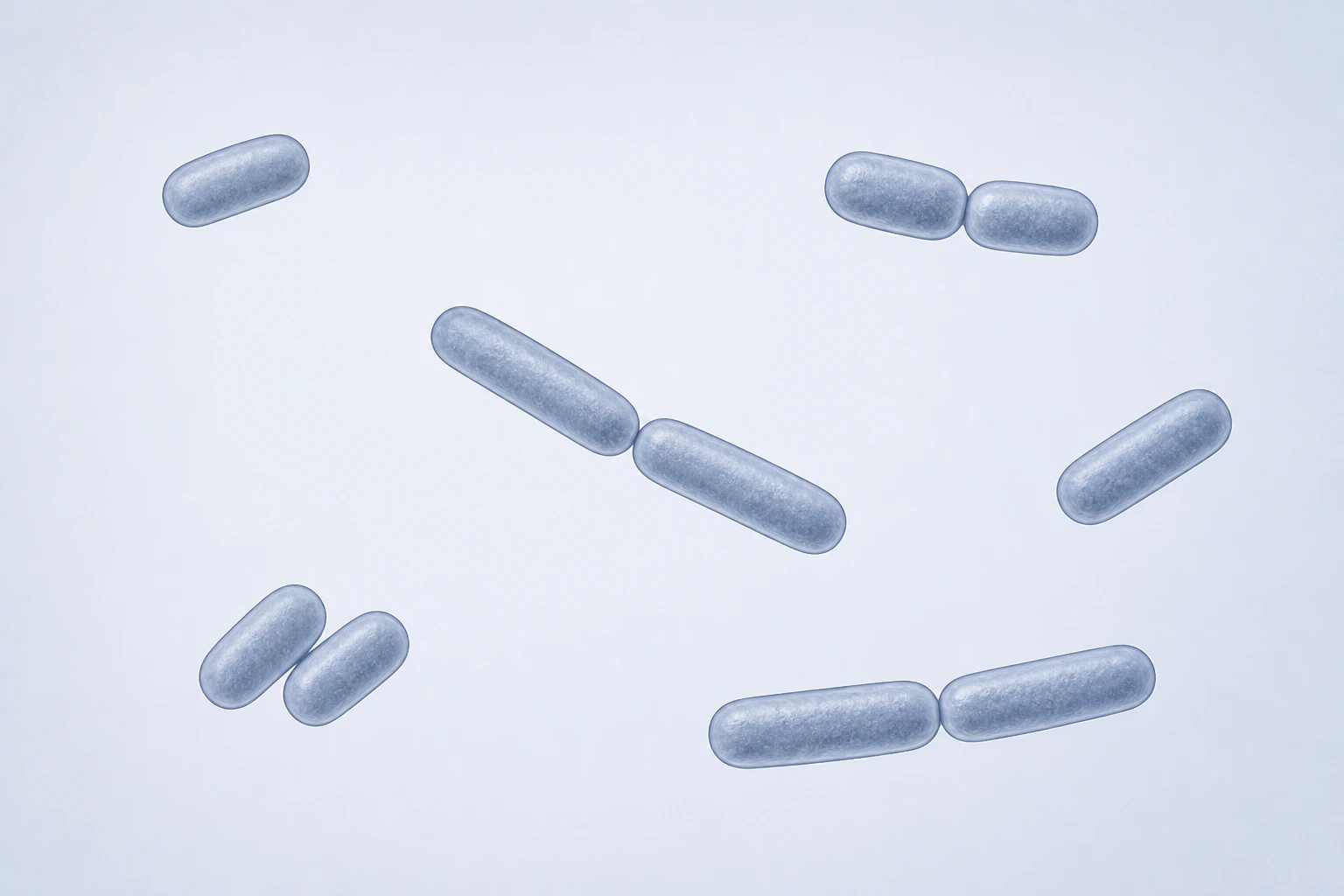
Selected Enterobacteriaceae bacillary diversity, shown as ten short coccobacillary or longer straight bodies in six groupings. This is a representative bacillary family-level reconstruction, not a universal morphology, and is non-diagnostic and not a micrograph.
Scientific media record1 verified identifier
- Subject
- Enterobacteriaceaetaxon · family
- Identifiers
- NCBITaxon:543
- Review
- Editorial review completeIdentifiers authority-verified · Accessibility validated · · enterobacteriaceae|enterobacteriaceae-microbial-community-v1.webp
- Digital source
- Trained-algorithmic mediaCreated with a trained generative algorithm and reviewed by WikiBiome for subject identity, scientific framing, identifiers, provenance, and accessibility.
- Scientific basis
- Enterobacteriaceae — NCBI TaxonomyEnterobacteriaceae — LPSNEnterobacteriaceae emended family treatmentEnterobacteriaceae conserved-name treatment
- License
- CC BY-SA 4.0Created
A family of Gram-negative, facultative anaerobic Gammaproteobacteria that includes many of the most important human pathogens: Escherichia coli, Klebsiella pneumoniae, Salmonella enterica serovar Typhimurium, Shigella flexneri, Yersinia pestis, Proteus mirabilis, Morganella, and Serratia.
Their bloom in the gut is the hallmark signature of Dysbiosis across virtually every disease state in this wiki, and their iron-scavenging capacity gives them a decisive competitive advantage under conditions of Gut-Metal-Microbiome Interactions disruption.
Evidence map6 cited passagesInspect provenance +
The iron-rich tumor microenvironment in colorectal cancer selects for siderophore-producing E. coli strains, including genotoxic pks+ strains that produce colibactin.
[NiFe] hydrogenase enables hydrogen-dependent energy metabolism in the gut, conferring a metabolic advantage in the H2-rich colonic environment.
Cardiovascular disease: enriched in ACVD with increased TMA lyase genes (CutC/D, YeaW/X) for TMAO production. LPS biosynthesis genes also enriched.
Colorectal cancer: enriched in CRC patients; alcohol consumption further increases abundance. pks+ E. coli produces colibactin causing DNA double-strand breaks.
Parkinson's disease: reported as increased in multiple PD datasets; LPS translocation is proposed to contribute to neuroinflammation via TLR4/NF-kB.
Heavy metal exposure: enriched with As, Pb, Hg, and Cd exposure, as these bacteria possess metal efflux pumps and siderophores that confer metal tolerance.
Contents
1. Iron-Dependent Virulence2. Nickel-Dependent Enzymes3. Dysbiosis Bloom4. Metal-Antibiotic Co-Resistance5. Key Metabolites6. ConnectionsIron-Dependent Virulence#
Enterobacteriaceae are avid iron scavengers, producing multiple siderophore systems (enterobactin, aerobactin, yersiniabactin, salmochelin) to acquire Iron from the host environment.
Under Nutritional Immunity (Metal Sequestration) conditions (where the host sequesters iron), siderophore production becomes the primary competitive weapon against non-siderophore-producing commensals like Lachnospiraceae, Roseburia, and Faecalibacterium prausnitzii.
Excess dietary iron supplementation paradoxically promotes Enterobacteriaceae expansion by overwhelming host iron sequestration mechanisms.
The iron-rich tumor microenvironment in Colorectal Cancer selects for siderophore-producing E. coli strains, including genotoxic pks+ strains that produce colibactin.[1]Immune System, Microbiota, and Microbial Metabolites: The Unresolved Triad in Colorectal Cancer MicroenvironmentHanus M, Parada-Venegas D, Landskron G et al. · 2021Open reference 1 ↓
Nickel-Dependent Enzymes#
All Enterobacteriaceae are predicted to carry nickel (Ni)-dependent glyoxalase I (nickel-GloI), a metal-dependent detoxification enzyme. Nickel-dependent Urease (in Proteus, Klebsiella, Yersinia) generates Ammonia that raises local pH and damages epithelial cells.
[NiFe] Hydrogenase enables hydrogen-dependent energy metabolism in the gut, conferring a metabolic advantage in the H2-rich colonic environment.[2]Microbial Metallomics and Parkinson's Disease: A Unified Metal-Driven Framework Linking Ferroptosis, Dysbiosis, and alpha-Synuclein PathologyKaren Pendergrass · 2025Open reference 2 ↓
Dysbiosis Bloom#
Enterobacteriaceae expansion is enriched in virtually every disease state. Cardiovascular disease: enriched in ACVD with increased TMA lyase genes (CutC/D, YeaW/X) for TMAO production. LPS biosynthesis genes also enriched.[3]The gut microbiome in atherosclerotic cardiovascular diseaseZhuye Jie, Huihua Xia, Shi-Long Zhong et al. · 2017Open reference 3 ↓
Colorectal cancer: enriched in CRC patients; alcohol consumption further increases abundance.[4]Dysbiotic microbiome variation in colorectal cancer patients is linked to lifestyles and metabolic diseasesTung Hoang, Minjung Kim, Ji Won Park et al. · 2023Open reference 4 ↓ pks+ E. coli produces colibactin causing DNA double-strand breaks.
Parkinson's disease: reported as increased in multiple PD datasets; LPS translocation is proposed to contribute to neuroinflammation via TLR4/NF-kB.[2]Microbial Metallomics and Parkinson's Disease: A Unified Metal-Driven Framework Linking Ferroptosis, Dysbiosis, and alpha-Synuclein PathologyKaren Pendergrass · 2025Open reference 2 ↓
IBD: blooms during flares when oxygen leaks into the lumen through damaged epithelium, favoring facultative anaerobes over obligate anaerobes.
Heavy metal exposure: enriched with arsenic (As), lead (Pb), mercury (Hg), and cadmium (Cd) exposure, as these bacteria possess metal efflux pumps and siderophores that confer metal tolerance.[5]Rezazadegan et al. 2025 — Heavy Metals and Gut Microbiota: A Systematic ReviewFatemeh Rezazadegan, Maryam Mahmoudi, Seyed Mohammad Mousavi · 2025Open reference 5 ↓
Metal-Antibiotic Co-Resistance#
Enterobacteriaceae frequently carry plasmids encoding both metal resistance genes and antibiotic resistance genes on the same mobile genetic elements. Exposure to Heavy Metals can co-select for antibiotic resistance even without antibiotic exposure, through co-resistance and cross-resistance mechanisms.
Metal efflux pumps (e.g., CzcCBA for cadmium (Cd)/zinc (Zn)/cobalt (Co), CopA for copper (Cu)) share regulatory elements with multidrug efflux systems. This co-resistance positions Enterobacteriaceae as a nexus linking environmental metal contamination to the antimicrobial resistance crisis.
Key Metabolites#
LPS (endotoxin)—outer membrane component that triggers TLR4/NF-kB Metal-Driven Inflammation cascade upon translocation. TMA/TMAO—TMA lyase (CutC/D) converts dietary choline/carnitine to TMA, oxidized to TMAO in the liver; pro-atherogenic metabolite linked to Cardiovascular Disease. Colibactin—genotoxin from pks+ E. coli strains causing DNA damage in Colorectal Cancer.
Siderophores—iron-chelating molecules that reshape metal availability in the gut lumen.
Connections#
- Iron—siderophore-mediated iron acquisition is central to virulence and competitive advantage
- Nickel—nickel (Ni)-dependent urease, hydrogenase, and GloI across the family
- Escherichia coli—flagship species; pks+ strains produce colibactin in CRC
- Klebsiella pneumoniae—nickel-urease producer; enriched in IBD and autoimmune disease
- Lachnospiraceae—inversely correlated; Enterobacteriaceae bloom when Lachnospiraceae deplete
- Faecalibacterium prausnitzii—displaced by Enterobacteriaceae under dysbiotic conditions
- Cardiovascular Disease—TMAO production and LPS-driven atherosclerosis
- Colorectal Cancer—colibactin genotoxicity and iron-rich tumor niche
- Parkinson's Disease—LPS-driven neuroinflammation via gut-brain axis
- dysbiosis—their bloom is THE hallmark of dysbiotic gut states
- inflammation—LPS/TLR4/NF-kB endotoxemia cascade
- Gut-Metal-Microbiome Interactions—metal-tolerant; bloom under heavy metal exposure
- Ferroptosis—iron-dependent; may contribute to iron-driven cell death pathways
- Biofilm—forms iron-dependent biofilms that harbor metal and antibiotic resistance
References 5
Numbered by first appearance in the article, then reconciled with its declared source list.
- 1
Hanus M, Parada-Venegas D, Landskron G et al. (2021). Immune System, Microbiota, and Microbial Metabolites: The Unresolved Triad in Colorectal Cancer Microenvironment. Frontiers in Immunology.
- 2
★Karen Pendergrass (2025). Microbial Metallomics and Parkinson's Disease: A Unified Metal-Driven Framework Linking Ferroptosis, Dysbiosis, and alpha-Synuclein Pathology. Conference Presentation.
- 3
Zhuye Jie, Huihua Xia, Shi-Long Zhong et al. (2017). The gut microbiome in atherosclerotic cardiovascular disease. Nature Communications.
- 4
Tung Hoang, Minjung Kim, Ji Won Park et al. (2023). Dysbiotic microbiome variation in colorectal cancer patients is linked to lifestyles and metabolic diseases. BMC Microbiology.
- 5
Fatemeh Rezazadegan, Maryam Mahmoudi, Seyed Mohammad Mousavi (2025). Rezazadegan et al. 2025 — Heavy Metals and Gut Microbiota: A Systematic Review. Journal of Health, Population and Nutrition.
Article network
Mentioned here 18
Pages linking here 55
Connect the evidence
Publicly readable discussion by ORCID-authenticated researchers. Questions, interpretation, methods, corrections, and new evidence stay attached to this record.
No discussion yet. Start with a precise question or a source-backed observation.
Activity and accepted changes
Accepted researcher context, editorial status, public discussion, and upstream Git revisions are shown together. Pending, declined, and withdrawn proposals remain private.
- published revision
Strengthen TLR4 and link high-leverage contexts
Karen Pendergrass · +1 −1
Inspect exact Git diff ↗ - published revision
Backfill heavy metals concept links
Karen Pendergrass · +1 −1
Inspect exact Git diff ↗ - published revision
Backfill inflammation concept links
Karen Pendergrass · +1 −1
Inspect exact Git diff ↗ - published revision
Complete corpus-wide Dysbiosis linking
Karen Pendergrass · +2 −2
Inspect exact Git diff ↗ - published revision
Complete Ammonia contextual coverage
Karen Pendergrass · +1 −1
Inspect exact Git diff ↗ - published revision
Complete Hydrogenase contextual coverage
Karen Pendergrass · +1 −1
Inspect exact Git diff ↗ - published revision
Complete reviewed Urease contextual coverage
Karen Pendergrass · +1 −1
Inspect exact Git diff ↗ - published revision
massive wiki expansion: 149 stubs fixed, 100+ new pages, Rule 15 scan, keystone papers
WikiBiome Deploy Bot · +13 −13
Inspect exact Git diff ↗ - published revision
nightly maintenance: 94 stub demotions, 181 source_count fixes, 22 auto-discovered stubs, 5 adversarial audits, 3 boundary fixes, 3 evidence-level corrections
WikiBiome Deploy Bot · +1 −0
Inspect exact Git diff ↗ - published revision
wiki: bulk entity upgrades, new article pages, and site regeneration
WikiBiome Deploy Bot · +6 −0
Inspect exact Git diff ↗ - published revision
WikiBiome update — integrity fixes, metallomic diet pages, cross-condition analyses
WikiBiome Deploy Bot · +9 −7
Inspect exact Git diff ↗ - published revision
WikiBiome update — 2026-04-10 13:49
WikiBiome Deploy Bot · +68 −0
Inspect exact Git diff ↗