
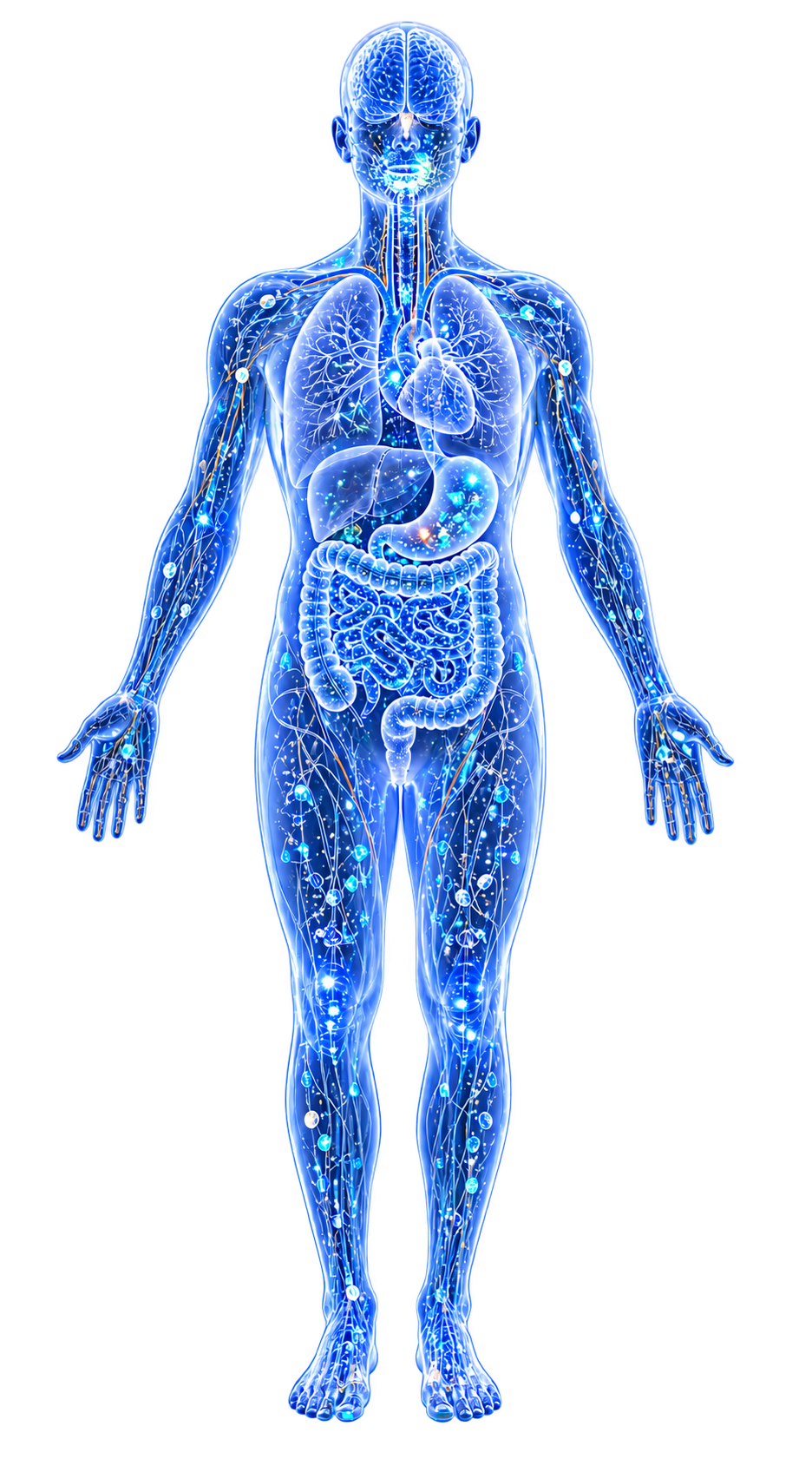
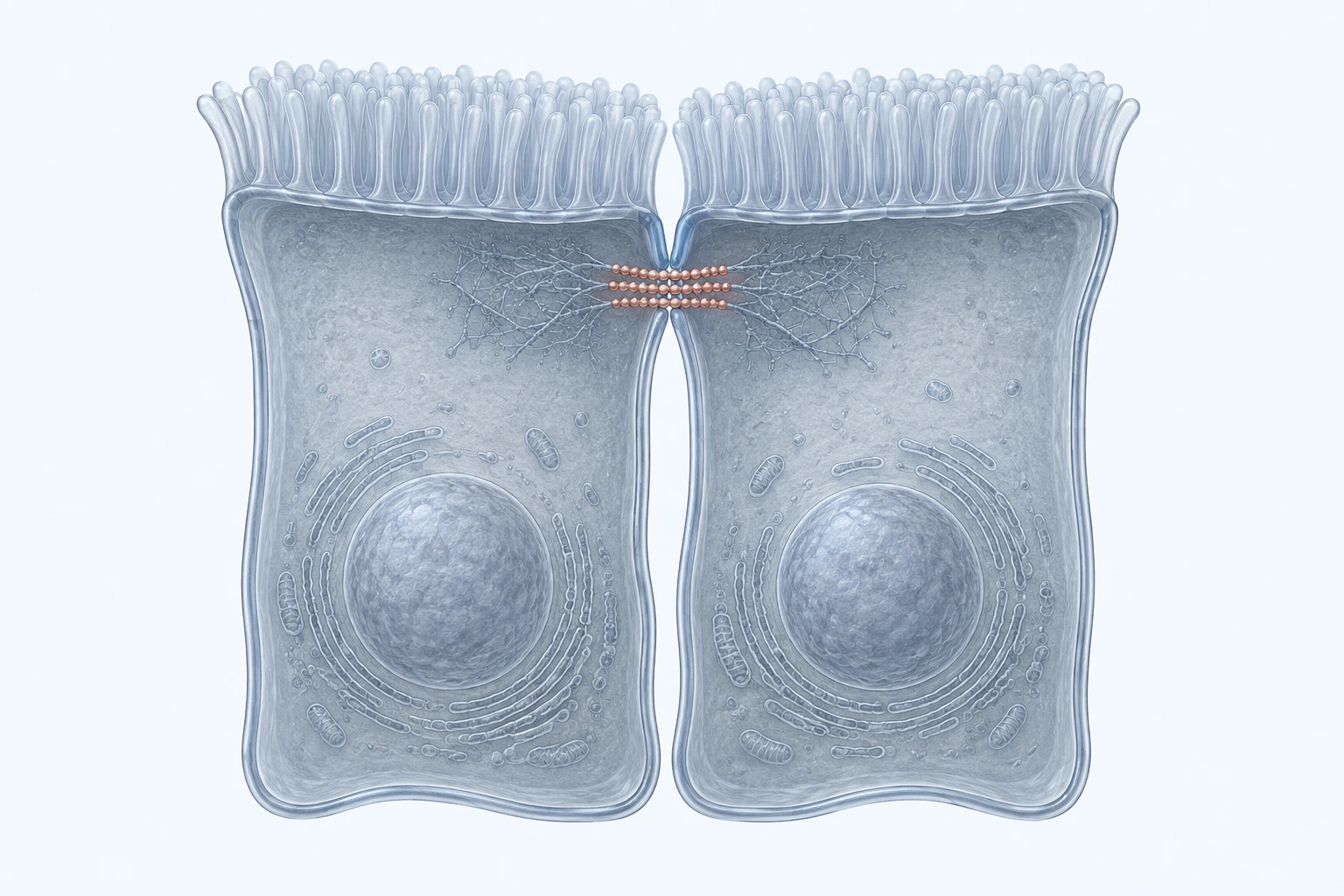
Tissue-scale orientation to a tight junction at the apical contact between two adjacent epithelial cells. Protein subtype, copy number, molecular structure, tissue-specific permeability, and disease state are intentionally not depicted; this is an educational reconstruction, not a micrograph.
Scientific media record2 verified identifiers
- Subject
- Tight Junctionsbiological-process
- Identifiers
- WikiBiome:tight-junctionsMeSH:D019108
- Review
- Editorial review completeIdentifiers authority-verified · Accessibility validated · · tight-junctions|tight-junctions-mechanism-v1.webp
- Digital source
- Trained-algorithmic mediaCreated with a trained generative algorithm and reviewed by WikiBiome for subject identity, scientific framing, identifiers, provenance, and accessibility.
- Scientific basis
- Tight Junctions — Medical Subject HeadingsBiophysics of claudin proteins in tight junction architecture: Three decades of progressTight Junctions
- License
- CC BY-SA 4.0Created
Tight junctions are the multiprotein complexes that seal the paracellular space between intestinal epithelial cells, forming the physical barrier that separates the gut lumen (with its ~10^13 bacteria, LPS, and dietary antigens) from the underlying lamina propria and systemic circulation.
Their integrity determines whether the gut is a contained ecosystem or a source of Endotoxemia and Bacteremia. With 221 file mentions, tight junctions are the most frequently referenced barrier concept in this wiki.
Evidence map4 cited passagesInspect provenance +
Claudin family proteins (27 members in humans) form the backbone of tight junction strands. Claudin-1, -3, -4, -5, and -7 are "sealing" claudins that restrict paracellular permeability; claudin-2 is a pore-forming claudin that increases permeability when upregulated (common in IBD). Claudin-5 is the primary tight junction protein of the blood-brain barrier—
Occludin regulates tight junction assembly and stability. Its phosphorylation state determines whether it promotes barrier tightening or loosening. heavy metals (cadmium, lead) disrupt occludin localization.
cadmium: Directly disrupts ZO-1 and occludin via oxidative stress and MAPK activation.
Barrier failure is measurable: elevated zonulin, lactulose/mannitol ratio, serum LPS antibodies (SMD=2.72 in schizophrenia ), and serum sCD14.
Contents
1. Key Proteins2. What Breaks Tight Junctions3. Consequences of Barrier Failure4. Cross-ReferencesKey Proteins#
Claudins#
Claudin family proteins (27 members in humans) form the backbone of tight junction strands. Claudin-1, -3, -4, -5, and -7 are "sealing" claudins that restrict paracellular permeability; claudin-2 is a pore-forming claudin that increases permeability when upregulated (common in IBD).
Claudin-5 is the primary tight junction protein of the blood-brain barrier—its downregulation enables Neuroinflammation.[1]Gut Dysbiosis in Severe Mental Illness and Chronic Fatigue: A Novel Trans-Diagnostic Construct? A Systematic Review and Meta-AnalysisSafadi JM, Quinton AMG, Lennox B et al. · 2022Open reference 1 ↓
Occludin#
Occludin regulates tight junction assembly and stability. Its phosphorylation state determines whether it promotes barrier tightening or loosening. Heavy Metals (Cadmium, Lead) disrupt occludin localization.[2]Effects of Heavy Metals on Gut Barrier Integrity and Gut MicrobiotaSweta Ghosh, Syam P. Nukavarpu, Venkatakrishna Rao Jala · 2024Open reference 2 ↓
Zonula Occludens (ZO-1, ZO-2, ZO-3)#
ZO proteins are cytoplasmic scaffolding proteins that anchor claudins and occludin to the actin cytoskeleton. ZO-1 downregulation is a consistent finding in Dysbiosis-associated barrier failure. Zonulin (pre-haptoglobin-2) triggers ZO-1 disassembly, opening the paracellular pathway.
What Breaks Tight Junctions#
Heavy Metals#
Cadmium: Directly disrupts ZO-1 and occludin via Oxidative Stress and MAPK activation.[2]Effects of Heavy Metals on Gut Barrier Integrity and Gut MicrobiotaSweta Ghosh, Syam P. Nukavarpu, Venkatakrishna Rao Jala · 2024Open reference 2 ↓[3]Molecular Mechanisms of Cellular Injury and Role of Toxic Heavy Metals in Chronic Kidney DiseaseManish Mishra, Larry Nichols, Aditi A. Dave et al. · 2022Open reference 3 ↓
Lead: Displaces calcium from adherens junctions (which anchor tight junctions); reduces claudin expression. Arsenic: Generates ROS that oxidize tight junction protein sulfhydryl groups.
Dysbiosis#
Loss of Butyrate-producing commensals (Faecalibacterium prausnitzii, Roseburia) removes the primary stimulus for tight junction protein expression—butyrate upregulates claudin-1, occludin, and ZO-1 via AMPK and HDAC inhibition.
Pathobiont LPS can activate TLR4 → myosin light chain kinase (MLCK) → contractile opening of tight junctions. Zonulin release triggered by gliadin and certain bacteria opens tight junctions.
Inflammation#
IL-6, TNF-alpha, and IFN-gamma directly downregulate claudin expression and promote claudin-2 (pore-forming) upregulation. NF-kB Signaling Pathway activation drives MLCK expression → cytoskeletal contraction → junction opening.
Consequences of Barrier Failure#
Tight junction disruption → paracellular permeability → Endotoxemia (LPS translocation) → TLR4/NF-kB → Systemic Inflammation → multi-organ disease. This is the mechanistic bridge from gut dysbiosis to every systemic condition in this wiki.
Barrier failure is measurable: elevated Zonulin, lactulose/mannitol ratio, serum LPS antibodies (SMD=2.72 in schizophrenia[1]Gut Dysbiosis in Severe Mental Illness and Chronic Fatigue: A Novel Trans-Diagnostic Construct? A Systematic Review and Meta-AnalysisSafadi JM, Quinton AMG, Lennox B et al. · 2022Open reference 1 ↓), and serum sCD14.
Cross-References#
- Intestinal Permeability—clinical concept of "leaky gut"
- Zonulin—tight junction opener
- Endotoxemia—consequence of barrier failure
- butyrate—primary tight junction protector via HDAC inhibition
- Metal-Driven Inflammation—cytokines disrupt tight junctions
- Cadmium—direct tight junction toxicity
References 6
Numbered by first appearance in the article, then reconciled with its declared source list.
- 1
Safadi JM, Quinton AMG, Lennox B et al. (2022). Gut Dysbiosis in Severe Mental Illness and Chronic Fatigue: A Novel Trans-Diagnostic Construct? A Systematic Review and Meta-Analysis. Molecular Psychiatry.
- 2
★Sweta Ghosh, Syam P. Nukavarpu, Venkatakrishna Rao Jala (2024). Effects of Heavy Metals on Gut Barrier Integrity and Gut Microbiota. Microbiota and Host.
- 3
★Manish Mishra, Larry Nichols, Aditi A. Dave et al. (2022). Molecular Mechanisms of Cellular Injury and Role of Toxic Heavy Metals in Chronic Kidney Disease. International Journal of Molecular Sciences.
- 4
Chen S, Jiang D, Zhuang Q et al. (2024). Esophageal microbial dysbiosis impairs mucosal barrier integrity via toll-like receptor 2 pathway in patients with gastroesophageal reflux symptoms. Journal of Translational Medicine.
- 5
★Honghong Bao, Yi Wang, Hanlin Xiong et al. (2024). Mechanism of Iron Ion Homeostasis in Intestinal Immunity and Gut Microbiota Remodeling. International Journal of Molecular Sciences.
- 6
Haijing Wang, Yuanjun Wang, Libin Yang et al. (2024). Wang 2024 — Integrated 16S rRNA sequencing and metagenomics insights into microbial dysbiosis and distinct virulence factors in inflammatory bowel disease. Frontiers in Microbiology.
Article network
Mentioned here 18
Pages linking here 102
Connect the evidence
Publicly readable discussion by ORCID-authenticated researchers. Questions, interpretation, methods, corrections, and new evidence stay attached to this record.
No discussion yet. Start with a precise question or a source-backed observation.
Activity and accepted changes
Accepted researcher context, editorial status, public discussion, and upstream Git revisions are shown together. Pending, declined, and withdrawn proposals remain private.
- published revision
Strengthen TLR4 and link high-leverage contexts
Karen Pendergrass · +1 −1
Inspect exact Git diff ↗ - published revision
Add reviewed neuroinflammation coverage batch
Karen Pendergrass · +1 −1
Inspect exact Git diff ↗ - published revision
Backfill heavy metals concept links
Karen Pendergrass · +1 −1
Inspect exact Git diff ↗ - published revision
Backfill oxidative stress concept links
Karen Pendergrass · +1 −1
Inspect exact Git diff ↗ - published revision
Complete corpus-wide Dysbiosis linking
Karen Pendergrass · +1 −1
Inspect exact Git diff ↗ - published revision
massive wiki expansion: 149 stubs fixed, 100+ new pages, Rule 15 scan, keystone papers
WikiBiome Deploy Bot · +67 −0
Inspect exact Git diff ↗