
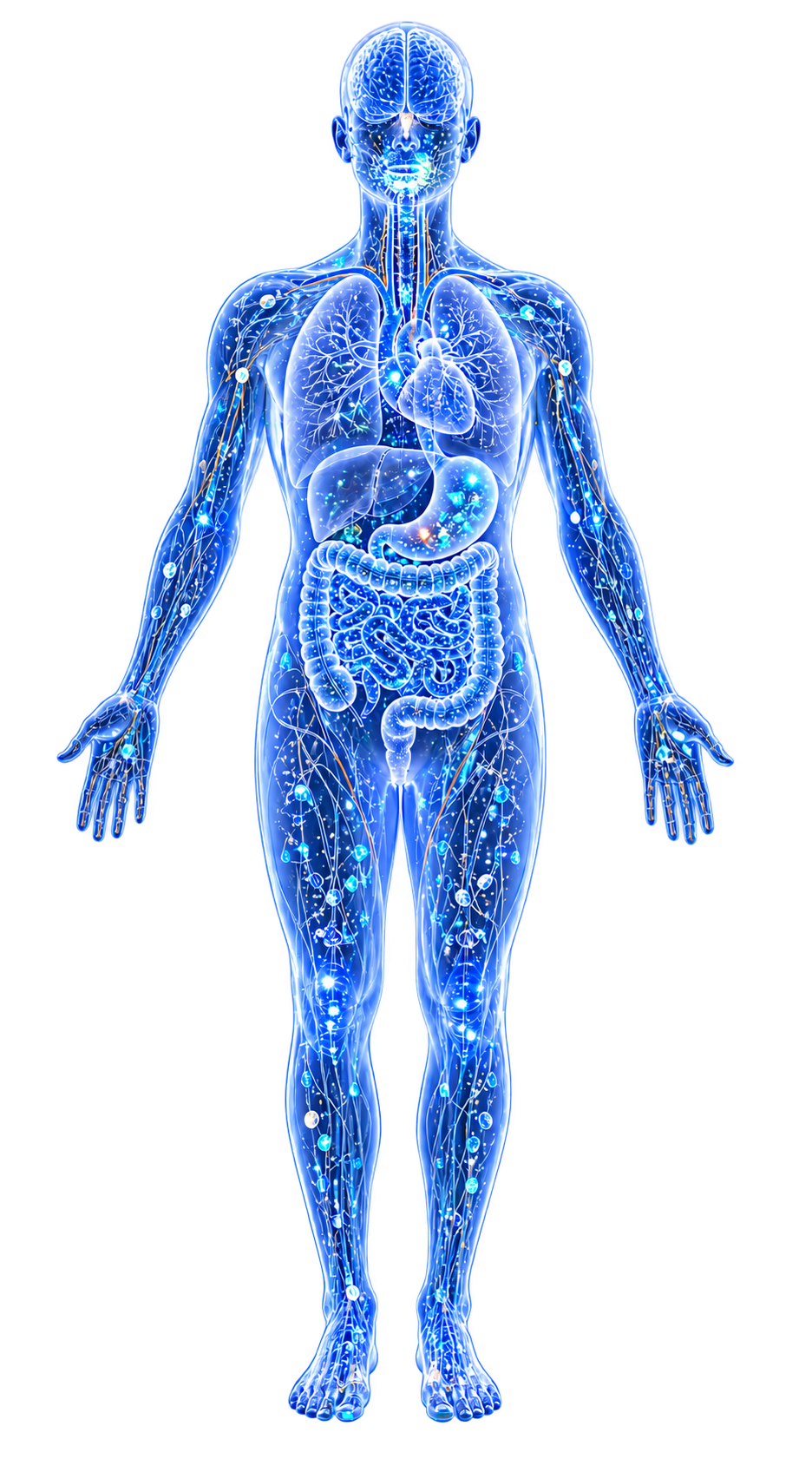
Nuclear factor kappa-light-chain-enhancer of activated B cells (NF-kB) is a family of transcription factors that regulate Metal-Driven Inflammation, immune responses, cell survival, and proliferation.
NF-kB is a convergence point where metal toxicity, pathogen signaling, and chronic disease intersect—activated by Heavy Metals, LPS, cytokines, and Oxidative Stress through overlapping upstream pathways.
Evidence map7 cited passagesInspect provenance +
nickel activates NF-kB through ROS generation, contributing to both its carcinogenic and inflammatory effects.
In endometriosis, dietary nickel exposure may drive NF-kB-mediated inflammation, contributing to the gastrointestinal and gynecological symptoms seen in Ni ACM.
Low-dose arsenic activates NF-kB, promoting cell survival and proliferation—this may be key to arsenic's tumor promotion activity.
Activates NF-kB via ROS-dependent mechanisms, driving inflammatory cytokine production in kidney, liver, and gut tissues.
Activates NF-kB in the CNS, contributing to neuroinflammation. LPS from Pb-induced gut dysbiosis may further amplify NF-kB signaling via TLR4 in microglia.
NF-kB-driven neuroinflammation is a shared pathway across AD and PD, amplified by metal-induced microglial activation and gut-derived LPS.
NF-kB activation by environmental metals contributes to autoimmune thyroid disease, rheumatoid arthritis, and IBD, ].
Contents
1. Core Pathway2. Metal Activation of NF-kB3. NF-kB in Disease Contexts4. Therapeutic Implications5. ConnectionsCore Pathway#
Canonical Activation#
In resting cells, NF-kB dimers (typically p65/p50) are held inactive in the cytoplasm by IkB inhibitory proteins. Activation signals (TNF-alpha, IL-1, LPS, metals, ROS) activate the IKK complex (IKKalpha/IKKbeta/NEMO), which phosphorylates IkB, targeting it for proteasomal degradation.
Released NF-kB translocates to the nucleus and drives transcription of pro-inflammatory cytokines (IL-6, TNF-alpha, IL-1beta), anti-apoptotic genes (Bcl-2, Bcl-xL), and adhesion molecules.
Downstream Effects#
Inflammation: IL-6, TNF-alpha, IL-1beta, COX-2, iNOS. Cell survival: anti-apoptotic proteins that protect cells from programmed death. Immune activation: MHC molecules, immunoglobulin light chains, cytokine receptors.
Tissue remodeling: matrix metalloproteinases Matrix Metalloproteases (MMPs).
Metal Activation of NF-kB#
Nickel#
Nickel activates NF-kB through ROS generation, contributing to both its carcinogenic and inflammatory effects.[1]Genetic and Epigenetic Mechanisms in Metal Carcinogenesis and Cocarcinogenesis: Nickel, Arsenic, and ChromiumKonstantin Salnikov, Anatoly Zhitkovich · 2008Open reference 1 ↓
In endometriosis, dietary nickel exposure may drive NF-kB-mediated inflammation, contributing to the gastrointestinal and gynecological symptoms seen in nickel (Ni) ACM.[2]Irritable Bowel Syndrome-Like Disorders in Endometriosis: Prevalence of Nickel Sensitivity and Effects of a Low-Nickel Diet. An Open-Label Pilot StudyBorghini R, Porpora MG, Casale R et al. · 2020Open reference 2 ↓
NF-kB activation by nickel is part of its role as a metalloestrogen and inflammatory driver.
Arsenic—The Dose Paradox#
Low-dose Arsenic activates NF-kB, promoting cell survival and proliferation—this may be key to arsenic's tumor promotion activity.[1]Genetic and Epigenetic Mechanisms in Metal Carcinogenesis and Cocarcinogenesis: Nickel, Arsenic, and ChromiumKonstantin Salnikov, Anatoly Zhitkovich · 2008Open reference 1 ↓ High-dose arsenic inhibits NF-kB, inducing apoptosis—this is exploited therapeutically in acute promyelocytic leukemia (APL) treatment with arsenic trioxide.
This biphasic response means arsenic can be both a carcinogen (low dose, chronic) and a cancer treatment (high dose, acute).
Cadmium#
Activates NF-kB via ROS-dependent mechanisms, driving inflammatory cytokine production in kidney, liver, and gut tissues.[3]Molecular Mechanisms of Cellular Injury and Role of Toxic Heavy Metals in Chronic Kidney DiseaseManish Mishra, Larry Nichols, Aditi A. Dave et al. · 2022Open reference 3 ↓ NF-kB activation contributes to cadmium-induced renal inflammation and progressive nephron loss.
Lead#
- Activates NF-kB in the CNS, contributing to neuroinflammation. LPS from lead (Pb)-induced gut Dysbiosis may further amplify NF-kB signaling via TLR4 in microglia.[4]Associations of Environmental Exposure to Arsenic, Manganese, Lead, and Cadmium with Alzheimer's Disease: A Review of Recent Evidence from Mechanistic StudiesGiasuddin Ahmed, Md. Shiblur Rahaman, Enrique Perez et al. · 2025Open reference 4 ↓
Mercury#
- mercury (Hg) compounds activate NF-kB through thiol oxidation and ROS generation, driving autoimmune and inflammatory responses.
NF-kB in Disease Contexts#
Neurodegeneration#
- NF-kB-driven neuroinflammation is a shared pathway across AD and PD, amplified by metal-induced microglial activation and gut-derived LPS.[4]Associations of Environmental Exposure to Arsenic, Manganese, Lead, and Cadmium with Alzheimer's Disease: A Review of Recent Evidence from Mechanistic StudiesGiasuddin Ahmed, Md. Shiblur Rahaman, Enrique Perez et al. · 2025Open reference 4 ↓
Autoimmune Disease#
- NF-kB activation by environmental metals contributes to autoimmune thyroid disease, rheumatoid arthritis, and IBD.[5]Kravchenko 2023 — Thyroid hormones and minerals in immunocorrection of disorders in autoimmune thyroid diseasesKravchenko V, Zakharchenko T · 2023Open reference 5 ↓[6]Environmental Exposures and Autoimmune Diseases: Contribution of Gut MicrobiomeM. Firoze Khan, Hui Wang · 2020Open reference 6 ↓
Endometriosis#
- H2S and nickel both activate NF-kB in endometriotic tissue, driving inflammatory cytokine production, angiogenesis, and lesion growth. This links dietary nickel exposure to disease progression.
Cancer#
- NF-kB activation promotes tumor cell survival, proliferation, and resistance to apoptosis. Metal-induced constitutive NF-kB activation is a proposed mechanism in Metal Carcinogenesis.
Therapeutic Implications#
NF-kB inhibition is a therapeutic target across multiple metal-associated diseases. Anti-inflammatory dietary patterns (e.g., Mediterranean Diet) may partially exert their effects through NF-kB suppression. However, complete NF-kB blockade compromises immune defense, creating a therapeutic window challenge.
Connections#
- Nickel, Arsenic, Cadmium, Lead, Mercury—all activate NF-kB
- inflammation—NF-kB is the master inflammatory transcription factor
- oxidative stress—ROS activates NF-kB; NF-kB target genes produce more ROS
- Metal Carcinogenesis—NF-kB-mediated cell survival promotes tumorigenesis
- Gut-Metal-Microbiome Interactions—LPS from metal-induced dysbiosis activates NF-kB via TLR4
References 9
Numbered by first appearance in the article, then reconciled with its declared source list.
- 1
Konstantin Salnikov, Anatoly Zhitkovich (2008). Genetic and Epigenetic Mechanisms in Metal Carcinogenesis and Cocarcinogenesis: Nickel, Arsenic, and Chromium. Chemical Research in Toxicology.
- 2
Borghini R, Porpora MG, Casale R et al. (2020). Irritable Bowel Syndrome-Like Disorders in Endometriosis: Prevalence of Nickel Sensitivity and Effects of a Low-Nickel Diet. An Open-Label Pilot Study. Nutrients.
- 3
★Manish Mishra, Larry Nichols, Aditi A. Dave et al. (2022). Molecular Mechanisms of Cellular Injury and Role of Toxic Heavy Metals in Chronic Kidney Disease. International Journal of Molecular Sciences.
- 4
★Giasuddin Ahmed, Md. Shiblur Rahaman, Enrique Perez et al. (2025). Associations of Environmental Exposure to Arsenic, Manganese, Lead, and Cadmium with Alzheimer's Disease: A Review of Recent Evidence from Mechanistic Studies. Journal of Xenobiotics.
- 5
★Kravchenko V, Zakharchenko T (2023). Kravchenko 2023 — Thyroid hormones and minerals in immunocorrection of disorders in autoimmune thyroid diseases. Frontiers in Endocrinology.
- 6
M. Firoze Khan, Hui Wang (2020). Environmental Exposures and Autoimmune Diseases: Contribution of Gut Microbiome. Frontiers in Immunology.
- 7
Jessica Briffa, Emmanuel Sinagra, Renald Blundell (2020). Heavy Metal Pollution in the Environment and Their Toxicological Effects on Humans. Heliyon.
- 8
Sabath E, Robles-Osorio ML (2012). Renal health and the environment: heavy metal nephrotoxicity. Nefrologia.
- 9
Liu S, Wang H, Cao Y et al. (2025). The association between low-concentration heavy metal exposure and chronic kidney disease risk through alpha-klotho. Scientific Reports.
Article network
Mentioned here 15
Pages linking here 36
Connect the evidence
Publicly readable discussion by ORCID-authenticated researchers. Questions, interpretation, methods, corrections, and new evidence stay attached to this record.
No discussion yet. Start with a precise question or a source-backed observation.
Activity and accepted changes
Accepted researcher context, editorial status, public discussion, and upstream Git revisions are shown together. Pending, declined, and withdrawn proposals remain private.
- published revision
Strengthen TLR4 and link high-leverage contexts
Karen Pendergrass · +1 −1
Inspect exact Git diff ↗ - published revision
Backfill heavy metals concept links
Karen Pendergrass · +1 −1
Inspect exact Git diff ↗ - published revision
Backfill oxidative stress concept links
Karen Pendergrass · +2 −2
Inspect exact Git diff ↗ - published revision
Backfill inflammation concept links
Karen Pendergrass · +2 −2
Inspect exact Git diff ↗ - published revision
Complete corpus-wide Dysbiosis linking
Karen Pendergrass · +1 −1
Inspect exact Git diff ↗ - published revision
massive wiki expansion: 149 stubs fixed, 100+ new pages, Rule 15 scan, keystone papers
WikiBiome Deploy Bot · +6 −6
Inspect exact Git diff ↗ - published revision
nightly maintenance: 94 stub demotions, 181 source_count fixes, 22 auto-discovered stubs, 5 adversarial audits, 3 boundary fixes, 3 evidence-level corrections
WikiBiome Deploy Bot · +1 −0
Inspect exact Git diff ↗ - published revision
pre-overnight checkpoint 2026-04-18
WikiBiome Deploy Bot · +5 −3
Inspect exact Git diff ↗ - published revision
Deep content + citation pass: 10 entities enriched, 7 new sources, DOI integrity
WikiBiome Deploy Bot · +1 −1
Inspect exact Git diff ↗ - published revision
WikiBiome update — 2026-04-15 17:23
WikiBiome Deploy Bot · +0 −1
Inspect exact Git diff ↗ - published revision
WikiBiome update — integrity fixes, metallomic diet pages, cross-condition analyses
WikiBiome Deploy Bot · +17 −7
Inspect exact Git diff ↗ - published revision
WikiBiome v7 — interactive microbiome metallomics encyclopedia
Karen Pendergrass · +73 −0
Inspect exact Git diff ↗