
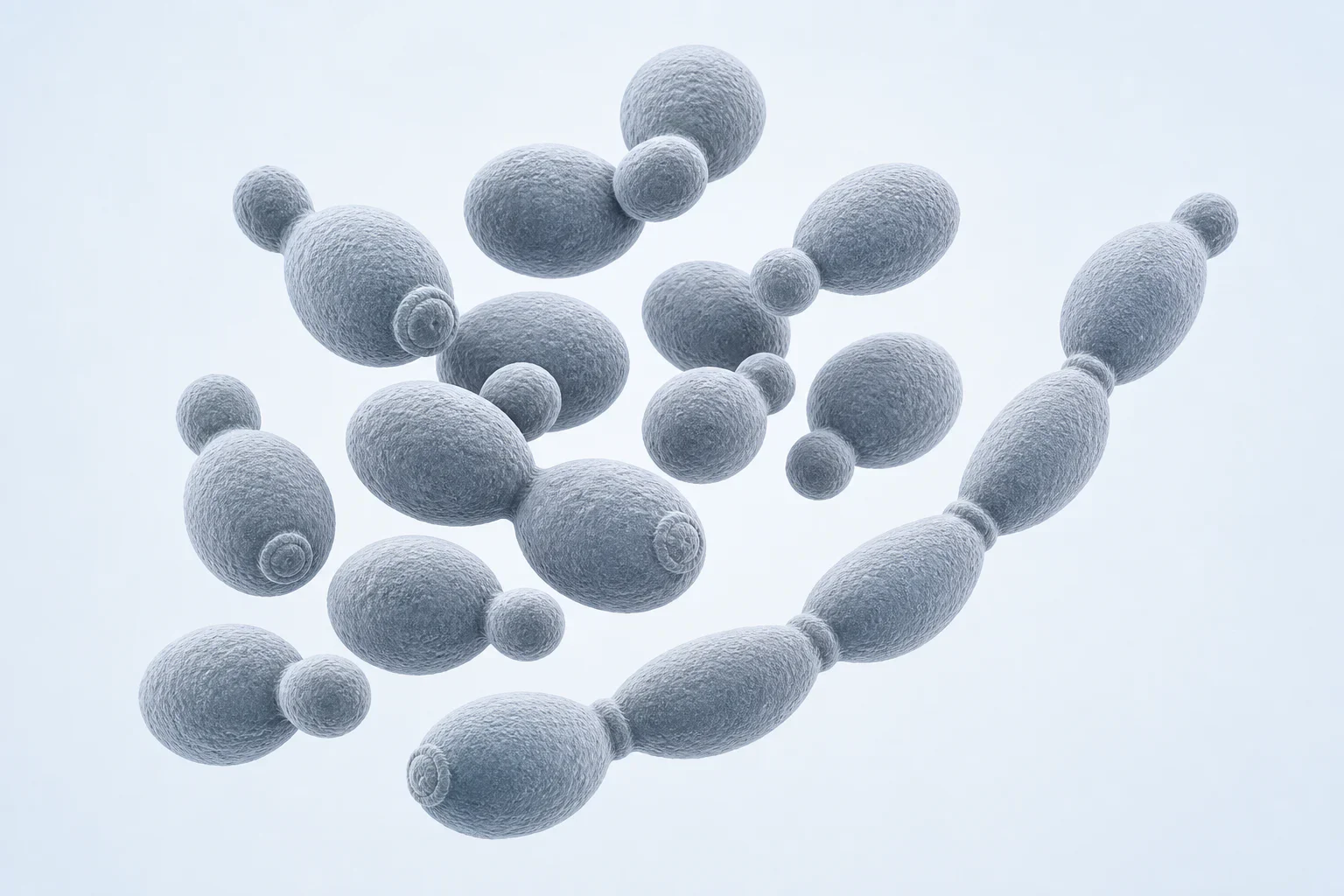
Representative C. albicans yeast and pseudohyphal forms, with budding cells and constrictions between elongated cells. Morphology changes with growth state; this is an educational reconstruction, not a clinical micrograph.
Scientific media record1 verified identifier
- Subject
- Candida albicanstaxon · species
- Identifiers
- NCBITaxon:5476
- Review
- Editorial review completeIdentifiers authority-verified · Accessibility validated · · candida-albicans|candida-albicans-morphology-v1.webp
- Digital source
- Trained-algorithmic mediaCreated with a trained generative algorithm and reviewed by WikiBiome for subject identity, scientific framing, identifiers, provenance, and accessibility.
- License
- CC BY-SA 4.0Created
An opportunistic fungal pathogen whose relationship with metals is multifaceted: C. albicans can biosorb Heavy Metals from its environment, heavy metal exposure promotes its virulence in immunocompromised hosts, and metal nanoparticles are being developed as antifungal weapons against it.
This page also covers Cryptococcus neoformans, a related fungal pathogen that uses nickel (Ni)-dependent Urease for brain invasion.
Evidence map15 cited passagesInspect provenance +
C. albicans demonstrates remarkable heavy metal tolerance and uptake:
In HIV-positive patients, Candida strains show differential metal susceptibility:
Fe acquisition: C. albicans has dedicated iron uptake systems including reductive iron assimilation (Fre/Ftr/Fet), siderophore uptake (Sit1), and hemoglobin/heme receptors. Iron limitation triggers the yeast-to-hyphae morphological switch—a key virulence transition.
Magnesium homeostasis: intracellular magnesium is a key immune evasion signal that modulates C. albicans-phagocyte interactions.
C. albicans actively masks cell-wall beta-1,3-glucan from host pattern recognition receptors (Dectin-1), blunting phagocytosis and cytokine responses. Masking is coordinated through a drug-sensitive signaling network that includes PKC, Mkc1, Hog1, and cAMP-PKA.
The masking program is regulated by Ace2, Mnt1/Mnt2, and multiple MAPK cascades; pharmacologic disruption unmasks beta-glucan and restores host immune recognition.
Lactate-induced masking: environmental lactate—produced abundantly by gut Lactobacillus and by colonic epithelium—triggers beta-glucan masking, allowing C. albicans to persist as an invisible commensal in the mucosal niche.
Candida-Staphylococcus reciprocal virulence masking: C. albicans and Staphylococcus aureus form mixed biofilms in which each partner masks the other's recognition by host immunity, increasing invasive disease severity in co-infection models.
C. albicans forms functional biofilms with resident gut and oral bacteria that modulate virulence and persistence.
A growing therapeutic approach:
C. neoformans uses a Ni-dependent urease that is essential for CNS invasion:
Gastric colonization with PPI use: proton pump inhibitor therapy raises gastric pH and drives fungal dysbiosis with Candida overgrowth, contributing to GERD-associated fungal disease.
Autism spectrum disorder: elevated anti-Candida antibodies have been reported in children with ASD.
Schizophrenia / bipolar disorder: C. albicans seropositivity is associated with psychiatric diagnosis in a sex-specific manner.
Lung cancer ecology: Candida expansion occurs in dysbiotic lung and gut microbiomes of cancer patients.
Contents
1. Candida albicans2. Cryptococcus neoformans—Ni-Urease for Brain Invasion3. Nutritional Immunity and Fungal Pathogens4. Disease Associations5. Connection to Environmental Metal Exposure6. ConnectionsCandida albicans#
Metal Biosorption Capacity#
C. albicans demonstrates remarkable heavy metal tolerance and uptake.[1]Biosorption of Heavy Metals by Candida albicansIsmael Acosta Rodriguez, Juan Fernando Cardenas-Gonzalez, Victor Manuel Martinez Juarez et al. · 2018Open reference 1 ↓ Can grow in concentrations of: 2000 ppm zinc, lead, and copper; 2000 ppm chromium (Cr)(VI); 1500 ppm As(III); 500 ppm silver; 300 ppm cobalt; 200 ppm mercury and cadmium.
Biosorption removal efficiency (modified biomass): chromium(VI) 76%, lead 57%, silver 51%, cadmium 46%, As(III) 40%, cobalt 37%, mercury 36%, copper 31%, zinc 22%.
This biosorption capacity means C. albicans in the human GI tract or mucosal surfaces may act as a metal sink, altering local metal bioavailability for both the host and competing microbiota.
Metal Susceptibility in Immunocompromised Hosts#
In HIV-positive patients, Candida strains show differential metal susceptibility.[2]Effect of Heavy Metal Ions on Candida Isolated from HIV Positive PatientsMonal M. Kukde, Silpi Basak, Deepak P. Selkar · 2019Open reference 2 ↓
100% resistant to zinc ions (100 mM)—zinc does not inhibit Candida growth. 100% susceptible to cadmium (1 mM), mercury (10 mM), and silver (10 mM). Silver and mercury ions inhibit plasma membrane H+-ATPase by direct binding interactions.
Cadmium, mercury, cobalt, and nickel also inhibit plasma membrane ATPase of eukaryotic cells. Implication: in immunocompromised patients, environmental zinc exposure may favor Candida overgrowth while silver/mercury have antifungal potential.
Metal-Dependent Virulence Factors#
iron (Fe) acquisition: C. albicans has dedicated iron uptake systems including reductive iron assimilation (Fre/Ftr/Fet), siderophore uptake (Sit1), and hemoglobin/heme receptors. Iron limitation triggers the yeast-to-hyphae morphological switch—a key virulence transition.[3]Corrales 2024 — Characterization of a Selective, Iron-Chelating Antifungal Compound That Disrupts Fungal Metabolism and Synergizes with FluconazoleJeanne Corrales, Lucia Ramos-Alonso, Javier Gonzalez-Sabin et al. · 2024Open reference 3 ↓[4]Alves et al. 2020 — Adapting to Survive: How Candida Overcomes Host-Imposed ConstraintsAlves R, et al. · 2020Open reference 4 ↓
copper (Cu)-SOD: copper-zinc superoxide dismutase for Oxidative Stress defense within macrophage phagosomes. zinc (Zn) homeostasis: Zrt1/Zrt2 zinc transporters; zinc is required for alcohol dehydrogenase and numerous metalloenzymes. Magnesium homeostasis: intracellular magnesium is a key immune evasion signal that modulates C. albicans-phagocyte interactions.[5]Hans et al. 2022 — Magnesium Deprivation Causes Candida Beta-Glucan Unmasking and Immune Evasion ChangesHans S, et al. · 2022Open reference 5 ↓
Beta-Glucan Masking and Immune Evasion#
C. albicans actively masks cell-wall beta-1,3-glucan from host pattern recognition receptors (Dectin-1), blunting phagocytosis and cytokine responses. Masking is coordinated through a drug-sensitive signaling network that includes PKC, Mkc1, Hog1, and cAMP-PKA.[6]Wheeler & Fink 2006 — A Drug-Sensitive Genetic Network Masks Fungi from the Immune SystemWheeler RT, Fink GR · 2006Open reference 6 ↓
The masking program is regulated by Ace2, Mnt1/Mnt2, and multiple MAPK cascades; pharmacologic disruption unmasks beta-glucan and restores host immune recognition.[7]Chen, Wagner & Reynolds 2022 — Beta-Glucan Masking Signaling Pathways in CandidaChen T, Wagner AS, Reynolds TB · 2022Open reference 7 ↓
Lactate-induced masking: environmental lactate—produced abundantly by gut Lactobacillus and by colonic epithelium—triggers beta-glucan masking, allowing C. albicans to persist as an invisible commensal in the mucosal niche.[7]Chen, Wagner & Reynolds 2022 — Beta-Glucan Masking Signaling Pathways in CandidaChen T, Wagner AS, Reynolds TB · 2022Open reference 7 ↓
Interkingdom Synergy with Bacteria#
Candida-Staphylococcus reciprocal virulence masking: C. albicans and Staphylococcus aureus form mixed biofilms in which each partner masks the other's recognition by host immunity, increasing invasive disease severity in co-infection models.[8]Pasman et al. 2025 — Candida-Staphylococcus Reciprocal Virulence and Masking in Co-culturePasman ME, et al. · 2025Open reference 8 ↓
C. albicans forms functional biofilms with resident gut and oral bacteria that modulate virulence and persistence.[9]Li et al. 2022 — Candida albicans and Resident Microbiota InteractionsLi XV, et al. · 2022Open reference 9 ↓
Metal Nanoparticles as Antifungal Strategy#
A growing therapeutic approach.[10]Metal Nanoparticles to Combat Candida albicans Infections: An UpdatePaulo Henrique Fonseca do Carmo, Maira Terra Garcia, Livia Mara Alves Figueiredo-Godoi et al. · 2023Open reference 10 ↓
Silver nanoparticles (AgNPs): most studied; synergistic with fluconazole against resistant strains; restore susceptibility phenotype by reducing efflux pump activity. Gold nanoparticles (AuNPs): chitosan-functionalized forms inhibit biofilm formation. Iron oxide nanoparticles (IONPs): ferumoxytol (FDA-approved for anemia) disrupts oral Candida biofilms; AMB-IONPs show 16-25x improved efficacy vs. amphotericin B alone.
Nickel-containing bimetallic nanoparticles: silver (Ag)-NiNPs showed potent activity at 0.19-1.56 ug/mL; nickel (Ni)-copper (Cu)-zinc (Zn)-IONPs caused complete yeast cell lysis via ROS production and membrane disruption.
Cryptococcus neoformans—Ni-Urease for Brain Invasion#
C. neoformans uses a nickel (Ni)-dependent urease that is essential for CNS invasion.[11]Role of Nickel in Microbial PathogenesisRobert J. Maier, Stéphane L. Benoit · 2019Open reference 11 ↓
Urease activity promotes crossing of the blood-brain barrier. Urease-negative mutants show dramatically reduced brain colonization in animal models. Ammonia production from urease may damage endothelial tight junctions (paralleling Helicobacter pylori urease disruption of gastric tight junctions).
C. neoformans causes cryptococcal meningitis, a leading killer of HIV/AIDS patients, making its nickel-urease a critical virulence factor in the global HIV burden.
Nutritional Immunity and Fungal Pathogens#
Host calprotectin sequesters zinc and manganese at infection sites, inhibiting Candida growth and hyphal morphogenesis. Lactoferrin and transferrin restrict iron, slowing fungal proliferation. C. albicans evades iron restriction through reductive iron uptake and hemoglobin binding.
Copper intoxication: macrophages pump copper into phagosomes to kill engulfed Candida; the fungus counters with copper (Cu)-SOD and copper exporters.
Disease Associations#
Candida albicans#
- Oral thrush (especially HIV/AIDS)
- Vulvovaginal candidiasis
- Invasive candidiasis / candidemia (ICU patients, post-surgical)
- Chronic mucocutaneous candidiasis
- Esophageal candidiasis
- Gastric colonization with PPI use: proton pump inhibitor therapy raises gastric pH and drives fungal Dysbiosis with Candida overgrowth, contributing to GERD-associated fungal disease.[12]Shi 2023 — PPI-Induced Fungal Dysbiosis in Patients with Gastroesophageal Reflux DiseaseYichao Shi, Jianfeng Li, Shuntian Cai et al. · 2023Open reference 12 ↓
- Autism spectrum disorder: elevated anti-Candida antibodies have been reported in children with ASD.[13]Hughes 2018 — Anti-Candida albicans IgG Antibodies in Children With Autism Spectrum DisordersHeather K. Hughes, Paul Ashwood · 2018Open reference 13 ↓
- Schizophrenia / bipolar disorder: C. albicans seropositivity is associated with psychiatric diagnosis in a sex-specific manner.[14]Severance 2016 — Candida albicans Exposures, Sex Specificity and Cognitive Deficits in Schizophrenia and Bipolar DisorderEmily G. Severance, Kristin L. Gressitt, Catherine R. Stallings et al. · 2016Open reference 14 ↓
- Lung cancer ecology: Candida expansion occurs in dysbiotic lung and gut microbiomes of cancer patients.[15]Seelbinder et al. 2023 — Candida Expansion in the Gut Is Determined by Bacterial EcologySeelbinder B, et al. · 2023Open reference 15 ↓
Cryptococcus neoformans#
- Cryptococcal meningitis (HIV/AIDS, transplant recipients)
- Pulmonary cryptococcosis
Connection to Environmental Metal Exposure#
C. albicans biosorption capacity means it may accumulate dietary heavy metals in the gut, potentially sequestering metals from absorption or concentrating them in biofilms.
In immunocompromised patients, environmental zinc exposure may support C. albicans (which is zinc-resistant) while suppressing zinc-sensitive competitors, promoting overgrowth. Heavy metal contamination in water/food may indirectly promote fungal pathogenesis by disrupting competing bacterial microbiota.
For C. neoformans, environmental nickel availability (soil, bird droppings—its natural habitat) supports urease metalation that enables subsequent brain invasion.
Connections#
- Metal-Dependent Virulence—C. neoformans nickel (Ni)-urease for brain invasion; C. albicans iron (Fe)-dependent morphological switch
- Nickel—cofactor for C. neoformans urease (brain invasion); component of antifungal bimetallic nanoparticles
- Iron—essential for C. albicans yeast-to-hyphae transition; target of host nutritional immunity
- Zinc—C. albicans is highly zinc-resistant; host calprotectin sequesters zinc (Zn) as defense
- Copper—host macrophages use copper (Cu) intoxication against engulfed Candida
- Nutritional Immunity (Metal Sequestration)—host deploys calprotectin, lactoferrin, copper intoxication against fungal pathogens
- Helicobacter pylori—C. neoformans urease parallels H. pylori urease in disrupting tight junctions
- Proteus mirabilis—both use nickel-urease for pathogenesis in different niches
References 19
Numbered by first appearance in the article, then reconciled with its declared source list.
- 1
Ismael Acosta Rodriguez, Juan Fernando Cardenas-Gonzalez, Victor Manuel Martinez Juarez et al. (2018). Biosorption of Heavy Metals by Candida albicans. Advances in Bioremediation and Phytoremediation (IntechOpen).
- 2
Monal M. Kukde, Silpi Basak, Deepak P. Selkar (2019). Effect of Heavy Metal Ions on Candida Isolated from HIV Positive Patients. Journal of Clinical and Diagnostic Research.
- 3
Jeanne Corrales, Lucia Ramos-Alonso, Javier Gonzalez-Sabin et al. (2024). Corrales 2024 — Characterization of a Selective, Iron-Chelating Antifungal Compound That Disrupts Fungal Metabolism and Synergizes with Fluconazole. Microbiology Spectrum.
- 4
Alves R, et al. (2020). Alves et al. 2020 — Adapting to Survive: How Candida Overcomes Host-Imposed Constraints. PLoS Pathogens.
- 5
Hans S, et al. (2022). Hans et al. 2022 — Magnesium Deprivation Causes Candida Beta-Glucan Unmasking and Immune Evasion Changes. PLoS ONE.
- 6
Wheeler RT, Fink GR (2006). Wheeler & Fink 2006 — A Drug-Sensitive Genetic Network Masks Fungi from the Immune System. PLoS Pathogens.
- 7
Chen T, Wagner AS, Reynolds TB (2022). Chen, Wagner & Reynolds 2022 — Beta-Glucan Masking Signaling Pathways in Candida. Frontiers in Fungal Biology.
- 8
Pasman ME, et al. (2025). Pasman et al. 2025 — Candida-Staphylococcus Reciprocal Virulence and Masking in Co-culture. Frontiers in Cellular and Infection Microbiology.
- 9
Li XV, et al. (2022). Li et al. 2022 — Candida albicans and Resident Microbiota Interactions. Frontiers in Microbiology.
- 10
Paulo Henrique Fonseca do Carmo, Maira Terra Garcia, Livia Mara Alves Figueiredo-Godoi et al. (2023). Metal Nanoparticles to Combat Candida albicans Infections: An Update. Microorganisms.
- 11
★Robert J. Maier, Stéphane L. Benoit (2019). Role of Nickel in Microbial Pathogenesis. Inorganics.
- 12
Yichao Shi, Jianfeng Li, Shuntian Cai et al. (2023). Shi 2023 — PPI-Induced Fungal Dysbiosis in Patients with Gastroesophageal Reflux Disease. Frontiers in Cellular and Infection Microbiology.
- 13
Heather K. Hughes, Paul Ashwood (2018). Hughes 2018 — Anti-Candida albicans IgG Antibodies in Children With Autism Spectrum Disorders. Frontiers in Psychiatry.
- 14
Emily G. Severance, Kristin L. Gressitt, Catherine R. Stallings et al. (2016). Severance 2016 — Candida albicans Exposures, Sex Specificity and Cognitive Deficits in Schizophrenia and Bipolar Disorder. npj Schizophrenia.
- 15
Seelbinder B, et al. (2023). Seelbinder et al. 2023 — Candida Expansion in the Gut Is Determined by Bacterial Ecology. Nature Communications.
- 16
★Dominika Bartnicka, Miriam Gonzalez-Gonzalez, Joanna Sykut et al. (2020). Bartnicka et al. 2020 — Candida albicans Shields the Periodontal Killer Porphyromonas gingivalis from Recognition by the Host Immune System and Supports the Bacterial Infection of Gingival Tissue. International Journal of Molecular Sciences.
- 17
Yiyuan Pan, Zhaoling Shi, Yadong Wang et al. (2024). Pan et al. 2024 — Baicalin Promotes β-1,3-Glucan Exposure in Candida albicans and Enhances Macrophage Response. Frontiers in Cellular and Infection Microbiology.
- 18
XiaoHui Sem, Giang T. T. Le, Alrina S. M. Tan et al. (2016). Sem et al. 2016 — β-Glucan Exposure on the Fungal Cell Wall Tightly Correlates with Competitive Fitness of Candida Species in the Mouse Gastrointestinal Tract. Frontiers in Cellular and Infection Microbiology.
- 19
Andrew S. Wagner, Stephen W. Lumsdaine, Mikayla M. Mangrum et al. (2022). Wagner et al. 2022 — Cek1 Regulates ß(1,3)-Glucan Exposure Through Calcineurin Effectors in Candida albicans. PLOS Genetics.
Article network
Mentioned here 14
Pages linking here 75
Connect the evidence
Publicly readable discussion by ORCID-authenticated researchers. Questions, interpretation, methods, corrections, and new evidence stay attached to this record.
No discussion yet. Start with a precise question or a source-backed observation.
Activity and accepted changes
Accepted researcher context, editorial status, public discussion, and upstream Git revisions are shown together. Pending, declined, and withdrawn proposals remain private.
- published revision
Backfill heavy metals concept links
Karen Pendergrass · +1 −1
Inspect exact Git diff ↗ - published revision
Backfill oxidative stress concept links
Karen Pendergrass · +1 −1
Inspect exact Git diff ↗ - published revision
Complete corpus-wide Dysbiosis linking
Karen Pendergrass · +1 −1
Inspect exact Git diff ↗ - published revision
Complete Ammonia contextual coverage
Karen Pendergrass · +1 −1
Inspect exact Git diff ↗ - published revision
Complete Tight junctions contextual coverage
Karen Pendergrass · +1 −1
Inspect exact Git diff ↗ - published revision
Complete reviewed Urease contextual coverage
Karen Pendergrass · +1 −1
Inspect exact Git diff ↗ - published revision
massive wiki expansion: 149 stubs fixed, 100+ new pages, Rule 15 scan, keystone papers
WikiBiome Deploy Bot · +30 −30
Inspect exact Git diff ↗ - published revision
nightly maintenance: 94 stub demotions, 181 source_count fixes, 22 auto-discovered stubs, 5 adversarial audits, 3 boundary fixes, 3 evidence-level corrections
WikiBiome Deploy Bot · +1 −0
Inspect exact Git diff ↗ - published revision
pre-overnight checkpoint 2026-04-18
WikiBiome Deploy Bot · +1 −0
Inspect exact Git diff ↗ - published revision
11 new sources for Hashimotos/MS/CVD + 10 microbe entity citation pass
WikiBiome Deploy Bot · +17 −1
Inspect exact Git diff ↗ - published revision
WikiBiome update — 2026-04-15 17:23
WikiBiome Deploy Bot · +2 −0
Inspect exact Git diff ↗ - published revision
WikiBiome v2 migration: signature pages + safety fixes + gap analysis
WikiBiome Deploy Bot · +1 −0
Inspect exact Git diff ↗ - published revision
WikiBiome update — integrity fixes, metallomic diet pages, cross-condition analyses
WikiBiome Deploy Bot · +6 −4
Inspect exact Git diff ↗ - published revision
WikiBiome v7 — interactive microbiome metallomics encyclopedia
Karen Pendergrass · +90 −0
Inspect exact Git diff ↗