
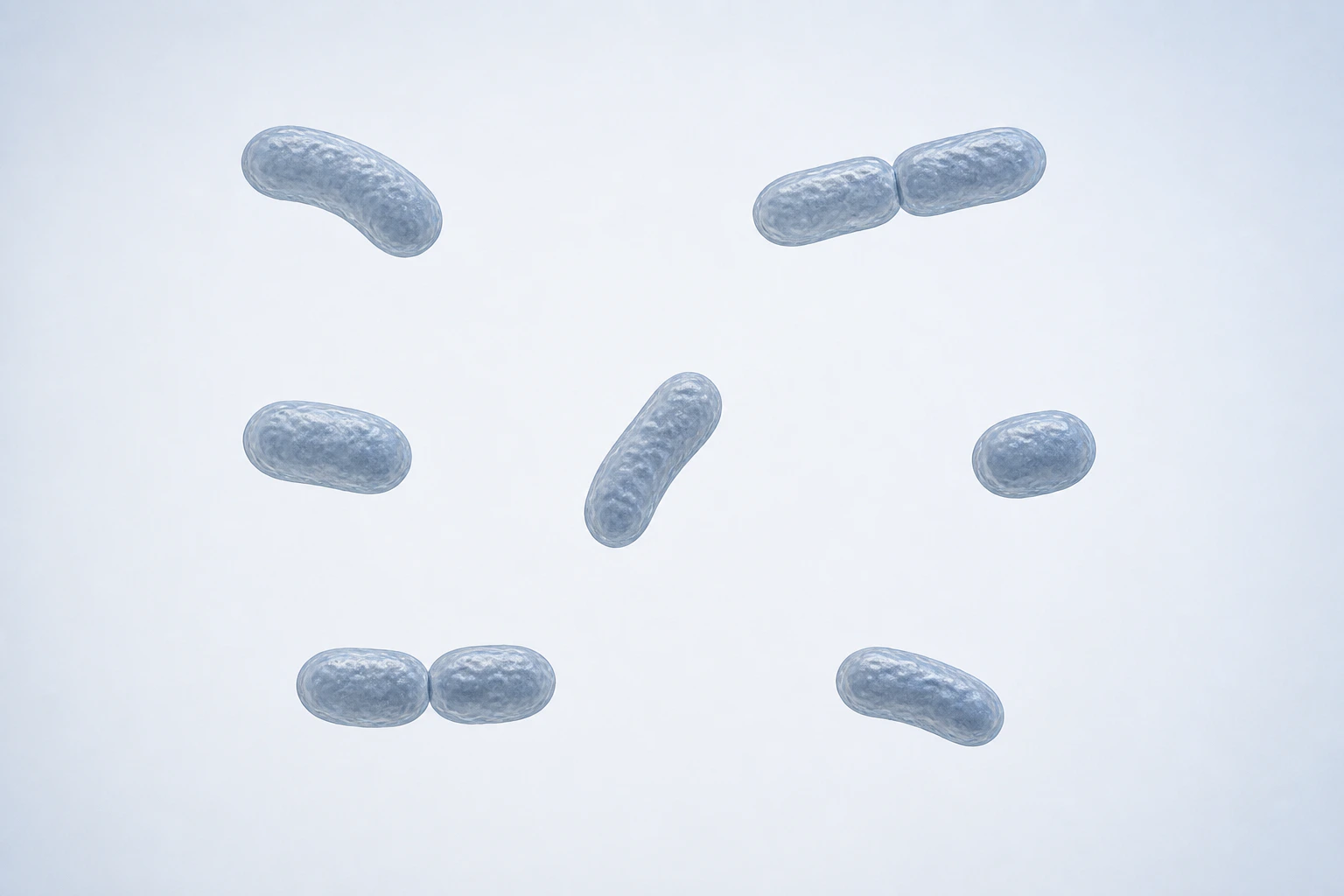
Selected type-species-anchored Collinsella short rod-to-coccobacillus forms, shown as nine bodies in seven groupings. This genus-level reconstruction is representative, non-exhaustive, non-diagnostic, and not a micrograph.
Scientific media record1 verified identifier
- Subject
- Collinsellataxon · genus
- Identifiers
- NCBITaxon:102106
- Review
- Editorial review completeIdentifiers authority-verified · Accessibility validated · · collinsella|collinsella-morphology-v1.webp
- Digital source
- Trained-algorithmic mediaCreated with a trained generative algorithm and reviewed by WikiBiome for subject identity, scientific framing, identifiers, provenance, and accessibility.
- Scientific basis
- Collinsella — NCBI TaxonomyCollinsella — LPSNCollinsella gen. nov.Collinsella gen. nov. primary descriptionCollinsella aerofaciens type strain — BacDive
- License
- CC BY-SA 4.0Created
A genus of Gram-positive, obligate anaerobic bacteria within the Actinobacteria phylum (family Coriobacteriaceae) that has emerged as a consistent pathobiont enriched in cardiometabolic and autoimmune diseases. C. aerofaciens is the most studied species, with established roles in bile acid deconjugation, increased gut permeability, and promotion of atherosclerosis.
Notably, Collinsella is one of the few genera enriched by heavy metal exposure across multiple metals.
Evidence map3 cited passagesInspect provenance +
Cardiovascular disease/atherosclerosis: one of the most consistently enriched taxa in CVD. Linked to arterial stiffness and carotid intima-media thickness. Part of the pro-atherogenic microbiome signature.
Autism spectrum disorder: enriched in ASD children alongside lactobacillus and Corynebacterium; associated with altered bile acid metabolism.
Collinsella is a shared pathobiont across multiple metal exposures—enriched by arsenic, lead, and mercury in human studies.
Contents
1. Mechanisms of Pathogenicity2. Disease Associations3. Heavy Metal Enrichment4. Key Metabolites5. ConnectionsMechanisms of Pathogenicity#
Bile Acid Deconjugation#
C. aerofaciens possesses potent bile salt hydrolase (BSH) activity, deconjugating primary bile acids. Altered bile acid profiles disrupt FXR signaling in the liver and intestine, reducing cholesterol excretion and promoting lipid accumulation.
Deconjugated bile acids are more readily converted to secondary bile acids (DCA, LCA) by other bacteria, compounds that are pro-inflammatory and potentially genotoxic in the colon.
Gut Barrier Disruption#
Collinsella increases intestinal permeability by downregulating tight junction proteins in colonocytes. Promotes a "leaky gut" state that enables LPS translocation and systemic Metal-Driven Inflammation—a direct pathway to atherosclerosis. Produces hydrogen and CO2 gas, contributing to bloating and GI discomfort.
Lipid and Cholesterol Metabolism#
Alters host cholesterol metabolism by reducing hepatic bile acid synthesis via disrupted FXR signaling. Associated with increased serum LDL-cholesterol and triglycerides. Reduces cholesterol excretion via altered bile acid cycling, contributing to hyperlipidemia.
Disease Associations#
Cardiovascular disease/atherosclerosis: one of the most consistently enriched taxa in CVD. Linked to arterial stiffness and carotid intima-media thickness.[1]Network of Interactions Between Gut Microbiome, Host Biomarkers, and Urine Metabolome in Carotid AtherosclerosisRui-Jun Li, Zhu-Ye Jie, Qiang Feng et al. · 2021Open reference 1 ↓ Part of the pro-atherogenic microbiome signature.[2]Gut macrobiotic and its metabolic pathways modulate cardiovascular diseaseJunwen Zhu, Jin Lyu, Ruochi Zhao et al. · 2023Open reference 2 ↓
Rheumatoid arthritis: enriched in RA patients; C. aerofaciens promotes Th17 polarization and increases gut permeability, potentially enabling molecular mimicry and autoimmune activation. Type 2 diabetes: enriched in T2D; associated with insulin resistance and altered glucose metabolism.
Autism spectrum disorder: enriched in ASD children alongside Lactobacillus and Corynebacterium; associated with altered bile acid metabolism.[3]Strati 2017 — New Evidences on the Altered Gut Microbiota in Autism Spectrum DisordersFrancesco Strati, Duccio Cavalieri, Davide Albanese et al. · 2017Open reference 3 ↓
Symptomatic atherosclerosis: enriched in patients with symptomatic vs asymptomatic carotid plaques.
Heavy Metal Enrichment#
Collinsella is a shared pathobiont across multiple metal exposures—enriched by Arsenic, Lead, and Mercury in human studies.[4]Rezazadegan et al. 2025 — Heavy Metals and Gut Microbiota: A Systematic ReviewFatemeh Rezazadegan, Maryam Mahmoudi, Seyed Mohammad Mousavi · 2025Open reference 4 ↓
This cross-metal enrichment pattern is unusual and suggests that Collinsella possesses inherent metal tolerance mechanisms or benefits from the ecological vacuum created when metal-sensitive commensals are depleted.
Metal-driven Collinsella expansion may represent a direct mechanistic link between environmental metal exposure and Cardiovascular Disease via bile acid dysregulation and barrier disruption. Depleted by Mediterranean diet interventions, which also reduce heavy metal bioavailability through chelation by polyphenols and fiber.
Key Metabolites#
Deconjugated bile acids—BSH-mediated deconjugation alters enterohepatic circulation. Hydrogen and CO2—gas production from carbohydrate fermentation. Lactate—minor fermentation product.
Connections#
- Cardiovascular Disease—enriched in CVD; promotes atherosclerosis via bile acids and barrier disruption
- Rheumatoid Arthritis—enriched; Th17 polarization and gut permeability
- Type 2 Diabetes—enriched; linked to insulin resistance
- Autism Spectrum Disorder—enriched in ASD children
- Arsenic—enriched by arsenic exposure
- Lead—enriched by lead exposure
- Mercury—enriched by mercury exposure
- Iron—indirectly relevant; may benefit from iron-driven depletion of competitors
- Dysbiosis—its enrichment signals pro-inflammatory dysbiosis
- inflammation—increases gut permeability and LPS translocation
- Gut-Metal-Microbiome Interactions—metal-tolerant pathobiont; cross-metal enrichment pattern
- Oxidative Stress—altered bile acid metabolism promotes oxidative damage
- Blautia—opposing trends; Blautia depleted where Collinsella enriched in CVD
References 5
Numbered by first appearance in the article, then reconciled with its declared source list.
- 1
Rui-Jun Li, Zhu-Ye Jie, Qiang Feng et al. (2021). Network of Interactions Between Gut Microbiome, Host Biomarkers, and Urine Metabolome in Carotid Atherosclerosis. Frontiers in Cellular and Infection Microbiology.
- 2
Junwen Zhu, Jin Lyu, Ruochi Zhao et al. (2023). Gut macrobiotic and its metabolic pathways modulate cardiovascular disease. Frontiers in Microbiology.
- 3
Francesco Strati, Duccio Cavalieri, Davide Albanese et al. (2017). Strati 2017 — New Evidences on the Altered Gut Microbiota in Autism Spectrum Disorders. Microbiome.
- 4
Fatemeh Rezazadegan, Maryam Mahmoudi, Seyed Mohammad Mousavi (2025). Rezazadegan et al. 2025 — Heavy Metals and Gut Microbiota: A Systematic Review. Journal of Health, Population and Nutrition.
- 5
Ameer Luqman, Adil Hassan, Mehtab Ullah et al. (2024). Role of the intestinal microbiome and its therapeutic intervention in cardiovascular disorder. Frontiers in Immunology.
Article network
Mentioned here 15
Pages linking here 16
Connect the evidence
Publicly readable discussion by ORCID-authenticated researchers. Questions, interpretation, methods, corrections, and new evidence stay attached to this record.
No discussion yet. Start with a precise question or a source-backed observation.
Activity and accepted changes
Accepted researcher context, editorial status, public discussion, and upstream Git revisions are shown together. Pending, declined, and withdrawn proposals remain private.
- published revision
Backfill inflammation concept links
Karen Pendergrass · +1 −1
Inspect exact Git diff ↗ - published revision
Complete Tight junctions contextual coverage
Karen Pendergrass · +1 −1
Inspect exact Git diff ↗ - published revision
massive wiki expansion: 149 stubs fixed, 100+ new pages, Rule 15 scan, keystone papers
WikiBiome Deploy Bot · +10 −10
Inspect exact Git diff ↗ - published revision
nightly maintenance: 94 stub demotions, 181 source_count fixes, 22 auto-discovered stubs, 5 adversarial audits, 3 boundary fixes, 3 evidence-level corrections
WikiBiome Deploy Bot · +1 −0
Inspect exact Git diff ↗ - published revision
WikiBiome update — 2026-04-15 17:23
WikiBiome Deploy Bot · +0 −1
Inspect exact Git diff ↗ - published revision
wiki: bulk entity upgrades, new article pages, and site regeneration
WikiBiome Deploy Bot · +6 −0
Inspect exact Git diff ↗ - published revision
WikiBiome update — integrity fixes, metallomic diet pages, cross-condition analyses
WikiBiome Deploy Bot · +10 −3
Inspect exact Git diff ↗ - published revision
WikiBiome update — 2026-04-10 13:49
WikiBiome Deploy Bot · +68 −0
Inspect exact Git diff ↗