
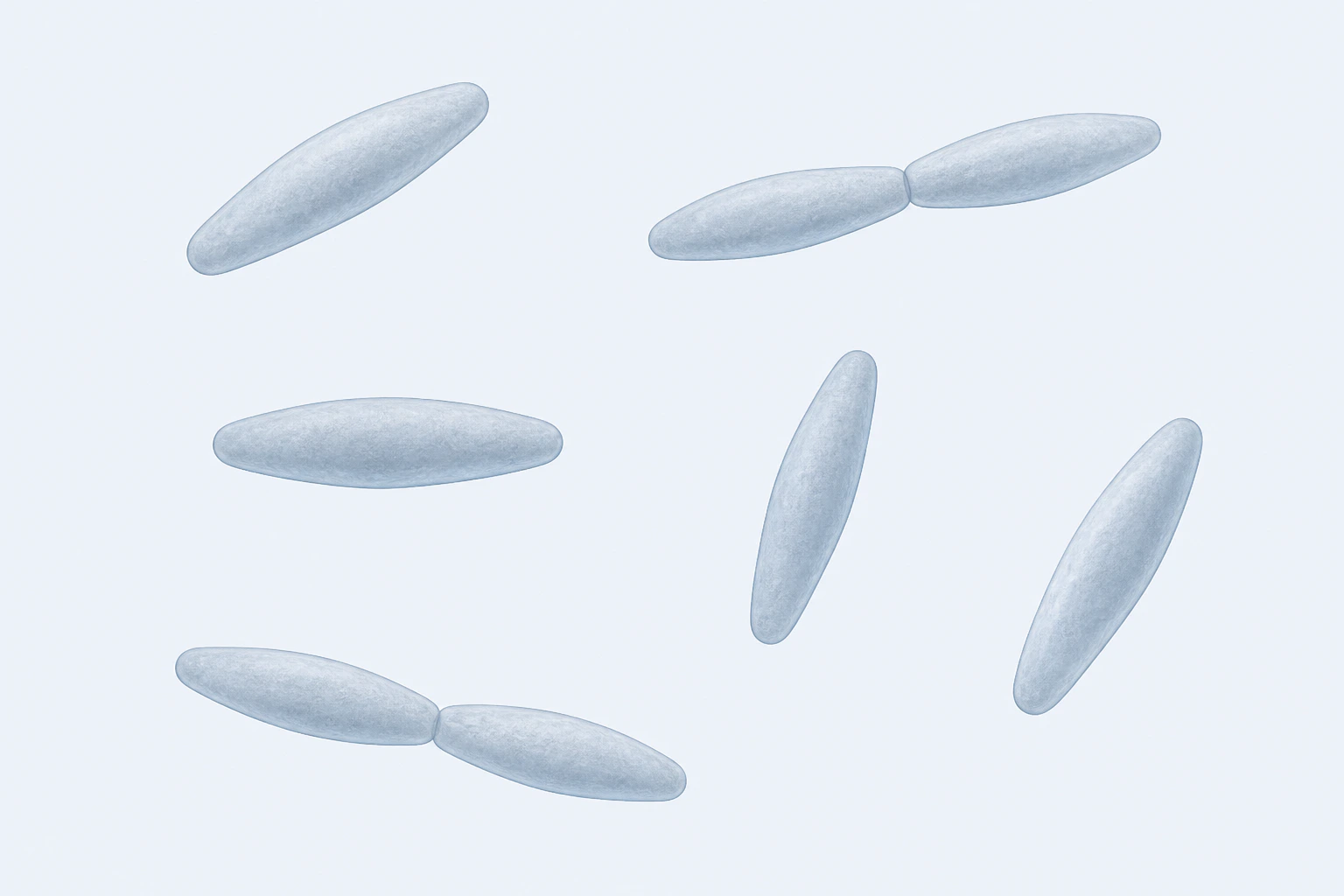
Representative Clostridium symbiosum cigar-to-lemon-shaped rod forms, shown as eight bodies in six single or paired groupings. This reconstruction is non-diagnostic, shows no visible spores or flagella, and is not a micrograph.
Scientific media record1 verified identifier
- Subject
- Clostridium symbiosumtaxon · species
- Identifiers
- NCBITaxon:1512
- Review
- Editorial review completeIdentifiers authority-verified · Accessibility validated · · clostridium-symbiosum|clostridium-symbiosum-morphology-v1.webp
- Digital source
- Trained-algorithmic mediaCreated with a trained generative algorithm and reviewed by WikiBiome for subject identity, scientific framing, identifiers, provenance, and accessibility.
- Scientific basis
- Clostridium symbiosum — NCBI TaxonomyClostridium symbiosum — LPSNClostridium symbiosum type strain — BacDiveTaxonomic study of Clostridium symbiosumClostridium symbiosum morphology record
- License
- CC BY-SA 4.0Created
Clostridium symbiosum is a Gram-positive, obligately anaerobic bacterium within the Clostridium cluster XIVa—a taxonomic group enriched for short-chain fatty acid (SCFA) producers and specialized bile acid metabolizers.
Despite its ambiguous name (suggesting symbiotic commensal status), C. symbiosum is dramatically enriched in colorectal cancer (CRC) across multiple studies of both young-onset and older-onset CRC patients (;[1]Consistent signatures in the human gut microbiome of old- and young-onset colorectal cancerYouwen Qin, Xin Tong, Wei-Jian Mei et al. · 2024Open reference 1 ↓[2]Multi-omic profiling reveals associations between the gut microbiome, host genome and transcriptome in patients with colorectal cancerShaomin Zou, Chao Yang, Jieping Zhang et al. · 2024Open reference 2 ↓), making it a core member of the oncogenic dysbiotic consortium alongside Fusobacterium nucleatum, Bacteroides fragilis, and Parvimonas micra ([3]Characteristics of the gut virome in patients with premalignant colorectal adenomaPan Zhang, Xiaofeng Tuo, Jiong Jiang et al. · 2025Open reference 3 ↓).
Its primary pathogenic role in CRC is secondary bile acid (DCA, LCA) production and conversion of primary bile acids into carcinogenic metabolites that promote colorectal epithelial Metal-Driven Inflammation and malignant transformation.
Evidence map5 cited passagesInspect provenance +
Clostridium symbiosum is a Gram-positive, obligately anaerobic bacterium within the Clostridium cluster XIVa—a taxonomic group enriched for short-chain fatty acid (SCFA) producers and specialized bile acid metabolizers. Despite its ambiguous name (suggesting symbiotic commensal status), C. symbiosum is dramatically enriched in colorectal cancer (CRC) acros
The 7α-dehydroxylase activity is the clinical hallmark of pathogenic bile acid metabolism in CRC (; ). C. symbiosum is one of the few species capable of complete PBA → SBA conversion, making it a bottleneck enzyme controller in the carcinogenic pathway ().
Secondary bile acids (DCA, LCA): Weak or antagonistic FXR signaling; instead activate TGR5 (G protein-coupled bile acid receptor 1), which can drive pro-inflammatory IL-23 production ().
Secondary bile acids increase reactive oxygen species (ROS) production in colonocytes and nearby inflammatory cells (; ).
| Population | C. symbiosum (% of microbiota) | Notes | |------------|----------------------------------|-------| | Healthy adults | 0.5–2% | Low abundance; part of normal Clostridium XIVa diversity () | | Adenoma patients (pre-CRC) | 2–5% | Elevated; enrichment correlates with polyp burden () | | CRC patients (incident) | 5–15% | Dramatically enriched; core
Contents
1. Taxonomy and Basic Properties2. Bile Acid Metabolism and Iron Dependence3. Secondary Bile Acid (DCA, LCA) Pathogenic Mechanisms in CRC4. Role in Colorectal Cancer Dysbiosis5. Butyrate Production: Beneficial or Pathogenic Context?6. Detection and Quantification7. Typical Abundance Ranges8. Connections to WikiBiome Entities and Disease Signatures9. Clinical and Intervention Implications (Cureva Layer)Taxonomy and Basic Properties#
- Phylum: Firmicutes
- Class: Clostridia
- Order: Clostridiales
- Family: Clostridiaceae
- Taxon: Clostridium symbiosum (reclassified as Oscillibacter symbiosus in recent genomic studies, but still referred to as C. symbiosum in clinical literature)
- Cell Type: Rod-shaped, anaerobic bacterium
- Gram Stain: Positive (thick peptidoglycan cell wall; endospore-forming)
- Flagella: Motile; peritrichous flagellation
- Genome: ~4.2 Mb (complete genome available)
- Spore Formation: Yes; produces dormant spores enabling environmental persistence
Bile Acid Metabolism and Iron Dependence#
Bile Acid Deconjugation and Conversion Pathway#
C. symbiosum specializes in primary bile acid (PBA) → secondary bile acid (SBA) conversion:
`` Cholesterol (liver) → Cholic Acid (CA) / Chenodeoxycholic Acid (CDCA) [Primary Bile Acids] ↓ (bile secretion into duodenum) [bacterial enzymatic conversion] CA → Deoxycholic Acid (DCA) [Secondary Bile Acid] CDCA → Lithocholic Acid (LCA) [Secondary Bile Acid] ``
Key Bile Acid Metabolizing Enzymes#
| Enzyme | Function | Product | Pathogenic Role |
|---|---|---|---|
| Bile Salt Hydrolase (BSH) | Hydrolyzes conjugated bile acids (glycine/taurine linkage) | Deconjugated PBA | First step; common in gut bacteria |
| 7α-Dehydroxylase (7α-DH) | Removes hydroxyl at C7 position of deconjugated PBA | Secondary bile acids (DCA, LCA) | Critical CRC driver; unique to few taxa including C. symbiosum |
| β-Glucuronidase | Deconjugates excreted estrogens (relevant to hormone-dependent cancers) | Free estrogens | Estrogen recirculation; secondary effect |
The 7α-dehydroxylase activity is the clinical hallmark of pathogenic bile acid metabolism in CRC (;[4]Secondary bile acids: an underrecognized cause of colon cancerHana Ajouz, Deborah Mukherji, Ali Shamseddine · 2014Open reference 4 ↓[5]Rezen et al. 2022 — The Role of Bile Acids in CarcinogenesisRezen T, Rozman D, Kovacs T et al. · 2022Open reference 5 ↓).
C. symbiosum is one of the few species capable of complete PBA → SBA conversion, making it a bottleneck enzyme controller in the carcinogenic pathway ([6]Bile acid: a potential inducer of colon cancer stem cellsLulu Farhana, Pratima Nangia-Makker, Evan Arbit et al. · 2016Open reference 6 ↓).
Iron Dependency#
- C. symbiosum is obligately iron-dependent; requires iron(II) (Fe2+)/iron(III) for:
- Cytochrome b5 and cytochrome c oxidases (anaerobic electron transport chains)
- Iron-sulfur cluster proteins ([4Fe-4S] in fumarase, dehydratases)
- Non-heme iron enzymes (catalases, peroxidases for Oxidative Stress tolerance)
- Iron availability is a rate-limiting factor for C. symbiosum growth in the CRC microenvironment.
- Elevated hepcidin (host iron-withholding defense) suppresses C. symbiosum; conversely, iron supplementation selectively enriches it.
- Siderophore production: Does not secrete siderophores; relies on scavenging ferrous iron or competing for transferrin-bound iron.
Secondary Bile Acid (DCA, LCA) Pathogenic Mechanisms in CRC#
Farnesoid X Receptor (FXR) Signaling Disruption#
Primary bile acids (CA, CDCA): Potent FXR agonists; activate protective anti-inflammatory signaling in colonocytes and hepatocytes.
Secondary bile acids (DCA, LCA): Weak or antagonistic FXR signaling; instead activate TGR5 (G protein-coupled bile acid receptor 1), which can drive pro-inflammatory IL-23 production ([5]Rezen et al. 2022 — The Role of Bile Acids in CarcinogenesisRezen T, Rozman D, Kovacs T et al. · 2022Open reference 5 ↓).
C. symbiosum-driven PBA → SBA conversion reduces FXR signaling, disrupting the colonocyte's ability to maintain tight junctions and produce anti-inflammatory IL-22.
NF-κB Activation and Epithelial Inflammation#
DCA and LCA are ligands for nuclear hormone receptor CAR (Constitutive Androstane Receptor). CAR activation → NF-κB activation → pro-inflammatory cytokine expression (IL-6, TNF-α, IL-1β). Chronic epithelial inflammation → increased DNA damage, aberrant crypt formation, and polyp development.
This is distinct from the acute inflammation of infectious diarrhea; C. symbiosum drives chronic, smoldering dysbiotic inflammation.
DNA Damage and Genotoxicity#
Secondary bile acids increase reactive oxygen species (ROS) production in colonocytes and nearby inflammatory cells (;[4]Secondary bile acids: an underrecognized cause of colon cancerHana Ajouz, Deborah Mukherji, Ali Shamseddine · 2014Open reference 4 ↓[6]Bile acid: a potential inducer of colon cancer stem cellsLulu Farhana, Pratima Nangia-Makker, Evan Arbit et al. · 2016Open reference 6 ↓).
ROS → DNA adducts, double-strand breaks, and activation of p53-dependent apoptosis or senescence. Over years, repeated DNA damage → somatic mutations in APC, KRAS, TP53 → adenoma-to-carcinoma progression.
Role in Colorectal Cancer Dysbiosis#
CRC Consortium Members#
C. symbiosum does not act in isolation. The CRC microbiome enriches a pathogenic consortium:
| Taxon | Primary Role | Synergy with C. symbiosum |
|---|---|---|
| Parvimonas micra | Oral pathogen; adhesion, biofilm nucleation | Biofilm co-aggregation; iron scavenging |
| Peptostreptococcus stomatis | Oral pathogen; colibactin genotoxin (pks+ operon) | DCA/LCA-driven inflammation amplifies DNA damage |
| Fusobacterium nucleatum | Adhesin-mediated epithelial invasion; immune evasion | Biofilm integration; reduces oxygen availability |
| Bacteroides fragilis (especially toxigenic BFT+ strains) | BFT toxin → epithelial damage, barrier disruption | DCA/LCA disrupts barrier repair; promotes LPS translocation |
| Escherichia coli (pks+, AIEC strains) | Colibactin genotoxin; LPS endotoxemia | Iron piracy; DCA/LCA promotes AIEC growth |
Ecological Context: Iron-Rich, Anaerobic, Mucosa-Proximal#
C. symbiosum thrives in the CRC dysbiotic environment. Chronic inflammation → increased hepcidin → functional iron anemia → host attempts to restore iron → iron supplementation or iron-containing therapies → Iron enrichment.
Reduced oxygen (biofilm-driven anaerobiosis) → suppression of aerobes and facultative aerobes; C. symbiosum dominates as obligate anaerobe. Mucosa-proximity: CRC lesions often develop from mucosal biofilms; C. symbiosum + other pathogens aggregate at the epithelial-luminal interface.
Dysbiotic competition: Loss of Faecalibacterium prausnitzii and Butyrate producers → ecological vacuum filled by C. symbiosum.
Butyrate Production: Beneficial or Pathogenic Context?#
C. symbiosum does produce butyrate via acetyl-CoA C-acetyltransferase (normal fermentation pathway):
`` Glucose → Pyruvate → Acetyl-CoA + Butyrate (via butyrate-CoA transferase) ``
However, in CRC:
- Butyrate becomes muted due to:
- Low substrate availability (Dysbiosis reduces total microbial fermentation)
- Low pH microenvironment (lactic acid bacteria dominance; pH < 6) suppresses butyrate synthesis
- Epithelial hypoxia-inducible factor (HIF) signaling disrupts butyrate sensing (GPR43/GPR109A)
- The pathogenic SBA metabolism outweighs the beneficial butyrate effect—net result is inflammation, not protection.
This is a critical distinction: C. symbiosum in a healthy, diverse microbiome (with competing bacteria and intact butyrate pathways) may be relatively benign; in CRC dysbiosis, its bile acid metabolism becomes a major risk factor.
Detection and Quantification#
Molecular Methods#
16S rRNA gene sequencing: Clostridium cluster XIVa-specific primers (e.g., targeting CPE regions); C. symbiosum is distinct from other Clostridium spp. Shotgun metagenomics: C. symbiosum genome is well-sequenced; read abundance correlates with species-level detection. qPCR: Species-specific 16S assays; typical abundance in CRC: 10^7–10^9 copies/g feces.
Functional Assays#
Bile acid deconjugation assay: Incubate fecal sample with conjugated PBA; measure 7α-DH activity via HPLC/LC-MS detection of DCA/LCA.
Secondary bile acid quantification: Fecal secondary bile acid levels (via mass spectrometry) are a functional biomarker for C. symbiosum and related bile acid metabolizers.
Typical Abundance Ranges#
| Population | C. symbiosum (% of microbiota) | Notes |
|---|---|---|
| Healthy adults | 0.5–2% | Low abundance; part of normal Clostridium XIVa diversity ([7]Stool Microbiome and Metabolome Differences between Colorectal Cancer Patients and Healthy AdultsTiffany L Weir, Daniel K Manter, Amy M Sheflin et al. · 2013Open reference 7 ↓) |
| Adenoma patients (pre-CRC) | 2–5% | Elevated; enrichment correlates with polyp burden ([3]Characteristics of the gut virome in patients with premalignant colorectal adenomaPan Zhang, Xiaofeng Tuo, Jiong Jiang et al. · 2025Open reference 3 ↓) |
| CRC patients (incident) | 5–15% | Dramatically enriched; core CRC consortium member (;[1]Consistent signatures in the human gut microbiome of old- and young-onset colorectal cancerYouwen Qin, Xin Tong, Wei-Jian Mei et al. · 2024Open reference 1 ↓[2]Multi-omic profiling reveals associations between the gut microbiome, host genome and transcriptome in patients with colorectal cancerShaomin Zou, Chao Yang, Jieping Zhang et al. · 2024Open reference 2 ↓) |
| Advanced CRC (stage III/IV) | 8–20% | Even higher in metastatic disease ([2]Multi-omic profiling reveals associations between the gut microbiome, host genome and transcriptome in patients with colorectal cancerShaomin Zou, Chao Yang, Jieping Zhang et al. · 2024Open reference 2 ↓) |
| Post-polypectomy (surveillance) | Slowly declines | Returns toward healthy levels over 1–2 years if protective interventions instituted |
Connections to WikiBiome Entities and Disease Signatures#
– Primary substrate; C. symbiosum converts PBA to pathogenic SBA. (DCA, LCA) – Direct product; pro-inflammatory and carcinogenic. – Key C. symbiosum product; drives CRC progression.
– Minor secondary bile acid produced by C. symbiosum. Iron – Absolute requirement; iron supplementation selectively enriches C. symbiosum. Hepcidin – Host iron-withholding defense; suppresses C. symbiosum.
inflammation – DCA/LCA-driven chronic inflammation; NF-κB activation. Colorectal Cancer – Dramatically enriched in CRC; core driver taxon; member of oncogenic consortium. dysbiosis – Enriched in dysbiotic CRC microbiota; suppressed in healthy, butyrate-dominated microbiota.
Faecalibacterium prausnitzii – Inverse relationship; F. prausnitzii suppression allows C. symbiosum expansion. Parvimonas micra – cobalt (Co)-enriched in CRC; biofilm partner. Fusobacterium nucleatum – cobalt-enriched in CRC; synergistic inflammation.
Bacteroides fragilis – cobalt-enriched (especially toxigenic strains); synergistic barrier disruption.
Clinical and Intervention Implications (Cureva Layer)#
Though not detailed in WikiBiome, practitioners note. Bile acid sequestrants (e.g., cholestyramine, colesevelam) bind DCA/LCA in the gut lumen, reducing colonic reabsorption and suppressing C. symbiosum-dependent inflammation. Ursodeoxycholic acid (UDCA) supplementation restores FXR-protective signaling, partially counteracting C. symbiosum-driven SBA metabolism.
Iron restriction (diet, phlebotomy for iron overload) can suppress C. symbiosum; conversely, iron supplementation should be cautious in CRC-risk patients. Butyrate-producing probiotic restoration (e.g., Faecalibacterium prausnitzii, resistant starch feeding) can outcompete C. symbiosum through ecological replacement.
Clostridium symbiosum exemplifies how a "normal" butyrate-producing Clostridium becomes pathogenic in the specific ecological context of CRC dysbiosis, driven by its bile acid metabolizing enzymes and iron dependencies.
References 7
Numbered by first appearance in the article, then reconciled with its declared source list.
- 1
Youwen Qin, Xin Tong, Wei-Jian Mei et al. (2024). Consistent signatures in the human gut microbiome of old- and young-onset colorectal cancer. Nature Communications.
- 2
Shaomin Zou, Chao Yang, Jieping Zhang et al. (2024). Multi-omic profiling reveals associations between the gut microbiome, host genome and transcriptome in patients with colorectal cancer. Journal of Translational Medicine.
- 3
Pan Zhang, Xiaofeng Tuo, Jiong Jiang et al. (2025). Characteristics of the gut virome in patients with premalignant colorectal adenoma. Journal of Translational Medicine.
- 4
Hana Ajouz, Deborah Mukherji, Ali Shamseddine (2014). Secondary bile acids: an underrecognized cause of colon cancer. World Journal of Surgical Oncology.
- 5
Rezen T, Rozman D, Kovacs T et al. (2022). Rezen et al. 2022 — The Role of Bile Acids in Carcinogenesis. Cellular and Molecular Life Sciences.
- 6
Lulu Farhana, Pratima Nangia-Makker, Evan Arbit et al. (2016). Bile acid: a potential inducer of colon cancer stem cells. Stem Cell Research & Therapy.
- 7
Tiffany L Weir, Daniel K Manter, Amy M Sheflin et al. (2013). Stool Microbiome and Metabolome Differences between Colorectal Cancer Patients and Healthy Adults. PLoS ONE.
Article network
Mentioned here 14
Pages linking here 4
Connect the evidence
Publicly readable discussion by ORCID-authenticated researchers. Questions, interpretation, methods, corrections, and new evidence stay attached to this record.
No discussion yet. Start with a precise question or a source-backed observation.
Activity and accepted changes
Accepted researcher context, editorial status, public discussion, and upstream Git revisions are shown together. Pending, declined, and withdrawn proposals remain private.
- published revision
Backfill oxidative stress concept links
Karen Pendergrass · +1 −1
Inspect exact Git diff ↗ - published revision
Backfill inflammation concept links
Karen Pendergrass · +2 −2
Inspect exact Git diff ↗ - published revision
Complete corpus-wide Dysbiosis linking
Karen Pendergrass · +2 −2
Inspect exact Git diff ↗ - published revision
Complete Tight junctions contextual coverage
Karen Pendergrass · +1 −1
Inspect exact Git diff ↗ - published revision
massive wiki expansion: 149 stubs fixed, 100+ new pages, Rule 15 scan, keystone papers
WikiBiome Deploy Bot · +63 −63
Inspect exact Git diff ↗ - published revision
nightly maintenance: 94 stub demotions, 181 source_count fixes, 22 auto-discovered stubs, 5 adversarial audits, 3 boundary fixes, 3 evidence-level corrections
WikiBiome Deploy Bot · +1 −0
Inspect exact Git diff ↗ - published revision
Deep content + citation pass: 10 entities enriched, 7 new sources, DOI integrity
WikiBiome Deploy Bot · +9 −9
Inspect exact Git diff ↗ - published revision
WikiBiome update — 2026-04-15 17:23
WikiBiome Deploy Bot · +13 −13
Inspect exact Git diff ↗ - published revision
wiki: bulk entity upgrades, new article pages, and site regeneration
WikiBiome Deploy Bot · +6 −0
Inspect exact Git diff ↗ - published revision
WikiBiome update — integrity fixes, metallomic diet pages, cross-condition analyses
WikiBiome Deploy Bot · +20 −18
Inspect exact Git diff ↗ - published revision
WikiBiome update — 2026-04-10 17:16
WikiBiome Deploy Bot · +177 −0
Inspect exact Git diff ↗