
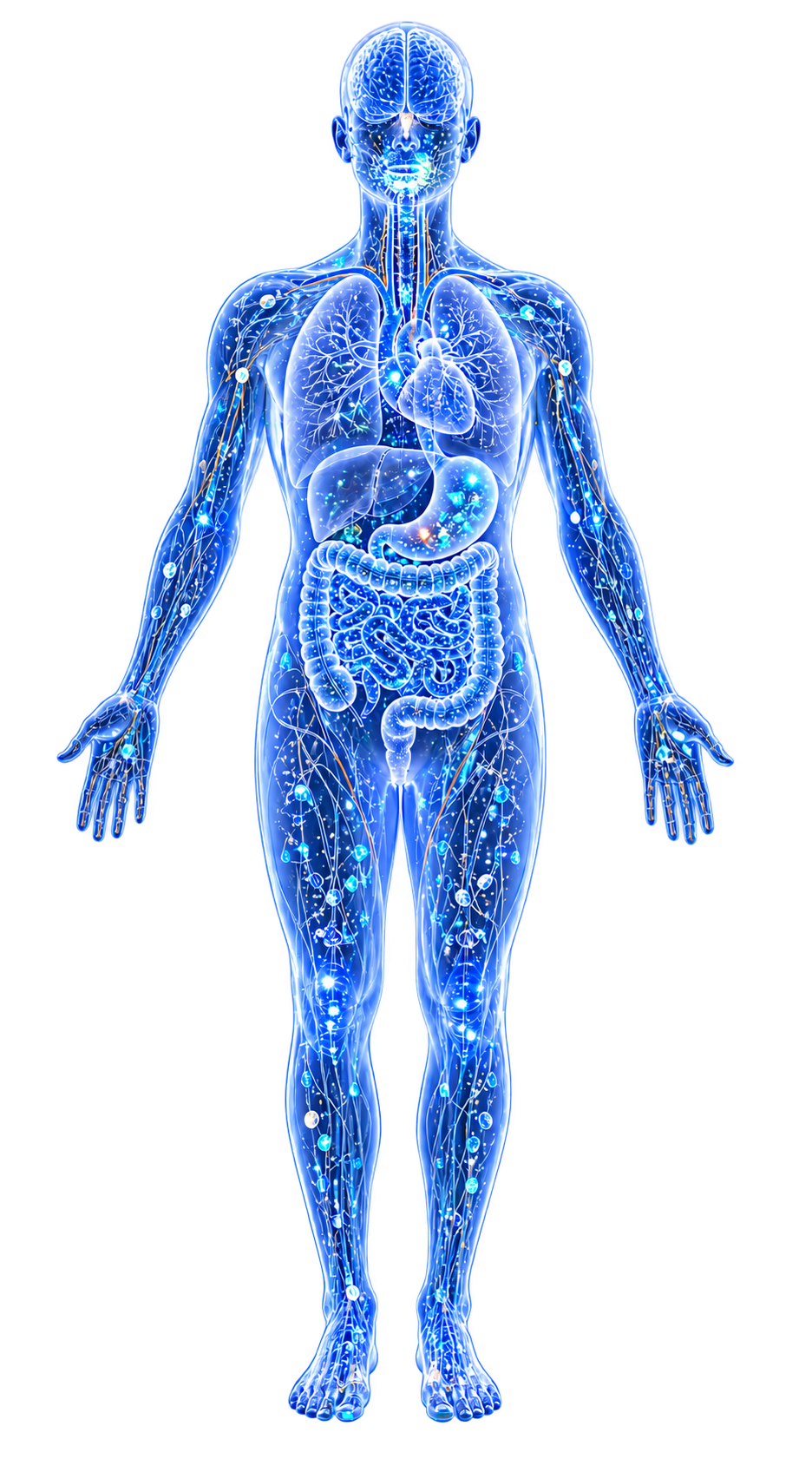
The master regulator of systemic iron homeostasis. Hepcidin is a 25-amino-acid peptide hormone produced primarily by hepatocytes that controls iron absorption, recycling, and distribution by binding to and degrading ferroportin (SLC40A1/FPN)—the only known cellular iron exporter.
Understanding hepcidin is essential for interpreting the iron supplementation paradox that recurs across multiple disease contexts in this wiki.
Evidence map6 cited passagesInspect provenance +
Hepcidin binds ferroportin on the surface of enterocytes, macrophages, and hepatocytes, triggering its internalization and degradation.
Unabsorbed oral iron reaches the colon, where it feeds siderophore-producing Enterobacteriaceae and disrupts the gut microbiome.
Vaginal lactoferrin concentrations positively correlate with serum hepcidin levels, suggesting coordinated systemic and mucosal iron restriction during infection.
Hepcidin accumulates in CKD due to reduced renal clearance and chronic inflammation, contributing to the anemia of CKD and functional iron deficiency.
Disruption of the hepcidin-ferroportin axis in the brain contributes to regional iron accumulation (substantia nigra in PD, hippocampus in AD), increasing ferroptosis vulnerability.
Hepcidin dysregulation has been documented in autoimmune thyroid disease, linking iron homeostasis to thyroid function.
Contents
1. Mechanism of Action2. Hepcidin and Nutritional Immunity3. Hepcidin in Disease Contexts4. Clinical Significance5. ConnectionsMechanism of Action#
The Hepcidin-Ferroportin Axis#
Hepcidin binds ferroportin on the surface of enterocytes, macrophages, and hepatocytes, triggering its internalization and degradation.[1]Mechanism of Iron Ion Homeostasis in Intestinal Immunity and Gut Microbiota RemodelingHonghong Bao, Yi Wang, Hanlin Xiong et al. · 2024Open reference 1 ↓
When hepcidin is high: ferroportin is destroyed, iron is trapped inside cells, serum iron falls. When hepcidin is low: ferroportin is expressed, iron flows into plasma from dietary absorption and macrophage recycling.
Regulation#
Iron excess upregulates hepcidin via the BMP-SMAD pathway (bone morphogenetic protein signaling). Metal-Driven Inflammation upregulates hepcidin via IL-6/JAK-STAT3 signaling—this is the basis of anemia of chronic disease. Iron deficiency and erythropoietic demand suppress hepcidin to increase iron availability.
Hypoxia suppresses hepcidin via HIF signaling.
Hepcidin and Nutritional Immunity#
Elevated hepcidin during infection represents the host INTENTIONALLY restricting iron availability—a key arm of Nutritional Immunity (Metal Sequestration). This has profound clinical implications:
The Iron Supplementation Paradox#
In inflammatory states (IBD, chronic infection, autoimmune disease), hepcidin is elevated and serum iron/ferritin may appear low. Clinicians interpret low iron markers as deficiency and prescribe iron supplementation.
However, high hepcidin means supplemental iron is poorly absorbed (blocked at the enterocyte) and what IS absorbed may feed iron-requiring pathogens rather than reaching the host's erythroid compartment.
Unabsorbed oral iron reaches the colon, where it feeds siderophore-producing Enterobacteriaceae and disrupts the Gut Microbiome.[1]Mechanism of Iron Ion Homeostasis in Intestinal Immunity and Gut Microbiota RemodelingHonghong Bao, Yi Wang, Hanlin Xiong et al. · 2024Open reference 1 ↓
Infection Context#
Hepcidin elevation during infection is part of a coordinated host defense that includes Lactoferrin (iron sequestration at mucosal surfaces), ferritin (intracellular iron storage), and transferrin (limiting free plasma iron).
Vaginal lactoferrin concentrations positively correlate with serum hepcidin levels, suggesting coordinated systemic and mucosal iron restriction during infection.[2]Mucosal lactoferrin response to genital tract infections is associated with iron and nutritional biomarkers in young Burkinabe womenRoberts SA, Brabin L, Diallo S et al. · 2019Open reference 2 ↓
Hepcidin in Disease Contexts#
Chronic Kidney Disease#
Hepcidin accumulates in CKD due to reduced renal clearance and chronic inflammation, contributing to the anemia of CKD and functional iron deficiency.[3]Molecular Mechanisms of Cellular Injury and Role of Toxic Heavy Metals in Chronic Kidney DiseaseManish Mishra, Larry Nichols, Aditi A. Dave et al. · 2022Open reference 3 ↓
Iron supplementation in CKD patients with elevated hepcidin may be ineffective or harmful.
Neurodegeneration#
- Disruption of the hepcidin-ferroportin axis in the brain contributes to regional iron accumulation (substantia nigra in PD, hippocampus in AD), increasing Ferroptosis vulnerability.[4]Microbial Metallomics and Parkinson's Disease: A Unified Metal-Driven Framework Linking Ferroptosis, Dysbiosis, and alpha-Synuclein PathologyKaren Pendergrass · 2025Open reference 4 ↓
Thyroid Disease#
- Hepcidin dysregulation has been documented in autoimmune thyroid disease, linking iron homeostasis to thyroid function.[5]Effects of Trace Elements on Endocrine Function and Pathogenesis of Thyroid Diseases — A Literature ReviewBrylinski L, Kostelecka K, Wolinski F et al. · 2025Open reference 5 ↓
Clinical Significance#
Hepcidin-guided iron assessment has been proposed as a way to distinguish functional iron withholding from true deficiency: supplementing iron when hepcidin is high is at best ineffective and at worst feeds pathogens and worsens Dysbiosis. This distinction is not reflected in standard iron panels, which do not include hepcidin measurement.
Connections#
- Iron—hepcidin is the master regulator of iron homeostasis
- Nutritional Immunity (Metal Sequestration)—hepcidin-mediated iron restriction is a core host defense
- Ferroptosis—hepcidin dysregulation contributes to iron-driven cell death
- Lactoferrin—coordinated mucosal iron restriction
- Gut-Metal-Microbiome Interactions—unabsorbed iron from supplementation feeds pathobionts
References 6
Numbered by first appearance in the article, then reconciled with its declared source list.
- 1
★Honghong Bao, Yi Wang, Hanlin Xiong et al. (2024). Mechanism of Iron Ion Homeostasis in Intestinal Immunity and Gut Microbiota Remodeling. International Journal of Molecular Sciences.
- 2
Roberts SA, Brabin L, Diallo S et al. (2019). Mucosal lactoferrin response to genital tract infections is associated with iron and nutritional biomarkers in young Burkinabe women. European Journal of Clinical Nutrition.
- 3
★Manish Mishra, Larry Nichols, Aditi A. Dave et al. (2022). Molecular Mechanisms of Cellular Injury and Role of Toxic Heavy Metals in Chronic Kidney Disease. International Journal of Molecular Sciences.
- 4
★Karen Pendergrass (2025). Microbial Metallomics and Parkinson's Disease: A Unified Metal-Driven Framework Linking Ferroptosis, Dysbiosis, and alpha-Synuclein Pathology. Conference Presentation.
- 5
★Brylinski L, Kostelecka K, Wolinski F et al. (2025). Effects of Trace Elements on Endocrine Function and Pathogenesis of Thyroid Diseases — A Literature Review. Nutrients.
- 6
★Robert J. Maier, Stéphane L. Benoit (2019). Role of Nickel in Microbial Pathogenesis. Inorganics.
Article network
Mentioned here 8
Pages linking here 48
Connect the evidence
Publicly readable discussion by ORCID-authenticated researchers. Questions, interpretation, methods, corrections, and new evidence stay attached to this record.
No discussion yet. Start with a precise question or a source-backed observation.
Activity and accepted changes
Accepted researcher context, editorial status, public discussion, and upstream Git revisions are shown together. Pending, declined, and withdrawn proposals remain private.
- published revision
Backfill gut microbiome concept links
Karen Pendergrass · +1 −1
Inspect exact Git diff ↗ - published revision
Backfill inflammation concept links
Karen Pendergrass · +1 −1
Inspect exact Git diff ↗ - published revision
Complete corpus-wide Dysbiosis linking
Karen Pendergrass · +1 −1
Inspect exact Git diff ↗ - published revision
massive wiki expansion: 149 stubs fixed, 100+ new pages, Rule 15 scan, keystone papers
WikiBiome Deploy Bot · +4 −4
Inspect exact Git diff ↗ - published revision
nightly maintenance: 94 stub demotions, 181 source_count fixes, 22 auto-discovered stubs, 5 adversarial audits, 3 boundary fixes, 3 evidence-level corrections
WikiBiome Deploy Bot · +1 −0
Inspect exact Git diff ↗ - published revision
semantic integrity pass: boundary fixes, 10 interventions, 31 STOPs, 2 supersessions, keystone revalidation
WikiBiome Deploy Bot · +1 −1
Inspect exact Git diff ↗ - published revision
pre-overnight checkpoint 2026-04-18
WikiBiome Deploy Bot · +3 −1
Inspect exact Git diff ↗ - published revision
WikiBiome update — 2026-04-15 17:23
WikiBiome Deploy Bot · +0 −1
Inspect exact Git diff ↗ - published revision
WikiBiome update — integrity fixes, metallomic diet pages, cross-condition analyses
WikiBiome Deploy Bot · +13 −6
Inspect exact Git diff ↗ - published revision
WikiBiome v7 — interactive microbiome metallomics encyclopedia
Karen Pendergrass · +63 −0
Inspect exact Git diff ↗