

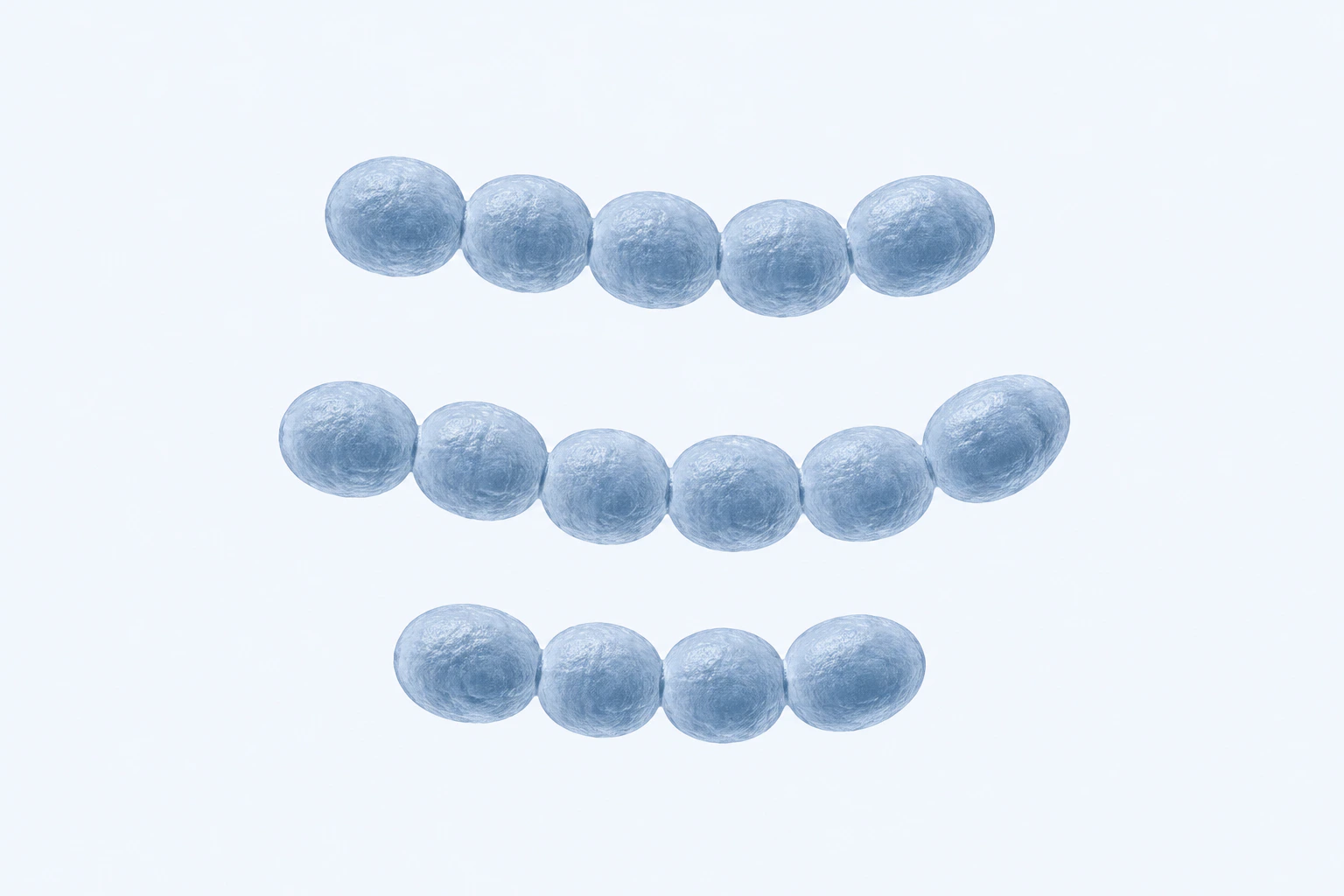
Type-strain-anchored Streptococcus agalactiae reconstruction with fifteen cocci in three chains. Representative, non-diagnostic, and not a micrograph; capsule and hemolysis are not depicted.
Scientific media record1 verified identifier
- Subject
- Streptococcus agalactiaetaxon · species
- Identifiers
- NCBITaxon:1311
- Review
- Editorial review completeIdentifiers authority-verified · Accessibility validated · · streptococcus-agalactiae|streptococcus-agalactiae-morphology-v1.webp
- Digital source
- Trained-algorithmic mediaCreated with a trained generative algorithm and reviewed by WikiBiome for subject identity, scientific framing, identifiers, provenance, and accessibility.
- Scientific basis
- Streptococcus agalactiae — NCBI TaxonomyStreptococcus agalactiae — LPSNStreptococcus — Medical Microbiology
- License
- CC BY-SA 4.0Created
Streptococcus agalactiae, also known as Group B Streptococcus (GBS), is a Gram-positive, facultatively anaerobic coccus that exists in two clinical contexts: (1) as a major neonatal pathogen causing life-threatening meningitis and sepsis in newborns, and (2) as an enriched dysbiotic pathobiont in Endometriosis and other estrogen-dependent conditions.
The latter role is less well-recognized but epidemiologically significant: GBS is enriched in the reproductive tract and distal gut of endometriosis patients and may contribute to disease pathogenesis through zinc-dependent metallopeptidase secretion, beta-glucuronidase activity driving estrogen recirculation, and biofilm formation that promotes chronic Metal-Driven Inflammation and Dysbiosis.
Its zinc and manganese dependencies and roles in metal-dependent virulence make it a key Cureva/WikiBiome entity.
Evidence map7 cited passagesInspect provenance +
S. agalactiae is enriched in the reproductive tract microbiota of endometriosis patients (;; ).
Key point: All of these virulence factors require bioavailable zinc (). Zinc deprivation—either from dietary insufficiency, host metallothionein sequestration, or systemic inflammation—reduces GBS virulence and slows disease progression (; ).
S. agalactiae produces Mn-superoxide dismutase (MnSOD; also called Mn-dependent SOD) for antioxidant defense ().
MnSOD is essential for intracellular survival within macrophages and neutrophils (where ROS is the primary killing mechanism) ().
Manganese deficiency impairs MnSOD synthesis → weakened intracellular survival → easier clearance by phagocytes ().
Enriched in reproductive tract microbiota: GBS abundance correlates with endometriosis severity score (; ).
Elevated in peritoneal fluid: In some endometriosis patients with active peritoneal inflammation ().
Contents
1. Taxonomy and Basic Properties2. Epidemiology: Commensal and Pathogen3. Zinc-Dependent Metallopeptidases and Virulence4. Beta-Glucuronidase and Estrogen Recirculation5. Manganese and Iron Dependencies6. Biofilm Formation and Intracellular Persistence7. Disease Associations8. Detection and Quantification9. Typical Abundance Ranges10. Connections to WikiBiome Entities and Disease Signatures11. Zinc and Endometriosis Intervention Implications (Cureva Layer)Taxonomy and Basic Properties#
- Phylum: Firmicutes
- Class: Bacilli
- Order: Bacillales
- Family: Streptococcaceae
- Genus: Streptococcus
- Species: Streptococcus agalactiae (Lancefield Group B)
- Cell Type: Spherical coccus; arranged in chains (characteristic of Streptococcus genus)
- Gram Stain: Positive (thick peptidoglycan; no outer membrane)
- Oxygen Requirement: Facultative anaerobe; prefers aerobic but survives anaerobically
- Cell Size: 0.6–1.0 µm diameter
- Genome: ~2.1 Mb (multiple strains sequenced; high genomic variability)
- Spore Formation: No
- Motility: Non-motile; lacks flagella
Epidemiology: Commensal and Pathogen#
Neonatal Infection (Classic Role)#
S. agalactiae colonizes the lower genital tract and rectum in 10–30% of pregnant women (depending on geography and ethnicity; Verani et al. 2010 CDC guidelines). During vaginal delivery, newborns are exposed to GBS in amniotic fluid or birth canal secretions.
If mother is colonized and infant is not treated with intrapartum antibiotic prophylaxis (IAP). Early-onset GBS (EOB) disease: Occurs in 1–2 per 1000 live births (pre-IAP era; now <0.5/1000 with universal screening + penicillin G prophylaxis; Verani et al. 2010 CDC; Schrag et al.
2000 NEJM).
Neonatal sepsis: Fever, hypotension, multi-organ failure within 24 hours of birth. Neonatal meningitis: Occurs in 5–10% of EOB cases; 15–30% mortality despite antibiotics; neurologic sequelae in 30–50% of survivors (Libster et al. 2012 Pediatrics).
Risk factors: Prematurity (<37 weeks), maternal GBS bacteriuria, prolonged rupture of membranes (>18 hours), maternal fever, low birth weight (Schrag et al. 2002 NEJM).
Gynecologic and Endometriosis Context#
Less clinically recognized, but epidemiologically relevant. S. agalactiae is enriched in the reproductive tract microbiota of endometriosis patients (;[1]The Endobiota Study: Comparison of Vaginal, Cervical and Gut Microbiota Between Women with Stage 3/4 Endometriosis and Healthy ControlsAta B, Yildiz S, Turkgeldi E et al. · 2019Open reference 1 ↓;[2]Microbiota composition and distribution along the female reproductive tract of women with endometriosisWei W, Zhang X, Tang H et al. · 2020Open reference 2 ↓[3]Microbiome of the lower genital tract in Chinese women with endometriosis by 16s-rRNA sequencing technique: a pilot studyChen S, Gu Z, Zhang W et al. · 2020Open reference 3 ↓).
Hypothesis: Ascended S. agalactiae (from lower genital tract to uterus/fallopian tubes) via dysbiotic-state facilitation. Role in endometriosis: Chronic inflammation, dysbiotic dysbiosis, and estrogen recirculation (via beta-glucuronidase) may promote ectopic endometrial growth and pain. Not the sole cause, but a contributing dysbiotic driver.
Zinc-Dependent Metallopeptidases and Virulence#
Zinc-Dependent Proteases (ZdPs)#
S. agalactiae produces multiple zinc-containing metallopeptidases that mediate tissue invasion and immune evasion:
| Enzyme | Metal | Function | Pathogenic Role |
|---|---|---|---|
| ScpA (streptopain) | zinc(II) (Zn2+); also requires calcium(II) (Ca2+) | Cysteine protease; cleaves fibrinogen, IgG, complement | Blocks complement cascade; degrades opsonizing antibodies |
| Metallopeptidase (serotype-variable) | zinc(II) | C5a peptidase analog | Cleaves C5a (anaphylatoxin); prevents neutrophil recruitment |
| Hyaluronidase | zinc(II) | Degrades hyaluronic acid (ECM component) | Breaks down tissue barriers; enables deeper invasion |
| Collagen-binding protease | zinc(II) | Degrades type I/III collagen | Invades subepithelial tissues |
Key point: All of these virulence factors require bioavailable zinc ([4]Metal Homeostasis in Pathogenic StreptococciAkbari MS, Doran KS, Burcham LR · 2022Open reference 4 ↓).
Zinc deprivation—either from dietary insufficiency, host metallothionein sequestration, or systemic inflammation—reduces GBS virulence and slows disease progression (;[5]Goh 2024 — An Opportunistic Pathogen Under Stress: How Group B Streptococcus Responds to Cytotoxic Reactive Species and Conditions of Metal Ion Imbalance to SurviveKelvin G K Goh, Devika Desai, Ruby Thapa et al. · 2024Open reference 5 ↓[6]Sullivan 2024 — Resisting Death by Metal: Metabolism and Cu/Zn Homeostasis in BacteriaMatthew J. Sullivan, Ignacio Teran, Kelvin GK Goh et al. · 2024Open reference 6 ↓).
Metallopeptidase Specificity#
Unlike broad-spectrum endopeptidases, GBS metallopeptidases are highly specific for immune components:
- Degrade complement proteins (C3, C5) → prevent complement-mediated killing
- Cleave IgG, IgA, IgM → reduce opsonization and immune recognition
- Dismantle neutrophil chemotaxis (C5a degradation) → prevent neutrophil infiltration
This targeted immune evasion is more subtle and persistent than toxin-mediated damage, making GBS a chronic dysbiotic agent rather than an acute pathogenic invader.
Zinc Acquisition#
S. agalactiae encodes zinc transporters (ZnuA, ZnuB homologs; zinc ABC transporters). Competes with host metal-binding proteins (lactoferrin, transferrin, metallothioneins). Elevated hepcidin (iron-withholding) and elevated calprotectin/lactoferrin (zinc-withholding as part of nutritional immunity) suppress GBS growth.
Conversely, zinc supplementation can increase GBS burden in dysbiotic patients.
Beta-Glucuronidase and Estrogen Recirculation#
Estrobolome Context#
S. agalactiae produces β-glucuronidase, an enzyme that deconjugates excreted estrogens in the gut, enabling their reabsorption:
`` Estradiol (E2, circulating) → Estradiol-17β-glucuronide (conjugated, excreted) ↓ (fecal secretion) [bacterial β-glucuronidase activity] ↓ Free E2 (reabsorbed via enterohepatic circulation) ↓ Elevated systemic E2 → estrogen-responsive tissue proliferation/inflammation ``
Role in Endometriosis#
The estrobolome hypothesis posits that dysbiotic β-glucuronidase-dominant microbiota (enriched in S. agalactiae, Bacteroides fragilis, and other deconjugators) drives.
Estrogen recirculation: 50–60% of circulating estradiol undergoes hepatic conjugation daily; dysbiotic reabsorption increases E2 level by 5–15%. Ectopic endometrial proliferation: Elevated E2 stimulates estrogen receptor α (ERα) in ectopic endometrial foci, promoting tissue growth and angiogenesis.
Chronic inflammation: GBS-produced β-glucuronidase is co-produced with pro-inflammatory metabolites; local chronic inflammatory environment enables ectopic endometrial survival. Dysbiotic feedback loop: Elevated estrogen → dysbiotic shift toward β-glucuronidase producers (including GBS) → further estrogen recirculation.
This makes GBS a key driver in the estrobolome-endometriosis axis, though it is one of several β-glucuronidase-producing taxa.
Manganese and Iron Dependencies#
Manganese-Dependent Superoxide Dismutase (Mn-SOD)#
S. agalactiae produces manganese (Mn)-superoxide dismutase (MnSOD; also called manganese-dependent SOD) for antioxidant defense ([4]Metal Homeostasis in Pathogenic StreptococciAkbari MS, Doran KS, Burcham LR · 2022Open reference 4 ↓).
MnSOD is essential for intracellular survival within macrophages and neutrophils (where ROS is the primary killing mechanism) ([5]Goh 2024 — An Opportunistic Pathogen Under Stress: How Group B Streptococcus Responds to Cytotoxic Reactive Species and Conditions of Metal Ion Imbalance to SurviveKelvin G K Goh, Devika Desai, Ruby Thapa et al. · 2024Open reference 5 ↓).
Manganese deficiency impairs MnSOD synthesis → weakened intracellular survival → easier clearance by phagocytes ([5]Goh 2024 — An Opportunistic Pathogen Under Stress: How Group B Streptococcus Responds to Cytotoxic Reactive Species and Conditions of Metal Ion Imbalance to SurviveKelvin G K Goh, Devika Desai, Ruby Thapa et al. · 2024Open reference 5 ↓).
Iron-Dependent Enzymes#
Non-heme iron enzymes: Ribonucleotide reductase (DNA synthesis), cytochromes (energy metabolism). S. agalactiae encodes iron transporters and can scavenge heme iron from hemoglobin-haptoglobin. Iron-dependent growth is less critical than zinc for GBS virulence, but still important for biofilm formation and intracellular persistence.
Biofilm Formation and Intracellular Persistence#
Biofilm Architecture#
S. agalactiae forms robust biofilms on. Reproductive tissues: Fallopian tube epithelium, endometrial surface (especially in endometriosis lesions). Gastrointestinal epithelium: Colon; associated with dysbiosis and inflammation.
Urinary tract: Bladder epithelium; asymptomatic bacteriuria in some women.
Biofilm polysaccharide matrix contains:
| Component | Function |
|---|---|
| Group B carbohydrate (GBC) | Antiphagocytic; mimics host hyaluronic acid (molecular mimicry) |
| Sialic acid coating | Further immune evasion; sialylated capsule reduces complement binding |
| Extracellular DNA (eDNA) | Matrix structural component; released from lysed cells |
The mimicry of host hyaluronic acid is particularly clever: the bacterial GBC is nearly identical to mammalian cartilage hyaluronic acid, making the immune system unable to distinguish GBS from self. This enables prolonged biofilm persistence with minimal immune clearance.
Intracellular Invasion and Persistence#
S. agalactiae can invade non-professional phagocytes (epithelial cells, trophoblasts). Employs β-hemolysin/cytolysin (CAMP factor) to create pores in cell membranes, enabling internalization. Survives intracellularly in vacuoles; avoids lysosomes (exact mechanism unclear).
Can "hide" from antibiotics and immune cells for weeks to months.
This intracellular niche is especially relevant in chronic endometriosis (persistent dysbiotic infection) and recurrent neonatal infection (if newborn survives initial GBS infection and develops carrier state).
Disease Associations#
Neonatal GBS (Well-Established)#
Early-onset disease (EOB): Sepsis, meningitis within 24–48 hours; 3–6% mortality (modern management). Late-onset disease (LOB): Occurs at 7–90 days; often meningitis; source may be vertical transmission or environmental acquisition.
Risk factors for invasive disease: Prematurity, prolonged rupture of membranes, maternal fever, low Apgar score, male sex (males 2–3× higher risk than females).
Maternal Complications#
Chorioamnionitis: GBS ascending infection → amniotic fluid infection → fever, preterm labor. Puerperal fever: Postpartum endometritis or sepsis (rare, <0.5% of pregnant women; more common if GBS bacteriuria or colonization).
Urinary tract infection (UTI) and asymptomatic bacteriuria (ASB): 5–10% of pregnant women with GBS ASB; 25% risk of pyelonephritis if untreated.
Endometriosis (Emerging Association)#
Enriched in reproductive tract microbiota: GBS abundance correlates with endometriosis severity score (;[1]The Endobiota Study: Comparison of Vaginal, Cervical and Gut Microbiota Between Women with Stage 3/4 Endometriosis and Healthy ControlsAta B, Yildiz S, Turkgeldi E et al. · 2019Open reference 1 ↓[2]Microbiota composition and distribution along the female reproductive tract of women with endometriosisWei W, Zhang X, Tang H et al. · 2020Open reference 2 ↓).
Elevated in peritoneal fluid: In some endometriosis patients with active peritoneal inflammation ([3]Microbiome of the lower genital tract in Chinese women with endometriosis by 16s-rRNA sequencing technique: a pilot studyChen S, Gu Z, Zhang W et al. · 2020Open reference 3 ↓). Estrogen-responsive dysbiosis: GBS β-glucuronidase activity amplifies estrogen recirculation, promoting disease progression. Pain phenotype: Elevated GBS associated with higher dysmenorrhea and pelvic pain severity scores.
Other Conditions#
Urinary tract infection: GBS is a less common uropathogen than E. coli, but can cause acute cystitis and pyelonephritis. Acute bacterial meningitis (non-neonatal): In elderly (>65) and immunocompromised; 15–30% mortality. Infective endocarditis: Rare; usually in patients with pre-existing valve disease (prosthetic valves, rheumatic disease).
Detection and Quantification#
Molecular Methods#
16S rRNA gene sequencing: Streptococcus agalactiae-specific primers; genus-level Streptococcus detection common; species-level differentiation requires careful design or additional markers. Lancefield typing: Latex agglutination with Group B antiserum (classic clinical method); identifies GBS among Streptococcus spp. MALDI-TOF mass spectrometry: Rapid species identification; increasingly used in clinical labs.
qPCR: Species-specific 16S assays; typical range in dysbiotic gut: 10^5–10^8 copies/g feces.
Culture-Based Methods#
Beta-hemolytic growth: S. agalactiae produces β-hemolysis (complete RBC lysis) on blood agar; distinguishes from α-hemolytic (green discoloration) Streptococcus spp. CAMP test: CAMP factor (β-hemolysin) + Staphylococcus aureus phage lysin → enhanced hemolysis; specific for GBS. PYR test: Positive (unlike most Streptococcus spp.); rapid presumptive identification.
Clinical Screening (Pregnancy)#
Vaginal/rectal swab culture: Taken at 35–37 weeks gestation; gold standard for identifying maternal colonization. Enrichment broth: Swabs placed in selective medium (e.g., Todd-Hewitt broth + antibiotics); improves sensitivity. Rapid molecular tests: PCR-based GBS detection; results in <1 hour; increasingly replacing culture in some settings.
Typical Abundance Ranges#
| Population | S. agalactiae (copies/g feces; % microbiota) | Notes |
|---|---|---|
| Healthy adults (non-dysbiotic) | <10^5 (<0.1%) | Minimal; occasional carriage |
| Asymptomatic vaginal colonization (pregnant women) | Variable; depends on site sampled | Vaginal/rectal swabs: culture-positive in 10–30% |
| Dysbiotic endometriosis patients | 10^6–10^8 (0.5–2%) | Enriched; correlates with severity |
| Dysbiotic gut (any condition) | 10^5–10^8 (0.1–1%) | Variable; elevated in dysbiotic states |
| Neonatal GBS disease | Bloodstream/CSF: 10^4–10^8 CFU/mL | Invasive infection; bacteremia |
Connections to WikiBiome Entities and Disease Signatures#
Zinc – Absolute requirement; metallopeptidases require zinc(II) (Zn2+) for activity. Manganese – Required for manganese (Mn)-superoxide dismutase (intracellular survival). Iron – Required for ribonucleotide reductase, cytochromes, heme iron scavenging.
Hepcidin – Host iron-withholding defense; suppresses GBS (indirectly). Calprotectin (S100A8/A9) – Host zinc-binding antimicrobial protein; zinc-withholding defense; suppresses GBS. Lactoferrin – Host iron/zinc-binding protein; competes with GBS for metals.
– GBS virulence factor; tissue-invasive enzyme. – Multiple GBS zinc-metallopeptidases; immune evasion. – GBS enzyme; blocks neutrophil recruitment (complement evasion).
Beta-Glucuronidase – GBS enzyme; deconjugates estrogens; estrogen recirculation. Estrobolome – GBS is a key β-glucuronidase producer; drives estrogen recirculation. Estrogen Recirculation – GBS-mediated β-glucuronidase activity increases circulating estradiol.
Endometriosis – Enriched in reproductive tract microbiota; β-glucuronidase drives disease pathogenesis. – Associated with GBS enrichment; chronic inflammation + estrogen elevation. – Elevated in endometriosis with GBS dysbiosis.
– Major pathogen; group B Streptococcus causes sepsis and meningitis in newborns. Biofilm – Forms robust biofilms on reproductive and GI epithelium; antiphagocytic. – Group B carbohydrate mimics host hyaluronic acid; immune evasion.
– Invades epithelial cells; survives in vacuoles. – Key pathobiont in dysbiotic reproductive microbiota. dysbiosis – Enriched in dysbiotic gut and reproductive tract.
Zinc and Endometriosis Intervention Implications (Cureva Layer)#
Though not covered in WikiBiome entity pages, practitioners note. Zinc supplementation: Paradoxically, may increase GBS burden in dysbiotic endometriosis; recommend only if zinc-replete (serum zinc >70 µg/dL). Zinc restriction (in context of dysbiotic endometriosis with elevated GBS): May suppress GBS metallopeptidase activity and reduce inflammation.
Estrogen-restriction: Low-estrogen diet (reduced aromatizable substrates) + estrogen receptor antagonists (e.g., aromatase inhibitors) reduce GBS's dysbiotic advantage. Probiotic restoration: Lactobacillus spp. produce bacteriocins and lactic acid; can suppress GBS in reproductive microbiota.
Streptococcus agalactiae represents a dual-context pathobiont: a major neonatal pathogen requiring prevention via maternal screening and intrapartum antibiotic prophylaxis, and an emerging driver of dysbiotic endometriosis through estrogen recirculation and chronic inflammation.
References 6
Numbered by first appearance in the article, then reconciled with its declared source list.
- 1
Ata B, Yildiz S, Turkgeldi E et al. (2019). The Endobiota Study: Comparison of Vaginal, Cervical and Gut Microbiota Between Women with Stage 3/4 Endometriosis and Healthy Controls. Scientific Reports.
- 2
Wei W, Zhang X, Tang H et al. (2020). Microbiota composition and distribution along the female reproductive tract of women with endometriosis. Annals of Clinical Microbiology and Antimicrobials.
- 3
Chen S, Gu Z, Zhang W et al. (2020). Microbiome of the lower genital tract in Chinese women with endometriosis by 16s-rRNA sequencing technique: a pilot study. Annals of Translational Medicine.
- 4
Akbari MS, Doran KS, Burcham LR (2022). Metal Homeostasis in Pathogenic Streptococci. Microorganisms.
- 5
Kelvin G K Goh, Devika Desai, Ruby Thapa et al. (2024). Goh 2024 — An Opportunistic Pathogen Under Stress: How Group B Streptococcus Responds to Cytotoxic Reactive Species and Conditions of Metal Ion Imbalance to Survive. FEMS Microbiology Reviews.
- 6
Matthew J. Sullivan, Ignacio Teran, Kelvin GK Goh et al. (2024). Sullivan 2024 — Resisting Death by Metal: Metabolism and Cu/Zn Homeostasis in Bacteria. Emerging Topics in Life Sciences.
Article network
Connect the evidence
Publicly readable discussion by ORCID-authenticated researchers. Questions, interpretation, methods, corrections, and new evidence stay attached to this record.
No discussion yet. Start with a precise question or a source-backed observation.
Activity and accepted changes
Accepted researcher context, editorial status, public discussion, and upstream Git revisions are shown together. Pending, declined, and withdrawn proposals remain private.
- published revision
Backfill inflammation concept links
Karen Pendergrass · +1 −1
Inspect exact Git diff ↗ - published revision
Complete corpus-wide Dysbiosis linking
Karen Pendergrass · +2 −2
Inspect exact Git diff ↗ - published revision
massive wiki expansion: 149 stubs fixed, 100+ new pages, Rule 15 scan, keystone papers
WikiBiome Deploy Bot · +103 −103
Inspect exact Git diff ↗ - published revision
nightly maintenance: 94 stub demotions, 181 source_count fixes, 22 auto-discovered stubs, 5 adversarial audits, 3 boundary fixes, 3 evidence-level corrections
WikiBiome Deploy Bot · +1 −0
Inspect exact Git diff ↗ - published revision
Deep content + citation pass: 10 entities enriched, 7 new sources, DOI integrity
WikiBiome Deploy Bot · +12 −12
Inspect exact Git diff ↗ - published revision
WikiBiome update — 2026-04-15 17:23
WikiBiome Deploy Bot · +14 −14
Inspect exact Git diff ↗ - published revision
v2 migration Priority 3: 17 metal + 82 microbe entities upgraded with seo_target, wikipedia_differentiation, conditions data
WikiBiome Deploy Bot · +6 −0
Inspect exact Git diff ↗ - published revision
WikiBiome update — integrity fixes, metallomic diet pages, cross-condition analyses
WikiBiome Deploy Bot · +24 −22
Inspect exact Git diff ↗ - published revision
WikiBiome update — 2026-04-10 17:16
WikiBiome Deploy Bot · +248 −0
Inspect exact Git diff ↗