
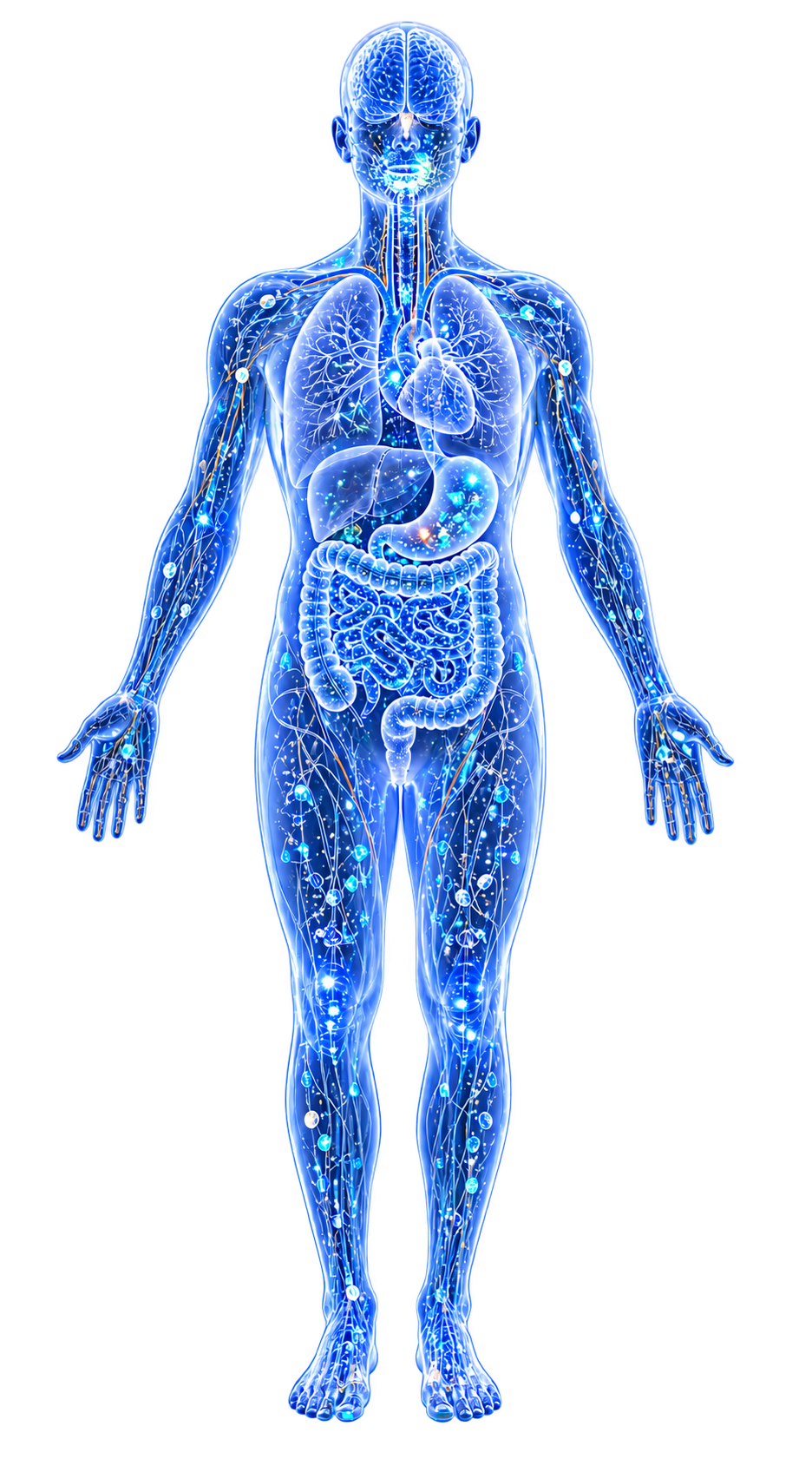
The only known cellular iron exporter in mammals. Encoded by the SLC40A1 gene, ferroportin (FPN) sits on the basolateral membrane of enterocytes, the surface of macrophages, and the membrane of hepatocytes, controlling the flow of iron from these cells into the bloodstream.
Every atom of dietary iron that reaches the plasma, every atom of recycled iron released from aged red blood cells, and every atom of stored iron mobilized from the liver must pass through ferroportin.
This makes it the single most consequential gatekeeper of systemic iron availability—and the direct target of Hepcidin, the master iron-regulatory hormone.
Evidence map4 cited passagesInspect provenance +
This axis is the master regulator of systemic iron homeostasis:
The hepcidin-ferroportin axis explains why oral iron supplementation can be harmful in inflammatory conditions:
In CKD, hepcidin accumulates due to reduced renal clearance and chronic inflammation, driving persistent ferroportin degradation. The resulting functional iron deficiency contributes to CKD anemia, and iron supplementation faces the same paradox as in IBD.
Brain ferroportin expression is disrupted in Parkinson's disease and Alzheimer's disease. Reduced ferroportin in the substantia nigra (PD) and hippocampus (AD) contributes to regional iron accumulation, increasing ferroptosis vulnerability.
Mechanism#
Iron Export#
Ferroportin transports iron(II) (Fe2+) (ferrous iron) from the cytoplasm across the cell membrane. Exported iron(II) is immediately oxidized to iron(III) (ferric iron) by Ceruloplasmin (in blood) or hephaestin (in enterocytes) for loading onto Transferrin. Without this oxidation step, iron(II) accumulates at the cell surface and generates hydroxyl radicals via Fenton Chemistry.
The Hepcidin-Ferroportin Axis#
This axis is the master regulator of systemic iron homeostasis.[1]Mechanism of Iron Ion Homeostasis in Intestinal Immunity and Gut Microbiota RemodelingHonghong Bao, Yi Wang, Hanlin Xiong et al. · 2024Open reference 1 ↓
Hepcidin binds ferroportin on the cell surface, triggering its internalization, ubiquitination, and lysosomal degradation. High hepcidin = ferroportin destroyed = iron trapped inside cells = serum iron falls. Low hepcidin = ferroportin expressed = iron flows into plasma = serum iron rises.
This axis integrates signals from iron stores (BMP-SMAD pathway), Metal-Driven Inflammation (IL-6/JAK-STAT3), erythropoietic demand, and hypoxia (HIF pathway).
Role in Nutritional Immunity#
Ferroportin degradation by hepcidin is a central arm of Nutritional Immunity (Metal Sequestration). During infection, IL-6 upregulates hepcidin, which destroys ferroportin on macrophages and enterocytes. Iron is deliberately trapped inside cells, reducing plasma iron availability to extracellular pathogens.
This is the molecular basis of anemia of chronic disease (also called anemia of inflammation)—the host intentionally restricts iron to starve pathogens, creating apparent iron deficiency.
Clinically, this means low serum iron + high hepcidin = functional iron restriction (host defense), not true deficiency requiring supplementation.
Disease Contexts#
Iron Supplementation Paradox#
The hepcidin-ferroportin axis explains why oral iron supplementation can be harmful in inflammatory conditions:[1]Mechanism of Iron Ion Homeostasis in Intestinal Immunity and Gut Microbiota RemodelingHonghong Bao, Yi Wang, Hanlin Xiong et al. · 2024Open reference 1 ↓
- Inflammation raises hepcidin, destroying ferroportin
- With ferroportin gone, supplemental iron cannot be exported from enterocytes into blood
- Unabsorbed iron reaches the colon, where it feeds siderophore-producing Enterobacteriaceae
- Gut Dysbiosis worsens, increasing inflammation, raising hepcidin further—a vicious cycle
This is the mechanistic basis for the STOP: Iron supplementation in IBD and similar STOP pages.
Chronic Kidney Disease#
In CKD, hepcidin accumulates due to reduced renal clearance and chronic inflammation, driving persistent ferroportin degradation. The resulting functional iron deficiency contributes to CKD anemia, and iron supplementation faces the same paradox as in IBD.[2]Molecular Mechanisms of Cellular Injury and Role of Toxic Heavy Metals in Chronic Kidney DiseaseManish Mishra, Larry Nichols, Aditi A. Dave et al. · 2022Open reference 2 ↓
Neurodegeneration#
Brain ferroportin expression is disrupted in Parkinson's disease and Alzheimer's disease. Reduced ferroportin in the substantia nigra (PD) and hippocampus (AD) contributes to regional iron accumulation, increasing Ferroptosis vulnerability.[3]Microbial Metallomics and Parkinson's Disease: A Unified Metal-Driven Framework Linking Ferroptosis, Dysbiosis, and alpha-Synuclein PathologyKaren Pendergrass · 2025Open reference 3 ↓
Cancer#
Many cancer types downregulate ferroportin to create an iron-accumulating phenotype that supports rapid cell division. Ovarian cancer cells upregulate transferrin receptor 1 (TfR1) while downregulating ferroportin, trapping iron for proliferative metabolism.
Connections#
- Hepcidin—the hormone that controls ferroportin degradation
- Iron—ferroportin is the only cellular iron exporter
- Ceruloplasmin—oxidizes iron(II) (Fe2+) exported by ferroportin for transferrin loading
- Transferrin—carries the iron(III) generated after ferroportin export
- Ferritin—intracellular iron storage when ferroportin is degraded
- Nutritional Immunity (Metal Sequestration)—ferroportin degradation restricts iron availability to pathogens
- Ferroptosis—ferroportin loss increases intracellular iron and ferroptotic vulnerability
- Fenton Chemistry—iron(II) accumulation from failed export drives ROS generation
References 3
Numbered by first appearance in the article, then reconciled with its declared source list.
- 1
★Honghong Bao, Yi Wang, Hanlin Xiong et al. (2024). Mechanism of Iron Ion Homeostasis in Intestinal Immunity and Gut Microbiota Remodeling. International Journal of Molecular Sciences.
- 2
★Manish Mishra, Larry Nichols, Aditi A. Dave et al. (2022). Molecular Mechanisms of Cellular Injury and Role of Toxic Heavy Metals in Chronic Kidney Disease. International Journal of Molecular Sciences.
- 3
★Karen Pendergrass (2025). Microbial Metallomics and Parkinson's Disease: A Unified Metal-Driven Framework Linking Ferroptosis, Dysbiosis, and alpha-Synuclein Pathology. Conference Presentation.
Article network
Mentioned here 11
Pages linking here 5
Connect the evidence
Publicly readable discussion by ORCID-authenticated researchers. Questions, interpretation, methods, corrections, and new evidence stay attached to this record.
No discussion yet. Start with a precise question or a source-backed observation.
Activity and accepted changes
Accepted researcher context, editorial status, public discussion, and upstream Git revisions are shown together. Pending, declined, and withdrawn proposals remain private.
- published revision
Backfill inflammation concept links
Karen Pendergrass · +1 −1
Inspect exact Git diff ↗ - published revision
Complete corpus-wide Dysbiosis linking
Karen Pendergrass · +1 −1
Inspect exact Git diff ↗ - published revision
massive wiki expansion: 149 stubs fixed, 100+ new pages, Rule 15 scan, keystone papers
WikiBiome Deploy Bot · +8 −8
Inspect exact Git diff ↗ - published revision
pre-overnight checkpoint 2026-04-18
WikiBiome Deploy Bot · +79 −0
Inspect exact Git diff ↗