
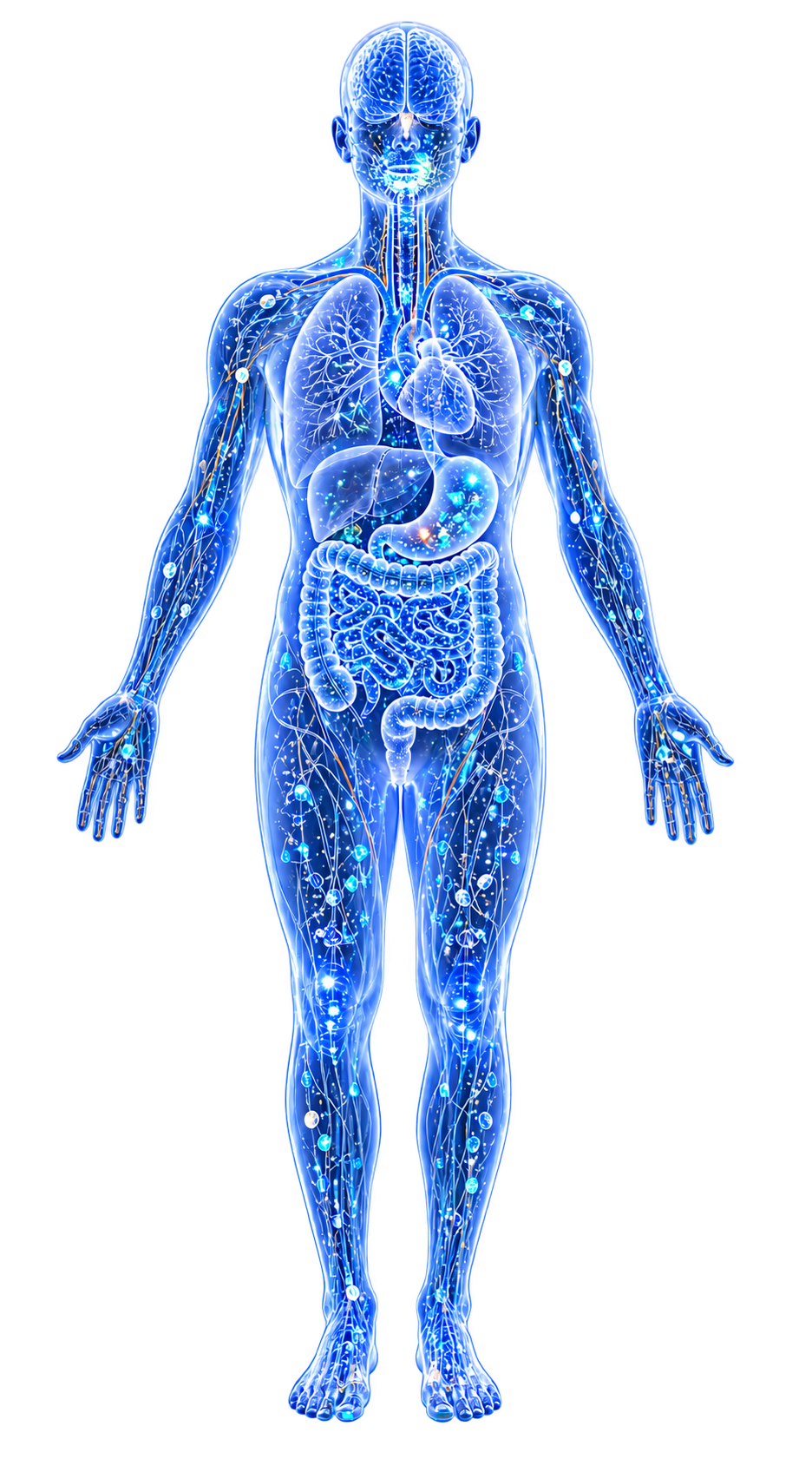
An iron-binding glycoprotein of the transferrin family that sequesters iron (and potentially other metals) from pathogens at mucosal surfaces and sites of Metal-Driven Inflammation. Lactoferrin is a key effector of Nutritional Immunity (Metal Sequestration), complementing Calprotectin (S100A8/A9)'s role in metal restriction.
Evidence map5 cited passagesInspect provenance +
Lactoferrin contains histidine and tyrosine ligand residues that could coordinate Ni(II). A nickel-sequestering role is plausible but has not been experimentally confirmed.
Vaginal lactoferrin concentrations increase dramatically with genital infections: 6.6-fold with bacterial vaginosis, 11.5-fold with Trichomonas vaginalis.
Lactoferrin levels positively correlate with serum hepcidin (P = 0.047), serum ferritin (P = 0.018), and total body iron stores (P = 0.042)—suggesting coordinated systemic and mucosal iron restriction.
IBD: Fecal lactoferrin, like fecal calprotectin, serves as a biomarker of intestinal inflammation.
Heavy metal interaction: heavy metals that disrupt iron homeostasis (Cd increases iron absorption via DMT1 upregulation in iron-depleted women) may indirectly impair lactoferrin-mediated defense.
Contents
1. Structure and Metal Binding2. Distribution3. Lactoferrin and Vaginal Health4. Antimicrobial Mechanisms5. Clinical Relevance6. ConnectionsStructure and Metal Binding#
Iron Binding#
Each lactoferrin molecule binds two iron (Fe)(III) ions with extremely high affinity (Kd ~10^-22 M), roughly 300-fold higher than transferrin.
Iron binding is pH-dependent: lactoferrin retains iron at pH values as low as 3, allowing it to function in acidic environments (stomach, abscess cavities, vaginal mucosa).
Iron-saturated lactoferrin (holo-lactoferrin) and iron-free lactoferrin (apo-lactoferrin) have distinct biological activities.
Potential Nickel Binding#
Lactoferrin contains Histidine and tyrosine ligand residues that could coordinate nickel (Ni)(II). A nickel-sequestering role is plausible but has not been experimentally confirmed.[1]Role of Nickel in Microbial PathogenesisRobert J. Maier, Stéphane L. Benoit · 2019Open reference 1 ↓
If validated, this would make lactoferrin a dual iron/nickel restriction factor at mucosal surfaces.
Distribution#
Breast milk: highest concentration (~7 mg/mL in colostrum, ~1-2 mg/mL in mature milk), providing neonatal innate immune defense. Mucosal secretions: saliva, tears, nasal secretions, vaginal fluid, seminal fluid, bronchial mucus. Neutrophil secondary granules: released at infection sites during degranulation, contributing to the metal-restricted abscess environment alongside Calprotectin (S100A8/A9).
Gut lumen: from dietary intake (breast milk) and neutrophil release during intestinal inflammation.
Lactoferrin and Vaginal Health#
The Roberts et al. (2019) study provides the most detailed characterization of lactoferrin's mucosal immune function in a metallomics context. Vaginal lactoferrin concentrations increase dramatically with genital infections: 6.6-fold with bacterial vaginosis, 11.5-fold with Trichomonas vaginalis.[2]Mucosal lactoferrin response to genital tract infections is associated with iron and nutritional biomarkers in young Burkinabe womenRoberts SA, Brabin L, Diallo S et al. · 2019Open reference 2 ↓
Lactoferrin levels positively correlate with serum Hepcidin (P = 0.047), serum ferritin (P = 0.018), and total body iron stores (P = 0.042)—suggesting coordinated systemic and mucosal iron restriction.[2]Mucosal lactoferrin response to genital tract infections is associated with iron and nutritional biomarkers in young Burkinabe womenRoberts SA, Brabin L, Diallo S et al. · 2019Open reference 2 ↓
Iron-deficient women had lower baseline lactoferrin, suggesting that iron deficiency compromises mucosal antimicrobial defense. Women with normal vaginal flora (Lactobacillus-dominant CST I) were more likely to be iron-replete.
Antimicrobial Mechanisms#
Direct Iron Deprivation#
- By binding free iron at mucosal surfaces, lactoferrin starves iron-dependent pathogens, inhibiting growth of gram-negative bacteria that require iron for siderophore-independent acquisition.
Beyond Iron Binding#
Lactoferricin (a peptide derived from lactoferrin digestion) has direct bactericidal activity via membrane disruption, independent of iron binding. Lactoferrin modulates immune cell function: enhances macrophage phagocytosis, promotes NK cell activity, and modulates cytokine production. Anti-biofilm activity: lactoferrin can disrupt early Biofilm formation by iron-dependent pathogens.
Clinical Relevance#
IBD: Fecal lactoferrin, like fecal Calprotectin (S100A8/A9), serves as a biomarker of intestinal inflammation.[3]Clinical and inflammatory biomarkers of inflammatory bowel diseases are linked to plasma trace elements and toxic metals; new insights into an old conceptAmerikanou C, Karavoltsos S, Gioxari A et al. · 2022Open reference 3 ↓
Neonatal protection: Breast milk lactoferrin is a major factor in neonatal gut immune defense; its absence in formula may contribute to increased infection risk and NEC.
Heavy metal interaction: Heavy Metals that disrupt iron homeostasis (cadmium (Cd) increases iron absorption via DMT1 upregulation in iron-depleted women) may indirectly impair lactoferrin-mediated defense.[4]Feng 2025 — Heavy Metal Exposure and Bacterial VaginosisYu-Xue Feng, Ming-Zhi Tan, Hui-Han Qiu et al. · 2025Open reference 4 ↓
Connections#
- Iron—lactoferrin's primary metal target
- Nutritional Immunity (Metal Sequestration)—lactoferrin is a major mucosal effector
- Hepcidin—coordinated systemic iron restriction
- Calprotectin (S100A8/A9)—complementary metal-sequestering protein (zinc (Zn)/manganese (Mn)/nickel (Ni)-focused)
- Gut-Metal-Microbiome Interactions—lactoferrin shapes microbial access to iron in the gut
References 5
Numbered by first appearance in the article, then reconciled with its declared source list.
- 1
★Robert J. Maier, Stéphane L. Benoit (2019). Role of Nickel in Microbial Pathogenesis. Inorganics.
- 2
Roberts SA, Brabin L, Diallo S et al. (2019). Mucosal lactoferrin response to genital tract infections is associated with iron and nutritional biomarkers in young Burkinabe women. European Journal of Clinical Nutrition.
- 3
Amerikanou C, Karavoltsos S, Gioxari A et al. (2022). Clinical and inflammatory biomarkers of inflammatory bowel diseases are linked to plasma trace elements and toxic metals; new insights into an old concept. Frontiers in Nutrition.
- 4
Yu-Xue Feng, Ming-Zhi Tan, Hui-Han Qiu et al. (2025). Feng 2025 — Heavy Metal Exposure and Bacterial Vaginosis. PLOS ONE.
- 5
★Honghong Bao, Yi Wang, Hanlin Xiong et al. (2024). Mechanism of Iron Ion Homeostasis in Intestinal Immunity and Gut Microbiota Remodeling. International Journal of Molecular Sciences.
Article network
Mentioned here 9
Pages linking here 63
Connect the evidence
Publicly readable discussion by ORCID-authenticated researchers. Questions, interpretation, methods, corrections, and new evidence stay attached to this record.
No discussion yet. Start with a precise question or a source-backed observation.
Activity and accepted changes
Accepted researcher context, editorial status, public discussion, and upstream Git revisions are shown together. Pending, declined, and withdrawn proposals remain private.
- published revision
Backfill heavy metals concept links
Karen Pendergrass · +1 −1
Inspect exact Git diff ↗ - published revision
Backfill inflammation concept links
Karen Pendergrass · +1 −1
Inspect exact Git diff ↗ - published revision
Add reviewed Histidine concept coverage
Karen Pendergrass · +1 −1
Inspect exact Git diff ↗ - published revision
massive wiki expansion: 149 stubs fixed, 100+ new pages, Rule 15 scan, keystone papers
WikiBiome Deploy Bot · +8 −8
Inspect exact Git diff ↗ - published revision
nightly maintenance: 94 stub demotions, 181 source_count fixes, 22 auto-discovered stubs, 5 adversarial audits, 3 boundary fixes, 3 evidence-level corrections
WikiBiome Deploy Bot · +1 −0
Inspect exact Git diff ↗ - published revision
pre-overnight checkpoint 2026-04-18
WikiBiome Deploy Bot · +3 −1
Inspect exact Git diff ↗ - published revision
WikiBiome update — 2026-04-15 17:23
WikiBiome Deploy Bot · +0 −1
Inspect exact Git diff ↗ - published revision
WikiBiome update — integrity fixes, metallomic diet pages, cross-condition analyses
WikiBiome Deploy Bot · +12 −5
Inspect exact Git diff ↗ - published revision
WikiBiome v7 — interactive microbiome metallomics encyclopedia
Karen Pendergrass · +63 −0
Inspect exact Git diff ↗