

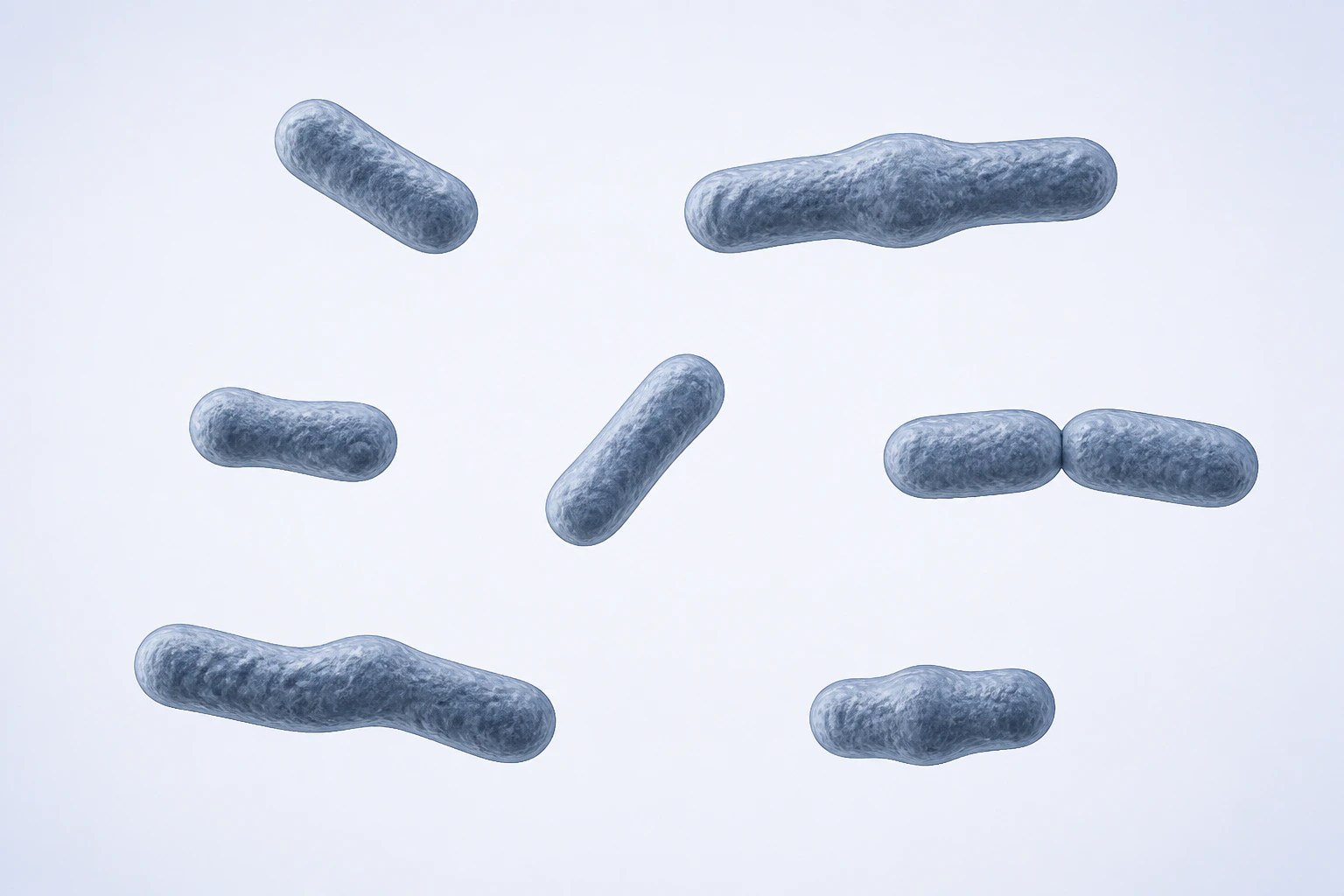
Representative rounded and mildly swollen F. varium rod forms, shown as eight bodies in six single and one paired grouping. Continuous constricted bodies remain single cells unless an ordinary two-cell boundary is visible; the plate is distinct from the long pointed F. nucleatum treatment, non-diagnostic, and not a micrograph.
Scientific media record1 verified identifier
- Subject
- Fusobacterium variumtaxon · species
- Identifiers
- NCBITaxon:856
- Review
- Editorial review completeIdentifiers authority-verified · Accessibility validated · · fusobacterium-varium|fusobacterium-varium-morphology-v1.webp
- Digital source
- Trained-algorithmic mediaCreated with a trained generative algorithm and reviewed by WikiBiome for subject identity, scientific framing, identifiers, provenance, and accessibility.
- Scientific basis
- Fusobacterium varium — NCBI TaxonomyFusobacterium varium — LPSNFusobacterium varium type strain — BacDiveFusobacterium varium morphology studyFusobacterium varium morphology recordFusobacterium varium clinical isolates
- License
- CC BY-SA 4.0Created
A Gram-negative obligate anaerobe that occupies a paradoxical niche in the gut microbiota: as a weak Butyrate producer (short-chain fatty acid), it has anti-inflammatory potential; as a virulent invasive pathobiont in inflammatory bowel disease (particularly ulcerative colitis), it breaches the intestinal epithelium and drives mucosal Metal-Driven Inflammation.
F. varium distinguishes itself from the related Fusobacterium nucleatum by greater enrichment in UC and lower pathogenic burden in non-inflamed controls.
Contents
1. Taxonomy and Classification2. Iron-Dependent Growth and Virulence3. Virulence Factors and Epithelial Invasion4. Butyrate Production—A Paradox5. Disease Associations6. Ecological Context in Inflamed Colon7. ConnectionsTaxonomy and Classification#
Phylum: Fusobacteria (Gram-negative, leptotrichous flagellation, pleomorphic rods).
Distinct from Fusobacterium nucleatum: F. nucleatum is oral-centric, implicated in colorectal cancer and periodontal disease. F. varium is gut-primary and more associated with IBD, especially UC.
Habitat: Lower gastrointestinal tract; oxygen-limited environments (crypts, mucus layer).
Iron-Dependent Growth and Virulence#
Iron Acquisition#
F. varium relies on iron for core metabolic enzymes and biofilm synthesis. Acquires iron via siderophore-mediated uptake and direct heme utilization (similar to other oral and gut anaerobes).
In the inflamed ulcerative colitis colon, elevated Iron bioavailability (from bleeding, increased transferrin and lactoferrin release, and dysregulated hepcidin) favors F. varium expansion.
Iron and Invasiveness#
Iron deficiency (functional anemia via elevated Hepcidin) restricts competing anaerobes more severely than F. varium, creating a selective advantage. Iron-rich conditions correlate with heightened epithelial invasiveness: hemolysins and proteases are upregulated in iron-replete growth.
Virulence Factors and Epithelial Invasion#
Hemolysins and Proteases#
Fusolysin (hepta-acylated lipid A mimetic)—outer membrane-derived; activates Toll-like receptor 4 and drives pro-inflammatory IL-6, TNF-α, and IL-8 secretion from epithelial cells and macrophages.
Serine proteases—cleave tight junction proteins (claudins, occludin, zonula occludens-1); disrupt intestinal barrier integrity. Lipopolysaccharide (LPS)—Gram-negative endotoxin; triggers TLR4 signaling and NF-κB activation.
Invasive Phenotype#
Unlike most commensal anaerobes, F. varium actively invades intestinal epithelial cells via macropinocytosis-like mechanisms. Internalized bacteria survive transiently in epithelial compartments, triggering apoptosis and epithelial shedding. This invasive behavior distinguishes F. varium from purely commensal Bacteroides and Faecalibacterium species.
Butyrate Production—A Paradox#
F. varium expresses butyrate synthesis enzymes (putative butyrate kinase homologs), capable of producing short-chain fatty acids (SCFAs) from carbohydrate fermentation. But: In inflamed UC colon, invasive pathogenic phenotype dominates over commensal SCFA production.
This mirrors the commensal-pathobiont spectrum seen in Bacteroides fragilis: the same organism can be protective (SCFA producer) or destructive (invasive), depending on iron bioavailability and immune state.
Disease Associations#
Inflammatory Bowel Disease (IBD)—Ulcerative Colitis (UC)#
Enrichment in UC: F. varium is consistently over-represented in UC microbiota compared to controls and Crohn's disease. Abundance correlates with disease activity: higher F. varium levels predict flares and non-remission. Epithelial invasion and LPS-driven inflammation exacerbate colonic inflammation.
Possible causative role: Longitudinal studies suggest F. varium bloom precedes symptom exacerbation, supporting a causal (not purely reactive) role.
Crohn's Disease#
- Variable presence; less specific than UC. When enriched, often in ileal involvement.
Mucosal Healing#
- Mucosal healing (endoscopic resolution) correlates with F. varium reduction, suggesting interventions that suppress this pathobiont may support barrier recovery.
Ecological Context in Inflamed Colon#
Iron Availability and Niche Emergence#
- Inflammation → intestinal bleeding and transferrin/lactoferrin release.
- Hepcidin elevation (acute phase response) reduces systemic iron but increases luminal iron accumulation (reduced absorption, increased secretion).
- Iron-rich, hypoxic, low-pH niche favors F. varium and other iron-dependent pathogens.
- Competing butyrate producers (Faecalibacterium, Roseburia) are outcompeted due to iron limitation elsewhere.
Biofilm Formation#
F. varium forms biofilms on inflamed epithelium; biofilm matrix protects from antimicrobials and immune attack. Biofilm niche accumulates iron, further cementing pathobiont advantage.
Functional Shielding#
- cobalt (Co)-localization with Candida albicans and other fungi in UC mucosa suggests interkingdom cooperation (e.g., fungal-derived molecules shield bacterial cell wall).
Connections#
- Iron—essential growth cofactor; elevated bioavailability in inflamed UC drives pathobiont expansion
- Hepcidin—upregulated in UC; sequesters systemic iron but increases luminal iron availability
- hemolysins and proteases disrupt tight junctions
- Inflammatory Bowel Disease (IBD)—enriched in UC; drives mucosal inflammation
- lipopolysaccharide—TLR4-mediated pro-inflammatory signaling
- butyrate—paradoxically capable of SCFA production, but pathogenic phenotype dominates in inflammation
- Fusobacterium nucleatum—related but distinct species; oral pathogenic vs. gut-UC pathobiont
- Dysbiosis—iron-rich, low-SCFA producing community state characteristic of active UC
- same species exhibits protection (SCFA producer) or pathology (invasive) depending on iron and immunity context
References 8
Numbered by first appearance in the article, then reconciled with its declared source list.
- 1
Xiaopeng Li, Jiahui Feng, Zhanggui Wang et al. (2023). Features of combined gut bacteria and fungi from a Chinese cohort of colorectal cancer, colorectal adenoma, and post-operative patients. Frontiers in Microbiology.
- 2
Melika Shirdarreh, Yasamin Sadeghi, Tina Rahimi (2021). The Impact of Ketogenic Diet on Colorectal Cancer Progression and the Co-evolution of Gut Microbiota: A Research Protocol. URNCST Journal.
- 3
Georgina Quaranta, Mauro Pittiruti, Brunella Posteraro et al. (2019). Quaranta 2019 — FMT as a Potential Tool for Female Reproductive Tract Diseases (Review). Frontiers in Immunology.
- 4
Jhommara Bautista, Walter D. Cardona-Maya, Kelly Gancino-Guevara et al. (2025). Bautista 2025 — Reprogramming Prostate Cancer Through the Microbiome. Frontiers in Medicine.
- 5
Wehedy, Ghali, Matboli (2022). Wehedy et al. 2022 — The Human Microbiome in CKD: A Double-Edged Sword. Frontiers in Medicine.
- 6
Cuipeng Zhu, Kaiqi Li, Xiao-Xu Peng et al. (2022). Berberine a Traditional Chinese Drug Repurposing: Its Actions in Inflammation-Associated Ulcerative Colitis and Cancer Therapy. Frontiers in Immunology.
- 7
Catala-Valentin AR, Mikhail S, Bernard JN et al. (2021). Corruption of Bacterial-Host Homeostasis as a Potential Risk Factor and Biomarker for Upper Gastrointestinal Carcinogenesis. Journal of Gastroenterology and Hepatobiliary Medicine.
- 8
Shuya Lv, Jingrong Huang, Yadan Luo et al. (2024). Lv 2024 — Gut Microbiota Is Involved in Male Reproductive Function: A Review. Frontiers in Microbiology.
Article network
Connect the evidence
Publicly readable discussion by ORCID-authenticated researchers. Questions, interpretation, methods, corrections, and new evidence stay attached to this record.
No discussion yet. Start with a precise question or a source-backed observation.
Activity and accepted changes
Accepted researcher context, editorial status, public discussion, and upstream Git revisions are shown together. Pending, declined, and withdrawn proposals remain private.
- published revision
Backfill inflammation concept links
Karen Pendergrass · +2 −2
Inspect exact Git diff ↗ - published revision
Complete Tight junctions contextual coverage
Karen Pendergrass · +1 −1
Inspect exact Git diff ↗ - published revision
massive wiki expansion: 149 stubs fixed, 100+ new pages, Rule 15 scan, keystone papers
WikiBiome Deploy Bot · +20 −14
Inspect exact Git diff ↗ - published revision
nightly maintenance: 94 stub demotions, 181 source_count fixes, 22 auto-discovered stubs, 5 adversarial audits, 3 boundary fixes, 3 evidence-level corrections
WikiBiome Deploy Bot · +3 −0
Inspect exact Git diff ↗ - published revision
WikiBiome update — 2026-04-15 17:23
WikiBiome Deploy Bot · +2 −2
Inspect exact Git diff ↗ - published revision
wiki: bulk entity upgrades, new article pages, and site regeneration
WikiBiome Deploy Bot · +6 −0
Inspect exact Git diff ↗ - published revision
WikiBiome update — integrity fixes, metallomic diet pages, cross-condition analyses
WikiBiome Deploy Bot · +3 −1
Inspect exact Git diff ↗ - published revision
WikiBiome update — 2026-04-10 17:16
WikiBiome Deploy Bot · +103 −0
Inspect exact Git diff ↗