
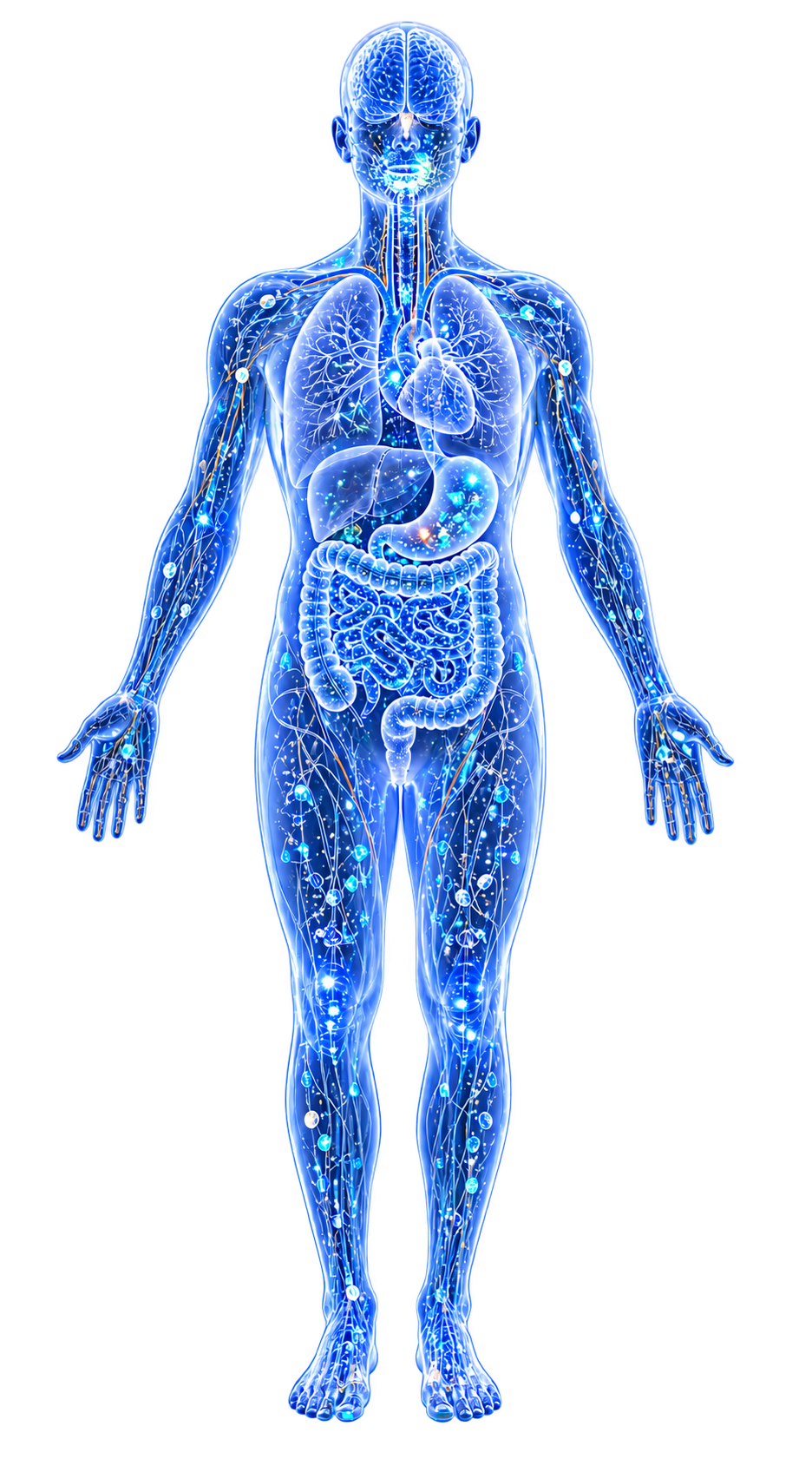
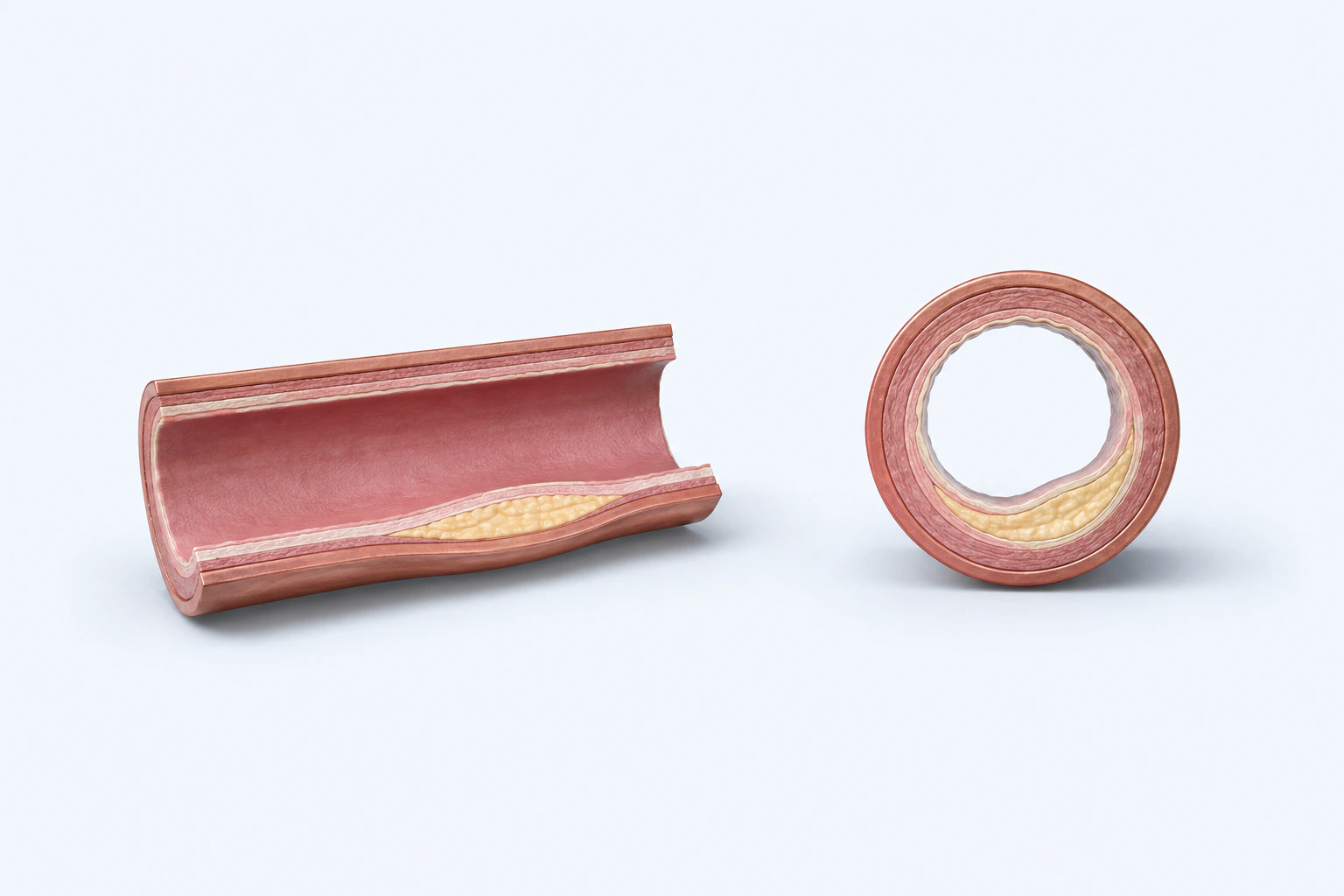
Generic arterial-wall and intimal-plaque orientation for atherosclerosis. This reconstruction does not show a patient-specific lesion, stenosis measurement, plaque stability, diagnosis, prognosis, or treatment result.
Scientific media record3 verified identifiers
- Subject
- Atherosclerosiscondition
- Review
- Editorial review completeIdentifiers authority-verified · Accessibility validated · · atherosclerosis|atherosclerosis-mechanism-v2.webp
- Digital source
- Trained-algorithmic mediaCreated with a trained generative algorithm and reviewed by WikiBiome for subject identity, scientific framing, identifiers, provenance, and accessibility.
- License
- CC BY-SA 4.0Created
Progressive inflammatory disease of the arterial wall characterized by lipid accumulation, immune cell infiltration, and fibrous plaque formation. In the Metallomics framework, atherosclerosis sits at the convergence of three interacting systems: heavy metal toxicity, gut/oral microbial Dysbiosis, and chronic Metal-Driven Inflammation.
Evidence map3 cited passagesInspect provenance +
Hepatic FMO3 oxidizes TMA to tmao, which promotes cholesterol deposition in macrophages, creating foam cells—the hallmark of early plaque.
Oral bacteria translocate to arterial plaques: porphyromonas gingivalis, Fusobacterium nucleatum, Aggregatibacter actinomycetemcomitans, and oral Streptococcus spp. have been detected in atherosclerotic tissue.
Fungal dysbiosis: Candida albicans, Exophiala, Malassezia enriched in coronary artery disease; Mucor racemosus depleted.
Contents
1. The Microbiome-Atherosclerosis Axis2. Metal Contributions to Atherosclerosis3. Protective Metabolites4. See AlsoThe Microbiome-Atherosclerosis Axis#
TMAO and Foam Cell Formation#
Gut bacteria convert dietary choline, phosphatidylcholine, and L-carnitine to trimethylamine (TMA) via cutC/cutD genes.
Hepatic FMO3 oxidizes TMA to Trimethylamine N-Oxide (TMAO), which promotes cholesterol deposition in macrophages, creating foam cells—the hallmark of early plaque.[1]Role of the intestinal microbiome and its therapeutic intervention in cardiovascular disorderAmeer Luqman, Adil Hassan, Mehtab Ullah et al. · 2024Open reference 1 ↓
TMAO also enhances platelet hyperreactivity and thrombosis risk.
Bacteria in Atherosclerotic Plaques#
Oral bacteria translocate to arterial plaques: Porphyromonas gingivalis, Fusobacterium nucleatum, Aggregatibacter actinomycetemcomitans, and oral Streptococcus spp. have been detected in atherosclerotic tissue.[2]Microbiome and Cardiovascular DiseaseHilde Herrema, Max Nieuwdorp, Albert K. Groen · 2020Open reference 2 ↓
Periodontitis is an independent risk factor for ASCVD; the CANTOS trial confirmed the central role of IL-1-beta-driven inflammation. FMT from atherosclerotic mice induces atherosclerosis in recipients, demonstrating causal microbial contribution.
Gut Dysbiosis in ASCVD#
ASCVD patients show decreased Bacteroidetes (Bacteroides, Prevotella) and enrichment of Enterobacteriaceae. Reduced SCFA production impairs anti-inflammatory Treg responses and gut barrier integrity. Fungal dysbiosis: Candida albicans, Exophiala, Malassezia enriched in coronary artery disease; Mucor racemosus depleted.[3]Gut mycobiome in cardiometabolic disease progression: current evidence and future directionsXiaoyu Wei, Zixin Guo, Jingyang Wang et al. · 2025Open reference 3 ↓
Metal Contributions to Atherosclerosis#
Copper#
copper (Cu) is elevated in atherosclerotic plaques; catalyzes LDL oxidation via Fenton-like reactions, accelerating foam cell formation. Ceruloplasmin (copper-containing) is an acute-phase protein elevated in cardiovascular inflammation.
Lead and Cadmium#
lead (Pb) exposure is an independent risk factor for cardiovascular mortality even at low blood levels. cadmium (Cd) promotes endothelial dysfunction, oxidative LDL modification, and smooth muscle cell proliferation. Both metals drive dysbiosis that further increases TMAO production and reduces protective SCFA output.
Iron#
Free iron in plaques generates ROS via Fenton chemistry, oxidizing LDL and destabilizing plaques. Hepcidin dysregulation in chronic inflammation alters systemic iron distribution.
Protective Metabolites#
Short-Chain Fatty Acids (SCFAs): Propionate and Butyrate are generally cardioprotective—anti-inflammatory, blood pressure-lowering via GPR41/Olfr78 balance. butyrate: HDAC inhibition reduces macrophage inflammatory activation. Secondary bile acids: FXR/TGR5 signaling modulates cholesterol metabolism.
See Also#
- Cardiovascular Disease—broader disease category
- Trimethylamine N-Oxide (TMAO)—key proatherogenic metabolite
- Porphyromonas—oral pathogen found in plaques
- inflammation—driving force of plaque progression
- Oxidative Stress—LDL oxidation and plaque instability
References 3
Numbered by first appearance in the article, then reconciled with its declared source list.
- 1
Ameer Luqman, Adil Hassan, Mehtab Ullah et al. (2024). Role of the intestinal microbiome and its therapeutic intervention in cardiovascular disorder. Frontiers in Immunology.
- 2
Hilde Herrema, Max Nieuwdorp, Albert K. Groen (2020). Microbiome and Cardiovascular Disease. Handbook of Experimental Pharmacology (Prevention and Treatment of Atherosclerosis).
- 3
Xiaoyu Wei, Zixin Guo, Jingyang Wang et al. (2025). Gut mycobiome in cardiometabolic disease progression: current evidence and future directions. Frontiers in Microbiology.
Article network
Mentioned here 11
Pages linking here 13
Connect the evidence
Publicly readable discussion by ORCID-authenticated researchers. Questions, interpretation, methods, corrections, and new evidence stay attached to this record.
No discussion yet. Start with a precise question or a source-backed observation.
Activity and accepted changes
Accepted researcher context, editorial status, public discussion, and upstream Git revisions are shown together. Pending, declined, and withdrawn proposals remain private.
- published revision
Strengthen Metallomics and link high-leverage contexts
Karen Pendergrass · +1 −1
Inspect exact Git diff ↗ - published revision
Backfill inflammation concept links
Karen Pendergrass · +1 −1
Inspect exact Git diff ↗ - published revision
Complete corpus-wide Dysbiosis linking
Karen Pendergrass · +2 −2
Inspect exact Git diff ↗ - published revision
nightly maintenance: 94 stub demotions, 181 source_count fixes, 22 auto-discovered stubs, 5 adversarial audits, 3 boundary fixes, 3 evidence-level corrections
WikiBiome Deploy Bot · +1 −0
Inspect exact Git diff ↗ - published revision
pre-overnight checkpoint 2026-04-18
WikiBiome Deploy Bot · +4 −2
Inspect exact Git diff ↗ - published revision
WikiBiome update — integrity fixes, metallomic diet pages, cross-condition analyses
WikiBiome Deploy Bot · +5 −3
Inspect exact Git diff ↗ - published revision
WikiBiome update — 2026-04-10 15:45
WikiBiome Deploy Bot · +58 −0
Inspect exact Git diff ↗