

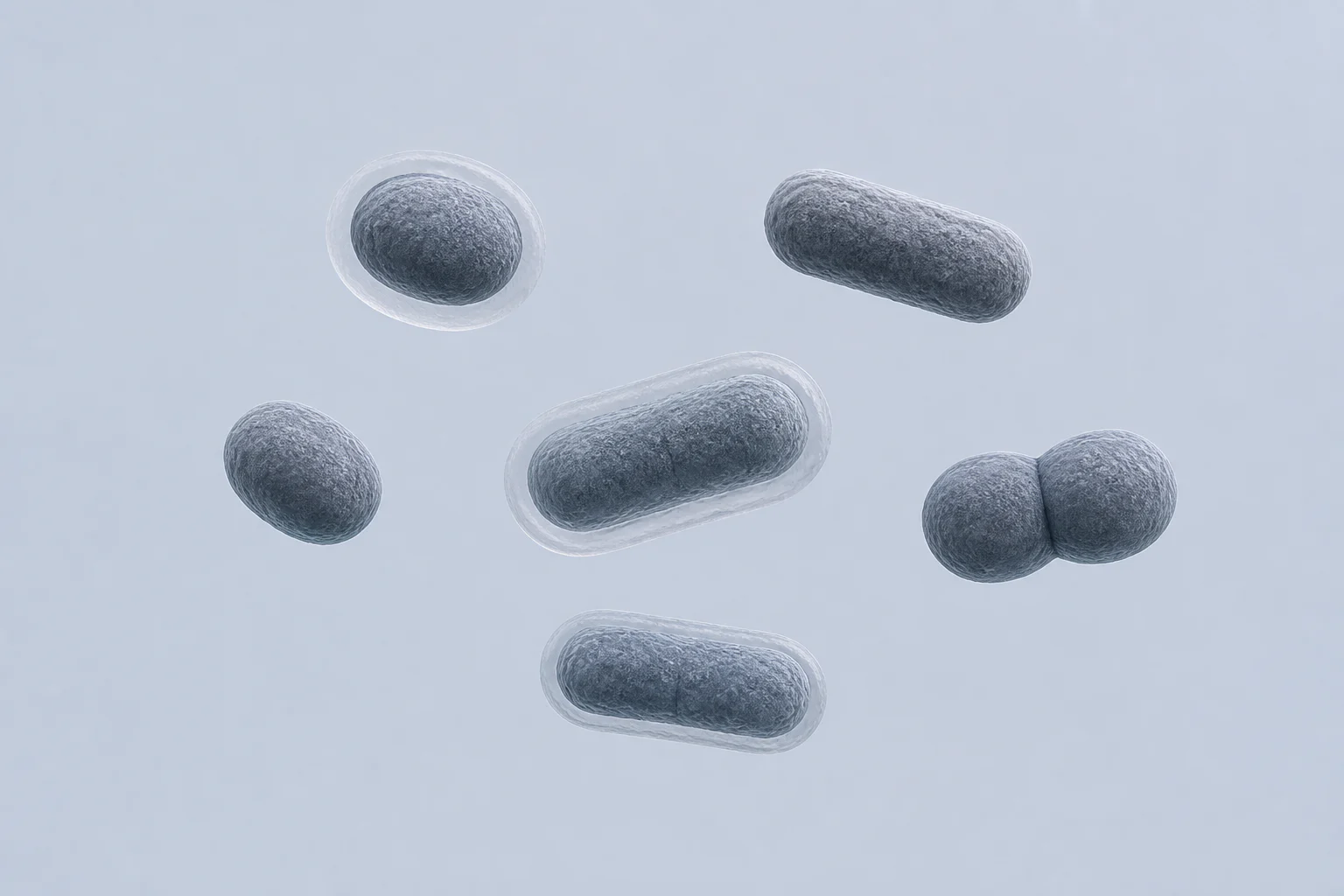
Representative Bacteroides fragilis cell forms and nonuniform visible capsule expression. Capsule structure varies among strains and cells; this reconstruction is not diagnostic or a micrograph.
Scientific media record1 verified identifier
- Subject
- Bacteroides fragilistaxon · species
- Identifiers
- NCBITaxon:817
- Review
- Editorial review completeIdentifiers authority-verified · Accessibility validated · · bacteroides-fragilis|bacteroides-fragilis-morphology-v1.webp
- Digital source
- Trained-algorithmic mediaCreated with a trained generative algorithm and reviewed by WikiBiome for subject identity, scientific framing, identifiers, provenance, and accessibility.
- Scientific basis
- Bacteroides fragilis — NCBI TaxonomyPolysaccharide capsule of Bacteroides fragilisCapsule diversity in Bacteroides fragilisBacteroides fragilis capsule heterogeneity
- License
- CC BY-SA 4.0Created
A Gram-negative obligate anaerobe and the most clinically significant member of the Bacteroides genus.
B. fragilis occupies a unique dual position in gut microbiology: as a non-toxigenic commensal (NTBF), it produces polysaccharide A (PSA) that shapes immune tolerance; as an enterotoxigenic pathobiont (ETBF), it secretes the zinc-dependent Bacteroides fragilis toxin (BFT/fragilysin), a metalloprotease that drives Metal-Driven Inflammation, epithelial disruption, and colorectal carcinogenesis.
The balance between these two strains within an individual's microbiome has major implications for immune homeostasis and cancer risk.
Evidence map12 cited passagesInspect provenance +
BFT is a Zn-dependent zinc metalloprotease (EC 3.4.24.-) that requires a zinc ion in its active site for all catalytic activity.
ETBF is significantly enriched in CRC tumor tissue across multiple studies,. BFT-mediated E-cadherin cleavage and beta-catenin activation provide a mechanistic link to carcinogenesis. A cataloging study of CRC-promoting bacteria names ETBF alongside pks+ E. coli, F. nucleatum, S. gallolyticus, and P. anaerobius as organisms with specific pro-tumor mechanisms
Appendectomy connection: After appendectomy, B. fragilis and B. vulgatus emerged as central network hubs with the strongest negative correlations to beneficial commensals, particularly in subjects 50 years old. This positions appendectomy-driven ETBF expansion as a microbiome mechanism for the 73% increased CRC incidence observed after appendectomy in a popu
The direction of Bacteroides change in Crohn's disease depends on whether ETBF or NTBF is measured. NTBF (PSA-producing) may be depleted, while ETBF strains contribute to mucosal inflammation. Zinc dyshomeostasis in the Crohn's gut (documented via ZIP8 variant studies) potentially modulates BFT activity by altering luminal zinc availability.
Non-toxigenic B. fragilis is significantly depleted in graves disease patients alongside alistipes and parabacteroides, contributing to the loss of anti-inflammatory commensals and reduced Treg-supporting activity.
Altered Bacteroides abundance is reported in Parkinson's and Alzheimer's disease microbiome profiles, though species-level attribution to B. fragilis specifically is not always established.
B. fragilis is depleted by arsenic exposure—higher arsenic levels in the gut environment decrease B. fragilis alongside bifidobacterium. This arsenic-driven depletion of a PSA-producing commensal may disinhibit immune pathways normally modulated by NTBF, representing a heavy metal → microbiome → immune consequence chain.
—BFT zinc-metalloprotease mechanism, isoforms, inhibition
—ETBF enrichment in CRC tissue
—B. fragilis as network hub in post-appendectomy CRC
—NTBF depletion in Graves' disease
—Zn context in Crohn's
Contents
1. Classification2. Zinc-Dependent Virulence—The BFT Metalloprotease3. Commensal Functions—Polysaccharide A (PSA)4. Iron Biology and Nutritional Competition5. Beta-Glucuronidase Activity6. Disease Associations7. Key Virulence Enzymes Summary8. What Wikipedia Doesn't Cover9. Cross-ReferencesClassification#
B. fragilis belongs to the genus Bacteroides (family Bacteroidaceae, phylum Bacteroidota). Within the gut, it typically constitutes <0.5% of total bacteria but exerts disproportionate influence through both immunomodulatory and pathogenic mechanisms. Approximately 20% of colonizing strains carry the bft gene encoding BFT; these are classified as ETBF.
The remaining ~80% are NTBF.
Zinc-Dependent Virulence—The BFT Metalloprotease#
Bacteroides fragilis Toxin (BFT / Fragilysin)#
BFT is the defining virulence factor of ETBF and one of the clearest examples of metal-dependent pathogenesis in the gut. BFT is a zinc (Zn)-dependent Zinc-Metalloprotease (EC 3.4.24.-) that requires a zinc ion in its active site for all catalytic activity.[1]Drug Discovery and Repurposing Inhibits a Major Gut Pathogen-Derived Oncogenic ToxinPaul Metz, Martijn J. H. Tjan, Shaoguang Wu et al. · 2019Open reference 1 ↓
Cleaves E-cadherin, the intercellular adhesion molecule of intestinal epithelial cells. E-cadherin cleavage disrupts cell-cell junctions, increases paracellular permeability, and activates beta-catenin/Wnt signaling—a pro-tumorigenic pathway central to CRC initiation.
Triggers NF-κB activation, IL-8 secretion, and neutrophil recruitment, driving chronic intestinal inflammation that precedes malignant transformation. Three isoforms exist (BFT-1, BFT-2, BFT-3); BFT-2 is the most biologically active. ETBF colonization promotes colonic tumorigenesis in APC-Min mice in a Th17-dependent manner, providing strong animal model evidence for the E-cadherin/beta-catenin carcinogenesis pathway.
Metal Context and Therapeutic Implications#
The zinc dependence of BFT creates both a vulnerability and a therapeutic concern. Host calprotectin sequesters zinc at sites of inflammation; whether this inhibits BFT activity in vivo is an active research question with potential therapeutic implications Nutritional Immunity (Metal Sequestration).
Zinc supplementation—commonly used in diarrheal disease—could theoretically enhance BFT activity in ETBF-colonized individuals. This represents a potential clinical STOP scenario where standard of care may worsen outcomes in a subpopulation.
The zinc chelation strategy proposed for metal-dependent pathogens (as with A. baumannii and P. aeruginosa) has theoretical applicability to ETBF, though direct evidence remains limited.
Commensal Functions—Polysaccharide A (PSA)#
Non-toxigenic B. fragilis (NTBF) produces polysaccharide A (PSA), a zwitterionic capsular polysaccharide with potent immunomodulatory effects. Activates CD4+ T cells via TLR2 signaling on dendritic cells. Promotes IL-10-producing regulatory T cells (Tregs), establishing immune tolerance to gut commensals.
Suppresses Th17 inflammatory responses; corrects Th1/Th2 imbalance in germ-free mice.
PSA-mediated immunomodulation is protective against colitis in multiple animal models. This dual nature (PSA-mediated protection vs. BFT-mediated pathology) makes B. fragilis the canonical example of the commensal-pathobiont spectrum.
Iron Biology and Nutritional Competition#
B. fragilis has robust iron acquisition systems including siderophore uptake and heme utilization, enabling competitive iron acquisition in the iron-limited colonic environment. Iron availability in the colonic lumen influences Bacteroides competitiveness; high-iron conditions can shift the Firmicutes/Bacteroidetes ratio and favor Bacteroides expansion.
ETBF uses iron-dependent metabolic pathways to sustain the energy demands of BFT secretion and rapid proliferation in inflammatory tissue.
Beta-Glucuronidase Activity#
B. fragilis expresses beta-glucuronidase, the enzyme that deconjugates glucuronide-bound estrogens (and other compounds) in the gut, liberating free estrogens for reabsorption via the enterohepatic circulation.
This estrobolome activity links B. fragilis to estrogen-dependent conditions including Endometriosis, Breast Cancer, and estrogen-receptor-positive Colorectal Cancer. In the context of elevated ETBF in CRC, the combination of BFT-mediated E-cadherin cleavage AND beta-glucuronidase-driven estrogen recirculation may create synergistic carcinogenic pressure.
Disease Associations#
Colorectal Cancer—ETBF Enriched#
ETBF is significantly enriched in CRC tumor tissue across multiple studies.[2]Tissue-Associated Bacterial Alterations in Rectal Carcinoma Patients Revealed by 16S rRNA Community ProfilingThomas AM, Jesus EC, Lopes A et al. · 2016Open reference 2 ↓[3]Multi-omic profiling reveals associations between the gut microbiome, host genome and transcriptome in patients with colorectal cancerShaomin Zou, Chao Yang, Jieping Zhang et al. · 2024Open reference 3 ↓ BFT-mediated E-cadherin cleavage and beta-catenin activation provide a mechanistic link to carcinogenesis.[1]Drug Discovery and Repurposing Inhibits a Major Gut Pathogen-Derived Oncogenic ToxinPaul Metz, Martijn J. H. Tjan, Shaoguang Wu et al. · 2019Open reference 1 ↓
A cataloging study of CRC-promoting bacteria names ETBF alongside pks+ E. coli, F. nucleatum, S. gallolyticus, and P. anaerobius as organisms with specific pro-tumor mechanisms.[4]Immune System, Microbiota, and Microbial Metabolites: The Unresolved Triad in Colorectal Cancer MicroenvironmentHanus M, Parada-Venegas D, Landskron G et al. · 2021Open reference 4 ↓
Appendectomy connection: After appendectomy, B. fragilis and B. vulgatus emerged as central network hubs with the strongest negative correlations to beneficial commensals, particularly in subjects >50 years old.[5]Altered Gut Microbiome Composition by Appendectomy Contributes to Colorectal CancerShi F, Liu G, Lin Y et al. · 2023Open reference 5 ↓
This positions appendectomy-driven ETBF expansion as a microbiome mechanism for the 73% increased CRC incidence observed after appendectomy in a population-based cohort of 129,155 subjects.
Crohn's Disease#
The direction of Bacteroides change in Crohn's disease depends on whether ETBF or NTBF is measured. NTBF (PSA-producing) may be depleted, while ETBF strains contribute to mucosal inflammation.
Zinc dyshomeostasis in the Crohn's gut (documented via ZIP8 variant studies) potentially modulates BFT activity by altering luminal zinc availability.[6]ZIP8 A391T Crohn's Disease-Linked Risk Variant Induces Colonic Metal Ion Dyshomeostasis, Microbiome Compositional Shifts, and InflammationYang JC, Zhao M, Chernikova D et al. · 2024Open reference 6 ↓
Graves' Disease—NTBF Depleted#
Non-toxigenic B. fragilis is significantly depleted in Graves' Disease patients alongside Alistipes and Parabacteroides, contributing to the loss of anti-inflammatory commensals and reduced Treg-supporting activity.[7]Alteration in gut microbiota is associated with immune imbalance in Graves' diseaseSu X, Yin X, Liu Y et al. · 2020Open reference 7 ↓
Intra-Abdominal Abscess#
B. fragilis is the most common anaerobic isolate from intra-abdominal infections, where its capsular polysaccharide (PSA) paradoxically promotes abscess formation. The same PSA that induces immune tolerance in the gut lumen drives localized encapsulation when translocated into the peritoneum.
Neurodegenerative Disease#
Altered Bacteroides abundance is reported in Parkinson's and Alzheimer's disease microbiome profiles, though species-level attribution to B. fragilis specifically is not always established.[8]Effects of gut microbiota on neurodegenerative diseasesKhatoon S, Kalam N, Rashid S et al. · 2023Open reference 8 ↓
Heavy Metal Sensitivity#
B. fragilis is depleted by arsenic exposure—higher arsenic levels in the gut environment decrease B. fragilis alongside Bifidobacterium.[9]Krajewski 2025 — Heavy Metals, Noradrenaline/Adrenaline Ratio, and Microbiome-Associated Hormone Precursor Metabolites: Biomarkers for Social Behaviour, ADHD Symptoms, and Executive Function in ChildrenKristin Krajewski · 2025Open reference 9 ↓
This arsenic-driven depletion of a PSA-producing commensal may disinhibit immune pathways normally modulated by NTBF, representing a heavy metal → microbiome → immune consequence chain.
Key Virulence Enzymes Summary#
| Enzyme | Metal Dependency | Function | Disease Relevance |
|---|---|---|---|
| BFT / Fragilysin | zinc (Zn)²⁺ (catalytic) | E-cadherin cleavage → beta-catenin activation | CRC carcinogenesis, IBD |
| Beta-glucuronidase | None | Estrogen deconjugation | Estrobolome, estrogen-dependent cancers |
| Siderophore receptors | iron (Fe) (uptake) | Iron acquisition | Competitive survival in iron-limited gut |
| zinc-dependent DNases | zinc²⁺ | DNA damage | Genotoxicity in colonocytes |
| Capsular PSA | None (immune) | Immune tolerance / abscess | Protective in gut; pathogenic in peritoneum |
What Wikipedia Doesn't Cover#
Wikipedia's Bacteroides fragilis entry covers BFT and PSA at a general level.
This page adds: the zinc-concentration dependence of BFT activity and the calprotectin/BFT inhibition hypothesis; the therapeutic implications of zinc supplementation in ETBF-colonized patients; the appendectomy-driven network hub mechanism with quantitative CRC incidence data; arsenic-driven NTBF depletion as a metal → immune tolerance loss cascade; and the compound risk from BFT carcinogenesis combined with beta-glucuronidase estrogen recirculation.
Cross-References#
- Zinc—cofactor for BFT metalloprotease; zinc availability modulates toxin activity
- Iron—siderophore iron acquisition; competitive survival in colonic iron milieu
- Arsenic—NTBF depleted by arsenic exposure; immune tolerance consequences
- Nutritional Immunity (Metal Sequestration)—calprotectin sequesters zinc (Zn); potential BFT inhibition
- Colorectal Cancer—ETBF enrichment; BFT-mediated E-cadherin/beta-catenin carcinogenesis
- Crohn's Disease—NTBF depletion vs. ETBF enrichment depending on strain composition
- Graves' Disease—NTBF (PSA-producing) depleted; contributes to Treg reduction
- Endometriosis—beta-glucuronidase-driven estrogen recirculation (estrobolome role)
- inflammation—BFT drives NF-κB/IL-8; PSA suppresses via Tregs; opposing effects by strain
- Calprotectin (S100A8/A9)—sequesters zinc at inflammation sites; potential BFT inhibition mechanism
- Estrobolome—beta-glucuronidase links B. fragilis to hormone recirculation
- Dysbiosis—ETBF enrichment vs. NTBF depletion defines disease-associated shifts
References 9
Numbered by first appearance in the article, then reconciled with its declared source list.
- 1
Paul Metz, Martijn J. H. Tjan, Shaoguang Wu et al. (2019). Drug Discovery and Repurposing Inhibits a Major Gut Pathogen-Derived Oncogenic Toxin. Frontiers in Cellular and Infection Microbiology.
- 2
Thomas AM, Jesus EC, Lopes A et al. (2016). Tissue-Associated Bacterial Alterations in Rectal Carcinoma Patients Revealed by 16S rRNA Community Profiling. Frontiers in Cellular and Infection Microbiology.
- 3
Shaomin Zou, Chao Yang, Jieping Zhang et al. (2024). Multi-omic profiling reveals associations between the gut microbiome, host genome and transcriptome in patients with colorectal cancer. Journal of Translational Medicine.
- 4
Hanus M, Parada-Venegas D, Landskron G et al. (2021). Immune System, Microbiota, and Microbial Metabolites: The Unresolved Triad in Colorectal Cancer Microenvironment. Frontiers in Immunology.
- 5
Shi F, Liu G, Lin Y et al. (2023). Altered Gut Microbiome Composition by Appendectomy Contributes to Colorectal Cancer. Oncogene.
- 6
★Yang JC, Zhao M, Chernikova D et al. (2024). ZIP8 A391T Crohn's Disease-Linked Risk Variant Induces Colonic Metal Ion Dyshomeostasis, Microbiome Compositional Shifts, and Inflammation. Digestive Diseases and Sciences.
- 7
Su X, Yin X, Liu Y et al. (2020). Alteration in gut microbiota is associated with immune imbalance in Graves' disease. EBioMedicine.
- 8
Khatoon S, Kalam N, Rashid S et al. (2023). Effects of gut microbiota on neurodegenerative diseases. Frontiers in Aging Neuroscience.
- 9
Kristin Krajewski (2025). Krajewski 2025 — Heavy Metals, Noradrenaline/Adrenaline Ratio, and Microbiome-Associated Hormone Precursor Metabolites: Biomarkers for Social Behaviour, ADHD Symptoms, and Executive Function in Children. Scientific Reports.
Article network
Mentioned here 17
Pages linking here 73
Connect the evidence
Publicly readable discussion by ORCID-authenticated researchers. Questions, interpretation, methods, corrections, and new evidence stay attached to this record.
No discussion yet. Start with a precise question or a source-backed observation.
Activity and accepted changes
Accepted researcher context, editorial status, public discussion, and upstream Git revisions are shown together. Pending, declined, and withdrawn proposals remain private.
- published revision
Backfill inflammation concept links
Karen Pendergrass · +2 −2
Inspect exact Git diff ↗ - published revision
massive wiki expansion: 149 stubs fixed, 100+ new pages, Rule 15 scan, keystone papers
WikiBiome Deploy Bot · +15 −15
Inspect exact Git diff ↗ - published revision
semantic integrity pass: boundary fixes, 10 interventions, 31 STOPs, 2 supersessions, keystone revalidation
WikiBiome Deploy Bot · +1 −1
Inspect exact Git diff ↗ - published revision
Deepen schizophrenia/CKD entities + 8 microbe entities; add 6 source pages
WikiBiome Deploy Bot · +103 −46
Inspect exact Git diff ↗ - published revision
18 foundational sources + 10 microbe entities deepened
WikiBiome Deploy Bot · +3 −3
Inspect exact Git diff ↗ - published revision
WikiBiome update — 2026-04-15 17:23
WikiBiome Deploy Bot · +4 −4
Inspect exact Git diff ↗ - published revision
wiki: bulk entity upgrades, new article pages, and site regeneration
WikiBiome Deploy Bot · +6 −0
Inspect exact Git diff ↗ - published revision
WikiBiome update — integrity fixes, metallomic diet pages, cross-condition analyses
WikiBiome Deploy Bot · +4 −2
Inspect exact Git diff ↗ - published revision
WikiBiome update — 2026-04-10 23:44
WikiBiome Deploy Bot · +1 −1
Inspect exact Git diff ↗ - published revision
WikiBiome v7 — interactive microbiome metallomics encyclopedia
Karen Pendergrass · +66 −0
Inspect exact Git diff ↗