

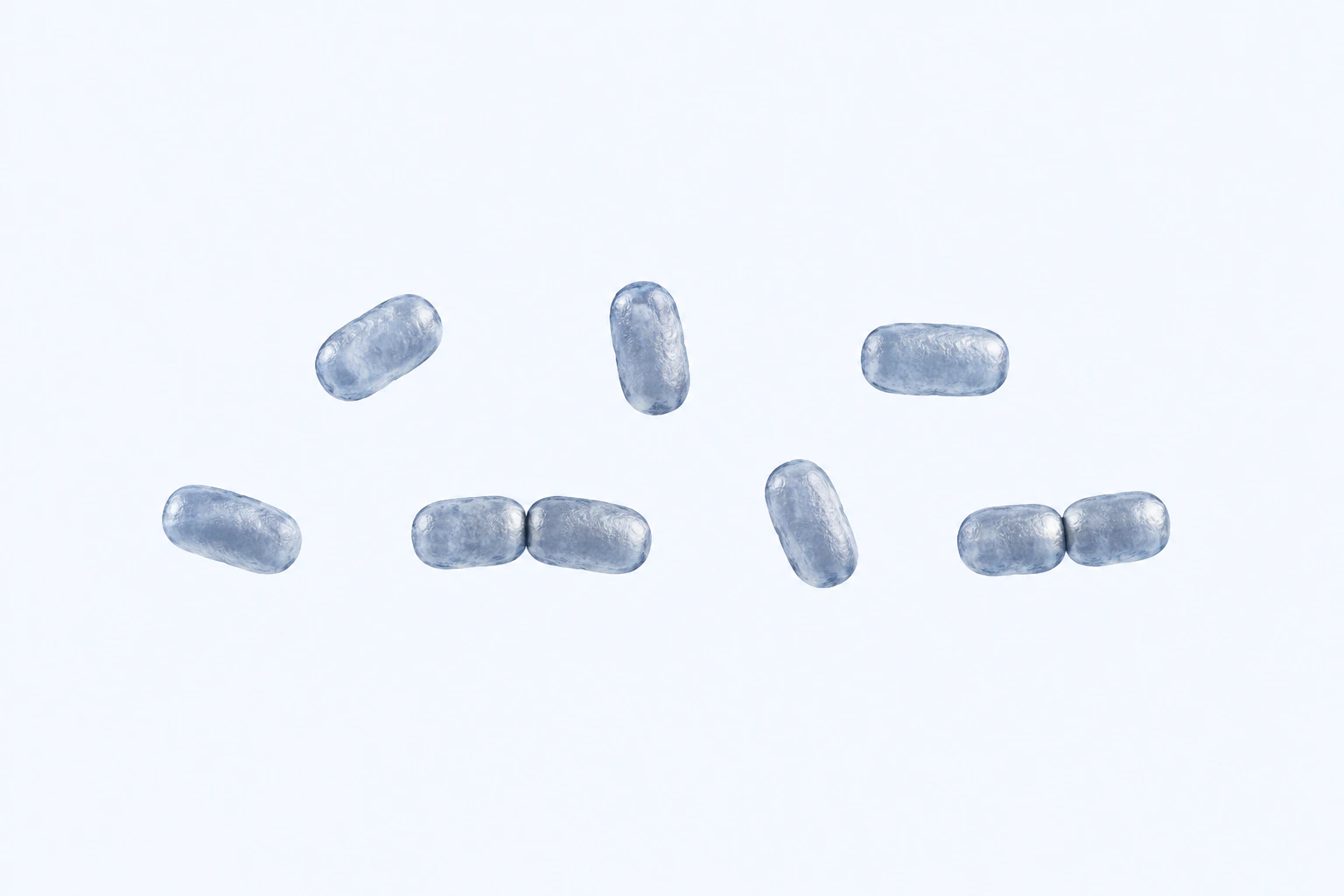
Type-species-anchored Mediterraneibacter compact coccobacillary-to-short-rod forms, shown as nine bodies in five single and two paired groupings. This genus-level scientific reconstruction is representative, non-universal, non-diagnostic, and not a micrograph.
Scientific media record1 verified identifier
- Subject
- Mediterraneibactertaxon · genus
- Identifiers
- NCBITaxon:2316020
- Review
- Editorial review completeIdentifiers authority-verified · Accessibility validated · · mediterraneibacter|mediterraneibacter-morphology-v1.webp
- Digital source
- Trained-algorithmic mediaCreated with a trained generative algorithm and reviewed by WikiBiome for subject identity, scientific framing, identifiers, provenance, and accessibility.
- Scientific basis
- Mediterraneibacter — NCBI TaxonomyMediterraneibacter — LPSNMediterraneibacter massiliensis original genus descriptionMediterraneibacter nomenclatural record
- License
- CC BY-SA 4.0Created
A Gram-positive, obligate anaerobic genus within the family Lachnospiraceae (phylum Firmicutes) that was recently reclassified from Ruminococcus based on phylogenomic evidence.
The key species Mediterraneibacter faecis (formerly Ruminococcus gnavus clade relatives) is a common gut commensal, but the genus has gained clinical attention through two distinct findings: its enrichment in PCOS fecal microbiota that causally transfers the PCOS phenotype via FMT, and its rapid cycling with dietary changes that mirrors LDL cholesterol fluctuations.
Evidence map5 cited passagesInspect provenance +
One of the most striking findings about Mediterraneibacter is its rapid response to dietary changes. Repeatedly adopting and abandoning a healthy dietary pattern leads to cycling in Mediterraneibacter (and collinsella) abundance, which is directly mirrored by cycling in LDL-C and total cholesterol. This suggests:
Mediterraneibacter is enriched in PCOS fecal microbiota, and FMT from PCOS patients to germ-free mice recapitulates the full PCOS phenotype (insulin resistance, ovarian dysfunction, obese-like phenotype). The transferred microbiome was enriched in Mediterraneibacter, phocaeicola, oscillospiraceae, and Lawsonibacter. Whether Mediterraneibacter is a driver or
The dietary cycling data linking Mediterraneibacter to LDL-C fluctuations suggests a role in cardiovascular risk modulation, though this is observational and mechanism-level evidence is limited.
(animal model/FMT)—PCOS phenotype transfer via microbiota enriched in Mediterraneibacter.
(review)—Dietary cycling of Mediterraneibacter mirroring cholesterol fluctuations.
Contents
1. Taxonomy2. Metal Dependencies3. Key Enzymes and Metabolic Features4. Ecological Role5. Conditions Associated6. Key Studies7. Open Questions8. Cross-ReferencesTaxonomy#
Genus Mediterraneibacter, family Lachnospiraceae, order Lachnospirales (or Clostridiales in traditional schemes), class Clostridia, phylum Firmicutes. Key species: M. faecis, M. gnavus (the relationship with Ruminococcus gnavus requires careful disambiguation depending on the classification scheme used). Named for the Mediterranean region; first characterized from Mediterranean population gut microbiomes.
The reclassification underscores the ongoing taxonomic revision within Lachnospiraceae, where many "Ruminococcus" species are being reassigned to new genera based on whole-genome phylogeny.
Metal Dependencies#
Iron. Standard iron-sulfur cluster requirements for anaerobic Lachnospiraceae metabolism. Ferredoxin-dependent oxidoreductases support the fermentative energy generation characteristic of the family.
Key Enzymes and Metabolic Features#
Bile salt hydrolase (BSH): Mediterraneibacter species can deconjugate bile salts, influencing bile acid composition and cholesterol metabolism. This function connects the genus to the gut-liver axis and cardiovascular health.
SCFA synthesis enzymes: As a Lachnospiraceae member, Mediterraneibacter participates in short-chain fatty acid production, though its contribution relative to other family members (Roseburia, Blautia, Coprococcus) remains to be quantified.
Ecological Role#
In the Healthy Gut#
Mediterraneibacter is a moderate-abundance member of the gut microbiota in individuals consuming varied diets. Its Lachnospiraceae family membership places it among the health-associated SCFA producers, though its specific functional contributions are less well characterized than those of Roseburia or Blautia.
Dietary Responsiveness#
One of the most striking findings about Mediterraneibacter is its rapid response to dietary changes. Repeatedly adopting and abandoning a healthy dietary pattern leads to cycling in Mediterraneibacter (and Collinsella) abundance, which is directly mirrored by cycling in LDL-C and total cholesterol.[1]Gut microbiota on cardiovascular diseases -- a mini review on current evidenceShouhong Zhang, Jing Li, Liping Li et al. · 2025Open reference 1 ↓
This suggests.
Mediterraneibacter abundance is acutely sensitive to diet composition. The genus's bile salt hydrolase activity may mediate the cholesterol-microbiome link. The molecular benefits of a healthy diet are transient and dependent on sustained dietary habits, partly because microbial mediators like Mediterraneibacter revert quickly.
Conditions Associated#
Polycystic Ovary Syndrome (Enriched—Causal Evidence)#
Mediterraneibacter is enriched in PCOS fecal microbiota, and FMT from PCOS patients to germ-free mice recapitulates the full PCOS phenotype (insulin resistance, ovarian dysfunction, obese-like phenotype).[2]Fecal microbiota transplantation from patients with polycystic ovary syndrome induces metabolic disorders and ovarian dysfunction in germ-free miceHuang F, Deng Y, Zhou M et al. · 2024Open reference 2 ↓ The transferred microbiome was enriched in Mediterraneibacter, Phocaeicola, Oscillospiraceae, and Lawsonibacter.
Whether Mediterraneibacter is a driver or passenger in PCOS pathogenesis remains to be determined.
Cardiovascular Risk#
The dietary cycling data linking Mediterraneibacter to LDL-C fluctuations[1]Gut microbiota on cardiovascular diseases -- a mini review on current evidenceShouhong Zhang, Jing Li, Liping Li et al. · 2025Open reference 1 ↓ suggests a role in cardiovascular risk modulation, though this is observational and mechanism-level evidence is limited.
Key Studies#
[2]Fecal microbiota transplantation from patients with polycystic ovary syndrome induces metabolic disorders and ovarian dysfunction in germ-free miceHuang F, Deng Y, Zhou M et al. · 2024Open reference 2 ↓ (animal model/FMT)—PCOS phenotype transfer via microbiota enriched in Mediterraneibacter.[1]Gut microbiota on cardiovascular diseases -- a mini review on current evidenceShouhong Zhang, Jing Li, Liping Li et al. · 2025Open reference 1 ↓ (review)—Dietary cycling of Mediterraneibacter mirroring cholesterol fluctuations.
Open Questions#
Unresolved questions identified by the current evidence record.
01Is Mediterraneibacter a driver or passenger in PCOS?+
The FMT evidence demonstrates that the PCOS microbiota (including Mediterraneibacter) transfers the phenotype, but single-species colonization experiments would be needed to establish a direct causal role.
02Does the bile salt hydrolase activity of Mediterraneibacter mediate the LDL-C cycling?+
BSH activity alters the bile acid pool, which regulates cholesterol absorption and hepatic cholesterol synthesis.
03How does the reclassification affect interpretation of existing Ruminococcus literature?+
Many studies reporting "Ruminococcus" in disease associations may actually describe Mediterraneibacter species.
Cross-References#
- Phocaeicola—co-enriched in PCOS FMT microbiota
- Polycystic Ovary Syndrome—PCOS phenotype transfer via enriched microbiota
- Lachnospiraceae—parent family
- Ruminococcus gnavus—related taxonomic revision; disambiguation required
- Collinsella—co-cycling with dietary changes in CVD context
- Bile Acid Metabolism—BSH activity connecting Mediterraneibacter to cholesterol homeostasis
References 2
Numbered by first appearance in the article, then reconciled with its declared source list.
- 1
Shouhong Zhang, Jing Li, Liping Li et al. (2025). Gut microbiota on cardiovascular diseases -- a mini review on current evidence. Frontiers in Microbiology.
- 2
Huang F, Deng Y, Zhou M et al. (2024). Fecal microbiota transplantation from patients with polycystic ovary syndrome induces metabolic disorders and ovarian dysfunction in germ-free mice. BMC Microbiology.
Article network
Connect the evidence
Publicly readable discussion by ORCID-authenticated researchers. Questions, interpretation, methods, corrections, and new evidence stay attached to this record.
No discussion yet. Start with a precise question or a source-backed observation.
Activity and accepted changes
Accepted researcher context, editorial status, public discussion, and upstream Git revisions are shown together. Pending, declined, and withdrawn proposals remain private.
- published revision
massive wiki expansion: 149 stubs fixed, 100+ new pages, Rule 15 scan, keystone papers
WikiBiome Deploy Bot · +10 −10
Inspect exact Git diff ↗ - published revision
nightly maintenance: 94 stub demotions, 181 source_count fixes, 22 auto-discovered stubs, 5 adversarial audits, 3 boundary fixes, 3 evidence-level corrections
WikiBiome Deploy Bot · +2 −0
Inspect exact Git diff ↗ - published revision
cycle 1: health check + lint fixes + 8 ingests + 2 stubs + gestational-diabetes signature
WikiBiome Deploy Bot · +1 −1
Inspect exact Git diff ↗ - published revision
pre-overnight checkpoint 2026-04-18
WikiBiome Deploy Bot · +84 −0
Inspect exact Git diff ↗