
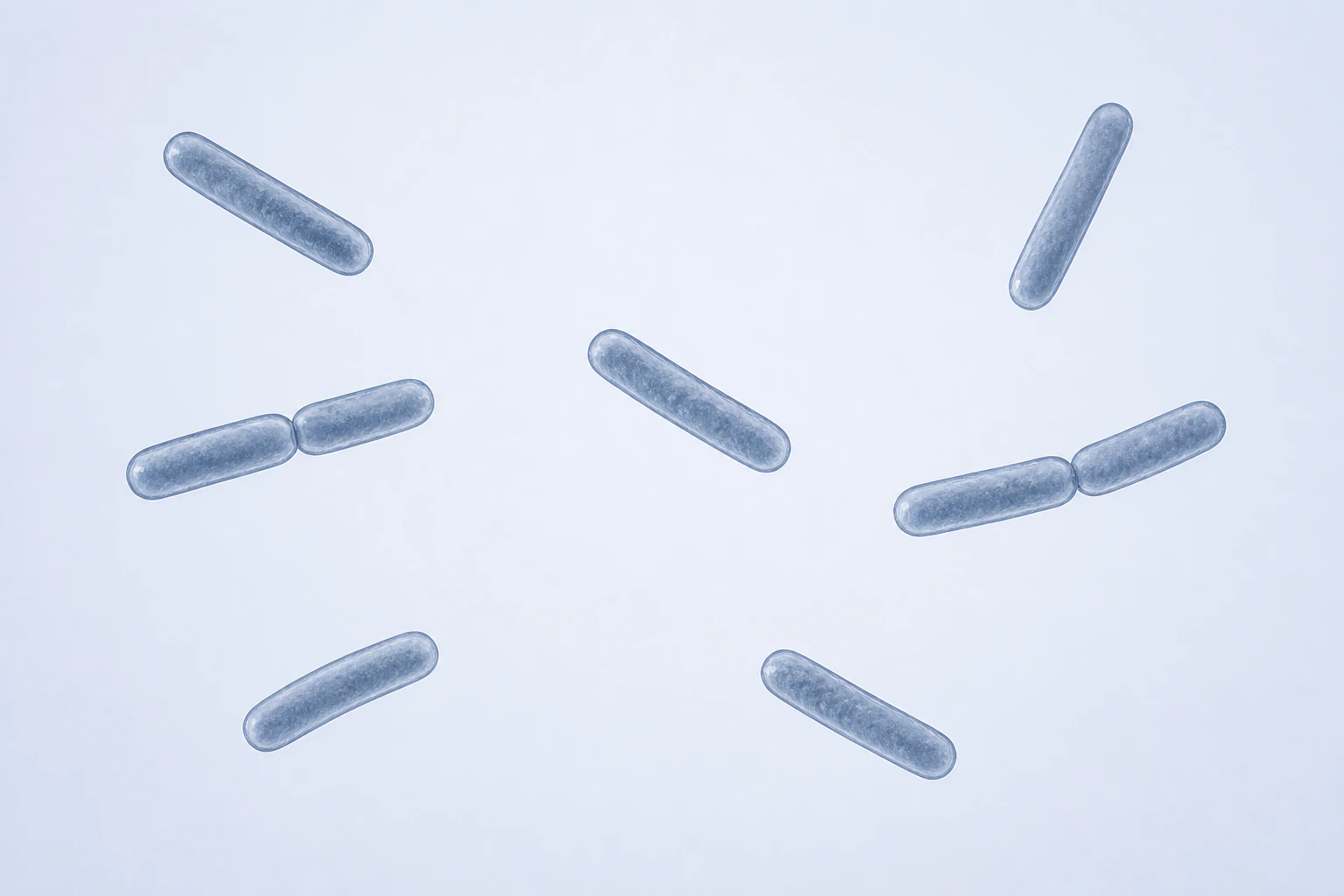
Representative Eggerthella lenta rod forms, shown as nine bodies in five single and two paired groupings. This reconstruction is non-diagnostic and not a micrograph.
Scientific media record1 verified identifier
- Subject
- Eggerthella lentataxon · species
- Identifiers
- NCBITaxon:84112
- Review
- Editorial review completeIdentifiers authority-verified · Accessibility validated · · eggerthella-lenta|eggerthella-lenta-morphology-v1.webp
- Digital source
- Trained-algorithmic mediaCreated with a trained generative algorithm and reviewed by WikiBiome for subject identity, scientific framing, identifiers, provenance, and accessibility.
- Scientific basis
- Eggerthella lenta — NCBI TaxonomyEggerthella lenta — LPSNEggerthella lenta type strain — BacDiveEggerthella lenta review
- License
- CC BY-SA 4.0Created
A Gram-positive obligate anaerobe and key estrobolome member that links metabolic Dysbiosis to hormone-driven diseases, particularly Endometriosis. E. lenta is remarkable for its ability to inactivate cardiac glycosides (like digoxin) and to produce beta-glucuronidase, the enzyme responsible for deconjugating and reactivating estrogen in the gut.
Its abundance modulates systemic estrogen exposure through the enterohepatic circulation—making E. lenta a central node in the estrogen recirculation axis. Critical cofactors are iron and molybdenum, both of which are elevated in endometriosis.
Contents
1. The Estrobolome and Beta-Glucuronidase2. The Endometriosis Connection3. Cardiac Glycoside Inactivation4. Iron Biology and Pathogenic Context5. Ecological Interactions6. Molybdenum Metabolism7. Ecological Modulators8. ConnectionsThe Estrobolome and Beta-Glucuronidase#
The Enterohepatic Estrogen Circulation#
The human estrogen recirculation system:
- Hepatic conjugation: The liver conjugates estrogen (E2) to estrogen glucuronide (E2G) via UDP-glucuronosyltransferase (UGT).
- Biliary excretion: E2G is excreted into the bile and reaches the intestinal lumen.
- Bacterial deconjugation: Intestinal bacteria expressing beta-glucuronidase cleave E2G back to free E2.
- Reabsorption: Free E2 is reabsorbed across the intestinal epithelium and returns to systemic circulation.
- Cycle: Free E2 re-enters the liver for re-conjugation, extending the half-life and increasing cumulative estrogen exposure.
Eggerthella lenta as Estrobolome Node#
E. lenta is a prolific beta-glucuronidase producer and a core estrobolome member alongside Bacteroides fragilis, Clostridium, and other anaerobes. Higher E. lenta abundance correlates with. Elevated urinary estrogen metabolites (indicating increased reabsorption and systemic circulation).
Higher serum estradiol in women, even when controlling for ovarian production. Enrichment in estrogen-dependent diseases: endometriosis, PCOS, breast cancer.
Iron and Molybdenum for Beta-Glucuronidase#
Beta-glucuronidase (EC 3.2.1.31) is an iron-containing metalloenzyme; some isoforms also contain molybdenum cofactors in regulatory or catalytic domains. Iron availability directly modulates E. lenta growth and beta-glucuronidase expression. Molybdenum is a cofactor for multiple oxidoreductases and may be rate-limiting for E. lenta beta-glucuronidase activity.
In endometriosis, both iron and molybdenum are often elevated (from bleeding and tissue Metal-Driven Inflammation), creating conditions favoring E. lenta expansion and maximal estrogen deconjugation.
The Endometriosis Connection#
The Endometriosis Microbiome Signature#
Endometriosis is characterized by. Elevated estrogen (both systemic and intra-lesional, partly driven by β-glucuronidase activity). Enriched estrobolome members including Eggerthella lenta, Bacteroides fragilis, and other β-glucuronidase producers.
Elevated iron and hemoglobin degradation products from ectopic endometrial bleeding.
Elevated molybdenum (elevated alongside iron in inflammatory lesions). Reduced gut barrier function (elevated zonula occludens-1 permeability; altered tight junction protein expression).
Estrogen Feedback on Dysbiosis#
Elevated systemic estrogen (driven by E. lenta-mediated estrogen reabsorption) perpetuates dysbiosis. Estrogen is bacteriostatic to many commensals Faecalibacterium prausnitzii, Bifidobacterium. Estrogen favors estrobolome members like E. lenta.
This creates a vicious cycle: E. lenta enrichment → increased estrogen reabsorption → higher systemic estrogen → further suppression of non-estrobolome commensals → E. lenta dominance solidifies.
Dysbiosis and Intestinal Permeability in Endometriosis#
Loss of Faecalibacterium prausnitzii and Akkermansia muciniphila (suppressed by elevated estrogen) → reduced Butyrate production → loss of HDAC inhibition → downregulation of tight junction genes (claudins, ZO-1, occludin).
Increased intestinal permeability allows elevated LPS translocation. Systemic LPS activates TLR4 on macrophages and dendritic cells → IL-6, IL-8, IL-17 production → perpetuates both endometriosis lesion inflammation and gut dysbiosis.
Cardiac Glycoside Inactivation#
Digoxin Metabolism#
E. lenta (and some other Gram-positive anaerobes) encodes cardiac glycoside-inactivating enzymes that metabolize digoxin and other cardiac glycosides to inactive metabolites.
This has important clinical pharmacokinetics implications: patients with high E. lenta abundance have reduced digoxin bioavailability and may require higher doses to achieve therapeutic levels.
Conversely, antibiotic treatment that reduces E. lenta can precipitate digoxin toxicity if the dose is not adjusted.
Enzyme Substrate and Metal Cofactors#
The mechanism of digoxin inactivation likely involves hydroxylation or other redox modifications. These reactions typically require metal cofactors (iron, molybdenum) and electron donors. This activity is another example of how E. lenta metabolism is sensitive to metal availability.
Iron Biology and Pathogenic Context#
Iron Acquisition#
E. lenta possesses iron uptake systems and requires iron for. Beta-glucuronidase and other redox enzymes. Cytochrome c oxidases for anaerobic respiration.
Ribonucleotide reductase for nucleotide synthesis. In endometriosis, where hemoglobin from bleeding ectopic lesions provides abundant iron/heme, E. lenta proliferates.
Iron as a Selective Pressure#
High-iron conditions in endometriosis lesions select for iron-dependent pathobionts like E. lenta over commensals with lower iron demand. This again exemplifies the metals as selective pressures principle: elevated iron in endometriosis tissue selects for dysbiotic estrobolome members.
Ecological Interactions#
Estrobolome Community#
E. lenta operates within a broader estrobolome consortium including. Bacteroides fragilis—also produces beta-glucuronidase; can be commensal or pathobiont depending on toxigenic strain. Clostridium species (e.g., C. scindens)—deconjugate estrogen via different mechanisms; produce estrobolome-specific metabolites. Blautia and other Firmicutes—some strains produce beta-glucuronidase; context-dependent roles.
Dysbiotic Enrichment Context#
E. lenta enrichment is observed alongside Prevotella copri, Ruminococcus gnavus, and Bacteroides vulgatus in endometriosis microbiome profiles. Depleted commensals Faecalibacterium prausnitzii, Akkermansia muciniphila, Bifidobacterium that would normally compete for ecological niches or produce anti-inflammatory metabolites are reduced.
Molybdenum Metabolism#
Molybdenum Cofactor (Moco)#
E. lenta, like all anaerobes with oxidoreductases, requires molybdenum cofactor (Moco) for multiple enzymes. Moco is synthesized de novo by bacteria from molybdenum (molybdenum (Mo)) and organic precursors. Molybdenum availability may be rate-limiting for E. lenta beta-glucuronidase expression, particularly in endometriosis where molybdenum elevation is part of the metallomic signature.
Ecological Modulators#
Competitive Displacement#
Promoting Faecalibacterium prausnitzii, Akkermansia muciniphila, and Bifidobacterium through prebiotic substrates shifts ecological balance away from E. lenta dominance, reducing beta-glucuronidase-mediated estrogen deconjugation. Restoring SCFA diversity (especially butyrate) strengthens tight junction integrity and reduces LPS-driven inflammatory signaling.
Beta-Glucuronidase Pathway Modulation#
High-insoluble-fiber substrates reduce beta-glucuronidase activity in the gut lumen, simultaneously limiting estrogen recirculation and removing a metabolic advantage that sustains E. lenta populations.
Metal Modulation#
Iron restriction: Reducing bioavailable iron removes a key growth substrate for E. lenta and other iron-dependent pathobionts.
Molybdenum as rate-limiter: Molybdenum cofactor (Moco) is required for E. lenta beta-glucuronidase expression. If molybdenum availability is rate-limiting, restricting this metal could suppress virulence enzyme activity—a hypothesis requiring further investigation.
Connections#
- Iron—iron-dependent for beta-glucuronidase and core metabolism; elevated iron in endometriosis selects for E. lenta
- Molybdenum—cofactor for redox enzymes and beta-glucuronidase regulation; elevated in endometriosis
- Endometriosis—enriched in endo microbiome; beta-glucuronidase drives estrogen recirculation and lesion inflammation
- E. lenta beta-glucuronidase extends estrogen half-life; elevated estrogen selectively favors E. lenta over competitors
- Estrobolome—core estrobolome member alongside Bacteroides fragilis and Clostridium
- Beta-Glucuronidase—key virulence enzyme; iron and molybdenum cofactors modulate activity
- Enterohepatic Circulation—E. lenta extends estrogen recirculation via deconjugation
- dysbiosis—enriched in endometriosis; depletes commensal barrier-protective taxa
- Faecalibacterium prausnitzii—co-depleted with E. lenta enrichment; loss of butyrate-mediated tight junction support
- E. lenta inactivates digoxin; clinical pharmacokinetic implications
- nutritional immunity—dysbiosis with E. lenta enrichment compromises tight junctions via loss of SCFA
References 8
Numbered by first appearance in the article, then reconciled with its declared source list.
- 1
Jiang L, Fei H, Tong J et al. (2021). Hormone Replacement Therapy Reverses Gut Microbiome and Serum Metabolome Alterations in Premature Ovarian Insufficiency. Frontiers in Endocrinology.
- 2
Goudman et al. (2024). Goudman 2024 — Gut Dysbiosis in Chronic Pain (Meta-Analysis). Frontiers in Immunology.
- 3
Liu H, Liu H, Liu C et al. (2022). Liu et al. 2022 — Gut Microbiome and the Role of Metabolites in the Study of Graves' Disease. Frontiers in Molecular Biosciences.
- 4
Sachiko Miyake, Sangwan Kim, Wataru Suda et al. (2015). Dysbiosis in the Gut Microbiota of Patients with Multiple Sclerosis, with a Striking Depletion of Species Belonging to Clostridia XIVa and IV Clusters. PLoS ONE.
- 5
Luyun Fan, Junru Chen, Qi Zhang et al. (2025). Fecal microbiota transplantation for hypertension: an exploratory, multicenter, randomized, blinded, placebo-controlled trial. Microbiome.
- 6
Hooi-Leng Ser, Siu-Jung Au Yong, Mohamad Nasir Shafiee et al. (2023). Ser 2023 — Current Updates on the Role of Microbiome in Endometriosis: A Narrative Review. Microorganisms.
- 7
Matteo Bronzini, Alessandro Maglione, Rachele Rosso et al. (2023). Feeding the gut microbiome: impact on multiple sclerosis. Frontiers in Immunology.
- 8
Esraa Mohsen, Hesham Haffez, Sandra Ahmed et al. (2025). Multiple Sclerosis: A Story of the Interaction Between Gut Microbiome and Components of the Immune System. Molecular Neurobiology.
Article network
Mentioned here 18
Pages linking here 13
Connect the evidence
Publicly readable discussion by ORCID-authenticated researchers. Questions, interpretation, methods, corrections, and new evidence stay attached to this record.
No discussion yet. Start with a precise question or a source-backed observation.
Activity and accepted changes
Accepted researcher context, editorial status, public discussion, and upstream Git revisions are shown together. Pending, declined, and withdrawn proposals remain private.
- published revision
Backfill inflammation concept links
Karen Pendergrass · +1 −1
Inspect exact Git diff ↗ - published revision
Complete corpus-wide Dysbiosis linking
Karen Pendergrass · +2 −2
Inspect exact Git diff ↗ - published revision
Complete Tight junctions contextual coverage
Karen Pendergrass · +1 −1
Inspect exact Git diff ↗ - published revision
massive wiki expansion: 149 stubs fixed, 100+ new pages, Rule 15 scan, keystone papers
WikiBiome Deploy Bot · +38 −32
Inspect exact Git diff ↗ - published revision
nightly maintenance: 94 stub demotions, 181 source_count fixes, 22 auto-discovered stubs, 5 adversarial audits, 3 boundary fixes, 3 evidence-level corrections
WikiBiome Deploy Bot · +3 −0
Inspect exact Git diff ↗ - published revision
Citation integrity pass: 38 citations added, 24 parenthesized citations fixed
WikiBiome Deploy Bot · +2 −2
Inspect exact Git diff ↗ - published revision
Adversarial audit fixes: confidence downgrades, disclaimers, STOP safety, entity cleanup
WikiBiome Deploy Bot · +8 −8
Inspect exact Git diff ↗ - published revision
WikiBiome update — 2026-04-15 17:23
WikiBiome Deploy Bot · +11 −11
Inspect exact Git diff ↗ - published revision
wiki: bulk entity upgrades, new article pages, and site regeneration
WikiBiome Deploy Bot · +6 −0
Inspect exact Git diff ↗ - published revision
WikiBiome update — integrity fixes, metallomic diet pages, cross-condition analyses
WikiBiome Deploy Bot · +3 −1
Inspect exact Git diff ↗ - published revision
WikiBiome update — 2026-04-10 17:16
WikiBiome Deploy Bot · +151 −0
Inspect exact Git diff ↗