
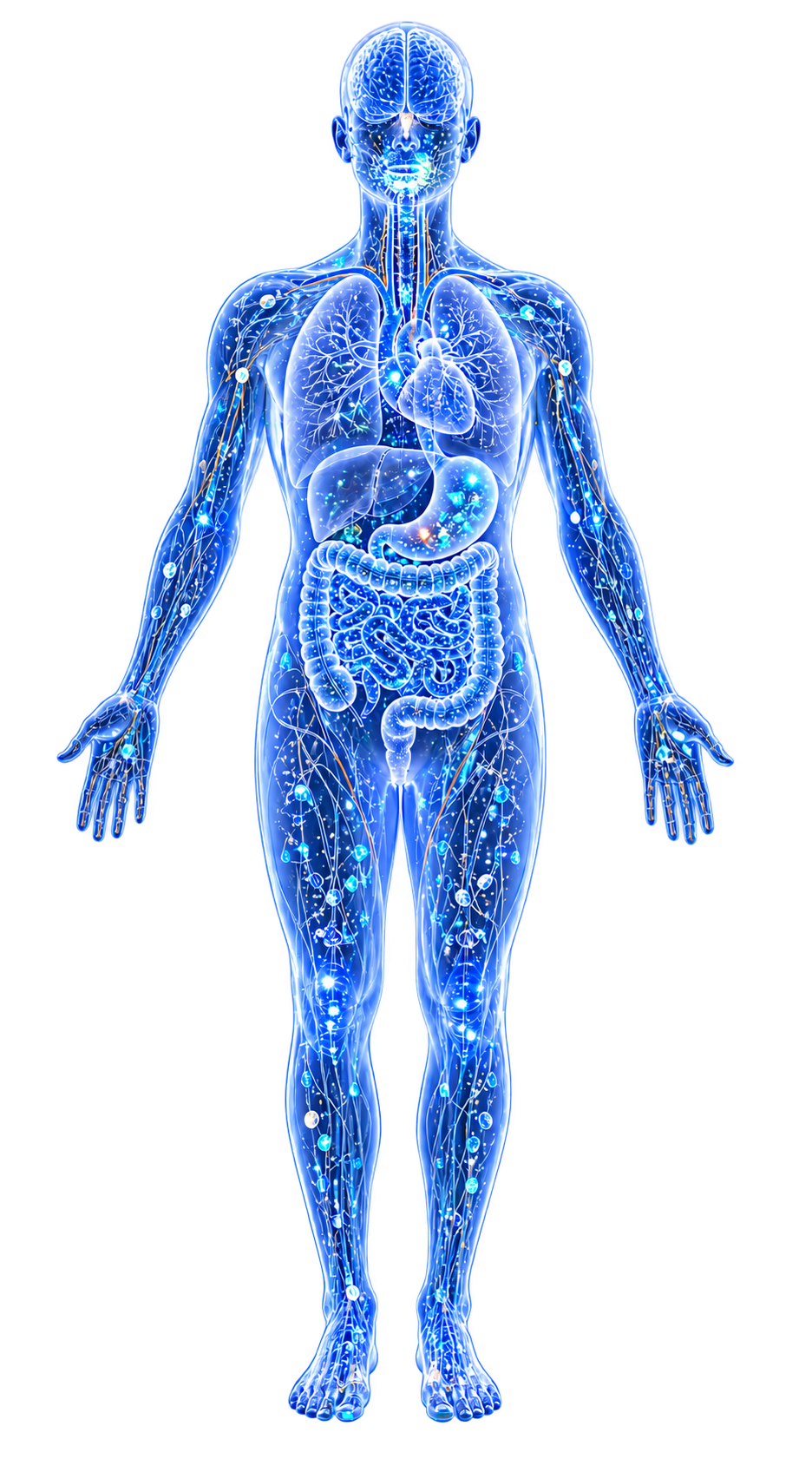
Autoimmune thyroid diseases (AITDs)—Hashimoto's Thyroiditis and Graves' Disease—are the most common organ-specific autoimmune conditions, affecting 5-10% of the global population.
The thyroid gland sits at a remarkable intersection of metal biology and immune regulation: it concentrates more Selenium than any other organ, depends on Iodine for hormone synthesis, requires Iron for thyroperoxidase activity, and is vulnerable to displacement by toxic metals that exploit these essential mineral pathways.
The emerging gut-thyroid axis adds another dimension: the Gut Microbiome modulates thyroid function through nutrient absorption, immune education, and metabolite production.
Evidence map7 cited passagesInspect provenance +
Selenium deficiency is an independent risk factor for both Graves' disease and Graves' ophthalmopathy:
200 ug Se/day for 6 months in a double-blind RCT significantly decreased Graves' ophthalmopathy severity, improved quality of life, and prevented disease worsening (randomized-controlled-trial).
Se supplementation reduces anti-TPO antibodies by 40% in those with levels 1200 IU/mL.
Se protects against cadmium toxicity by binding Cd and facilitating biliary excretion.
Se has an antagonistic relationship with mercury, providing protective effects when Hg levels are elevated.
Prevalence of autoimmune thyroiditis increases after salt iodization programs.
| Metal | Mechanism | Evidence | |-------|-----------|----------| | cadmium | Displaces zinc in thyroid receptors; blocks Se protective effects | Cd exposure correlates with anti-TPO elevation | | mercury | Binds selenocysteine residues in deiodinases, blocking T4→T3 conversion | Se-Hg antagonism is protective | | lead | Disrupts hypothalamic-pituitary-thyro
Contents
1. The Mineral Dependencies2. Toxic Metal Interference3. The Gut-Thyroid Axis4. Associated Conditions5. Open Questions6. Cross-ReferencesThe Mineral Dependencies#
Selenium—The Critical Thyroid Element#
The thyroid's selenium dependency is mediated by three selenoprotein families.
Deiodinases (DIO1, DIO2, DIO3): Convert T4 to active T3 (or inactive rT3). Without selenium, thyroid hormone activation fails regardless of hormone production. Glutathione peroxidases (GPx): Protect thyrocytes from hydrogen peroxide generated during thyroid hormone synthesis.
The thyroid generates more H2O2 than almost any other tissue.
Thioredoxin reductases: Maintain intracellular redox balance in thyrocytes.
Selenium deficiency is an independent risk factor for both Graves' disease and Graves' ophthalmopathy.[1]McGregor Brock 2015 — The Role of Selenium in Thyroid Autoimmunity: A ReviewMcGregor Brock · 2015Open reference 1 ↓ 200 ug selenium (Se)/day for 6 months in a double-blind RCT significantly decreased Graves' ophthalmopathy severity, improved quality of life, and prevented disease worsening (randomized-controlled-trial).[1]McGregor Brock 2015 — The Role of Selenium in Thyroid Autoimmunity: A ReviewMcGregor Brock · 2015Open reference 1 ↓
selenium supplementation reduces anti-TPO antibodies by 40% in those with levels >1200 IU/mL.[1]McGregor Brock 2015 — The Role of Selenium in Thyroid Autoimmunity: A ReviewMcGregor Brock · 2015Open reference 1 ↓ selenium protects against Cadmium toxicity by binding cadmium (Cd) and facilitating biliary excretion.[2]Kravchenko 2023 — Thyroid hormones and minerals in immunocorrection of disorders in autoimmune thyroid diseasesKravchenko V, Zakharchenko T · 2023Open reference 2 ↓
selenium has an antagonistic relationship with Mercury, providing protective effects when mercury (Hg) levels are elevated.[2]Kravchenko 2023 — Thyroid hormones and minerals in immunocorrection of disorders in autoimmune thyroid diseasesKravchenko V, Zakharchenko T · 2023Open reference 2 ↓
Iron#
Iron deficiency impairs thyroid function through multiple mechanisms. iron (Fe) is required for thyroperoxidase (TPO) activity—the enzyme that catalyzes thyroid hormone synthesis. iron deficiency reduces T3/T4 production and increases TSH.
iron has immunomodulating effects on M1/M2 macrophage polarization relevant to autoimmune regulation.
The Nutritional Immunity (Metal Sequestration) question applies here: is iron deficiency in AITD true deficiency, or is it host-mediated sequestration? Hepcidin measurement can distinguish these states.
Zinc#
Zinc is required for thyroid hormone receptor binding and gene expression. zinc (Zn) deficiency impairs immune function and increases autoimmune susceptibility. copper (Cu)/zinc ratio imbalance affects thyroid function independently.
Iodine—The Double-Edged Sword#
Iodine is essential for thyroid hormone synthesis but excess iodine can paradoxically trigger autoimmune thyroiditis. Excess iodine increases thyroglobulin immunogenicity. Iodine excess may directly damage thyrocytes through Oxidative Stress.
Prevalence of autoimmune thyroiditis increases after salt iodization programs.[3]Editorial: How can diet impair thyroid function?Mian C, Foresta C, Vermiglio F · 2022Open reference 3 ↓
Toxic Metal Interference#
Heavy Metals exploit the thyroid's mineral dependencies:
| Metal | Mechanism | Evidence |
|---|---|---|
| Cadmium | Displaces zinc in thyroid receptors; blocks selenium (Se) protective effects | cadmium (Cd) exposure correlates with anti-TPO elevation |
| Mercury | Binds selenocysteine residues in deiodinases, blocking T4→T3 conversion | selenium-mercury (Hg) antagonism is protective[2]Kravchenko 2023 — Thyroid hormones and minerals in immunocorrection of disorders in autoimmune thyroid diseasesKravchenko V, Zakharchenko T · 2023Open reference 2 ↓ |
| Lead | Disrupts hypothalamic-pituitary-thyroid axis signaling | lead (Pb) correlates with subclinical hypothyroidism |
| Nickel | Thyroid disruption documented | See Nickel for details |
This is a textbook example of Mis-Metallation (Karen's Brain Primitive 3): toxic metals entering through the same channels and binding sites that essential minerals use, disabling thyroid function from within.
The Gut-Thyroid Axis#
The gut microbiome influences thyroid autoimmunity through several mechanisms.
Nutrient absorption: Selenium, iodine, iron, and zinc are all absorbed in the gut. Dysbiosis-driven malabsorption compounds deficiency. Immune education: Gut microbiome composition shapes Th17/Treg balance, directly relevant to autoimmune tolerance. Molecular mimicry: Bacterial proteins with structural similarity to thyroid antigens may trigger cross-reactive immune responses.
SCFA-mediated immune regulation: Depletion of SCFA-producing bacteria (Faecalibacterium, Lachnospiraceae) reduces Treg induction and shifts toward pro-inflammatory Th17 dominance.
Microbiome signatures in AITD include. Depleted: Faecalibacterium prausnitzii, Lachnospiraceae, Bifidobacterium—the core SCFA-producing, anti-inflammatory community. Enriched: Fusobacterium, Streptococcus, Proteobacteria—pro-inflammatory, often metal-tolerant taxa.
Associated Conditions#
Thyroid autoimmunity clusters with other autoimmune and metal-related conditions. Celiac Disease: 4-5x increased prevalence of celiac among AITD patients; shared selenium and iron malabsorption Celiac Disease. Type 1 Diabetes: Shared HLA-DQ associations. Inflammatory Bowel Disease (IBD): MR evidence for Graves'-IBD comorbidity Graves' Disease.
Depression: Shared lead (Pb), iron (Fe), selenium (Se) associations and gut-brain axis disruption.
Open Questions#
Unresolved questions identified by the current evidence record.
01Does environmental metal exposure (cadmium (Cd), mercury (Hg), lead (Pb)) increase AITD incidence at the population level?+
The current WikiBiome record identifies this as an unresolved evidence gap.
02Can selenium supplementation prevent AITD onset in selenium-deficient populations?+
The current WikiBiome record identifies this as an unresolved evidence gap.
03What is the optimal selenium (Se):mercury (Hg) and selenium:cadmium (Cd) ratio for thyroid protection?+
The current WikiBiome record identifies this as an unresolved evidence gap.
04Does microbiome-targeted therapy (probiotics restoring SCFA producers) improve AITD outcomes?+
The current WikiBiome record identifies this as an unresolved evidence gap.
05Can iodine-induced thyroiditis be prevented by concurrent selenium supplementation?+
The current WikiBiome record identifies this as an unresolved evidence gap.
Cross-References#
- Graves' Disease—hyperthyroid AITD with detailed metal and microbiome analysis
- Hashimoto's Thyroiditis—hypothyroid AITD
- Selenium—critical thyroid selenoproteins
- Iodine—essential but double-edged
- Iron—TPO cofactor
- Cadmium—thyroid receptor displacement
- Mercury—selenocysteine binding in deiodinases
- Mis-Metallation—toxic metal entry through essential mineral pathways
- Nutritional Immunity (Metal Sequestration)—iron sequestration vs. true deficiency
- Autoimmunity—broader autoimmune framework
References 4
Numbered by first appearance in the article, then reconciled with its declared source list.
- 1
McGregor Brock (2015). McGregor Brock 2015 — The Role of Selenium in Thyroid Autoimmunity: A Review. Journal of Restorative Medicine.
- 2
★Kravchenko V, Zakharchenko T (2023). Kravchenko 2023 — Thyroid hormones and minerals in immunocorrection of disorders in autoimmune thyroid diseases. Frontiers in Endocrinology.
- 3
Mian C, Foresta C, Vermiglio F (2022). Editorial: How can diet impair thyroid function?. Frontiers in Endocrinology.
- 4
★Brylinski L, Kostelecka K, Wolinski F et al. (2025). Effects of Trace Elements on Endocrine Function and Pathogenesis of Thyroid Diseases — A Literature Review. Nutrients.
Article network
Mentioned here 18
Pages linking here 2
Connect the evidence
Publicly readable discussion by ORCID-authenticated researchers. Questions, interpretation, methods, corrections, and new evidence stay attached to this record.
No discussion yet. Start with a precise question or a source-backed observation.
Activity and accepted changes
Accepted researcher context, editorial status, public discussion, and upstream Git revisions are shown together. Pending, declined, and withdrawn proposals remain private.
- published revision
Backfill heavy metals concept links
Karen Pendergrass · +1 −1
Inspect exact Git diff ↗ - published revision
Backfill oxidative stress concept links
Karen Pendergrass · +1 −1
Inspect exact Git diff ↗ - published revision
Backfill gut microbiome concept links
Karen Pendergrass · +1 −1
Inspect exact Git diff ↗ - published revision
Complete corpus-wide Dysbiosis linking
Karen Pendergrass · +1 −1
Inspect exact Git diff ↗ - published revision
massive wiki expansion: 149 stubs fixed, 100+ new pages, Rule 15 scan, keystone papers
WikiBiome Deploy Bot · +21 −21
Inspect exact Git diff ↗ - published revision
pre-overnight checkpoint 2026-04-18
WikiBiome Deploy Bot · +117 −0
Inspect exact Git diff ↗