
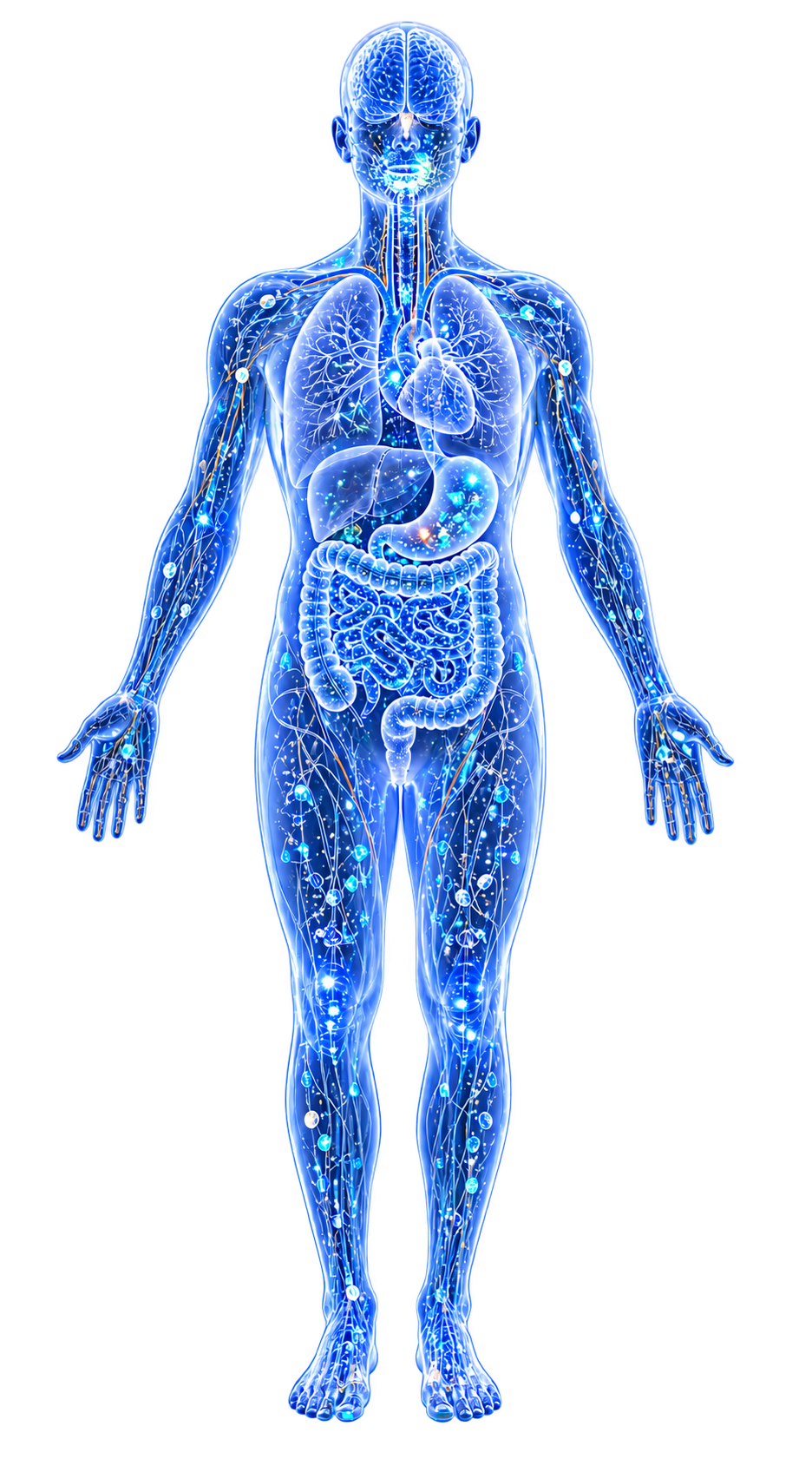
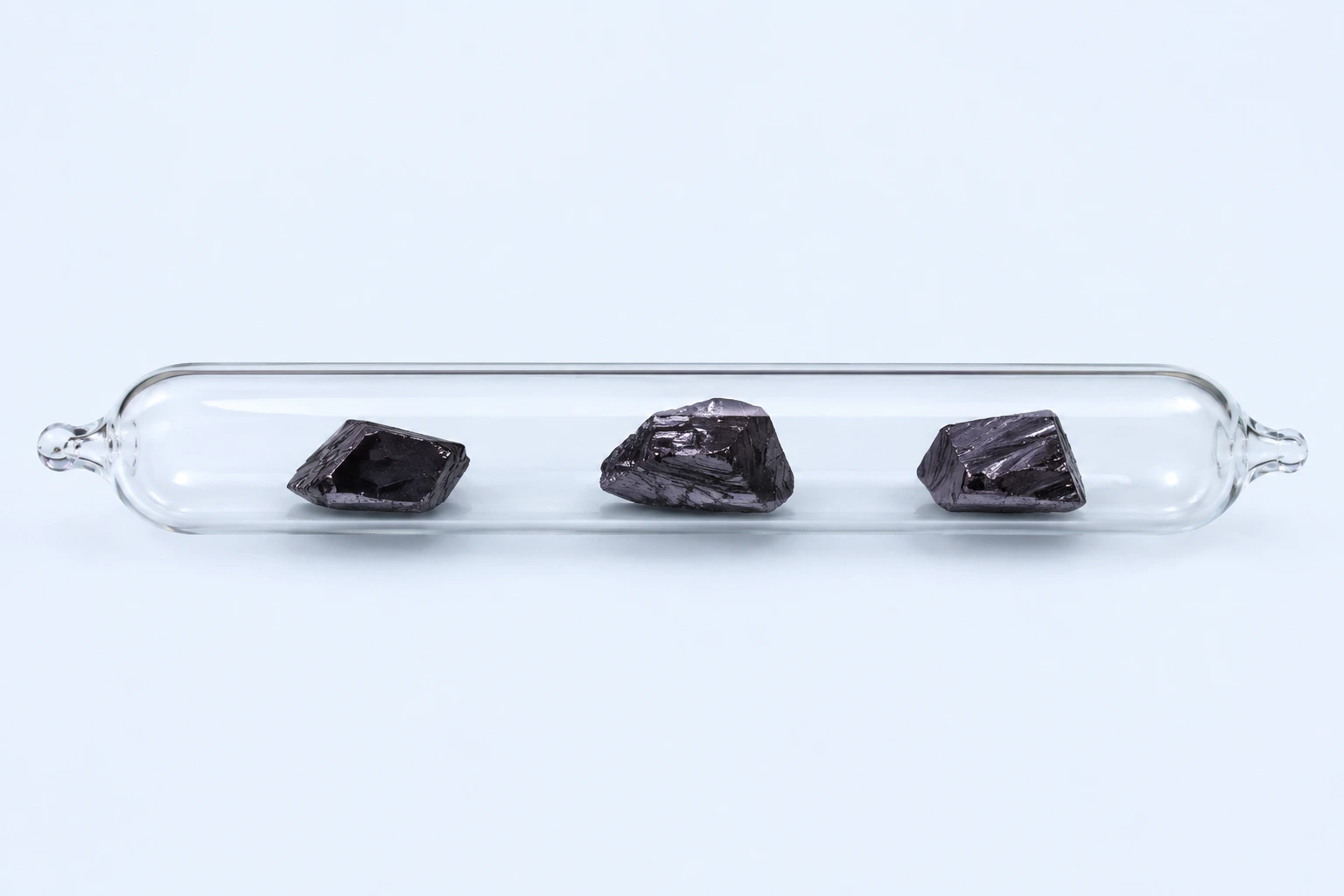
Elemental molecular iodine (I), represented as three dark lustrous crystalline pieces in a sealed ampoule. Containment does not certify purity; this is not iodide, analytical reference material, or a photograph.
Scientific media record2 verified identifiers
- Subject
- Iodineelement
- Identifiers
- Atomic number 53PubChem CID:807
- Review
- Editorial review completeIdentifiers authority-verified · Accessibility validated · · iodine|iodine-technical-specimen-v1.webp
- Digital source
- Trained-algorithmic mediaCreated with a trained generative algorithm and reviewed by WikiBiome for subject identity, scientific framing, identifiers, provenance, and accessibility.
- Scientific basis
- Iodine — PubChem ElementIodine, PubChem CID 807
- License
- CC BY-SA 4.0Created
An essential halogen required for thyroid hormone synthesis (T3 and T4). The thyroid gland is the primary iodine-concentrating organ, containing 70-80% of total body iodine.
Iodine occupies a unique position in the metallomics landscape: it is not a metal, but its interactions with metals Selenium, Iron, Cadmium, Mercury and its effects on the Gut Microbiome place it squarely within the metal-microbiome-disease framework.
Evidence map6 cited passagesInspect provenance +
This U-shaped curve is a critical interpretive constraint—iodine supplementation programs that overcorrect deficiency can trigger autoimmune thyroid disease.
The most important metal interaction for iodine. Three selenium-dependent enzyme families are required for iodine utilization:
Combined selenium-iodine deficiency produces more severe thyroid dysfunction than either alone. Selenium supplementation reduces anti-TPO antibodies in autoimmune thyroiditis.
Iron-deficient populations respond poorly to iodine supplementation.
An emerging area connecting iodine to the gut-thyroid axis:
Iodine content in food intersects with other metal exposures in complex ways:
Contents
1. Chemical Properties2. Sources of Exposure3. The U-Shaped Dose-Response4. Metal Interactions5. Iodine and the Gut Microbiome6. Dietary Considerations7. ConnectionsChemical Properties#
Halogen (Group 17); exists as iodide (I⁻) in biological systems. Absorbed in the stomach and upper small intestine with >90% efficiency. Concentrated in the thyroid via the sodium-iodide symporter (NIS); also concentrated in breast tissue, salivary glands, and gastric mucosa.
Normal serum iodine: 40-80 μg/L; urinary iodine concentration (UIC) is the primary population biomarker.
Sources of Exposure#
Dietary#
Seafood: Highest natural source (cod: ~99 μg per 3 oz; seaweed: 16-2,984 μg per sheet depending on type). Dairy: Iodophor sanitizers in dairy processing contribute significantly (1 cup milk: ~56 μg). Iodized salt: 45 μg per 1/4 teaspoon (primary public health intervention against deficiency).
Eggs: ~24 μg per egg. Bread: Iodate-conditioned dough contains variable iodine.
Environmental#
Iodine content in food is highly geography-dependent—soils near coastlines have more iodine than inland/mountainous regions. Goiter belts (Alps, Himalayas, Great Lakes region historically) reflect soil iodine depletion.
The U-Shaped Dose-Response#
Iodine's relationship to health is non-linear—both deficiency and excess cause thyroid dysfunction:
| Iodine Status (UIC) | Classification | Thyroid Effect |
|---|---|---|
| <20 μg/L | Severe deficiency | Cretinism, goiter, hypothyroidism |
| 20-49 μg/L | Moderate deficiency | Goiter, subclinical hypothyroidism |
| 50-99 μg/L | Mild deficiency | Increased thyroid volume |
| 100-199 μg/L | Adequate | Optimal thyroid function |
| 200-299 μg/L | Above requirements | Risk of iodine-induced hyperthyroidism |
| >300 μg/L | Excessive | Autoimmune thyroiditis, hypothyroidism |
This U-shaped curve is a critical interpretive constraint—iodine supplementation programs that overcorrect deficiency can trigger autoimmune thyroid disease.[1]McGregor Brock 2015 — The Role of Selenium in Thyroid Autoimmunity: A ReviewMcGregor Brock · 2015Open reference 1 ↓
Metal Interactions#
Selenium-Iodine Axis#
The most important metal interaction for iodine. Three selenium-dependent enzyme families are required for iodine utilization.[1]McGregor Brock 2015 — The Role of Selenium in Thyroid Autoimmunity: A ReviewMcGregor Brock · 2015Open reference 1 ↓
Deiodinases (DIO1, DIO2, DIO3)—convert T4 to T3 (the active hormone). Without selenium, the thyroid produces T4 it cannot activate. Glutathione peroxidases (GPx)—neutralize the H₂O₂ generated during thyroid hormone synthesis.
Without selenium, iodine-driven H₂O₂ damages thyroid tissue. Thioredoxin reductases—maintain intracellular redox balance in thyrocytes.
Combined selenium-iodine deficiency produces more severe thyroid dysfunction than either alone. Selenium supplementation reduces anti-TPO antibodies in autoimmune thyroiditis.[1]McGregor Brock 2015 — The Role of Selenium in Thyroid Autoimmunity: A ReviewMcGregor Brock · 2015Open reference 1 ↓
Iron-Iodine Interaction#
Thyroid peroxidase (TPO) is an iron-dependent heme enzyme—it catalyzes the iodination of thyroglobulin. Iron deficiency impairs TPO activity, reducing iodine utilization even when iodine status is adequate. Iron-deficient populations respond poorly to iodine supplementation.[2]Kravchenko 2023 — Thyroid hormones and minerals in immunocorrection of disorders in autoimmune thyroid diseasesKravchenko V, Zakharchenko T · 2023Open reference 2 ↓
Heavy Metal Interference#
Cadmium and Mercury compete with iodide for uptake via NIS and interfere with thyroid hormone synthesis. Lead disrupts HPT (hypothalamic-pituitary-thyroid) axis signaling.
These interferences mean that populations with high heavy metal exposure may develop functional iodine insufficiency despite adequate dietary intake—the metals block iodine's biological utilization.
Iodine and the Gut Microbiome#
An emerging area connecting iodine to the gut-thyroid axis.[3]Effects of iodine intake on gut microbiota and gut metabolites in Hashimoto thyroiditis-diseased humans and miceGong B, Meng F, Wang X et al. · 2024Open reference 3 ↓
Excess iodine alters gut microbial composition—high iodine intake shifts microbiota toward increased Enterobacteriaceae and decreased Lactobacillus and Bifidobacterium. This dysbiotic pattern mirrors the Hashimoto's disease microbiome signature. The gut microbiome modulates immune tolerance—Dysbiosis may trigger the autoimmune response against TPO that defines Hashimoto's Thyroiditis.
Thyroid hormones (T3, T4) regulate gut motility; hypothyroidism slows transit time, promoting bacterial overgrowth and further dysbiosis.
Dietary Considerations#
Iodine content in food intersects with other metal exposures in complex ways.[4]Role of Food and Nutrition in Pathogenesis and Prevention of Hashimoto's ThyroiditisPuszkarz I, Guty E, Stefaniak I et al. · 2018Open reference 4 ↓
Seaweed delivers high iodine but may also contain Arsenic (especially hijiki seaweed). Dairy provides iodine with relatively low heavy metal contamination. Seafood provides iodine + selenium (protective combination) but also Mercury (depending on species).
Cruciferous vegetables contain goitrogens (thiocyanates) that competitively inhibit iodide uptake—relevant for populations eating both high-cruciferous and low-iodine diets.
Connections#
- Selenium—selenoproteins (deiodinases, GPx) protect the thyroid during iodine-mediated H₂O₂ generation
- Iron—thyroid peroxidase is iron-dependent; iron deficiency impairs iodine utilization
- Hashimoto's Thyroiditis—excess iodine intake triggers autoimmune thyroiditis
- Graves' Disease—excess iodine alters TPO epitope presentation
- Cadmium, Mercury—compete with iodide at NIS
- Gut-Metal-Microbiome Interactions—thyroid-gut axis mediates bidirectional effects on microbiome composition
- Dietary Metal-Microbiome Interactions—iodine's gut microbiome effects connect to the broader metal-diet-microbiome framework
References 4
Numbered by first appearance in the article, then reconciled with its declared source list.
- 1
McGregor Brock (2015). McGregor Brock 2015 — The Role of Selenium in Thyroid Autoimmunity: A Review. Journal of Restorative Medicine.
- 2
★Kravchenko V, Zakharchenko T (2023). Kravchenko 2023 — Thyroid hormones and minerals in immunocorrection of disorders in autoimmune thyroid diseases. Frontiers in Endocrinology.
- 3
Gong B, Meng F, Wang X et al. (2024). Effects of iodine intake on gut microbiota and gut metabolites in Hashimoto thyroiditis-diseased humans and mice. Communications Biology.
- 4
Puszkarz I, Guty E, Stefaniak I et al. (2018). Role of Food and Nutrition in Pathogenesis and Prevention of Hashimoto's Thyroiditis. Journal of Education, Health and Sport.
Article network
Mentioned here 15
Pages linking here 6
Connect the evidence
Publicly readable discussion by ORCID-authenticated researchers. Questions, interpretation, methods, corrections, and new evidence stay attached to this record.
No discussion yet. Start with a precise question or a source-backed observation.
Activity and accepted changes
Accepted researcher context, editorial status, public discussion, and upstream Git revisions are shown together. Pending, declined, and withdrawn proposals remain private.
- published revision
Backfill gut microbiome concept links
Karen Pendergrass · +1 −1
Inspect exact Git diff ↗ - published revision
Complete corpus-wide Dysbiosis linking
Karen Pendergrass · +1 −1
Inspect exact Git diff ↗ - published revision
massive wiki expansion: 149 stubs fixed, 100+ new pages, Rule 15 scan, keystone papers
WikiBiome Deploy Bot · +17 −17
Inspect exact Git diff ↗ - published revision
pre-overnight checkpoint 2026-04-18
WikiBiome Deploy Bot · +1 −1
Inspect exact Git diff ↗ - published revision
Citation integrity pass: 38 citations added, 24 parenthesized citations fixed
WikiBiome Deploy Bot · +1 −1
Inspect exact Git diff ↗ - published revision
WikiBiome update — 2026-04-15 17:23
WikiBiome Deploy Bot · +1 −1
Inspect exact Git diff ↗ - published revision
wiki: bulk entity upgrades, new article pages, and site regeneration
WikiBiome Deploy Bot · +6 −0
Inspect exact Git diff ↗ - published revision
WikiBiome update — integrity fixes, metallomic diet pages, cross-condition analyses
WikiBiome Deploy Bot · +90 −15
Inspect exact Git diff ↗ - published revision
WikiBiome update — 2026-04-10 23:44
WikiBiome Deploy Bot · +24 −0
Inspect exact Git diff ↗