
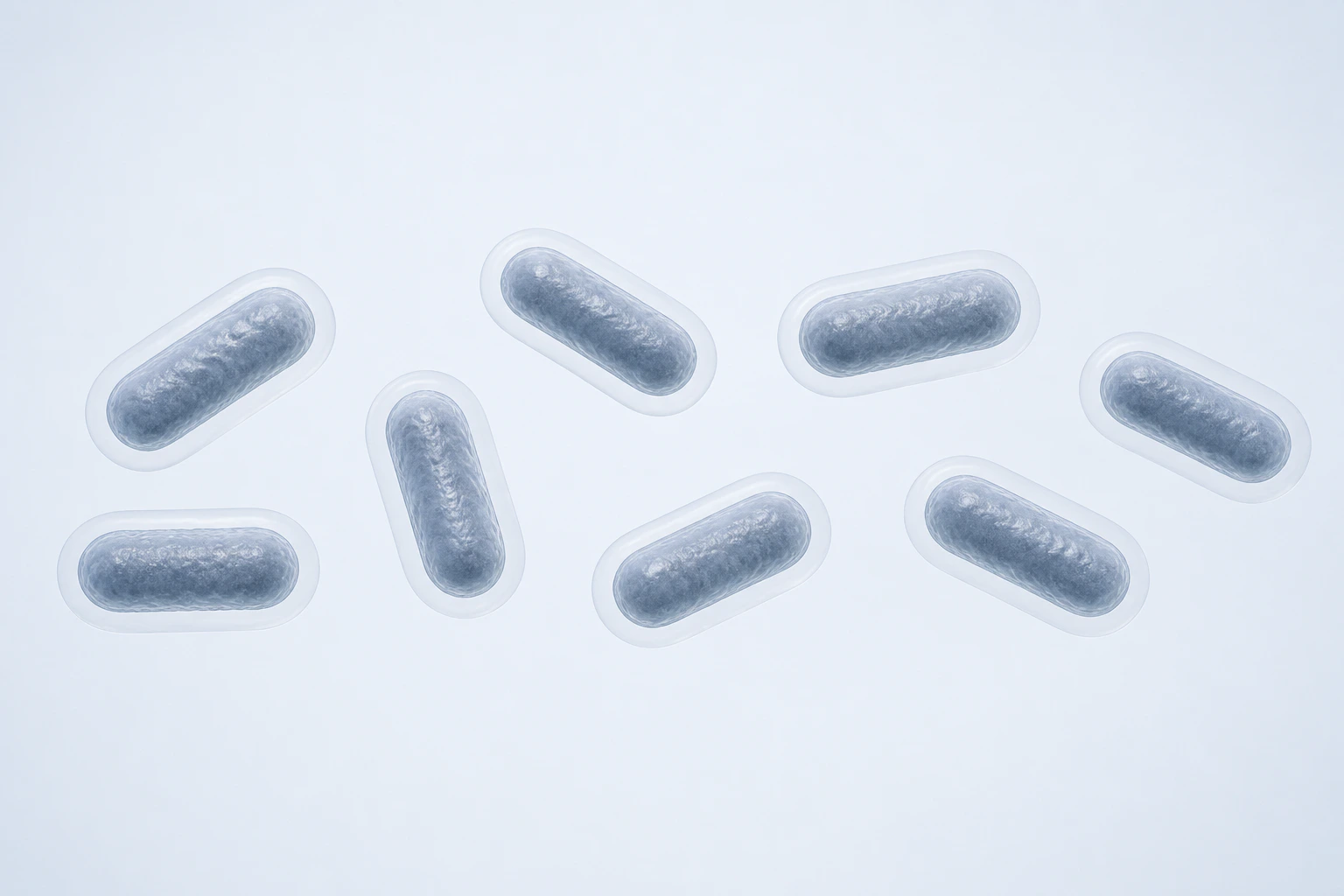
Representative encapsulated Klebsiella pneumoniae rods, shown as eight isolated bodies with individual hydrated halos. This scientific reconstruction is non-diagnostic, does not imply visual separation from other Klebsiella, and is not a micrograph.
Scientific media record1 verified identifier
- Subject
- Klebsiella pneumoniaetaxon · species
- Identifiers
- NCBITaxon:573
- Review
- Editorial review completeIdentifiers authority-verified · Accessibility validated · · klebsiella-pneumoniae|klebsiella-pneumoniae-morphology-v1.webp
- Digital source
- Trained-algorithmic mediaCreated with a trained generative algorithm and reviewed by WikiBiome for subject identity, scientific framing, identifiers, provenance, and accessibility.
- Scientific basis
- Klebsiella pneumoniae — NCBI TaxonomyKlebsiella pneumoniae — LPSNKlebsiella pneumoniaeKlebsiella pneumoniae capsule ultrastructure
- License
- CC BY-SA 4.0Created
A Gram-negative opportunistic pathogen and member of the ESKAPE group of antibiotic-resistant priority pathogens. K. pneumoniae deploys multiple Nickel-dependent enzymes for virulence and relies on the dual-function metallophore yersiniabactin for both Iron and nickel scavenging.
Evidence map9 cited passagesInspect provenance +
urease supports intestinal colonization and gastrointestinal stress resistance, enabling survival through the acidic stomach to establish gut reservoirs.
In the preterm gut, Klebsiella is a major NEC-associated pathogen. Dietary nickel from infant formula (especially soy-based, ~10x higher Ni than cow's milk) fuels urease, raising gut pH and promoting Proteobacteria bloom at the expense of acid-producing commensals like lactobacillus.
Predicted to possess Ni-dependent glyoxalase (GloI) based on genome analysis across all Enterobacteriaceae.
Produces yersiniabactin (Ybt), originally characterized in yersinia pestis but horizontally acquired by hypervirulent K. pneumoniae strains.
Ybt is a true dual-function metallophore: binds Fe3+ for classical iron acquisition and also chelates extracellular nickel, feeding Ni-dependent enzymes.
Neonatal sepsis and NEC: major pathogen in preterm infants; urease-driven pH shift contributes to dysbiosis and intestinal barrier breakdown. A Klebsiella pneumoniae-like OTU was detected in 11 of 12 NEC cases during week 1 of life in prospective preterm cohorts, corroborating earlier reports of gammaproteobacteria blooms 1-3 days before late-onset NEC.
LPS and gut translocation in COVID-19 / Long COVID: Enterobacteriaceae including K. pneumoniae translocate from the gut during severe COVID-19 and contribute to secondary bacteremia and post-acute sequelae.
Antibiotic resistance: carbapenem-resistant K. pneumoniae (CRKP) is a WHO Critical Priority pathogen. Metal resistance genes frequently co-locate with antibiotic resistance genes on mobile genetic elements, driving co-selection under environmental metal pressure. Zinc ionophores such as PBT2 can resensitize carbapenem-resistant K. pneumoniae to tigecycline.
Preterm brain injury: Klebsiella-dominated gut dysbiosis in preterm infants correlates with altered white matter development via the gut-brain axis.
Contents
1. Nickel-Dependent Virulence2. Iron and Multi-Metal Acquisition3. Clinical Significance4. The Metal-Resistance-Virulence Nexus5. ConnectionsNickel-Dependent Virulence#
Ni-Urease#
Urease supports intestinal colonization and gastrointestinal stress resistance, enabling survival through the acidic stomach to establish gut reservoirs.[1]Role of Nickel in Microbial PathogenesisRobert J. Maier, Stéphane L. Benoit · 2019Open reference 1 ↓ Host Calprotectin (S100A8/A9) (S100A8/A9) sequesters nickel from K. pneumoniae, directly inhibiting urease activity—a key Nutritional Immunity (Metal Sequestration) mechanism.
In the preterm gut, Klebsiella is a major NEC-associated pathogen. Dietary nickel from infant formula (especially soy-based, ~10x higher nickel (Ni) than cow's milk) fuels urease, raising gut pH and promoting Proteobacteria bloom at the expense of acid-producing commensals like Lactobacillus.[2]Nickel as a Catalytic Driver of Necrotizing Enterocolitis: Dietary Nickel, Microbial Metallomics, and the Activation of Nickel-Dependent Virulence Pathways in the Preterm GutKaren Pendergrass · 2026Open reference 2 ↓
Ni-Glyoxalase I#
Predicted to possess nickel (Ni)-dependent Glyoxalase I (GloI) based on genome analysis across all Enterobacteriaceae.[1]Role of Nickel in Microbial PathogenesisRobert J. Maier, Stéphane L. Benoit · 2019Open reference 1 ↓ GloI detoxifies methylglyoxal, a toxic glycolysis byproduct, enabling sustained growth during infection. The nickel-vs-zinc (Zn) selectivity difference between pathogen GloI and human GloI creates a potential selective drug target.
Iron and Multi-Metal Acquisition#
Yersiniabactin#
Produces yersiniabactin (Ybt), originally characterized in Yersinia pestis but horizontally acquired by hypervirulent K. pneumoniae strains.[3]Infection metallomics for critical care in the post-COVID eraPatil RH, Luptakova D, Havlicek V · 2021Open reference 3 ↓
Ybt is a true dual-function metallophore: binds iron(III) (Fe3+) for classical iron acquisition and also chelates extracellular nickel, feeding nickel (Ni)-dependent enzymes.[1]Role of Nickel in Microbial PathogenesisRobert J. Maier, Stéphane L. Benoit · 2019Open reference 1 ↓
Ybt-copper (Cu) complexes help resist copper toxicity in the urinary tract (paralleling UPEC). Ybt detection in urine is a potential diagnostic biomarker for invasive Klebsiella UTI.
Other Siderophores#
Also produces enterobactin and aerobactin for iron scavenging. Hypervirulent strains often carry additional siderophore gene clusters, correlating with invasive disease capacity.
Clinical Significance#
Urinary tract infections: a leading cause of hospital-acquired UTI, especially catheter-associated. Pneumonia: classical "Friedlander's pneumonia" with necrotizing lung destruction.
Neonatal sepsis and NEC: major pathogen in preterm infants; urease-driven pH shift contributes to Dysbiosis and intestinal barrier breakdown.[2]Nickel as a Catalytic Driver of Necrotizing Enterocolitis: Dietary Nickel, Microbial Metallomics, and the Activation of Nickel-Dependent Virulence Pathways in the Preterm GutKaren Pendergrass · 2026Open reference 2 ↓
A Klebsiella pneumoniae-like OTU was detected in 11 of 12 NEC cases during week 1 of life in prospective preterm cohorts, corroborating earlier reports of gammaproteobacteria blooms 1-3 days before late-onset NEC.[4]Zhou 2015 — Premature Infant Microbiome Prior to NECZhou Y, Shan G, Sodergren E et al. · 2015Open reference 4 ↓[5]Torrazza 2013 — Intestinal Microbial Ecology and Environmental Factors Affecting NECTorrazza RM, Ukhanova M, Wang X et al. · 2013Open reference 5 ↓[6]Devarajalu 2025 — Gut microbiota signatures in Indian preterm infants with NEC: shotgun metagenomic approachPrabavathi Devarajalu, Savita Verma Attri, Jogender Kumar et al. · 2025Open reference 6 ↓
LPS and gut translocation in COVID-19 / Long COVID: Enterobacteriaceae including K. pneumoniae translocate from the gut during severe COVID-19 and contribute to secondary bacteremia and post-acute sequelae.[7]Bernard-Raichon et al. 2022 — Gut microbiome dysbiosis in antibiotic-treated COVID-19 patients is associated with microbial translocation and bacteremiaLucie Bernard-Raichon, Mericien Venzon, Jon Klein et al. · 2022Open reference 7 ↓[8]Li et al 2024 — The Causal Role of Gut Microbiota in Susceptibility of Long COVID: A Mendelian Randomization StudyZuming Li, Qinghua Xia, Jieni Feng et al. · 2024Open reference 8 ↓[9]Rego & Araújo-Filho 2024 — The Impact of Gut Microbiota on Long COVID: Insights and ChallengesAmália Cinthia Meneses do Rêgo, Irami Araújo-Filho · 2024Open reference 9 ↓
Antibiotic resistance: carbapenem-resistant K. pneumoniae (CRKP) is a WHO Critical Priority pathogen. Metal resistance genes frequently co-locate with antibiotic resistance genes on mobile genetic elements, driving co-selection under environmental metal pressure.[10]Understanding the Development of Environmental Resistance Among Microbes: A ReviewSrivastava J, Chandra H, Singh N et al. · 2016Open reference 10 ↓
Zinc ionophores such as PBT2 can resensitize carbapenem-resistant K. pneumoniae to tigecycline.[11]Wang 2025 — Disruption of Zinc Homeostasis Reverses Tigecycline Resistance in Klebsiella pneumoniaeJinyu Wang, Cuiping Xia, Zhaoxin Xia et al. · 2025Open reference 11 ↓
Liver abscess: hypervirulent strains (hvKp) cause pyogenic liver abscess, particularly in East Asia.
Preterm brain injury: Klebsiella-dominated gut dysbiosis in preterm infants correlates with altered white matter development via the gut-brain axis.[12]Wang 2023 — Microbial Gut-Brain Axis and White Matter Injury in Preterm InfantsWang J, et al. · 2023Open reference 12 ↓
The Metal-Resistance-Virulence Nexus#
K. pneumoniae exemplifies the convergence of metal biology and antibiotic resistance: yersiniabactin-positive strains are more virulent, metal tolerance genes co-select for antibiotic resistance, and dietary/environmental nickel may fuel the very enzymes that enable gut colonization—the reservoir from which invasive infections arise.
Connections#
- Urease—nickel (Ni)-urease for GI colonization and NEC pathogenesis
- Glyoxalase I—predicted nickel-GloI for metabolic stress survival
- Siderophores and Metallophores—yersiniabactin as dual iron (Fe)/nickel metallophore
- Nickel—essential cofactor for urease and GloI
- Iron—acquired via yersiniabactin, enterobactin, aerobactin
- Nutritional Immunity (Metal Sequestration)—calprotectin sequesters nickel from K. pneumoniae
- Metal-Dependent Virulence—multiple metal-dependent virulence factors
- Yersinia pestis—shares yersiniabactin metallophore system
- Escherichia coli—shares Enterobacteriaceae nickel-enzyme complement
- Gut-Metal-Microbiome Interactions—dietary nickel fuels Klebsiella in the preterm gut
- Antimicrobial Resistance—carbapenem-resistant K. pneumoniae (KPC) is a WHO critical-priority AMR pathogen
- Co-Selection—metal resistance and carbapenemase genes co-carried on conjugative plasmids
References 12
Numbered by first appearance in the article, then reconciled with its declared source list.
- 1
★Robert J. Maier, Stéphane L. Benoit (2019). Role of Nickel in Microbial Pathogenesis. Inorganics.
- 2
Karen Pendergrass (2026). Nickel as a Catalytic Driver of Necrotizing Enterocolitis: Dietary Nickel, Microbial Metallomics, and the Activation of Nickel-Dependent Virulence Pathways in the Preterm Gut. Zenodo Preprint.
- 3
★Patil RH, Luptakova D, Havlicek V (2021). Infection metallomics for critical care in the post-COVID era. Mass Spectrometry Reviews.
- 4
Zhou Y, Shan G, Sodergren E et al. (2015). Zhou 2015 — Premature Infant Microbiome Prior to NEC. PLoS ONE.
- 5
Torrazza RM, Ukhanova M, Wang X et al. (2013). Torrazza 2013 — Intestinal Microbial Ecology and Environmental Factors Affecting NEC. PLoS ONE.
- 6
Prabavathi Devarajalu, Savita Verma Attri, Jogender Kumar et al. (2025). Devarajalu 2025 — Gut microbiota signatures in Indian preterm infants with NEC: shotgun metagenomic approach. Frontiers in Cellular and Infection Microbiology.
- 7
Lucie Bernard-Raichon, Mericien Venzon, Jon Klein et al. (2022). Bernard-Raichon et al. 2022 — Gut microbiome dysbiosis in antibiotic-treated COVID-19 patients is associated with microbial translocation and bacteremia. Nature Communications.
- 8
Zuming Li, Qinghua Xia, Jieni Feng et al. (2024). Li et al 2024 — The Causal Role of Gut Microbiota in Susceptibility of Long COVID: A Mendelian Randomization Study. Frontiers in Microbiology.
- 9
Amália Cinthia Meneses do Rêgo, Irami Araújo-Filho (2024). Rego & Araújo-Filho 2024 — The Impact of Gut Microbiota on Long COVID: Insights and Challenges. Journal of Scientific Case Reports.
- 10
Srivastava J, Chandra H, Singh N et al. (2016). Understanding the Development of Environmental Resistance Among Microbes: A Review. Clean - Soil, Air, Water.
- 11
Jinyu Wang, Cuiping Xia, Zhaoxin Xia et al. (2025). Wang 2025 — Disruption of Zinc Homeostasis Reverses Tigecycline Resistance in Klebsiella pneumoniae. Frontiers in Cellular and Infection Microbiology.
- 12
Wang J, et al. (2023). Wang 2023 — Microbial Gut-Brain Axis and White Matter Injury in Preterm Infants. Frontiers in Integrative Neuroscience.
Article network
Mentioned here 15
Pages linking here 31
Connect the evidence
Publicly readable discussion by ORCID-authenticated researchers. Questions, interpretation, methods, corrections, and new evidence stay attached to this record.
No discussion yet. Start with a precise question or a source-backed observation.
Activity and accepted changes
Accepted researcher context, editorial status, public discussion, and upstream Git revisions are shown together. Pending, declined, and withdrawn proposals remain private.
- published revision
massive wiki expansion: 149 stubs fixed, 100+ new pages, Rule 15 scan, keystone papers
WikiBiome Deploy Bot · +11 −11
Inspect exact Git diff ↗ - published revision
ingest: 87 papers (17 endometriosis, 67 erectile dysfunction, 3 cross-condition)
WikiBiome Deploy Bot · +1 −1
Inspect exact Git diff ↗ - published revision
nightly maintenance: 94 stub demotions, 181 source_count fixes, 22 auto-discovered stubs, 5 adversarial audits, 3 boundary fixes, 3 evidence-level corrections
WikiBiome Deploy Bot · +1 −0
Inspect exact Git diff ↗ - published revision
11 new sources for Hashimotos/MS/CVD + 10 microbe entity citation pass
WikiBiome Deploy Bot · +4 −2
Inspect exact Git diff ↗ - published revision
wiki: bulk entity upgrades, new article pages, and site regeneration
WikiBiome Deploy Bot · +6 −0
Inspect exact Git diff ↗ - published revision
WikiBiome v2 migration: signature pages + safety fixes + gap analysis
WikiBiome Deploy Bot · +2 −0
Inspect exact Git diff ↗ - published revision
WikiBiome update — integrity fixes, metallomic diet pages, cross-condition analyses
WikiBiome Deploy Bot · +7 −5
Inspect exact Git diff ↗ - published revision
WikiBiome v7 — interactive microbiome metallomics encyclopedia
Karen Pendergrass · +68 −0
Inspect exact Git diff ↗