
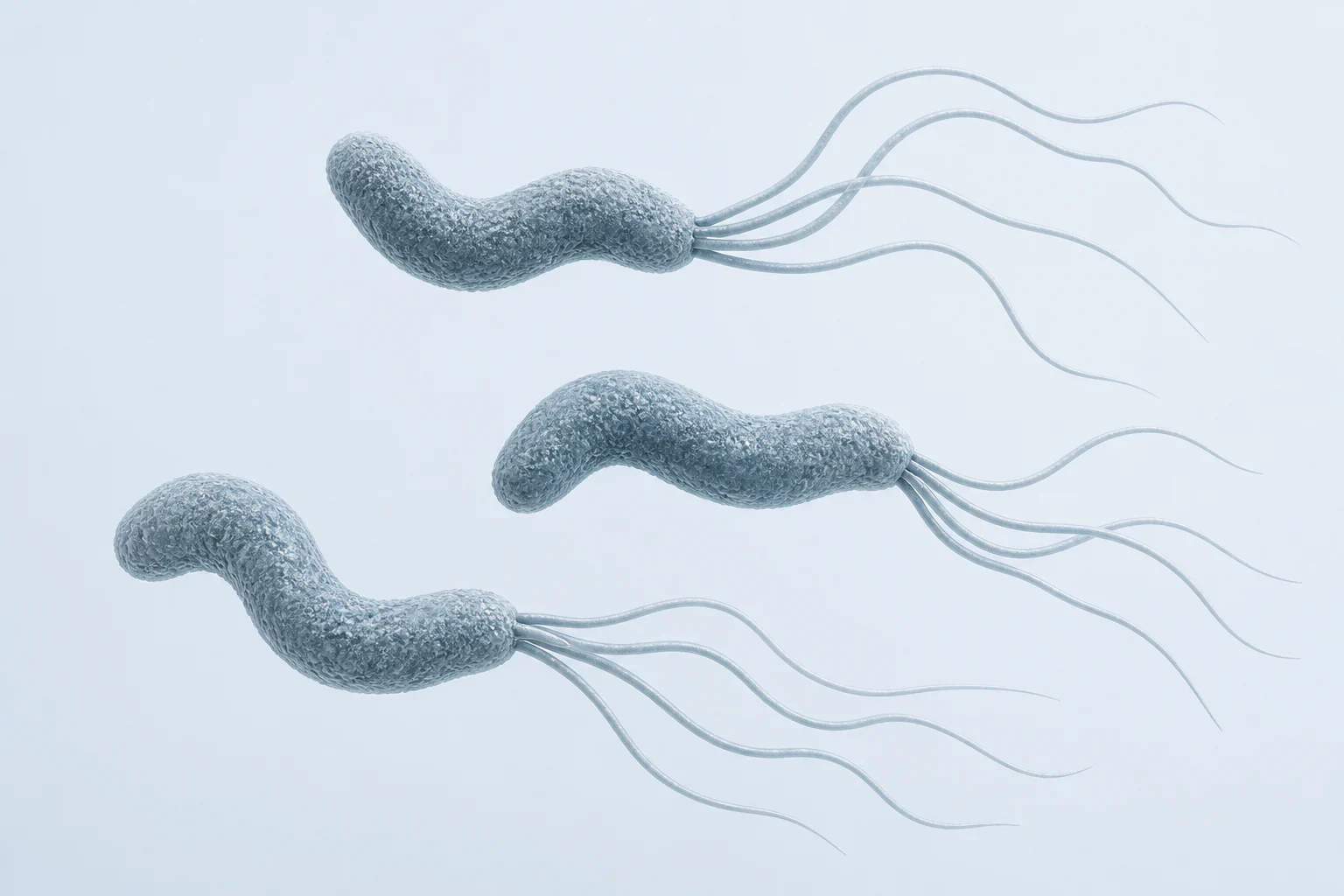
Representative H. pylori cells with curved-to-helical bodies and tufts of sheathed flagella at one pole. Morphology varies with growth state; this is an educational reconstruction, not a micrograph.
Scientific media record1 verified identifier
- Subject
- Helicobacter pyloritaxon · species
- Identifiers
- NCBITaxon:210
- Review
- Editorial review completeIdentifiers authority-verified · Accessibility validated · · helicobacter-pylori|helicobacter-pylori-morphology-v1.webp
- Digital source
- Trained-algorithmic mediaCreated with a trained generative algorithm and reviewed by WikiBiome for subject identity, scientific framing, identifiers, provenance, and accessibility.
- Scientific basis
- Helicobacter pylori — NCBI TaxonomyMorphology and Ultrastructure — Helicobacter pylori
- License
- CC BY-SA 4.0Created
A gastric pathogen that is arguably the most nickel-dependent human pathogen known. Two of its key virulence factors—Urease and [NiFe] Hydrogenase—require Nickel, and the bacterium has evolved an elaborate nickel trafficking, storage, and regulation system to support them.
Evidence map4 cited passagesInspect provenance +
Roles beyond acid neutralization: - Required for persistence even at neutral gastric pH. - Promotes angiogenesis. - Stimulates pro-inflammatory cytokines (neutrophil/monocyte chemotaxis). - Binds Class II MHC on gastric epithelial cells → induces apoptosis. - Disrupts epithelial tight junctions (via ammonia production → myosin activation). - Activates blood
Eradication therapy often includes bismuth—which competes with nickel transport via NiuBDE.
gerd—controversial relationship; H. pylori eradication may worsen reflux in some patients
Contrast with: nickel causes cancer in host cells via epigenetics, while in H. pylori it enables cancer via CagA
Contents
1. Nickel-Dependent Virulence Factors2. Nickel Trafficking System3. Clinical Significance4. ConnectionsNickel-Dependent Virulence Factors#
Urease#
Up to 10% of total proteome. Essential for in vivo survival: hydrolyzes Urea → Ammonia + bicarbonate, buffering cytoplasmic pH to near-neutral in the Acidic Microenvironment of the stomach. Roles beyond acid neutralization.[1]Role of Nickel in Microbial PathogenesisRobert J. Maier, Stéphane L. Benoit · 2019Open reference 1 ↓
Required for persistence even at neutral gastric pH. Promotes angiogenesis. Stimulates pro-inflammatory cytokines (neutrophil/monocyte chemotaxis).
Binds Class II MHC on gastric epithelial cells → induces apoptosis. Disrupts epithelial tight junctions (via ammonia production → myosin activation). Activates blood platelets (lipoxygenase-mediated pathway).
Alters mucin gene expression.
Holo-urease (nickel (Ni)-bound): catalytic urea hydrolysis + non-catalytic oxidant quenching (Met/Met-sulfoxide cycle with MSR repair). Apo-urease (nickel-free): retains only oxidant-quenching activity. Only 2-25% of urease is actually nickel-activated; the rest may serve the antioxidant role.
[NiFe] Hydrogenase#
Single H₂-uptake type (hydABCDE operon). H₂ is chronically available in the stomach (dissolved H₂ ~80 μM; enzyme Km ~1.8 μM—always saturated). Powers CagA translocation: the carcinogenic effector.
Hydrogenase deletion mutants cannot translocate CagA and do not induce gastric cancer in gerbils.
Enables H₂-stimulated CO₂ fixation (mixotrophy)—a growth mode never before described in a human pathogen. Strains from cancer patients have higher hydrogenase activity than gastritis-only strains.
Nickel Trafficking System#
Transport#
NiuBDE (ABC-type): the only transporter operating at both acidic and neutral pH. Can also transport cobalt/bismuth (relevant to bismuth-based eradication therapy). NixA (NiCoT-type): secondary, nickel (Ni)-only.
Required in vivo (nixA mutants cannot colonize mouse stomachs) but nixA mutants retain some colonization in other models. TonB-dependent FrpB4 for outer membrane transport.
Storage#
Hpn: 47% Histidine, 20-mer binding 5 nickel (Ni)(II)/monomer. Present in all gastric Helicobacter. Primary nickel reservoir.
HpnI (Hpn-like): 25% histidine. Restricted to H. pylori and H. acinonychis. Both compete for nickel under limiting conditions.
Recent discovery: storage proteins interact with a wide array of metabolic proteins—AmiE (aliphatic amidase), PepA (aminopeptidase), and maturation proteins. Suggests a central hub role in nickel metabolism far beyond simple storage.
Regulation#
NikR: nickel-responsive transcriptional regulator controlling urease and hydrogenase expression. Fur: iron-responsive regulator that also influences hyd gene expression.
Export#
- CznABC: cobalt-zinc-nickel efflux pump. Critical for nickel homeostasis and in vivo colonization.
Clinical Significance#
Infects ~50% of the global population. Causes gastritis, peptic ulcers, Gastric Adenocarcinoma, and MALT lymphoma. Eradication therapy often includes Bismuth—which competes with nickel transport via NiuBDE.[1]Role of Nickel in Microbial PathogenesisRobert J. Maier, Stéphane L. Benoit · 2019Open reference 1 ↓
HspA (GroES homolog with His-rich nickel (Ni)-binding C-terminus) has been explored as a vaccine candidate—partial protection in mice via intranasal administration.
Connections#
- Metal-Dependent Virulence—nickel (Ni)-urease and [NiFe]-hydrogenase are the paradigmatic metal-dependent virulence factors
- Nickel—essential cofactor for its two main virulence factors
- Nutritional Immunity (Metal Sequestration)—host calprotectin/lactoferrin may restrict nickel availability
- Metal Carcinogenesis—H. pylori-mediated gastric cancer is linked to hydrogenase-powered CagA translocation
- Gastric Cancer—H. pylori is the primary causative organism; nickel-dependent metalloenzymes power the cancer cascade
- Gastroesophageal Reflux Disease (GERD)—controversial relationship; H. pylori eradication may worsen reflux in some patients[2]Causal relationship between Helicobacter pylori antibodies and gastroesophageal reflux disease (GERD): A mendelian studyChen J, Zhang J, Ma X et al. · 2023Open reference 2 ↓[3]Analysis of gastric microbiota and Helicobacter pylori infection in gastroesophageal reflux diseaseSugihartono T, Fauzia KA, Miftahussurur M et al. · 2022Open reference 3 ↓[4]Effects of Helicobacter pylori Infection on the Oral Microbiota of Reflux Esophagitis PatientsLiang T, Liu F, Liu L et al. · 2021Open reference 4 ↓
- Contrast with:[5]Genetic and Epigenetic Mechanisms in Metal Carcinogenesis and Cocarcinogenesis: Nickel, Arsenic, and ChromiumKonstantin Salnikov, Anatoly Zhitkovich · 2008Open reference 5 ↓ nickel causes cancer in host cells via epigenetics, while in H. pylori it enables cancer via CagA
References 7
Numbered by first appearance in the article, then reconciled with its declared source list.
- 1
★Robert J. Maier, Stéphane L. Benoit (2019). Role of Nickel in Microbial Pathogenesis. Inorganics.
- 2
Chen J, Zhang J, Ma X et al. (2023). Causal relationship between Helicobacter pylori antibodies and gastroesophageal reflux disease (GERD): A mendelian study. PLoS ONE.
- 3
Sugihartono T, Fauzia KA, Miftahussurur M et al. (2022). Analysis of gastric microbiota and Helicobacter pylori infection in gastroesophageal reflux disease. Gut Pathogens.
- 4
Liang T, Liu F, Liu L et al. (2021). Effects of Helicobacter pylori Infection on the Oral Microbiota of Reflux Esophagitis Patients. Frontiers in Cellular and Infection Microbiology.
- 5
Konstantin Salnikov, Anatoly Zhitkovich (2008). Genetic and Epigenetic Mechanisms in Metal Carcinogenesis and Cocarcinogenesis: Nickel, Arsenic, and Chromium. Chemical Research in Toxicology.
- 6
Maurya AP, Rajkumari J, Bhattacharjee A et al. (2020). Development, spread and persistence of antibiotic resistance genes (ARGs) in the soil microbiomes through co-selection. Reviews on Environmental Health.
- 7
Campanale M, Nucera E, Ojetti V et al. (2014). Nickel Free-Diet Enhances the Helicobacter pylori Eradication Rate: A Pilot Study. Digestive Diseases and Sciences.
Article network
Mentioned here 18
Pages linking here 65
Connect the evidence
Publicly readable discussion by ORCID-authenticated researchers. Questions, interpretation, methods, corrections, and new evidence stay attached to this record.
No discussion yet. Start with a precise question or a source-backed observation.
Activity and accepted changes
Accepted researcher context, editorial status, public discussion, and upstream Git revisions are shown together. Pending, declined, and withdrawn proposals remain private.
- published revision
Add CagA concept and contextual links
Karen Pendergrass · +1 −1
Inspect exact Git diff ↗ - published revision
Add reviewed Ammonia concept coverage
Karen Pendergrass · +2 −2
Inspect exact Git diff ↗ - published revision
Add reviewed concept coverage orchestration
Karen Pendergrass · +8 −8
Inspect exact Git diff ↗ - published revision
massive wiki expansion: 149 stubs fixed, 100+ new pages, Rule 15 scan, keystone papers
WikiBiome Deploy Bot · +23 −20
Inspect exact Git diff ↗ - published revision
nightly maintenance: 94 stub demotions, 181 source_count fixes, 22 auto-discovered stubs, 5 adversarial audits, 3 boundary fixes, 3 evidence-level corrections
WikiBiome Deploy Bot · +3 −0
Inspect exact Git diff ↗ - published revision
18 foundational sources + 10 microbe entities deepened
WikiBiome Deploy Bot · +2 −2
Inspect exact Git diff ↗ - published revision
WikiBiome update — 2026-04-15 17:23
WikiBiome Deploy Bot · +11 −11
Inspect exact Git diff ↗ - published revision
wiki: bulk entity upgrades, new article pages, and site regeneration
WikiBiome Deploy Bot · +6 −0
Inspect exact Git diff ↗ - published revision
WikiBiome v2 migration: signature pages + safety fixes + gap analysis
WikiBiome Deploy Bot · +2 −0
Inspect exact Git diff ↗ - published revision
WikiBiome update — integrity fixes, metallomic diet pages, cross-condition analyses
WikiBiome Deploy Bot · +7 −2
Inspect exact Git diff ↗ - published revision
WikiBiome update — 2026-04-10 23:44
WikiBiome Deploy Bot · +1 −1
Inspect exact Git diff ↗ - published revision
WikiBiome v7 — interactive microbiome metallomics encyclopedia
Karen Pendergrass · +72 −0
Inspect exact Git diff ↗