

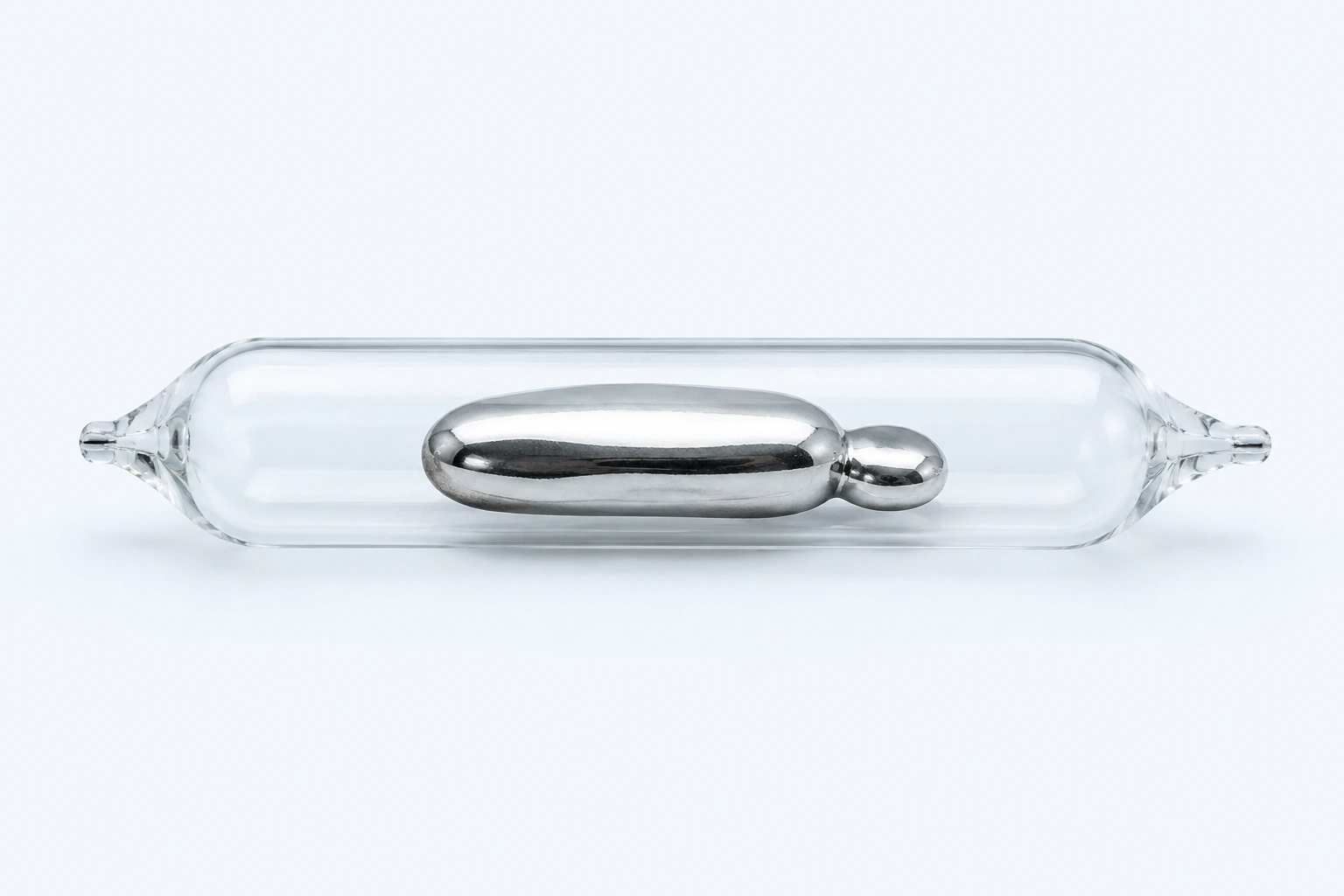
Elemental gallium (Ga), represented as one coherent silvery sample in a sealed ampoule. Phase and form vary with temperature, purity, and storage; containment does not certify purity, and this is not analytical reference material or a photograph.
Scientific media record2 verified identifiers
- Subject
- Galliumelement
- Identifiers
- Atomic number 31PubChem CID:5360835
- Review
- Editorial review completeIdentifiers authority-verified · Accessibility validated · · gallium|gallium-technical-specimen-v1.webp
- Digital source
- Trained-algorithmic mediaCreated with a trained generative algorithm and reviewed by WikiBiome for subject identity, scientific framing, identifiers, provenance, and accessibility.
- Scientific basis
- Gallium — PubChem ElementGallium, PubChem CID 5360835
- License
- CC BY-SA 4.0Created
A group 13 post-transition metal (atomic number 31) with no known biological function in any organism—yet one of the most promising antimicrobial metals precisely because of what it cannot do.
Ga3+ is nearly identical to iron(III) (Fe3+) in ionic radius (0.62 Å vs 0.645 Å) and coordination chemistry, but it cannot be reduced to Ga2+ under physiological conditions.
This makes gallium a perfect Trojan horse: bacteria import it through their iron uptake systems, and it irreversibly jams the iron-dependent enzymes they need to survive.
Evidence map14 cited passagesInspect provenance +
Siderophore hijacking Bacteria secrete siderophores to scavenge scarce iron. These chelators bind Ga3+ with similar affinity to Fe3+, and bacteria import the gallium-loaded siderophore through their normal outer membrane receptors. Every siderophore-mediated iron import is a potential gallium delivery route.
Ribonucleotide reductase (RNR) inhibition Ga3+ occupies the Fe3+ active site in class I RNR—the enzyme that reduces ribonucleotides to deoxyribonucleotides, an obligate step in DNA synthesis. RNR requires redox-active iron to generate the tyrosyl radical needed for catalysis. Ga3+ is coordination-compatible but redox-inactive, producing a dead-end inhibite
Cytochrome disruption Ga3+ displaces iron in cytochrome complexes in the electron transport chain. Without functional cytochromes, oxidative phosphorylation collapses. This effect is particularly potent in biofilm-embedded bacteria that depend on cytochrome-mediated respiration for the sustained energy demands of biofilm maintenance.
Fe-S cluster poisoning Incorporation of Ga3+ into iron-sulfur cluster assembly machinery renders clusters non-functional. Fe-S clusters are involved in central metabolic enzymes (aconitase, succinate dehydrogenase) and transcriptional regulators (Fur, IscR). Their failure disrupts metabolism at multiple levels simultaneously.
Biofilm disruption Pseudomonas aeruginosa biofilms require iron acquisition for structural integrity and maintenance. Gallium nitrate (Ga(NO3)3) disrupts biofilm formation and eradicates established P. aeruginosa biofilms by starving biofilm-embedded cells of functional iron. This anti-biofilm activity is significant because biofilm-embedded organisms are no
The simplest clinical form. Previously approved for hypercalcemia of malignancy—providing extensive human safety data for systemic gallium exposure. Now under investigation as an antimicrobial, particularly for:
A gallium-siderophore-fluoroquinolone conjugate: gallium is conjugated to a hydroxamate siderophore that is itself linked to a fluoroquinolone antibiotic. The result is dual targeting—Ga3+ mimics iron to gain entry, and once inside, the fluoroquinolone inhibits DNA gyrase.
FDA-approved in 2019. A siderophore-cephalosporin conjugate (catechol siderophore linked to a cephalosporin) that exploits bacterial iron transporters—specifically the catechol siderophore receptors of Gram-negative bacteria—to bypass porin-mediated resistance.
Enhanced antimicrobial activity through sustained Ga3+ release, increased surface area, and potential membrane interaction that supplements the iron-mimic mechanism. Nanoparticle formulations also enable controlled local delivery—relevant for implant coatings and wound care.
Used in implant coatings to prevent MRSA and P. aeruginosa implant infections; disrupts bacterial iron metabolism at the implant surface through sustained Ga3+ release from the ceramic matrix. Addresses the critical clinical problem of implant-associated infection without requiring systemic antibiotic exposure.
A novel delivery approach: Lactobacillus rhamnosus GG engineered with a gallium-polyphenol surface network. The gallium coating selectively eradicates tumor-promoting Proteobacteria within the pancreatic tumor microenvironment while preserving the probiotic core. In preclinical pancreatic cancer models, this approach:
Salmochelin conjugates—derived from the enterobactin of E. coli—selectively kill Enterobacteriaceae while sparing Lactobacillus and other commensals. This intrinsic selectivity is not achievable with conventional antibiotics, which kill broadly regardless of pathogen status.
Targets fundamental metabolism: Iron-dependent processes are not optional for bacteria; developing resistance requires rewiring core biochemistry, not just modifying a single target site.
Reduced resistance evolution: Bypasses porin mutations and efflux pumps—the primary resistance mechanisms in carbapenem-resistant Gram-negatives.
Contents
1. The Iron Mimic Principle2. Mechanisms of Antimicrobial Action3. Pharmacological Applications4. Microbiome Selectivity: The Key Advantage5. Advantages Over Conventional Antibiotics6. Connection to WikiBiome Metallomics Framework7. Cross-ReferencesThe Iron Mimic Principle#
The core insight is deceptively simple. Bacterial iron acquisition is a life-or-death process—iron is essential for DNA synthesis (ribonucleotide reductase), electron transport (cytochromes, iron (Fe)-S clusters), and many other central metabolic reactions.
Bacteria have evolved extraordinarily efficient systems to acquire scarce iron from the environment: siderophores, transferrin receptors, hemoglobin piracy. These systems cannot easily distinguish Ga3+ from iron(III), because the ionic properties are so similar.
When Ga3+ is imported in place of iron(III). It binds iron-coordination sites but cannot undergo iron(III) → iron(II) redox cycling. Iron-dependent enzymes that require electron transfer are irreversibly blocked.
The bacterium has consumed metabolic energy to import a metal it cannot use.
There is no Ga3+-rescue mechanism: bacteria have no gallium efflux systems optimized for Ga3+ because they did not evolve under gallium selection pressure.
This makes gallium effective against bacteria that have evolved resistance to conventional antibiotics—the resistance mechanisms (efflux pumps, porin loss, target modification) address the antibiotic, not the underlying iron acquisition process that gallium exploits.
Mechanisms of Antimicrobial Action#
1. Siderophore hijacking Bacteria secrete siderophores to scavenge scarce iron. These chelators bind Ga3+ with similar affinity to iron(III) (Fe3+), and bacteria import the gallium-loaded siderophore through their normal outer membrane receptors.[1]de Carvalho & Fernandes 2014 — Siderophores as Trojan Horses Against MDR Pathogensde Carvalho, C.C.C.R., Fernandes et al. · 2014Open reference 1 ↓
Every siderophore-mediated iron import is a potential gallium delivery route.
2. Ribonucleotide reductase (RNR) inhibition Ga3+ occupies the iron(III) active site in class I RNR—the enzyme that reduces ribonucleotides to deoxyribonucleotides, an obligate step in DNA synthesis. RNR requires redox-active iron to generate the tyrosyl radical needed for catalysis.
Ga3+ is coordination-compatible but redox-inactive, producing a dead-end inhibited enzyme complex and halting DNA replication.[2]Ikhazuagbe et al. 2025 — Gallium Nanoparticles as Antimicrobial AgentsIkhazuagbe, I., et al. · 2025Open reference 2 ↓
3. Cytochrome disruption Ga3+ displaces iron in cytochrome complexes in the electron transport chain. Without functional cytochromes, oxidative phosphorylation collapses.
This effect is particularly potent in biofilm-embedded bacteria that depend on cytochrome-mediated respiration for the sustained energy demands of biofilm maintenance.[2]Ikhazuagbe et al. 2025 — Gallium Nanoparticles as Antimicrobial AgentsIkhazuagbe, I., et al. · 2025Open reference 2 ↓
4. iron-S cluster poisoning Incorporation of Ga3+ into iron-sulfur cluster assembly machinery renders clusters non-functional. iron-S clusters are involved in central metabolic enzymes (aconitase, succinate dehydrogenase) and transcriptional regulators (Fur, IscR).
Their failure disrupts metabolism at multiple levels simultaneously.[3]Golden et al. 2024 — Metal Chelation as Antibacterial Strategy Against Pseudomonas and AcinetobacterGolden, M., et al. · 2024Open reference 3 ↓
5. Biofilm disruption Pseudomonas aeruginosa biofilms require iron acquisition for structural integrity and maintenance. Gallium nitrate (Ga(NO3)3) disrupts biofilm formation and eradicates established P. aeruginosa biofilms by starving biofilm-embedded cells of functional iron.[3]Golden et al. 2024 — Metal Chelation as Antibacterial Strategy Against Pseudomonas and AcinetobacterGolden, M., et al. · 2024Open reference 3 ↓
This anti-biofilm activity is significant because biofilm-embedded organisms are notoriously resistant to conventional antibiotics.
Pharmacological Applications#
Gallium Nitrate (Ga(NO3)3)#
The simplest clinical form. Previously approved for hypercalcemia of malignancy—providing extensive human safety data for systemic gallium exposure.[2]Ikhazuagbe et al. 2025 — Gallium Nanoparticles as Antimicrobial AgentsIkhazuagbe, I., et al. · 2025Open reference 2 ↓ Now under investigation as an antimicrobial, particularly for.
Pseudomonas aeruginosa lung infections in cystic fibrosis (CF): Phase 1/2 trial (NCT01093521) demonstrated that inhaled gallium nitrate reduced P. aeruginosa burden and improved lung function in CF patients—the first prospective clinical evidence for gallium antimicrobial activity.
Biofilm-associated infections where conventional antibiotics fail due to penetration barriers.
Galbofloxacin#
A gallium-siderophore-fluoroquinolone conjugate: gallium is conjugated to a hydroxamate siderophore that is itself linked to a fluoroquinolone antibiotic. The result is dual targeting—Ga3+ mimics iron to gain entry, and once inside, the fluoroquinolone inhibits DNA gyrase.[4]Pandey et al. 2021 — Galbofloxacin: Rationally Designed Gallium-Siderophore Antibiotic Against S. aureusPandey, A., et al. · 2021Open reference 4 ↓
Against Staphylococcus aureus, galbofloxacin achieves an MIC of 93 nM versus 920 nM for ciprofloxacin alone—a 10-fold potency improvement through siderophore-mediated targeted delivery. The specificity of the siderophore determines which bacteria import the conjugate, theoretically enabling pathogen-selective activity.
Cefiderocol#
FDA-approved in 2019. A siderophore-cephalosporin conjugate (catechol siderophore linked to a cephalosporin) that exploits bacterial iron transporters—specifically the catechol siderophore receptors of Gram-negative bacteria—to bypass porin-mediated resistance.[1]de Carvalho & Fernandes 2014 — Siderophores as Trojan Horses Against MDR Pathogensde Carvalho, C.C.C.R., Fernandes et al. · 2014Open reference 1 ↓
Active against carbapenem-resistant Acinetobacter baumannii, Pseudomonas aeruginosa, and Klebsiella pneumoniae—the most feared hospital-acquired pathogens in the antimicrobial resistance crisis. Phase 3 trial (CREDIBLE-CR, n=152) demonstrated clinical success rates comparable to best available therapy.
Gallium Nanoparticles#
Enhanced antimicrobial activity through sustained Ga3+ release, increased surface area, and potential membrane interaction that supplements the iron-mimic mechanism.[2]Ikhazuagbe et al. 2025 — Gallium Nanoparticles as Antimicrobial AgentsIkhazuagbe, I., et al. · 2025Open reference 2 ↓ Nanoparticle formulations also enable controlled local delivery—relevant for implant coatings and wound care.
Gallium-Hydroxyapatite (Ga/HA) Bioceramics#
Used in implant coatings to prevent MRSA and P. aeruginosa implant infections; disrupts bacterial iron metabolism at the implant surface through sustained Ga3+ release from the ceramic matrix.[5]Nguyen 2024 — Engineering Antibacterial Bioceramics: Design Principles and Mechanisms of ActionNgoc Huu Nguyen, Zufu Lu, Aaron Elbourne et al. · 2024Open reference 5 ↓ Addresses the critical clinical problem of implant-associated infection without requiring systemic antibiotic exposure.
Gallium-Polyphenol Probiotics (LGG@Ga-poly)#
A novel delivery approach: Lactobacillus rhamnosus GG engineered with a gallium-polyphenol surface network. The gallium coating selectively eradicates tumor-promoting Proteobacteria within the pancreatic tumor microenvironment while preserving the probiotic core.[6]Probiotics functionalized with a gallium-polyphenol network modulate the intratumor microbiota and promote anti-tumor immune responses in pancreatic cancerZi-Yi Han, Zhuang-Jiong Fu, Yu-Zhang Wang et al. · 2024Open reference 6 ↓ In preclinical pancreatic cancer models, this approach.
Reduced microbiota-derived LPS in the tumor microenvironment. Decreased PD-L1 and IL-1β expression. Improved CD8+ cytotoxic T cell infiltration.
Enhanced efficacy of anti-PD-1 immune checkpoint blockade.
This represents a convergence of gallium antimicrobial chemistry with the emerging field of intratumoral microbiome modulation.
Microbiome Selectivity: The Key Advantage#
The most compelling property of siderophore-gallium strategies is their taxonomic selectivity. Different bacterial genera use different siderophore structures and receptor systems:
- Enteric pathogens (Enterobacteriaceae) use enterobactin-type catechol siderophores
- Pseudomonas uses pyoverdine and pyochelin
- Staphylococcus uses staphyloferrin-type siderophores
- Commensals like Lactobacillus and Bifidobacterium have minimal or absent siderophore-dependent iron acquisition
Salmochelin conjugates—derived from the enterobactin of E. coli—selectively kill Enterobacteriaceae while sparing Lactobacillus and other commensals.[7]Passari et al. 2023 — Siderophores: Medical Applications Beyond AntimicrobialsPassari, A.K., et al. · 2023Open reference 7 ↓ This intrinsic selectivity is not achievable with conventional antibiotics, which kill broadly regardless of pathogen status.
Advantages Over Conventional Antibiotics#
Targets fundamental metabolism: Iron-dependent processes are not optional for bacteria; developing resistance requires rewiring core biochemistry, not just modifying a single target site.[7]Passari et al. 2023 — Siderophores: Medical Applications Beyond AntimicrobialsPassari, A.K., et al. · 2023Open reference 7 ↓
Exploits bacterial weaponry against itself: Siderophores bacteria evolved for iron acquisition become the delivery vehicle for their own destruction. Reduced resistance evolution: Bypasses porin mutations and efflux pumps—the primary resistance mechanisms in carbapenem-resistant Gram-negatives.[1]de Carvalho & Fernandes 2014 — Siderophores as Trojan Horses Against MDR Pathogensde Carvalho, C.C.C.R., Fernandes et al. · 2014Open reference 1 ↓
Host compatibility: Human cells do not express bacterial-type siderophore receptors; gallium's iron-mimic toxicity is bacterium-specific.
Connection to WikiBiome Metallomics Framework#
Gallium therapeutics represent a deliberate application of mis-metallation as antimicrobial strategy—the same principle that makes cadmium and lead toxic to humans (displacement of correct metal cofactors) is weaponized here against bacterial pathogens.
The difference is directionality: toxic metal contamination poisons human enzymes through mis-metallation; gallium therapy poisons bacterial enzymes through the same mechanism, but selectively in organisms with iron-dependent biochemistry.
This positions gallium as a therapeutic inversion of the nutritional immunity concept: where the host withholds iron from pathogens, gallium provides a counterfeit iron that poisons rather than feeds.
Cross-References#
- Iron—The metal gallium mimics; ionic radius and coordination chemistry similarity enable the deception
- Siderophores and Metallophores—The uptake systems gallium exploits for pathogen-selective delivery
- Mis-Metallation—The mechanism by which gallium poisons bacterial iron-dependent enzymes
- Nutritional Immunity (Metal Sequestration)—The host strategy gallium therapeutically amplifies
- Pseudomonas aeruginosa—Primary target; biofilm-active; Phase 1/2 CF trial conducted
- Acinetobacter—Carbapenem-resistant target; cefiderocol active
- Staphylococcus aureus—Target of galbofloxacin (93 nM MIC)
- Klebsiella pneumoniae—Cefiderocol target
- Bismuth—Synergistic partner in siderophore-antibiotic combinations
- Antimicrobial Resistance—The crisis driving siderophore-gallium development
- Biofilm—Gallium disrupts iron-dependent biofilm maintenance
- Pancreatic Cancer—LGG@Ga-poly modulates intratumoral Proteobacteria
References 8
Numbered by first appearance in the article, then reconciled with its declared source list.
- 1
de Carvalho, C.C.C.R., Fernandes et al. (2014). de Carvalho & Fernandes 2014 — Siderophores as Trojan Horses Against MDR Pathogens. Frontiers in Microbiology.
- 2
Ikhazuagbe, I., et al. (2025). Ikhazuagbe et al. 2025 — Gallium Nanoparticles as Antimicrobial Agents. RSC Advances.
- 3
Golden, M., et al. (2024). Golden et al. 2024 — Metal Chelation as Antibacterial Strategy Against Pseudomonas and Acinetobacter. RSC Chemical Biology.
- 4
Pandey, A., et al. (2021). Pandey et al. 2021 — Galbofloxacin: Rationally Designed Gallium-Siderophore Antibiotic Against S. aureus. Chemical Science.
- 5
Ngoc Huu Nguyen, Zufu Lu, Aaron Elbourne et al. (2024). Nguyen 2024 — Engineering Antibacterial Bioceramics: Design Principles and Mechanisms of Action. Materials Today Bio.
- 6
Zi-Yi Han, Zhuang-Jiong Fu, Yu-Zhang Wang et al. (2024). Probiotics functionalized with a gallium-polyphenol network modulate the intratumor microbiota and promote anti-tumor immune responses in pancreatic cancer. Nature Communications.
- 7
Passari, A.K., et al. (2023). Passari et al. 2023 — Siderophores: Medical Applications Beyond Antimicrobials. Applied Microbiology and Biotechnology.
- 8
Patil, A., Gholap et al. (2021). Patil 2021 — Infection Metallomics in the COVID Era. Mass Spectrometry Reviews.
Article network
Mentioned here 12
Pages linking here 9
Connect the evidence
Publicly readable discussion by ORCID-authenticated researchers. Questions, interpretation, methods, corrections, and new evidence stay attached to this record.
No discussion yet. Start with a precise question or a source-backed observation.
Activity and accepted changes
Accepted researcher context, editorial status, public discussion, and upstream Git revisions are shown together. Pending, declined, and withdrawn proposals remain private.
- published revision
massive wiki expansion: 149 stubs fixed, 100+ new pages, Rule 15 scan, keystone papers
WikiBiome Deploy Bot · +15 −15
Inspect exact Git diff ↗ - published revision
Batch: fix 1025 broken wikilinks, wire 13 STOP pages, deepen PPD/GERD/T1D/8 microbes
WikiBiome Deploy Bot · +101 −35
Inspect exact Git diff ↗ - published revision
Citation integrity pass: 38 citations added, 24 parenthesized citations fixed
WikiBiome Deploy Bot · +1 −1
Inspect exact Git diff ↗ - published revision
Health check fixes: 40 intervention pages + 14 entity Connections sections
WikiBiome Deploy Bot · +1 −0
Inspect exact Git diff ↗ - published revision
Health check gap fill: 15 missing pages identified and created
WikiBiome Deploy Bot · +59 −0
Inspect exact Git diff ↗