
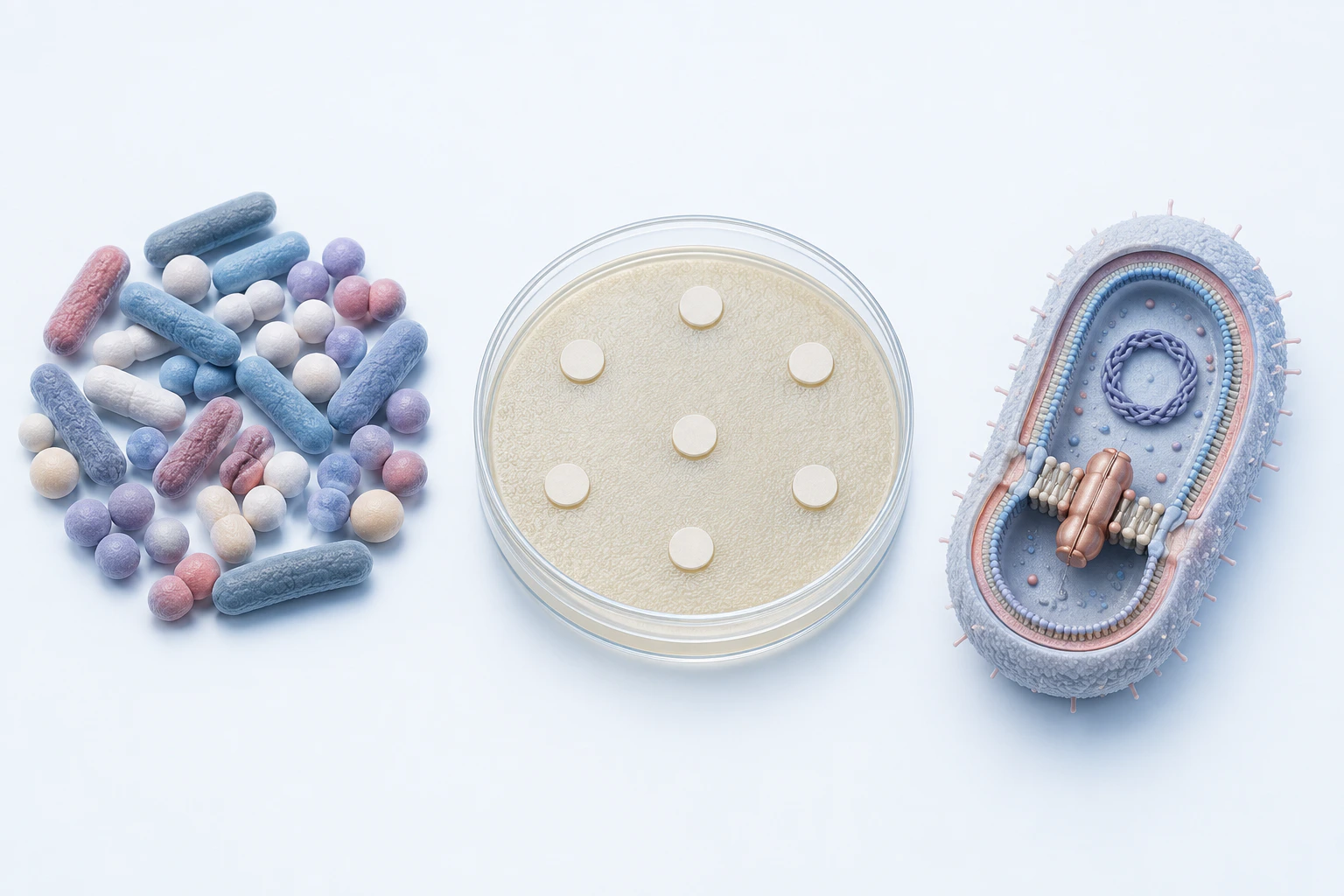
Broad microbial drug-resistance orientation. The uniform dish is not an interpreted susceptibility test, and the plate does not assign species, drug, genotype, phenotype, mechanism, prevalence, or treatment guidance.
Scientific media record2 verified identifiers
- Subject
- Antimicrobial Resistancebiological-process
- Review
- Editorial review completeIdentifiers authority-verified · Accessibility validated · · antimicrobial-resistance|antimicrobial-resistance-mechanism-v1.webp
- Digital source
- Trained-algorithmic mediaCreated with a trained generative algorithm and reviewed by WikiBiome for subject identity, scientific framing, identifiers, provenance, and accessibility.
- Scientific basis
- Drug Resistance, Microbial — MeSHAntimicrobial Resistance
- License
- CC BY-SA 4.0Created
The ability of microorganisms to survive and replicate in the presence of antimicrobial agents—antibiotics, antifungals, antivirals, antiparasitic drugs—at concentrations that would normally inhibit or kill them.
Antimicrobial resistance (AMR) is designated by the WHO as one of the greatest threats to global public health, projected to cause 10 million deaths annually by 2050.
Within the WikiBiome framework, the central insight is this: heavy metal exposure is a major, underappreciated driver of antimicrobial resistance—and it operates through the Gut Microbiome. When metals contaminate food, water, soil, or the gut environment, they select for metal-tolerant bacteria.
Because metal resistance genes and antibiotic resistance genes frequently co-exist on the same mobile genetic elements, metal selection simultaneously selects for antibiotic resistance. This process—Co-Selection—creates a direct causal pathway from dietary metal exposure to clinical antibiotic treatment failure.
Evidence map10 cited passagesInspect provenance +
Efflux pumps—Multi-drug efflux pumps actively transport antibiotics out of the bacterial cell before they can reach effective intracellular concentrations. The AcrAB-TolC system in Gram-negative bacteria is the canonical example—and critically, it also transports certain metals, meaning metal exposure selects for its overexpression.
The metallomic dimension of AMR is the key insight WikiBiome adds to the standard narrative:
Physical gene linkage (co-resistance): Metal resistance operons and antibiotic resistance gene cassettes are physically co-located on transferable plasmids and transposons. The tcrB copper resistance gene is co-located with vanA (vancomycin resistance) and ermB (macrolide resistance) on a single transferable Enterococcus plasmid—copper supplementation in l
Regulatory crosstalk: The MarRAB regulon in E. coli and Salmonella responds to copper liberation under biocide stress, inducing AcrAB-TolC overexpression and OmpF downregulation—creating multi-drug resistance via a metal signaling intermediate.
The food chain pathway: 90% of in-feed zinc and copper passes through livestock unchanged into feces, contaminating manure-amended agricultural soils. Soil bacteria in metal-contaminated agricultural fields carry significantly higher antibiotic resistance gene abundances than in uncontaminated reference soils—a direct environmental measure of co-selection.
AMR perpetuates dysbiosis: When antibiotic treatment fails due to resistance, the underlying infection persists, maintaining the inflammatory state that sustains dysbiosis. In CKD, for example, metal-driven co-selection enriches pathogens that are resistant to the antibiotics most commonly used to treat CKD-associated UTIs—creating a cycle in which infecti
High-fat, low-fiber diets increase the gut resistome by selecting for Proteobacteria and reducing SCFA producers that compete with resistant organisms for niche resources. Antibiotic resistance genes in the gut are documented in colorectal cancer microbiomes, including genes for aminoglycoside modification, tetracycline efflux, and beta-lactam hydrolysis—c
K. pneumoniae: zinc ionophore clioquinol/PBT2 can overcome tigecycline resistance by disrupting zinc homeostasis in resistant strains—demonstrating the direct mechanistic link between zinc and antibiotic resistance
Enterococcus: 120 years of temporal data show accelerating co-occurrence of metal tolerance (Hg, As, Cu) and antibiotic resistance genes on conjugative plasmids
| Source | Evidence Level | Key Contribution | |--------|---------------|-----------------| | (2006) | Expert opinion (review) | Foundational framework: three mechanisms of co-selection; metals as permanent selection pressure | | (2015) | Expert opinion (review) | Food chain pathway; copper activation of MarRAB; biocides as third co-selective agent | | (2021
Contents
1. How Resistance Arises2. Metal-Driven Resistance: The Co-Selection Connection3. Dysbiosis as Both Cause and Consequence4. Resistance Genes in the Gut Resistome5. ESKAPE Pathogens and Metal Co-Resistance6. Therapeutic Implications7. Key Studies8. The One-Health Dimension9. Cross-ReferencesHow Resistance Arises#
Resistance emerges through four main mechanisms that bacteria deploy individually or in combination:
- Target modification—The antibiotic's cellular target is altered so the drug can no longer bind effectively. Example: methicillin-resistant Staphylococcus aureus (MRSA) produces an altered penicillin-binding protein (PBP2a) that penicillins cannot inhibit.
- Drug inactivation—Enzymes produced by the bacterium chemically degrade or modify the antibiotic. Example: beta-lactamases hydrolyze the beta-lactam ring; aminoglycoside-modifying enzymes inactivate aminoglycosides.
- Efflux pumps—Multi-drug efflux pumps actively transport antibiotics out of the bacterial cell before they can reach effective intracellular concentrations. The AcrAB-TolC system in Gram-negative bacteria is the canonical example—and critically, it also transports certain metals, meaning metal exposure selects for its overexpression.[1]Baker-Austin 2006 — Co-selection of Antibiotic and Metal ResistanceBaker-Austin C, Wright MS, Stepanauskas R et al. · 2006Open reference 1 ↓
- Reduced permeability—Downregulation of outer membrane porins (particularly OmpF in E. coli) reduces antibiotic entry. This is the same adaptation selected by arsenic, copper, zinc, and manganese exposure.
Metal-Driven Resistance: The Co-Selection Connection#
The metallomic dimension of AMR is the key insight WikiBiome adds to the standard narrative:[1]Baker-Austin 2006 — Co-selection of Antibiotic and Metal ResistanceBaker-Austin C, Wright MS, Stepanauskas R et al. · 2006Open reference 1 ↓
Efflux pumps as a shared mechanism: The CzcCBA efflux system exports cobalt (Co), zinc (Zn), and cadmium (Cd)—its overexpression is selected by any of these metals. But the same system also confers reduced susceptibility to certain antibiotics. The TetL protein transports both tetracycline and cobalt.
Selection pressure from any substrate upregulates the pump, conferring cross-resistance to all substrates.
Physical gene linkage (co-resistance): Metal resistance operons and antibiotic resistance gene cassettes are physically co-located on transferable plasmids and transposons.
The tcrB copper resistance gene is co-located with vanA (vancomycin resistance) and ermB (macrolide resistance) on a single transferable Enterococcus plasmid—copper supplementation in livestock feed selects simultaneously for vancomycin-resistant enterococci.[1]Baker-Austin 2006 — Co-selection of Antibiotic and Metal ResistanceBaker-Austin C, Wright MS, Stepanauskas R et al. · 2006Open reference 1 ↓
Regulatory crosstalk: The MarRAB regulon in E. coli and Salmonella responds to copper liberation under biocide stress, inducing AcrAB-TolC overexpression and OmpF downregulation—creating multi-drug resistance via a metal signaling intermediate.[2]Co-Selection of Resistance to Antibiotics, Biocides and Heavy Metals, and Its Relevance to Foodborne PathogensWales AD, Davies RH · 2015Open reference 2 ↓
The food chain pathway: 90% of in-feed zinc and copper passes through livestock unchanged into feces, contaminating manure-amended agricultural soils.[2]Co-Selection of Resistance to Antibiotics, Biocides and Heavy Metals, and Its Relevance to Foodborne PathogensWales AD, Davies RH · 2015Open reference 2 ↓
Soil bacteria in metal-contaminated agricultural fields carry significantly higher antibiotic resistance gene abundances than in uncontaminated reference soils—a direct environmental measure of co-selection. These organisms and their resistance genes enter the human gut via food.
Dysbiosis as Both Cause and Consequence#
The relationship between AMR and Dysbiosis is bidirectional and self-reinforcing:
Dysbiosis selects for AMR: A dysbiotic gut enriched with metal-tolerant Proteobacteria (enriched by heavy metal dietary exposure) is by definition a gut enriched with organisms that have already been through metal selection pressure and carry co-selected antibiotic resistance genes. The dysbiotic state is the state in which co-selected AMR flourishes.
Antibiotics cause dysbiosis: Antibiotic treatment eliminates broad swaths of commensal bacteria—the SCFA-producing Firmicutes, the mucin-layer maintainers, the colonization-resistance providers—while enriching naturally resistant organisms. A single course of ciprofloxacin can reduce gut microbiome diversity measurably for months van-goitsenhoven-2020-microbiome-antibiotics-autoimmune.
Repeated antibiotic courses, common in chronic disease management, accumulate these losses.
AMR perpetuates dysbiosis: When antibiotic treatment fails due to resistance, the underlying infection persists, maintaining the inflammatory state that sustains dysbiosis.
In CKD, for example, metal-driven co-selection enriches pathogens that are resistant to the antibiotics most commonly used to treat CKD-associated UTIs—creating a cycle in which infection persists, antibiotic courses are repeated, dysbiosis worsens, and metal-selected resistance intensifies.[3]Miranda 2022 — Characterization of Metal(loid)s and Antibiotic Resistance in Bacteria of Human Gut Microbiota from CKD SubjectsMaría V. Miranda, Fernanda C. González, Osvaldo S. Paredes-Godoy et al. · 2022Open reference 3 ↓
Resistance Genes in the Gut Resistome#
The collection of antibiotic resistance genes present in the gut microbiome at any given time is the gut resistome. In healthy adults it is dominated by intrinsic resistance genes in commensal organisms. In dysbiotic states it shifts toward horizontally acquired, clinically concerning resistance determinants.
High-fat, low-fiber diets increase the gut resistome by selecting for Proteobacteria and reducing SCFA producers that compete with resistant organisms for niche resources.[4]High-fat and low-fiber diet elevates the gut resistome: a comparative metagenomic studyYingbo Shen, Da Sun, Kun Chen et al. · 2025Open reference 4 ↓
Antibiotic resistance genes in the gut are documented in colorectal cancer microbiomes, including genes for aminoglycoside modification, tetracycline efflux, and beta-lactam hydrolysis—consistent with the dysbiotic enrichment of Gram-negative pathogens characteristic of CRC.[5]Species-Level Analysis of the Human Gut Microbiome Shows Antibiotic Resistance Genes Associated With Colorectal CancerChuanfa Liu, Zhiming Li, Jiahong Ding et al. · 2021Open reference 5 ↓
ESKAPE Pathogens and Metal Co-Resistance#
The six ESKAPE pathogens—Enterococcus faecium, Staphylococcus aureus, Klebsiella pneumoniae, Acinetobacter baumannii, Pseudomonas aeruginosa, and Enterobacter species—are priority AMR organisms because they account for the majority of hospital-acquired infections that fail conventional treatment. All six demonstrate metal-antibiotic co-resistance.
S. aureus (MRSA): cadmium and arsenic resistance genes co-occur with mecA on staphylococcal cassette chromosomes. P. aeruginosa: CzcCBA pump provides zinc (Zn)/cobalt (Co)/cadmium (Cd) resistance and broad antibiotic cross-resistance; biofilm induction under metal stress confers 10–1,000× antibiotic MIC elevation.
K. pneumoniae: zinc ionophore clioquinol/PBT2 can overcome tigecycline resistance by disrupting zinc homeostasis in resistant strains—demonstrating the direct mechanistic link between zinc and antibiotic resistance.[6]Wang 2025 — Disruption of Zinc Homeostasis Reverses Tigecycline Resistance in Klebsiella pneumoniaeJinyu Wang, Cuiping Xia, Zhaoxin Xia et al. · 2025Open reference 6 ↓
Enterococcus: 120 years of temporal data show accelerating co-occurrence of metal tolerance (mercury (Hg), arsenic (As), copper (Cu)) and antibiotic resistance genes on conjugative plasmids.[7]Diversity of metal and antibiotic resistance genes in Enterococcus spp. from the last century reflects multiple pollution and genetic exchange among phyla from overlapping ecosystemsRebelo A, Mourao J, Freitas AR et al. · 2021Open reference 7 ↓
Therapeutic Implications#
The metallomic view of AMR suggests several intervention strategies beyond standard antibiotic stewardship:
Metal restriction as resistance mitigation: If co-selection maintains resistance genes in the gut, reducing dietary metal load (particularly from contaminated food and water) could reduce selection pressure on the gut resistome. This remains theoretical but mechanistically plausible.
Metal-based antimicrobials: Exploiting the essential metal dependencies of AMR pathogens is an active area. Gallium (Ga³⁺) disrupts iron-dependent bacterial metabolism by displacing iron (Fe)³⁺ in iron-requiring enzymes; Ga-based compounds show activity against P. aeruginosa biofilms. Zinc ionophores can sensitize resistant organisms to existing antibiotics by disrupting zinc homeostasis in resistance enzymes.
Microbiome restoration: Restoring colonization resistance through probiotics, prebiotics, or FMT may reduce the ecological niche available to AMR organisms in the dysbiotic gut—an ecological rather than pharmacological resistance management strategy.
Key Studies#
| Source | Evidence Level | Key Contribution |
|---|---|---|
| [1]Baker-Austin 2006 — Co-selection of Antibiotic and Metal ResistanceBaker-Austin C, Wright MS, Stepanauskas R et al. · 2006Open reference 1 ↓ (2006) | Expert opinion (review) | Foundational framework: three mechanisms of co-selection; metals as permanent selection pressure |
| [2]Co-Selection of Resistance to Antibiotics, Biocides and Heavy Metals, and Its Relevance to Foodborne PathogensWales AD, Davies RH · 2015Open reference 2 ↓ (2015) | Expert opinion (review) | Food chain pathway; copper activation of MarRAB; biocides as third co-selective agent |
| [7]Diversity of metal and antibiotic resistance genes in Enterococcus spp. from the last century reflects multiple pollution and genetic exchange among phyla from overlapping ecosystemsRebelo A, Mourao J, Freitas AR et al. · 2021Open reference 7 ↓ (2021) | Cross-sectional | 120-year demonstration in Enterococcus; accelerating co-occurrence since 1990s |
| [3]Miranda 2022 — Characterization of Metal(loid)s and Antibiotic Resistance in Bacteria of Human Gut Microbiota from CKD SubjectsMaría V. Miranda, Fernanda C. González, Osvaldo S. Paredes-Godoy et al. · 2022Open reference 3 ↓ (2022) | Cross-sectional | Human gut evidence; stage-specific co-resistance in CKD patients from metal-contaminated region |
| [4]High-fat and low-fiber diet elevates the gut resistome: a comparative metagenomic studyYingbo Shen, Da Sun, Kun Chen et al. · 2025Open reference 4 ↓ (2025) | Experimental | Diet-induced dysbiosis enriches gut resistome; dietary fiber depletes AMR organisms |
The One-Health Dimension#
AMR is fundamentally a One Health problem—it cannot be addressed through human medicine alone because resistance genes circulate continuously between human gut bacteria, animal gut bacteria, environmental microbiomes, and food-chain organisms. Metal pollution links these compartments.
Metals enter agricultural soils via livestock manure, sewage sludge, and industrial waste. Soil bacteria under metal selection pressure acquire and share resistance genes. Those genes transfer to zoonotic pathogens (Salmonella, MRSA, Campylobacter) during animal husbandry.
Food-chain transfer brings co-selected organisms and their resistance determinants to human gut bacteria. Human gut bacteria share resistance genes with each other and with transient food-borne organisms via horizontal gene transfer.
This cycle means that antibiotic stewardship in human medicine alone—without addressing agricultural metal use and environmental contamination—cannot control the human gut resistome. Metal management is antibiotic resistance management.
Cross-References#
- Co-Selection—the mechanistic framework linking metal and antibiotic resistance
- dysbiosis—bidirectional relationship with AMR
- Nutritional Immunity (Metal Sequestration)—host metal restriction that may inadvertently select for co-resistant strains
- Biofilm—provides physical protection against both metals and antibiotics
- Gut-Metal-Microbiome Interactions—the environment where co-selection operates in the human body
- Horizontal Gene Transfer and Mobile Genetic Elements—plasmids and transposons as vehicles of resistance dissemination
- Copper—livestock feed additive; tcrB co-selected with vanA/ermB
- Zinc—90% of in-feed zinc (Zn) enters agricultural soils; selects for co-resistant organisms
- Mercury—Tn21 transposons link mercury resistance to multi-drug cassettes
- Arsenic—arsC and arsA co-located with ARGs in CKD gut microbiome
References 8
Numbered by first appearance in the article, then reconciled with its declared source list.
- 1
Baker-Austin C, Wright MS, Stepanauskas R et al. (2006). Baker-Austin 2006 — Co-selection of Antibiotic and Metal Resistance. Trends in Microbiology.
- 2
Wales AD, Davies RH (2015). Co-Selection of Resistance to Antibiotics, Biocides and Heavy Metals, and Its Relevance to Foodborne Pathogens. Antibiotics.
- 3
María V. Miranda, Fernanda C. González, Osvaldo S. Paredes-Godoy et al. (2022). Miranda 2022 — Characterization of Metal(loid)s and Antibiotic Resistance in Bacteria of Human Gut Microbiota from CKD Subjects. Biological Research.
- 4
Yingbo Shen, Da Sun, Kun Chen et al. (2025). High-fat and low-fiber diet elevates the gut resistome: a comparative metagenomic study. npj Biofilms and Microbiomes.
- 5
Chuanfa Liu, Zhiming Li, Jiahong Ding et al. (2021). Species-Level Analysis of the Human Gut Microbiome Shows Antibiotic Resistance Genes Associated With Colorectal Cancer. Frontiers in Microbiology.
- 6
Jinyu Wang, Cuiping Xia, Zhaoxin Xia et al. (2025). Wang 2025 — Disruption of Zinc Homeostasis Reverses Tigecycline Resistance in Klebsiella pneumoniae. Frontiers in Cellular and Infection Microbiology.
- 7
Rebelo A, Mourao J, Freitas AR et al. (2021). Diversity of metal and antibiotic resistance genes in Enterococcus spp. from the last century reflects multiple pollution and genetic exchange among phyla from overlapping ecosystems. Science of the Total Environment.
- 8
Imran M, Das KR, Naik MM (2019). Co-selection of multi-antibiotic resistance in bacterial pathogens in metal and microplastic contaminated environments: an emerging health threat. Chemosphere.
Article network
Mentioned here 11
Pages linking here 44
Connect the evidence
Publicly readable discussion by ORCID-authenticated researchers. Questions, interpretation, methods, corrections, and new evidence stay attached to this record.
No discussion yet. Start with a precise question or a source-backed observation.
Activity and accepted changes
Accepted researcher context, editorial status, public discussion, and upstream Git revisions are shown together. Pending, declined, and withdrawn proposals remain private.
- published revision
Backfill gut microbiome concept links
Karen Pendergrass · +1 −1
Inspect exact Git diff ↗ - published revision
Complete corpus-wide Dysbiosis linking
Karen Pendergrass · +1 −1
Inspect exact Git diff ↗ - published revision
massive wiki expansion: 149 stubs fixed, 100+ new pages, Rule 15 scan, keystone papers
WikiBiome Deploy Bot · +16 −16
Inspect exact Git diff ↗ - published revision
ingest: 87 papers (17 endometriosis, 67 erectile dysfunction, 3 cross-condition)
WikiBiome Deploy Bot · +1 −1
Inspect exact Git diff ↗ - published revision
Deepen 8 concept pages + 2 CP source pages (co-selection, AMR, alpha-synuclein, metabolites, gut-microbiome, propionic-acid, amyloid-beta, dyshomeostasis)
WikiBiome Deploy Bot · +100 −17
Inspect exact Git diff ↗ - published revision
WikiBiome update — integrity fixes, metallomic diet pages, cross-condition analyses
WikiBiome Deploy Bot · +4 −2
Inspect exact Git diff ↗ - published revision
WikiBiome update — 2026-04-10 23:44
WikiBiome Deploy Bot · +28 −0
Inspect exact Git diff ↗