

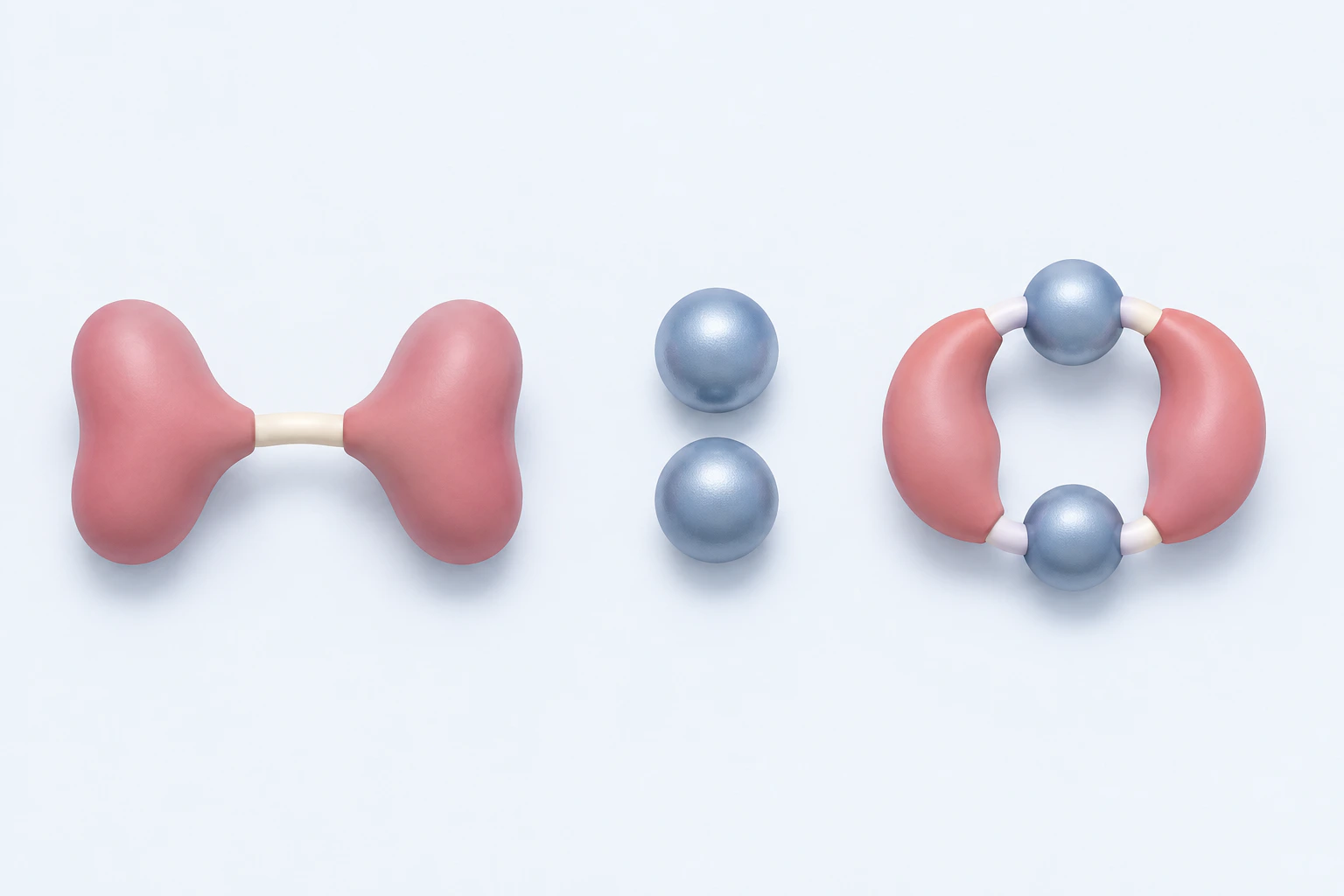
Dimethylglyoxime identity-and-complexation orientation. These are non-literal teaching forms, not a validated molecular model, stoichiometric claim, observed reaction, analytical result, exposure finding, or clinical test.
Scientific media record2 verified identifiers
- Subject
- Dimethylglyoximebiological-process
- Identifiers
- WikiBiome:dimethylglyoximePubChem:135459645
- Review
- Editorial review completeIdentifiers authority-verified · Accessibility validated · · dimethylglyoxime|dimethylglyoxime-mechanism-v1.webp
- Digital source
- Trained-algorithmic mediaCreated with a trained generative algorithm and reviewed by WikiBiome for subject identity, scientific framing, identifiers, provenance, and accessibility.
- Scientific basis
- DimethylglyoximeDimethylglyoxime — CID 135459645Dimethylglyoxime
- License
- CC BY-SA 4.0Created
Dimethylglyoxime (DMG) is a high-affinity, nickel-specific chelator—two DMG molecules coordinate one nickel (Ni)²⁺ ion to form a characteristic red complex (Tschugaeff reaction).
Unlike broad-spectrum chelation agents (EDTA, DMSA) that bind multiple divalent cations indiscriminately, DMG is selective for nickel, making it a precision tool for disabling nickel-dependent virulence without stripping essential metals like zinc, iron, or manganese.
This selectivity is a paradigm shift: chelation therapy is not inherently non-selective. Selective chelators exist, and DMG is the proof of concept.
Evidence map4 cited passagesInspect provenance +
The Benoit et al. (2019) study demonstrated that oral DMG is effective against multi-drug resistant (MDR) WHO priority pathogens by targeting their nickel-dependent virulence enzymes:
DMG-mediated nickel chelation could be effective against the majority of the world's most dangerous antibiotic-resistant pathogens.
Separately, DMG has been tested against nickel-induced amyloid-beta aggregation—targeted nickel removal reduces pathological protein misfolding without stripping essential metals. This connects the anti-pathogen and neurodegeneration applications through the same selectivity mechanism.
DMG is also the standard dermatological spot-test reagent for detecting nickel on surfaces (jewelry, implants, tools) in nickel allergy management.
Contents
1. Anti-Pathogen Activity—The Landmark Finding2. Why This Matters for WikiBiome3. Alzheimer's Application4. Nickel Contact Allergy5. Cross-ReferencesAnti-Pathogen Activity—The Landmark Finding#
The Benoit et al. (2019) study demonstrated that oral DMG is effective against multi-drug resistant (MDR) WHO priority pathogens by targeting their nickel-dependent virulence enzymes:[1]Benoit et al. 2019 — Nickel Chelation Therapy as an Approach to Combat Multi-Drug Resistant Enteric PathogensStéphane L. Benoit, Alan A. Schmalstig, John Glushka et al. · 2019Open reference 1 ↓
In Vitro#
Growth inhibition: DMG is bacteriostatic against MDR Klebsiella pneumoniae (NDM-1+, carbapenem-resistant) and MDR Salmonella Typhimurium at 5–10 mM. Hydrogenase abolished: NiFe hydrogenase activity in Salmonella completely eliminated at 10 mM DMG. Adding NiCl₂ restored activity, confirming the mechanism is nickel sequestration.
Urease abolished: urease activity in Klebsiella completely eliminated at 5 mM DMG. Since urease-negative K. pneumoniae mutants cannot colonize the intestine, this predicts in vivo efficacy.
In Vivo#
Mouse typhoid model: Oral DMG reduced S. Typhimurium mortality from 100% to 50% (9-day treatment). Organ colonization (liver, spleen) was 10-fold lower in treated mice (P < 0.01).
Wax moth larvae: DMG pre-treatment led to 40% survival (MDR K. pneumoniae) and 60% survival (MDR S. Typhimurium) vs. 100% mortality without DMG.
Non-toxic: Oral DMG at therapeutic doses showed zero toxicity symptoms in mice over 6 days. NMR confirmed DMG reaches the liver after oral administration—orally bioavailable.
Far safer than EDTA: EDTA LD₅₀ ~400 mg/kg; disulfiram LD₅₀ ~200 µg/mouse. DMG showed no toxicity at comparable or higher doses.
WHO Priority Pathogen Coverage#
Among the 12 WHO critical MDR pathogens needing new antibiotics most urgently. 10 are urease-positive. 6 are hydrogenase-positive. 4 have both (hydrogenase + urease).
8 have nickel-dependent glyoxalase I.
DMG-mediated nickel chelation could be effective against the majority of the world's most dangerous antibiotic-resistant pathogens.[1]Benoit et al. 2019 — Nickel Chelation Therapy as an Approach to Combat Multi-Drug Resistant Enteric PathogensStéphane L. Benoit, Alan A. Schmalstig, John Glushka et al. · 2019Open reference 1 ↓
Why This Matters for WikiBiome#
This paper is the in vivo proof that Karen's Brain Primitive 4 (Metal Dependencies as Achilles' Heels) works as a therapeutic strategy:
- Pathogens cannot evolve around nickel dependency. Antibiotic resistance is encoded on plasmids and can be transferred horizontally. Nickel dependency is encoded in the organism's core metabolism—hydrogenase and urease are essential metalloenzymes, not accessory resistance genes. You can evolve around penicillin; you cannot evolve around needing nickel.
- Selective chelation preserves the commensal microbiome. Most gut commensals (Bacteroidetes, Firmicutes SCFA producers) are not nickel-dependent. By targeting nickel specifically, DMG weakens pathobionts while leaving the protective microbiome intact—the opposite of broad-spectrum antibiotics.
- This approach complements, not replaces, existing therapies. DMG weakens the pathogen's colonization machinery; the host immune system or a co-administered antibiotic finishes the job. DMG could rescue antibiotics that have lost efficacy against MDR strains.
Alzheimer's Application#
Separately, DMG has been tested against nickel-induced amyloid-beta aggregation—targeted nickel removal reduces pathological protein misfolding without stripping essential metals.[2]The nickel-chelator dimethylglyoxime inhibits human amyloid beta peptide in vitro aggregationBenoit SL, Bhatt RJ, Maier RJ · 2021Open reference 2 ↓ This connects the anti-pathogen and neurodegeneration applications through the same selectivity mechanism.
Nickel Contact Allergy#
DMG is also the standard dermatological spot-test reagent for detecting nickel on surfaces (jewelry, implants, tools) in Nickel Allergy and Allergic Contact Dermatitis management.[3]Nickel Allergy and Allergic Contact Dermatitis: A Clinical ReviewAhlström MG, Thyssen JP, Wennervaldt M et al. · 2019Open reference 3 ↓
Cross-References#
- Nickel—the target metal
- Salmonella—hydrogenase disabled by DMG; in vivo efficacy
- Klebsiella—urease disabled by DMG
- Antimicrobial Resistance—DMG effective where antibiotics fail
- Metal Chelation Therapy—selective vs. non-selective chelation
- Nutritional Immunity (Metal Sequestration)—DMG extends host metal restriction pharmacologically
- Microbial Metallomics—the framework predicting this intervention
- Urease—nickel (Ni)-dependent enzyme disabled by DMG
- NiFe-Hydrogenase—nickel-dependent enzyme disabled by DMG
- Amyloid-Beta—nickel-dependent aggregation reduced by DMG
- Curli Amyloid Fibers—Enterobacteriaceae amyloid connection
- Competitive Exclusion—DMG weakens pathobionts, enabling commensal recovery
References 3
Numbered by first appearance in the article, then reconciled with its declared source list.
- 1
★Stéphane L. Benoit, Alan A. Schmalstig, John Glushka et al. (2019). Benoit et al. 2019 — Nickel Chelation Therapy as an Approach to Combat Multi-Drug Resistant Enteric Pathogens. Scientific Reports.
- 2
Benoit SL, Bhatt RJ, Maier RJ (2021). The nickel-chelator dimethylglyoxime inhibits human amyloid beta peptide in vitro aggregation. Scientific Reports.
- 3
Ahlström MG, Thyssen JP, Wennervaldt M et al. (2019). Nickel Allergy and Allergic Contact Dermatitis: A Clinical Review. Contact Dermatitis.
Article network
Mentioned here 15
Connect the evidence
Publicly readable discussion by ORCID-authenticated researchers. Questions, interpretation, methods, corrections, and new evidence stay attached to this record.
No discussion yet. Start with a precise question or a source-backed observation.
Activity and accepted changes
Accepted researcher context, editorial status, public discussion, and upstream Git revisions are shown together. Pending, declined, and withdrawn proposals remain private.
- published revision
Complete Hydrogenase contextual coverage
Karen Pendergrass · +1 −1
Inspect exact Git diff ↗ - published revision
Complete reviewed Urease contextual coverage
Karen Pendergrass · +2 −2
Inspect exact Git diff ↗ - published revision
massive wiki expansion: 149 stubs fixed, 100+ new pages, Rule 15 scan, keystone papers
WikiBiome Deploy Bot · +84 −0
Inspect exact Git diff ↗