
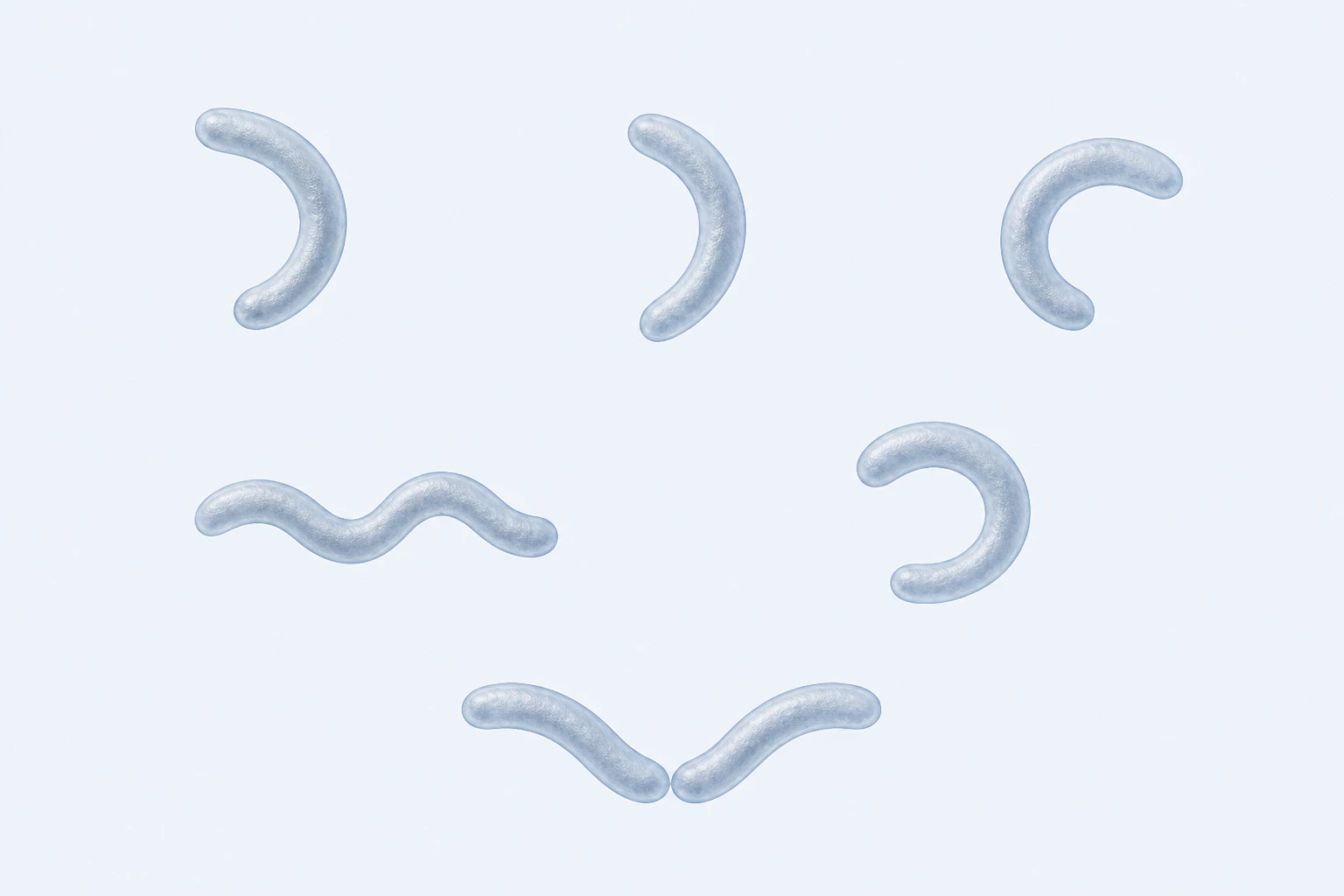
Representative Campylobacter jejuni curved forms, shown as seven bodies in six single or gull-wing groupings. The species is not visually diagnostic from this reconstruction, which is not a micrograph.
Scientific media record1 verified identifier
- Subject
- Campylobacter jejunitaxon · species
- Identifiers
- NCBITaxon:197
- Review
- Editorial review completeIdentifiers authority-verified · Accessibility validated · · campylobacter-jejuni|campylobacter-jejuni-morphology-v1.webp
- Digital source
- Trained-algorithmic mediaCreated with a trained generative algorithm and reviewed by WikiBiome for subject identity, scientific framing, identifiers, provenance, and accessibility.
- Scientific basis
- Campylobacter jejuni — NCBI TaxonomyCampylobacter jejuni type strain — BacDiveMorphology of Campylobacter jejuni
- License
- CC BY-SA 4.0Created
The leading bacterial cause of diarrheal disease worldwide, with an estimated 400-500 million cases annually. C. jejuni is notable in the metallomics context for possessing a Nickel-dependent [NiFe] Hydrogenase essential for colonization but lacking Urease—a striking contrast with the closely related Helicobacter pylori.
Evidence map5 cited passagesInspect provenance +
Possesses a membrane-bound [NiFe] uptake-type hydrogenase that oxidizes H2 to generate proton motive force (PMF) for ATP synthesis.
Leading cause of bacterial gastroenteritis in developed countries. Primarily foodborne (undercooked poultry, unpasteurized milk).
Causes watery or bloody diarrhea, abdominal pain, fever. Usually self-limiting but can be severe in children and immunocompromised patients.
Guillain-Barre syndrome (GBS): C. jejuni infection is the most common antecedent of GBS, an autoimmune peripheral neuropathy. Molecular mimicry between C. jejuni lipooligosaccharide and gangliosides drives the autoimmune response.
Reactive arthritis: post-infectious joint inflammation; related C. fetus has been linked to spondylitis-CKD syndromes demonstrating extraintestinal sequelae of the genus.
Contents
1. Nickel-Dependent Virulence2. Iron Acquisition3. Clinical Significance4. The Hydrogenase-Only Model5. ConnectionsNickel-Dependent Virulence#
[NiFe] Hydrogenase—No Urease#
Possesses a membrane-bound [NiFe] uptake-type hydrogenase that oxidizes H2 to generate proton motive force (PMF) for ATP synthesis.[1]Role of Nickel in Microbial PathogenesisRobert J. Maier, Stéphane L. Benoit · 2019Open reference 1 ↓
Hydrogenase is essential for chicken colonization—the primary animal reservoir and food safety concern. hydB deletion mutants show impaired cell division and reduced host cell interaction.
H2 is abundant in the intestinal lumen (produced by fermentative gut microbiota), providing a reliable energy source in the microaerobic environment of the intestinal mucus layer.
C. concisus (a related species) has the highest H2-uptake activity of any pathogenic bacterium characterized to date.
No urease: unlike H. pylori, C. jejuni does not produce urease. It does not colonize the acidic stomach but rather the lower intestinal tract, where acid buffering is unnecessary. This makes C. jejuni a hydrogenase-only nickel (Ni)-dependent pathogen.
Competitive Advantage via H2 Metabolism#
In the microaerobic intestinal mucus niche, H2 oxidation provides a competitive energy advantage over fermentation-only organisms. Hydrogenase activity enables C. jejuni to thrive at the epithelial surface where O2 gradients create favorable conditions for microaerobic H2-dependent respiration.
This nickel-dependent energy metabolism supports the flagellar motility and chemotaxis that are critical for mucosal colonization.
Iron Acquisition#
C. jejuni produces enterobactin receptors (CfrA, CfrB) for siderophore piracy—scavenging iron-loaded siderophores produced by other gut microbes rather than synthesizing its own.
Also acquires iron via ferric enterochelin, hemin, and transferrin/lactoferrin binding proteins. Iron restriction is a major host defense; C. jejuni iron-uptake mutants are severely attenuated.
Clinical Significance#
Leading cause of bacterial gastroenteritis in developed countries. Primarily foodborne (undercooked poultry, unpasteurized milk).[1]Role of Nickel in Microbial PathogenesisRobert J. Maier, Stéphane L. Benoit · 2019Open reference 1 ↓
Causes watery or bloody diarrhea, abdominal pain, fever. Usually self-limiting but can be severe in children and immunocompromised patients.[2]Bushman 2025 — The Exploitation of Nutrient Metals by Bacteria for Survival and Infection in the GutSummer D Bushman, Eric P Skaar, N Luisa Hiller · 2025Open reference 2 ↓
Guillain-Barre syndrome (GBS): C. jejuni infection is the most common antecedent of GBS, an autoimmune peripheral neuropathy. Molecular mimicry between C. jejuni lipooligosaccharide and gangliosides drives the autoimmune response.[1]Role of Nickel in Microbial PathogenesisRobert J. Maier, Stéphane L. Benoit · 2019Open reference 1 ↓
Reactive arthritis: post-infectious joint Metal-Driven Inflammation; related C. fetus has been linked to spondylitis-CKD syndromes demonstrating extraintestinal sequelae of the genus.[3]Choi et al. 2016 — Campylobacter fetus subsp. testudinum Spondylitis in CKD PatientHong Sang Choi, Sung Un Shin, Eun Hui Bae et al. · 2016Open reference 3 ↓
Growing fluoroquinolone resistance complicates treatment of severe cases.
The Hydrogenase-Only Model#
C. jejuni demonstrates that [NiFe] hydrogenase alone—without urease—can be sufficient for nickel-dependent pathogenesis when the ecological niche does not require acid neutralization. This contrasts with Helicobacter pylori (urease + hydrogenase), Salmonella enterica serovar Typhimurium (four hydrogenases), and Shigella flexneri (hydrogenase for phagolysosomal acid combat).
The pathogen's niche determines which nickel (Ni)-enzymes are essential.
Connections#
- Urease—notably absent; contrasts with H. pylori
- Nickel—essential cofactor for hydrogenase
- Iron—acquired via siderophore piracy and dedicated transporters
- Metal-Dependent Virulence—hydrogenase-only nickel (Ni)-dependent virulence model
- Helicobacter pylori—closely related but with very different nickel-enzyme complement
- Gut-Metal-Microbiome Interactions—H2 availability in the gut lumen enables hydrogenase function
- Nutritional Immunity (Metal Sequestration)—host iron restriction limits C. jejuni colonization
References 5
Numbered by first appearance in the article, then reconciled with its declared source list.
- 1
★Robert J. Maier, Stéphane L. Benoit (2019). Role of Nickel in Microbial Pathogenesis. Inorganics.
- 2
Summer D Bushman, Eric P Skaar, N Luisa Hiller (2025). Bushman 2025 — The Exploitation of Nutrient Metals by Bacteria for Survival and Infection in the Gut. PLOS Pathogens.
- 3
Hong Sang Choi, Sung Un Shin, Eun Hui Bae et al. (2016). Choi et al. 2016 — Campylobacter fetus subsp. testudinum Spondylitis in CKD Patient. Japanese Journal of Infectious Diseases.
- 4
★Qinheng Zhu, Boyan Chen, Fu Zhang et al. (2024). Toxic and Essential Metals: Metabolic Interactions with the Gut Microbiota and Health Implications. Frontiers in Nutrition.
- 5
Mengfan Tao, Kanglin Cao, Xinsheng Pu et al. (2024). Cadmium Exposure Induces Changes in Gut Microbial Composition and Metabolic Function in Long-Tailed Dwarf Hamsters, Cricetulus longicaudatus. Ecology and Evolution.
Article network
Mentioned here 11
Pages linking here 4
Connect the evidence
Publicly readable discussion by ORCID-authenticated researchers. Questions, interpretation, methods, corrections, and new evidence stay attached to this record.
No discussion yet. Start with a precise question or a source-backed observation.
Activity and accepted changes
Accepted researcher context, editorial status, public discussion, and upstream Git revisions are shown together. Pending, declined, and withdrawn proposals remain private.
- published revision
Backfill inflammation concept links
Karen Pendergrass · +1 −1
Inspect exact Git diff ↗ - published revision
Keep Hydrogenase links contextual
Karen Pendergrass · +0 −1
Inspect exact Git diff ↗ - published revision
Remove repeated Hydrogenase links
Karen Pendergrass · +1 −1
Inspect exact Git diff ↗ - published revision
Complete reviewed Urease contextual coverage
Karen Pendergrass · +2 −2
Inspect exact Git diff ↗ - published revision
massive wiki expansion: 149 stubs fixed, 100+ new pages, Rule 15 scan, keystone papers
WikiBiome Deploy Bot · +9 −9
Inspect exact Git diff ↗ - published revision
nightly maintenance: 94 stub demotions, 181 source_count fixes, 22 auto-discovered stubs, 5 adversarial audits, 3 boundary fixes, 3 evidence-level corrections
WikiBiome Deploy Bot · +1 −0
Inspect exact Git diff ↗ - published revision
Add 11 deepened microbe entities and 9 new OC/CVD/infertility source pages
WikiBiome Deploy Bot · +5 −5
Inspect exact Git diff ↗ - published revision
WikiBiome update — 2026-04-15 17:23
WikiBiome Deploy Bot · +0 −1
Inspect exact Git diff ↗ - published revision
wiki: bulk entity upgrades, new article pages, and site regeneration
WikiBiome Deploy Bot · +6 −0
Inspect exact Git diff ↗ - published revision
WikiBiome update — integrity fixes, metallomic diet pages, cross-condition analyses
WikiBiome Deploy Bot · +9 −1
Inspect exact Git diff ↗ - published revision
WikiBiome v7 — interactive microbiome metallomics encyclopedia
Karen Pendergrass · +60 −0
Inspect exact Git diff ↗