
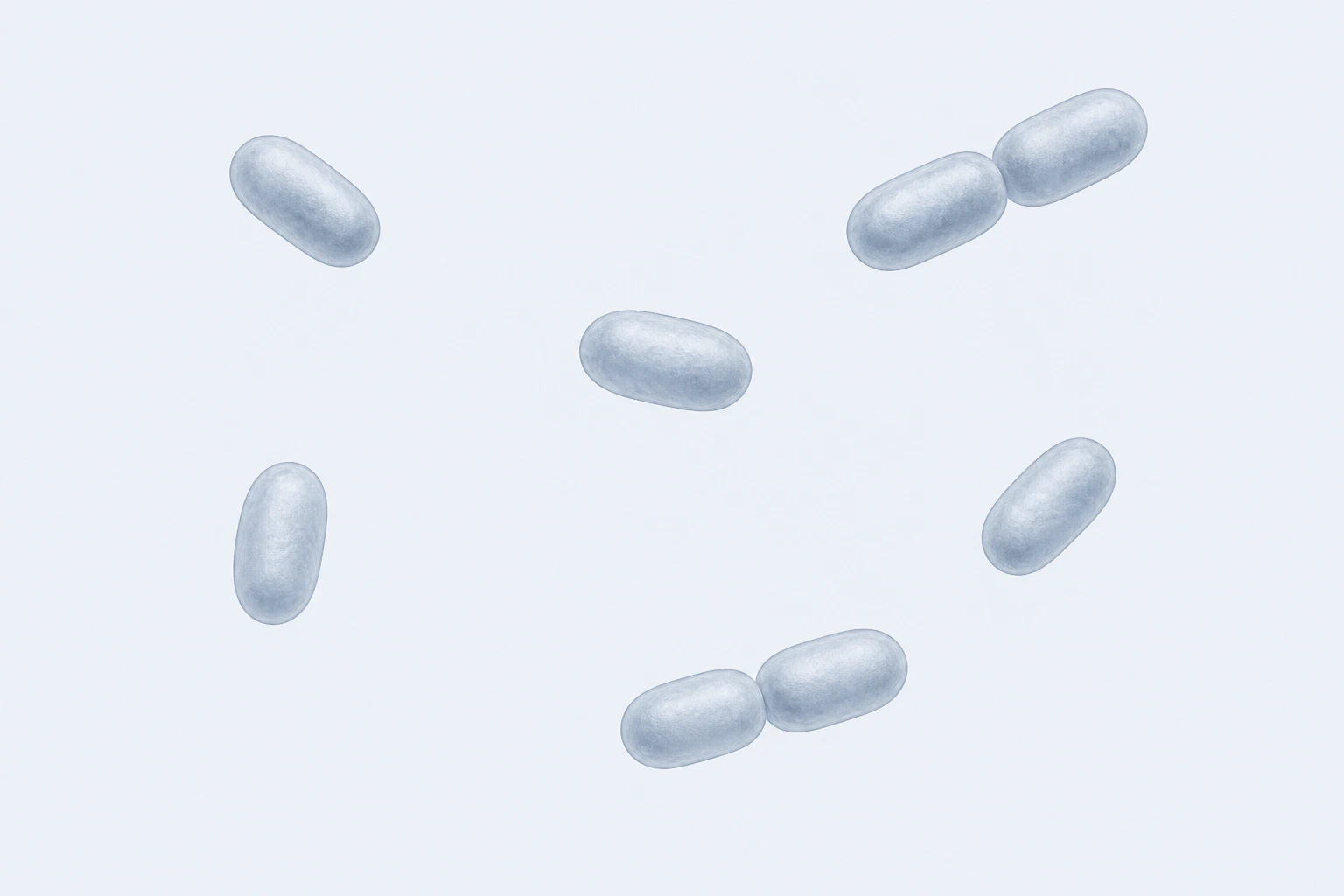
Representative Brucella coccobacillary morphology, shown as eight bodies in six single or paired groupings. This genus-level reconstruction is non-diagnostic and is not a micrograph.
Scientific media record1 verified identifier
- Subject
- Brucellataxon · genus
- Identifiers
- NCBITaxon:234
- Review
- Editorial review completeIdentifiers authority-verified · Accessibility validated · · brucella|brucella-morphology-v1.webp
- Digital source
- Trained-algorithmic mediaCreated with a trained generative algorithm and reviewed by WikiBiome for subject identity, scientific framing, identifiers, provenance, and accessibility.
- Scientific basis
- Brucella — NCBI TaxonomyBrucella — Medical Microbiology
- License
- CC BY-SA 4.0Created
A genus of Gram-negative intracellular pathogens causing brucellosis, the most common bacterial zoonosis worldwide.
Brucella species depend on Nickel-activated Urease for gastrointestinal survival during the initial phase of infection, and urease immunization has been shown to protect against Brucella challenge—providing direct evidence that nickel (Ni)-dependent enzymes are viable vaccine targets.
Evidence map7 cited passagesInspect provenance +
Urease is essential for survival during gastrointestinal passage and initial intestinal colonization.
Immunization with urease protects against Brucella infection—one of the clearest demonstrations that a Ni-dependent virulence factor can serve as a protective antigen.
Brucella species produce siderophores (brucebactin) for iron scavenging within the macrophage phagosome.
Iron acquisition is critical for intracellular survival and replication, complementing the nickel-dependent acid survival that enables initial colonization.
Brucellosis: causes undulant fever, arthritis, endocarditis, neurobrucellosis. Over 500,000 new human cases annually worldwide.
Zoonotic reservoir: cattle (B. abortus), goats/sheep (B. melitensis), swine (B. suis), dogs (B. canis).
Intracellular persistence: survives within macrophages by preventing phagosome-lysosome fusion, creating chronic and relapsing infections.
Contents
1. Nickel-Dependent Virulence2. Iron Acquisition3. Clinical Significance4. The Nickel-Vaccine Connection5. ConnectionsNickel-Dependent Virulence#
Ni-Urease—Gateway to Infection#
Urease is essential for survival during gastrointestinal passage and initial intestinal colonization.[1]Role of Nickel in Microbial PathogenesisRobert J. Maier, Stéphane L. Benoit · 2019Open reference 1 ↓
Brucella is typically acquired through ingestion of contaminated dairy products or direct contact with infected animals. The oral route demands acid resistance during gastric transit.
Urease-generated ammonia and bicarbonate buffer the Acidic Microenvironment of the stomach, enabling bacteria to reach the intestinal mucosa intact. Once past the GI barrier, Brucella establishes intracellular infection in macrophages, where it resides in a modified phagosome.
Urease as Vaccine Target#
Immunization with urease protects against Brucella infection—one of the clearest demonstrations that a nickel (Ni)-dependent virulence factor can serve as a protective antigen.[1]Role of Nickel in Microbial PathogenesisRobert J. Maier, Stéphane L. Benoit · 2019Open reference 1 ↓
This validates urease as a targetable vulnerability, paralleling the HspA vaccine candidate approach for Helicobacter pylori. The finding has broader implications: any pathogen whose colonization depends on urease-mediated acid survival could be targeted with urease-based immunization strategies.
Iron Acquisition#
Brucella species produce siderophores (brucebactin) for iron scavenging within the macrophage phagosome.[1]Role of Nickel in Microbial PathogenesisRobert J. Maier, Stéphane L. Benoit · 2019Open reference 1 ↓ Iron acquisition is critical for intracellular survival and replication, complementing the nickel-dependent acid survival that enables initial colonization.[1]Role of Nickel in Microbial PathogenesisRobert J. Maier, Stéphane L. Benoit · 2019Open reference 1 ↓
Clinical Significance#
Brucellosis: causes undulant fever, arthritis, endocarditis, neurobrucellosis. Over 500,000 new human cases annually worldwide.[1]Role of Nickel in Microbial PathogenesisRobert J. Maier, Stéphane L. Benoit · 2019Open reference 1 ↓ Zoonotic reservoir: cattle (B. abortus), goats/sheep (B. melitensis), swine (B. suis), dogs (B. canis).[1]Role of Nickel in Microbial PathogenesisRobert J. Maier, Stéphane L. Benoit · 2019Open reference 1 ↓
Intracellular persistence: survives within macrophages by preventing phagosome-lysosome fusion, creating chronic and relapsing infections.[1]Role of Nickel in Microbial PathogenesisRobert J. Maier, Stéphane L. Benoit · 2019Open reference 1 ↓ Occupational and food-borne: pasteurization of dairy products is the primary prevention strategy; absence of pasteurization in endemic regions drives ongoing transmission.
Treatment requires prolonged combination antibiotic therapy (doxycycline + streptomycin/rifampin), and relapse rates remain significant.
The Nickel-Vaccine Connection#
Brucella illustrates a clean narrative: a pathogen that must traverse the stomach to establish infection, depends on nickel (Ni)-urease for that transit, and can be blocked by targeting that enzyme immunologically. This makes the nickel-urease axis both a virulence determinant and a therapeutic vulnerability.
Connections#
- Urease—essential for GI transit; validated vaccine antigen
- Nickel—cofactor for the urease that gates initial infection
- Nutritional Immunity (Metal Sequestration)—host nickel restriction could complement vaccination
- Metal-Dependent Virulence—urease as the primary nickel (Ni)-virulence factor
- Helicobacter pylori—parallels in urease-dependent acid survival
- Staphylococcus aureus—another urease-dependent pathogen in a different niche
References 1
Numbered by first appearance in the article, then reconciled with its declared source list.
- 1
★Robert J. Maier, Stéphane L. Benoit (2019). Role of Nickel in Microbial Pathogenesis. Inorganics.
Article network
Connect the evidence
Publicly readable discussion by ORCID-authenticated researchers. Questions, interpretation, methods, corrections, and new evidence stay attached to this record.
No discussion yet. Start with a precise question or a source-backed observation.
Activity and accepted changes
Accepted researcher context, editorial status, public discussion, and upstream Git revisions are shown together. Pending, declined, and withdrawn proposals remain private.
- published revision
massive wiki expansion: 149 stubs fixed, 100+ new pages, Rule 15 scan, keystone papers
WikiBiome Deploy Bot · +7 −7
Inspect exact Git diff ↗ - published revision
nightly maintenance: 94 stub demotions, 181 source_count fixes, 22 auto-discovered stubs, 5 adversarial audits, 3 boundary fixes, 3 evidence-level corrections
WikiBiome Deploy Bot · +3 −0
Inspect exact Git diff ↗ - published revision
Add 11 deepened microbe entities and 9 new OC/CVD/infertility source pages
WikiBiome Deploy Bot · +5 −5
Inspect exact Git diff ↗ - published revision
wiki: bulk entity upgrades, new article pages, and site regeneration
WikiBiome Deploy Bot · +6 −0
Inspect exact Git diff ↗ - published revision
WikiBiome update — integrity fixes, metallomic diet pages, cross-condition analyses
WikiBiome Deploy Bot · +4 −2
Inspect exact Git diff ↗ - published revision
WikiBiome update — 2026-04-10 23:44
WikiBiome Deploy Bot · +1 −1
Inspect exact Git diff ↗ - published revision
WikiBiome v7 — interactive microbiome metallomics encyclopedia
Karen Pendergrass · +56 −0
Inspect exact Git diff ↗