

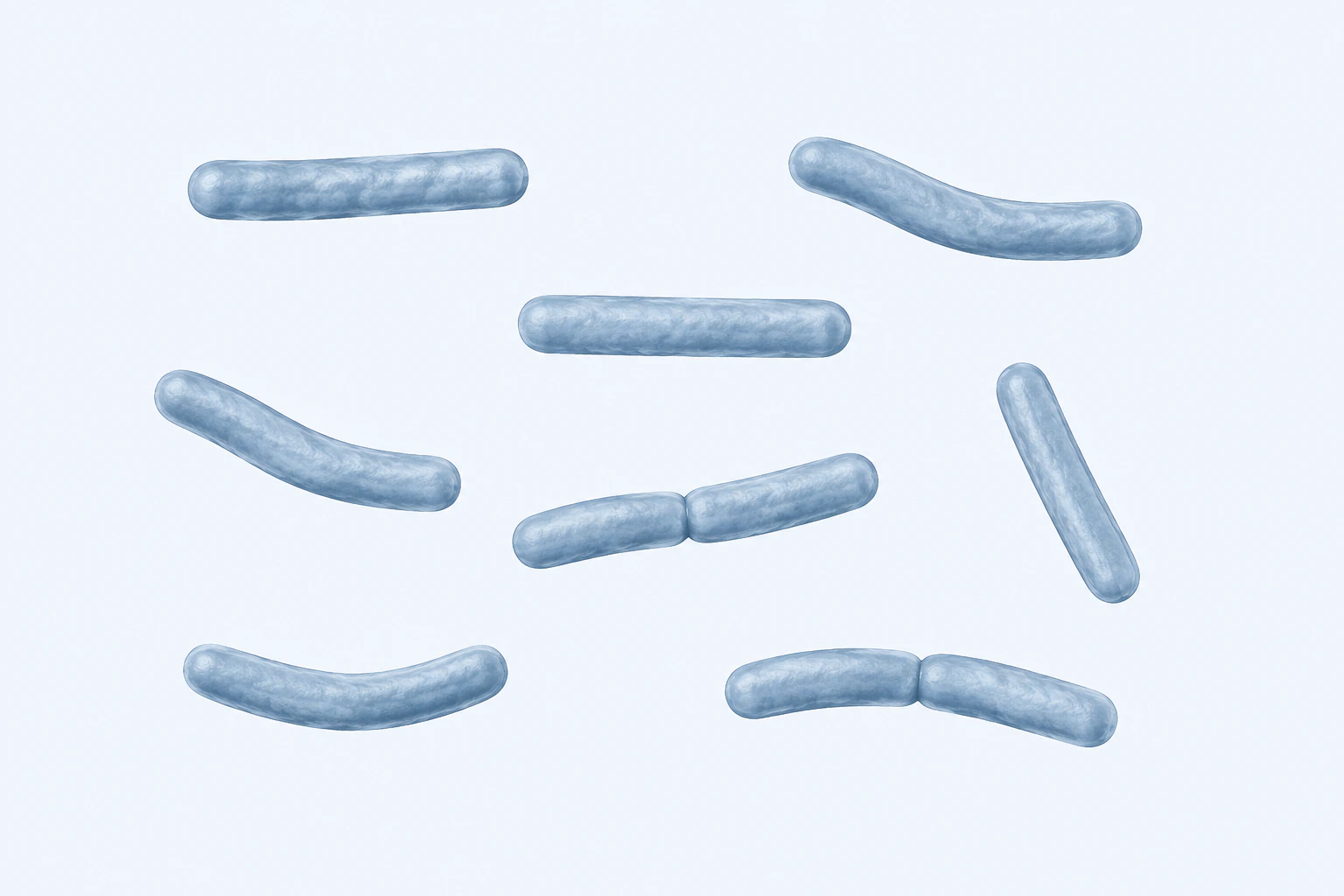
Type-strain-anchored Mycobacterium tuberculosis slender rods, shown as nine bodies in five single and two paired groupings. This scientific reconstruction is representative, non-diagnostic, and not a micrograph or stained specimen.
Scientific media record1 verified identifier
- Subject
- Mycobacterium tuberculosistaxon · species
- Identifiers
- NCBITaxon:1773
- Review
- Editorial review completeIdentifiers authority-verified · Accessibility validated · · mycobacterium-tuberculosis|mycobacterium-tuberculosis-morphology-v1.webp
- Digital source
- Trained-algorithmic mediaCreated with a trained generative algorithm and reviewed by WikiBiome for subject identity, scientific framing, identifiers, provenance, and accessibility.
- Scientific basis
- Mycobacterium tuberculosis — NCBI TaxonomyMycobacterium tuberculosis — LPSNMycobacterium tuberculosis acid-fast rodsTuberculosis
- License
- CC BY-SA 4.0Created
The causative agent of tuberculosis (TB), the leading infectious disease killer worldwide (~1.3 million deaths annually). M. tuberculosis has an exceptionally complex metal biology: it deploys Nickel-dependent Hydrogenase and Urease for intracellular survival, species-specific siderophores (mycobactins) for Iron scavenging, and must resist host Copper intoxication within macrophage phagosomes.
Evidence map5 cited passagesInspect provenance +
M. tuberculosis possesses a Hyc-type [NiFe] hydrogenase that is upregulated during macrophage infection.
Urease supports survival under nitrogen-limited conditions encountered during chronic infection and latency.
M. tuberculosis produces two structurally related siderophores: - Mycobactins: hydrophobic, cell-associated. Retain iron at the cell envelope for membrane transport. - Carboxymycobactins: hydrophilic, secreted into the extracellular environment to scavenge iron from host proteins.
Host macrophages may deploy zinc intoxication as an antimicrobial strategy against intracellular mycobacteria, paralleling the zinc poisoning of streptococci.
Mycobactin-based diagnostics: siderophore detection in sputum or urine could provide rapid, non-culture-based TB diagnosis.
Contents
1. Nickel-Dependent Virulence2. Iron Acquisition—The Mycobactin System3. Copper Toxicity Defense4. Zinc Biology5. Clinical Significance6. ConnectionsNickel-Dependent Virulence#
[NiFe] Hydrogenase (Hyc)#
M. tuberculosis possesses a Hyc-type [NiFe] hydrogenase that is upregulated during macrophage infection.[1]Role of Nickel in Microbial PathogenesisRobert J. Maier, Stéphane L. Benoit · 2019Open reference 1 ↓
Within the phagosome, conventional carbon sources are scarce. H2 oxidation provides an alternative energy source (PMF generation) for survival in this nutrient-limited intracellular niche.
The upregulation specifically during macrophage residence suggests the bacterium shifts to H2-dependent energy metabolism as part of its intracellular persistence program. Connects to the broader theme of hydrogenase-dependent intracellular survival seen in Salmonella enterica serovar Typhimurium and Shigella flexneri.
Ni-Urease#
Urease supports survival under nitrogen-limited conditions encountered during chronic infection and latency.[1]Role of Nickel in Microbial PathogenesisRobert J. Maier, Stéphane L. Benoit · 2019Open reference 1 ↓ Ammonia from urease provides a nitrogen source when amino acid availability is restricted within the granuloma.
Urease may also modulate phagosomal pH, though this is less well characterized than in Helicobacter pylori or Cryptococcus neoformans.
Iron Acquisition—The Mycobactin System#
Mycobactins and Carboxymycobactins#
M. tuberculosis produces two structurally related siderophores.[2]Infection metallomics for critical care in the post-COVID eraPatil RH, Luptakova D, Havlicek V · 2021Open reference 2 ↓ Mycobactins: hydrophobic, cell-associated. Retain iron at the cell envelope for membrane transport.
Carboxymycobactins: hydrophilic, secreted into the extracellular environment to scavenge iron from host proteins.
Species-specific side chain variations in mycobactins enable diagnostic identification—each mycobacterial species produces characteristic mycobactin structures. Iron acquisition via mycobactins is essential for virulence; mutants lacking mycobactin biosynthesis are severely attenuated in animal models.
Host Iron Restriction#
Macrophages restrict iron availability within the phagosome via NRAMP1 (SLC11A1)-mediated iron export. NRAMP1 polymorphisms in humans are associated with susceptibility to TB—directly linking host metal transport to TB outcome. Hepcidin-mediated hypoferremia during TB infection reduces circulating iron, though this also contributes to the anemia of chronic infection.
Copper Toxicity Defense#
Macrophages deliver toxic copper concentrations into phagosomes as an antimicrobial strategy. M. tuberculosis possesses CtpV (P-type ATPase copper exporter) and MctB (outer membrane channel) for copper efflux. MymT: a copper metallothionein that sequesters cytoplasmic copper.
Copper resistance is essential for macrophage survival; CtpV mutants show increased copper sensitivity and reduced virulence.
Zinc Biology#
Host macrophages may deploy zinc intoxication as an antimicrobial strategy against intracellular mycobacteria, paralleling the zinc poisoning of streptococci.[3]Metal Homeostasis in Pathogenic StreptococciAkbari MS, Doran KS, Burcham LR · 2022Open reference 3 ↓
M. tuberculosis zinc homeostasis involves multiple exporters and importers to navigate between zinc starvation and zinc toxicity within the phagosome.
Clinical Significance#
Tuberculosis: ~10 million new cases annually. Primarily pulmonary but can affect any organ (miliary TB, TB meningitis, bone TB).
Latent TB: one-quarter of the global population carries latent M. tuberculosis infection; metal homeostasis (particularly iron and nickel) likely determines the balance between latency and reactivation.
Drug-resistant TB: MDR-TB and XDR-TB are growing crises; novel drug targets including nickel (Ni)-dependent enzymes are urgently needed.
HIV co-infection: TB is the leading killer of people living with HIV. Altered metal homeostasis in HIV infection (reduced zinc, altered iron) may favor TB reactivation.
Mycobactin-based diagnostics: siderophore detection in sputum or urine could provide rapid, non-culture-based TB diagnosis.[2]Infection metallomics for critical care in the post-COVID eraPatil RH, Luptakova D, Havlicek V · 2021Open reference 2 ↓
Connections#
- Hydrogenase—Hyc upregulated in macrophages for intracellular energy generation
- Urease—nitrogen acquisition during chronic/latent infection
- Siderophores and Metallophores—mycobactins/carboxymycobactins for iron acquisition
- Nickel—cofactor for hydrogenase and urease
- Iron—the most critical metal for TB virulence; mycobactin-dependent
- Copper—host macrophage weapon; M. tuberculosis resists via CtpV/MctB/MymT
- Nutritional Immunity (Metal Sequestration)—NRAMP1 iron restriction is genetically linked to TB susceptibility
- Metal-Dependent Virulence—multi-metal virulence strategy
- Salmonella enterica serovar Typhimurium—shares intracellular hydrogenase-dependent survival strategy
- Staphylococcus aureus—parallel metal acquisition systems for different intracellular niches
References 4
Numbered by first appearance in the article, then reconciled with its declared source list.
- 1
★Robert J. Maier, Stéphane L. Benoit (2019). Role of Nickel in Microbial Pathogenesis. Inorganics.
- 2
★Patil RH, Luptakova D, Havlicek V (2021). Infection metallomics for critical care in the post-COVID era. Mass Spectrometry Reviews.
- 3
Akbari MS, Doran KS, Burcham LR (2022). Metal Homeostasis in Pathogenic Streptococci. Microorganisms.
- 4
★James E. Cassat, Eric P. Skaar (2012). Metal Ion Acquisition in Staphylococcus aureus: Overcoming Nutritional Immunity. Seminars in Immunopathology.
Article network
Mentioned here 14
Pages linking here 3
Connect the evidence
Publicly readable discussion by ORCID-authenticated researchers. Questions, interpretation, methods, corrections, and new evidence stay attached to this record.
No discussion yet. Start with a precise question or a source-backed observation.
Activity and accepted changes
Accepted researcher context, editorial status, public discussion, and upstream Git revisions are shown together. Pending, declined, and withdrawn proposals remain private.
- published revision
Complete Ammonia contextual coverage
Karen Pendergrass · +1 −1
Inspect exact Git diff ↗ - published revision
Complete Hydrogenase contextual coverage
Karen Pendergrass · +3 −3
Inspect exact Git diff ↗ - published revision
Complete reviewed Urease contextual coverage
Karen Pendergrass · +2 −2
Inspect exact Git diff ↗ - published revision
massive wiki expansion: 149 stubs fixed, 100+ new pages, Rule 15 scan, keystone papers
WikiBiome Deploy Bot · +15 −15
Inspect exact Git diff ↗ - published revision
nightly maintenance: 94 stub demotions, 181 source_count fixes, 22 auto-discovered stubs, 5 adversarial audits, 3 boundary fixes, 3 evidence-level corrections
WikiBiome Deploy Bot · +1 −0
Inspect exact Git diff ↗ - published revision
WikiBiome update — 2026-04-15 17:23
WikiBiome Deploy Bot · +2 −3
Inspect exact Git diff ↗ - published revision
wiki: bulk entity upgrades, new article pages, and site regeneration
WikiBiome Deploy Bot · +6 −0
Inspect exact Git diff ↗ - published revision
WikiBiome update — integrity fixes, metallomic diet pages, cross-condition analyses
WikiBiome Deploy Bot · +12 −5
Inspect exact Git diff ↗ - published revision
WikiBiome v7 — interactive microbiome metallomics encyclopedia
Karen Pendergrass · +79 −0
Inspect exact Git diff ↗