
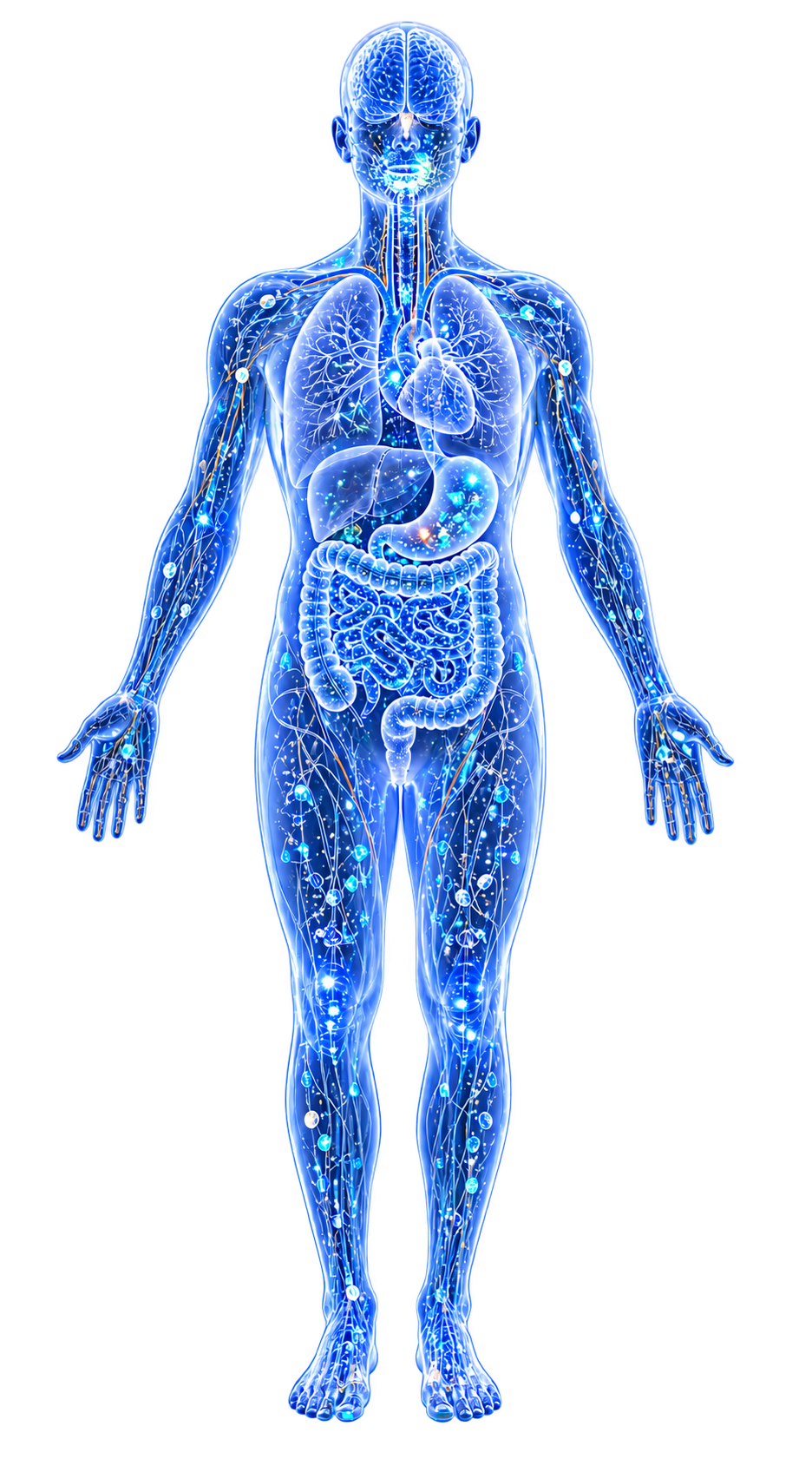
The transfer of processed stool from a healthy donor into a recipient's gastrointestinal tract to restore a disrupted microbial community. FMT is the most direct form of microbiome intervention—replacing the entire community rather than supplementing individual strains Probiotics or feeding existing commensals Prebiotics. It represents community-level ecological restoration.
Evidence map4 cited passagesInspect provenance +
Mouse models: FMT from MS-twin-derived microbiota increased autoimmune incidence; FMT from healthy donors showed protective immunoregulatory activity.
FMT from atherosclerotic mice induces atherosclerosis in recipient mice, demonstrating causal microbial contribution.
FMT as an innovative therapeutic approach for managing CVD is under active investigation.
Open-label FMT trial in ASD children reduced levels of p-cresol, 4-hydroxyphenylacetate, and indole; modified Prevotella, bifidobacterium, and Desulfovibrio abundances.
Contents
1. Mechanism2. Clinical Evidence by Disease3. Metal Angle4. Limitations and Risks5. See AlsoMechanism#
FMT introduces a complex, intact microbial ecosystem including bacteria, archaea, fungi Mycobiome, bacteriophages, and their metabolites. Proposed mechanisms of action.
Colonization resistance restoration: Donor commensals outcompete pathogens for niches and nutrients. SCFA production recovery: Donor Butyrate/propionate producers re-establish fermentative metabolism and colonocyte energy supply. Bile acid metabolism normalization: Donor bacteria restore secondary bile acid production, which inhibits C. difficile sporulation.
Immune recalibration: Restored SCFA and Indoles production rebalances Treg/Th17 and reduces Metal-Driven Inflammation. Barrier repair: Recovered butyrate production strengthens tight junctions and restores hypoxic colonic environment.
Clinical Evidence by Disease#
C. difficile Infection (Gold Standard)#
FMT cures recurrent C. difficile in ~90% of cases—far superior to antibiotics alone. FDA-approved live biotherapeutic products (REBYOTA, VOWST) now available. Mechanism primarily through restored colonization resistance and secondary bile acid metabolism.
IBD (Mixed Results)#
Ulcerative colitis: Multiple RCTs show induction of remission in 25-35% of patients (vs. 5-10% placebo), but durability and optimal protocols remain uncertain. Crohn's disease: Preliminary evidence; timing of repeat FMT may be critical (e.g., second FMT within 3 weeks showed greater mucosal improvement).
Challenge: IBD involves immune dysregulation beyond what microbiome restoration alone can correct.
Multiple Sclerosis (Pilot Data)#
Mouse models: FMT from MS-twin-derived microbiota increased autoimmune incidence; FMT from healthy donors showed protective immunoregulatory activity.[1]Gut-oriented interventions in patients with multiple sclerosis: fact or fiction?V. Martinelli, M. Albanese, M. Altieri et al. · 2022Open reference 1 ↓ Sutterella reduction identified as a key change in MS-associated FMT. Human data remain very limited; larger trials needed.
Cardiovascular Disease / Hypertension#
FMT from atherosclerotic mice induces atherosclerosis in recipient mice, demonstrating causal microbial contribution.[2]Microbiome and Cardiovascular DiseaseHilde Herrema, Max Nieuwdorp, Albert K. Groen · 2020Open reference 2 ↓ FMT as an innovative therapeutic approach for managing CVD is under active investigation.[3]Role of the intestinal microbiome and its therapeutic intervention in cardiovascular disorderAmeer Luqman, Adil Hassan, Mehtab Ullah et al. · 2024Open reference 3 ↓
Autism Spectrum Disorder (Open-Label)#
Open-label FMT trial in ASD children reduced levels of p-cresol, 4-hydroxyphenylacetate, and indole; modified Prevotella, Bifidobacterium, and Desulfovibrio abundances.[4]Zheng 2021 -- The Role of Bacterial-Derived Aromatic Amino Acids Metabolites Relevant in Autism Spectrum Disorders: A Comprehensive ReviewYuanpeng Zheng, Marie K. Bek, Naika Z. Prince et al. · 2021Open reference 4 ↓
GI symptoms and behavioral measures improved; effects persisted at 2-year follow-up in extended observations. Controlled trials are needed to confirm efficacy.
Other Applications Under Investigation#
Metabolic syndrome/obesity: FMT from lean donors to obese recipients temporarily improved insulin sensitivity in some trials. Hepatic encephalopathy: FMT reduced hospitalizations in cirrhotic patients. Graft-versus-host disease: FMT showing promise for steroid-refractory GI GVHD.
Metal Angle#
FMT may restore the metal-handling capacity of the microbiome disrupted by heavy metal exposure.
Biosorption capacity: Healthy donor microbiota includes metal-binding species (Lactobacillus, Bifidobacterium) that sequester lead (Pb), cadmium (Cd), and mercury (Hg) in the gut lumen. Barrier repair: Restored SCFA production reduces paracellular metal absorption through healed tight junctions. Competitive exclusion: Donor commensals displace metal-tolerant pathobionts (Enterobacteriaceae) that thrive in metal-contaminated, inflamed environments.
Detoxification enzymes: Donor bacteria may contribute arsenic methyltransferases (arsM), mercury demethylases (merB), and other biotransformation enzymes.
Limitations and Risks#
Donor screening: Risk of transmitting infections, antibiotic-resistant organisms, or unfavorable metabolic phenotypes. Durability: Engraftment is often incomplete; recipient diet and environment may select against donor species. Standardization: No consensus on preparation (fresh vs. frozen, capsule vs. colonoscopy), dosing, or donor selection criteria.
Regulatory: Classified as a biological product; access varies by jurisdiction.
See Also#
- Probiotics—single/multi-strain supplementation approach
- Prebiotics—substrate-based microbiome modulation
- Dysbiosis—the target condition FMT aims to correct
- butyrate—key metabolite restored by successful FMT
References 4
Numbered by first appearance in the article, then reconciled with its declared source list.
- 1
V. Martinelli, M. Albanese, M. Altieri et al. (2022). Gut-oriented interventions in patients with multiple sclerosis: fact or fiction?. European Review for Medical and Pharmacological Sciences.
- 2
Hilde Herrema, Max Nieuwdorp, Albert K. Groen (2020). Microbiome and Cardiovascular Disease. Handbook of Experimental Pharmacology (Prevention and Treatment of Atherosclerosis).
- 3
Ameer Luqman, Adil Hassan, Mehtab Ullah et al. (2024). Role of the intestinal microbiome and its therapeutic intervention in cardiovascular disorder. Frontiers in Immunology.
- 4
Yuanpeng Zheng, Marie K. Bek, Naika Z. Prince et al. (2021). Zheng 2021 -- The Role of Bacterial-Derived Aromatic Amino Acids Metabolites Relevant in Autism Spectrum Disorders: A Comprehensive Review. Frontiers in Neuroscience.
Article network
Mentioned here 9
Pages linking here 10
Connect the evidence
Publicly readable discussion by ORCID-authenticated researchers. Questions, interpretation, methods, corrections, and new evidence stay attached to this record.
No discussion yet. Start with a precise question or a source-backed observation.
Activity and accepted changes
Accepted researcher context, editorial status, public discussion, and upstream Git revisions are shown together. Pending, declined, and withdrawn proposals remain private.
- published revision
Complete Tight junctions contextual coverage
Karen Pendergrass · +1 −1
Inspect exact Git diff ↗ - published revision
massive wiki expansion: 149 stubs fixed, 100+ new pages, Rule 15 scan, keystone papers
WikiBiome Deploy Bot · +16 −16
Inspect exact Git diff ↗ - published revision
nightly maintenance: 94 stub demotions, 181 source_count fixes, 22 auto-discovered stubs, 5 adversarial audits, 3 boundary fixes, 3 evidence-level corrections
WikiBiome Deploy Bot · +1 −0
Inspect exact Git diff ↗ - published revision
pre-overnight checkpoint 2026-04-18
WikiBiome Deploy Bot · +3 −1
Inspect exact Git diff ↗ - published revision
Deep content + citation pass: 10 entities enriched, 7 new sources, DOI integrity
WikiBiome Deploy Bot · +2 −2
Inspect exact Git diff ↗ - published revision
WikiBiome update — integrity fixes, metallomic diet pages, cross-condition analyses
WikiBiome Deploy Bot · +6 −4
Inspect exact Git diff ↗ - published revision
WikiBiome update — 2026-04-10 15:45
WikiBiome Deploy Bot · +74 −0
Inspect exact Git diff ↗