
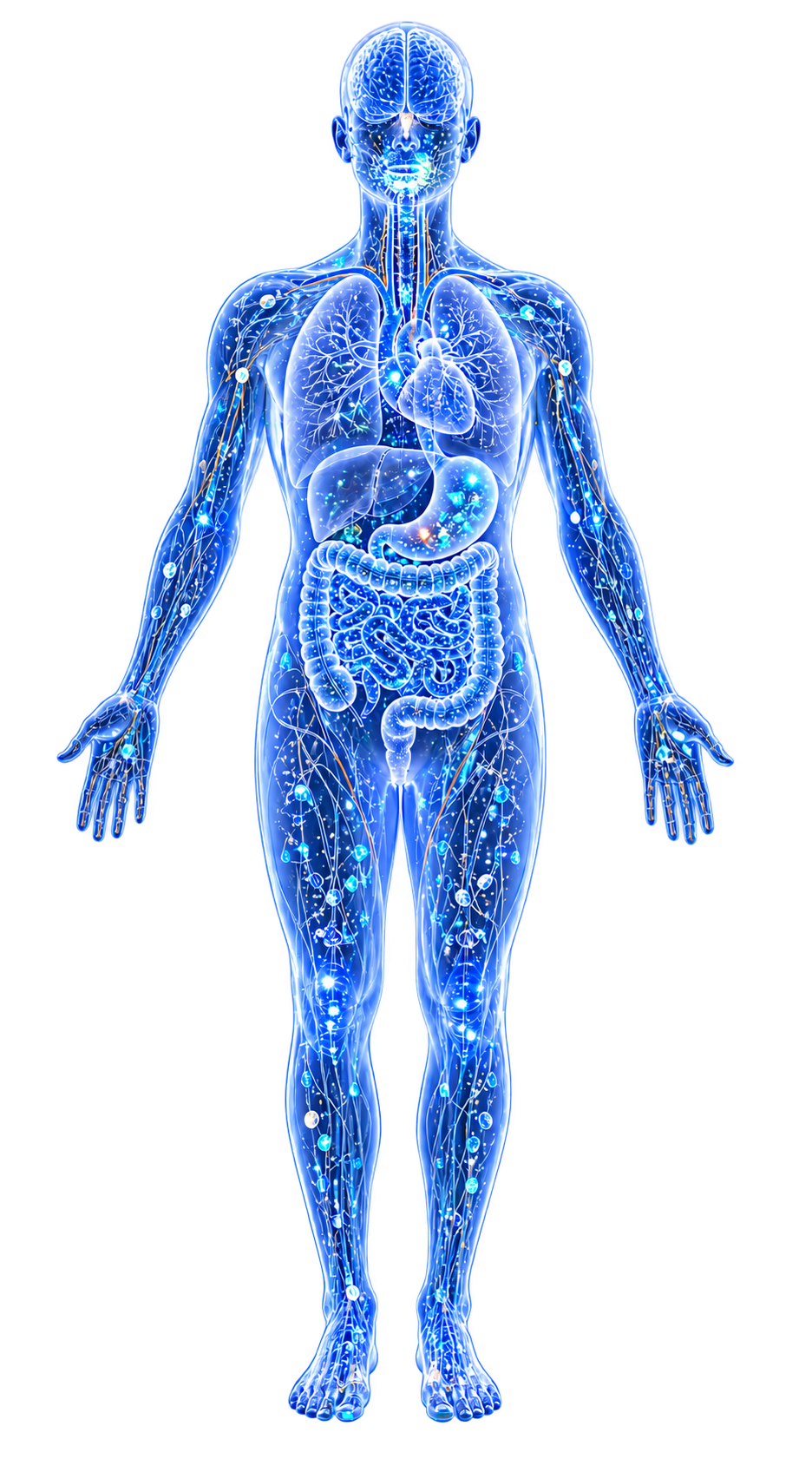
The fungal component of the human microbiome, comprising ~0.1-1% of the total gut microbial community by abundance but disproportionately active in immune signaling and cross-kingdom interactions.
While bacterial communities dominate microbiome research, emerging evidence implicates the mycobiome in IBD, colorectal cancer, cardiovascular disease, MS, and metabolic syndrome—often through mechanisms distinct from bacterial Dysbiosis.
Evidence map6 cited passagesInspect provenance +
Enriched in obesity (contributes to elevated intestinal free fatty acids), T2DM, coronary artery disease, and heart failure.
In colon cancer, Candida-dominant tumors show reduced survival via IL-22, TP53, and CD44 pathways.
Significantly enriched in hypertension cohorts, positively correlated with immunoglobulin light chains.
Produces siderophores (TAFC, ferricrocin) for iron acquisition—detectable in urine as infection biomarkers.
CRC: Intratumoral mycobiome detectable; oral fungi can reach the colon within 30 minutes via the sphincter of Oddi.
CVD/Hypertension: Malassezia and Candida enrichment; Mortierella appears protective in normotensive populations.
Contents
1. Key Fungal Genera2. Cross-Kingdom Interactions3. Disease Associations4. Metal Connections5. See AlsoKey Fungal Genera#
Candida#
Most abundant and best-studied gut fungus; C. albicans is the dominant species. Enriched in obesity (contributes to elevated intestinal free fatty acids), T2DM, coronary artery disease, and heart failure.[1]Gut mycobiome in cardiometabolic disease progression: current evidence and future directionsXiaoyu Wei, Zixin Guo, Jingyang Wang et al. · 2025Open reference 1 ↓
In colon cancer, Candida-dominant tumors show reduced survival via IL-22, TP53, and CD44 pathways.[2]The mycobiome in human cancer: analytical challenges, molecular mechanisms, and therapeutic implicationsTing Ding, Chang Liu, Zhengyu Li · 2025Open reference 2 ↓ Capable of yeast-to-hyphal transition, forming biofilms and invading epithelium when immune surveillance is compromised.
Saccharomyces#
S. cerevisiae is commensal; S. boulardii is used as a probiotic. Enriched in some cardiometabolic diseases; S. boulardii supplementation failed to improve cardiac function in the GutHeart trial. Saccharomycetes-dominant GI cancers show distinct patterns from Candida-dominant ones.
Malassezia#
Lipophilic yeast; primarily skin-associated but detected in gut. Significantly enriched in hypertension cohorts, positively correlated with immunoglobulin light chains.[3]Gut mycobiome dysbiosis contributes to the development of hypertension and its response to immunoglobulin light chainsYeqing Zou, Anxing Ge, Brako Lydia et al. · 2022Open reference 3 ↓ M. restricta increased in obesity; Malassezia spp. enriched in pancreatic ductal adenocarcinoma (PDAC), where antifungal therapy shows therapeutic promise.
Aspergillus#
Environmental mold; A. fumigatus is a major opportunistic pathogen. Produces siderophores (TAFC, ferricrocin) for iron acquisition—detectable in urine as infection biomarkers.[4]Infection metallomics for critical care in the post-COVID eraPatil RH, Luptakova D, Havlicek V · 2021Open reference 4 ↓ A. dublinensis cell wall components induce islet-resident macrophage infiltration in diabetes models.
Cross-Kingdom Interactions#
The mycobiome does not exist in isolation. Fungi and bacteria interact through.
Competition for nutrients: Bacteria and fungi compete for iron, carbon sources, and mucosal adhesion sites. Mutual inhibition: Bacterial SCFAs lower pH, suppressing fungal overgrowth; antibiotic-induced bacterial depletion triggers Candida bloom. Immune co-stimulation: Fungal beta-glucan (Dectin-1 ligand) and bacterial LPS (TLR4 ligand) synergistically activate innate immunity.
Biofilm cooperation: Mixed bacterial-fungal biofilms are more resistant to antimicrobials than single-kingdom biofilms.
Disease Associations#
IBD: Increased Candida, decreased Saccharomyces; anti-S. cerevisiae antibodies (ASCA) are a diagnostic marker for Crohn's disease.
CRC: Intratumoral mycobiome detectable; oral fungi can reach the colon within 30 minutes via the sphincter of Oddi.[2]The mycobiome in human cancer: analytical challenges, molecular mechanisms, and therapeutic implicationsTing Ding, Chang Liu, Zhengyu Li · 2025Open reference 2 ↓
CVD/Hypertension: Malassezia and Candida enrichment; Mortierella appears protective in normotensive populations.[1]Gut mycobiome in cardiometabolic disease progression: current evidence and future directionsXiaoyu Wei, Zixin Guo, Jingyang Wang et al. · 2025Open reference 1 ↓ MS: Altered fungal diversity; cross-kingdom shifts under dietary intervention.
Metal Connections#
Candida biosorption: C. albicans can biosorb Heavy Metals (cadmium (Cd), lead (Pb), copper (Cu)), potentially sequestering metals in the gut lumen but also shifting competitive dynamics with metal-sensitive bacteria.
Aspergillus siderophores: Iron-chelating metallophores (TAFC, ferricrocin, coprogen) are virulence factors that compete with host Nutritional Immunity (Metal Sequestration) for iron. Metal-driven fungal bloom: Heavy metal-induced bacterial dysbiosis (loss of SCFA producers and pH control) creates conditions permissive for fungal overgrowth, paralleling antibiotic-induced candidiasis.
See Also#
- Gut Microbiome—the broader microbial community
- dysbiosis—microbial community disruption
- Siderophores and Metallophores—fungal iron acquisition
- Biofilm—mixed-kingdom biofilm formation
References 4
Numbered by first appearance in the article, then reconciled with its declared source list.
- 1
Xiaoyu Wei, Zixin Guo, Jingyang Wang et al. (2025). Gut mycobiome in cardiometabolic disease progression: current evidence and future directions. Frontiers in Microbiology.
- 2
Ting Ding, Chang Liu, Zhengyu Li (2025). The mycobiome in human cancer: analytical challenges, molecular mechanisms, and therapeutic implications. Molecular Cancer.
- 3
Yeqing Zou, Anxing Ge, Brako Lydia et al. (2022). Gut mycobiome dysbiosis contributes to the development of hypertension and its response to immunoglobulin light chains. Frontiers in Immunology.
- 4
★Patil RH, Luptakova D, Havlicek V (2021). Infection metallomics for critical care in the post-COVID era. Mass Spectrometry Reviews.
Article network
Mentioned here 7
Pages linking here 15
Connect the evidence
Publicly readable discussion by ORCID-authenticated researchers. Questions, interpretation, methods, corrections, and new evidence stay attached to this record.
No discussion yet. Start with a precise question or a source-backed observation.
Activity and accepted changes
Accepted researcher context, editorial status, public discussion, and upstream Git revisions are shown together. Pending, declined, and withdrawn proposals remain private.
- published revision
Backfill heavy metals concept links
Karen Pendergrass · +1 −1
Inspect exact Git diff ↗ - published revision
Complete corpus-wide Dysbiosis linking
Karen Pendergrass · +1 −1
Inspect exact Git diff ↗ - published revision
Add Interleukin-22 concept and contextual links
Karen Pendergrass · +1 −1
Inspect exact Git diff ↗ - published revision
massive wiki expansion: 149 stubs fixed, 100+ new pages, Rule 15 scan, keystone papers
WikiBiome Deploy Bot · +11 −11
Inspect exact Git diff ↗ - published revision
nightly maintenance: 94 stub demotions, 181 source_count fixes, 22 auto-discovered stubs, 5 adversarial audits, 3 boundary fixes, 3 evidence-level corrections
WikiBiome Deploy Bot · +1 −0
Inspect exact Git diff ↗ - published revision
pre-overnight checkpoint 2026-04-18
WikiBiome Deploy Bot · +3 −1
Inspect exact Git diff ↗ - published revision
WikiBiome update — integrity fixes, metallomic diet pages, cross-condition analyses
WikiBiome Deploy Bot · +8 −6
Inspect exact Git diff ↗ - published revision
WikiBiome update — 2026-04-10 15:45
WikiBiome Deploy Bot · +63 −0
Inspect exact Git diff ↗