
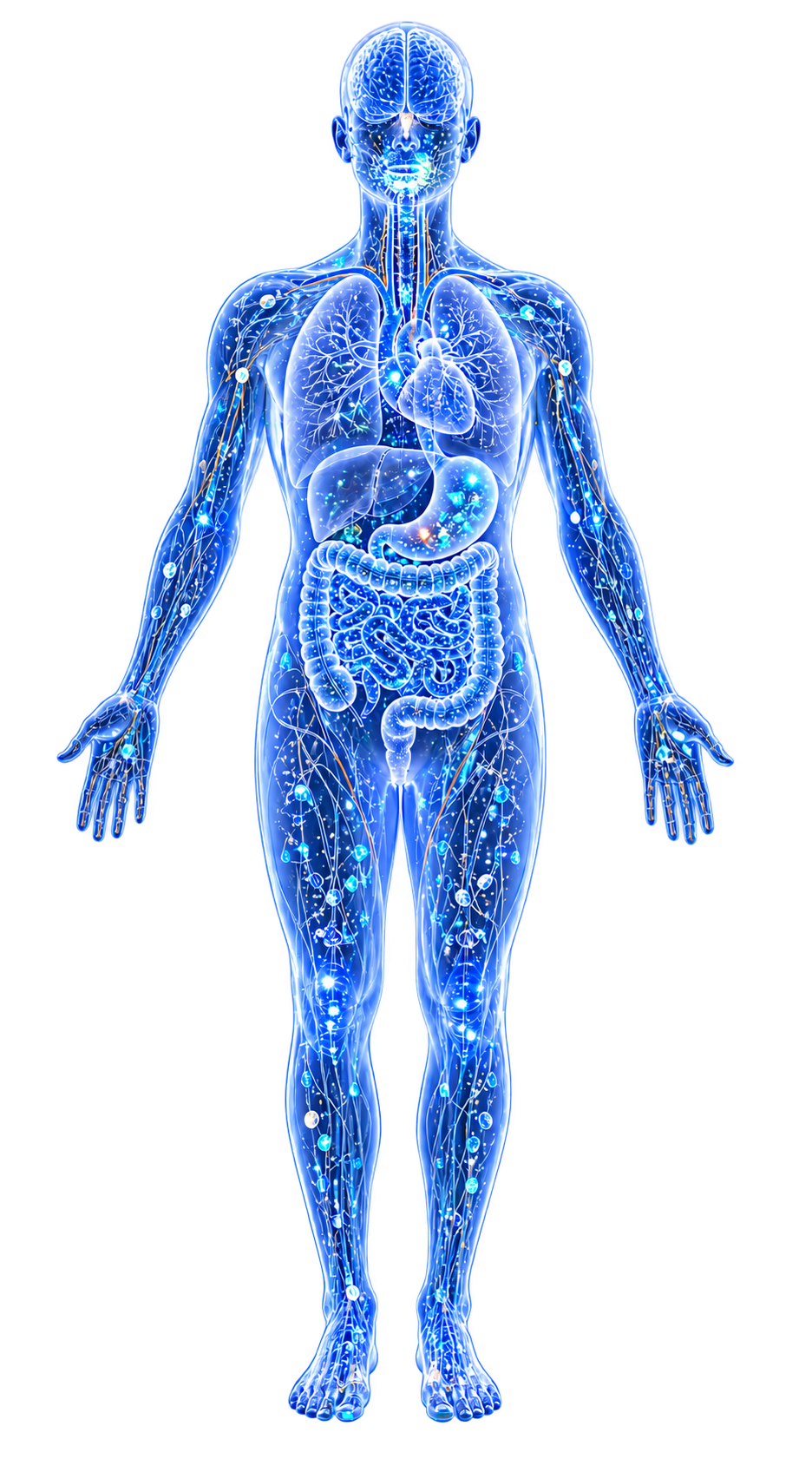
Metallomics is the systematic study of metals and metalloids in a biological system. The metallome is the set of metal and metalloid species present in a defined organism, tissue, cell, fluid, or microbial community; metallomics is the measurement and interpretation of that set.
A metallomic study may examine total elemental concentrations, chemical forms, isotope composition, spatial distribution, metal-binding molecules, or changes across conditions.
It is therefore broader than a single blood-metal test and more specific than using “metal exposure” as a synonym for any measured element.[1]The mouse metallomic landscape of aging and metabolismMorel JD, Sauzeat L, Goeminne LJE et al. · 2022Open reference 1 ↓[2]Blume 2026 — Combined Metallomics and Metabolomics Reveal Impact of Metal Homeostasis on Biological Pathways in C. elegansBastian Blume, Philippe Schmitt-Kopplin, Bernhard Michalke · 2026Open reference 2 ↓
The central idea is relational: metal biology depends on where an element is, which chemical species carries it, what it is bound to, and how the rest of the metallome changes with it.
An excess of one metal can alter the abundance or binding distribution of another, so a multi-element profile can reveal interactions that isolated measurements miss.[2]Blume 2026 — Combined Metallomics and Metabolomics Reveal Impact of Metal Homeostasis on Biological Pathways in C. elegansBastian Blume, Philippe Schmitt-Kopplin, Bernhard Michalke · 2026Open reference 2 ↓
Evidence map15 cited passagesInspect provenance +
Metallomics is the systematic study of metals and metalloids in a biological system. The metallome is the set of metal and metalloid species present in a defined organism, tissue, cell, fluid, or microbial community; metallomics is the measurement and interpretation of that set. A metallomic study may examine total elemental concentrations, chemical forms, i
The central idea is relational: metal biology depends on where an element is, which chemical species carries it, what it is bound to, and how the rest of the metallome changes with it. An excess of one metal can alter the abundance or binding distribution of another, so a multi-element profile can reveal interactions that isolated measurements miss.
“The human metallome” is not one fixed vector. Liver, brain, kidney, heart, muscle, serum, urine, stool, and microbial biomass can have different profiles. In mice, organ identity explained much of the observed metallomic variation, and aging produced smaller shifts within those organ-specific patterns. This compartment dependence is why a serum association
Inductively coupled plasma mass spectrometry (ICP-MS) and related techniques can quantify many elements in one sample. ICP-MS/MS can reduce spectral interferences in complex matrices, while ICP atomic-emission or optical-emission methods are also used for selected elements. These measurements answer how much of each element was detected in the analyzed sampl
Metal speciation separates an element into chemically or operationally distinct fractions. Chromatographic separation coupled to ICP-MS can distinguish high-molecular-mass, low-molecular-mass, and inorganic fractions or resolve particular compounds. In a C. elegans model, combined total-element and size-exclusion ICP-MS measurements showed that iron exposure
Laser-ablation ICP-MS and X-ray methods can map elements across tissues, while multi-collector ICP-MS can measure stable-isotope ratios. A pancreatic-cancer discovery study combined urinary calcium, magnesium, copper, and zinc concentrations with zinc-isotope measurements, illustrating that isotope composition may add information beyond concentration. Spatia
Mass spectrometry can also identify metal-associated biomolecules. Infection metallomics uses LC-MS, MALDI-MS, FTICR-MS, elemental detection, and isotope-pattern filtering to detect microbial metallophores in clinical or experimental samples. This is analytically distinct from measuring total iron or zinc because the molecule and its metal-binding function a
Metallomics can connect metal measurements to the proteome, metabolome, transcriptome, epigenome, and microbiome. Mouse organ profiling linked iron and copper measures with metabolic traits and with proteomic or metabolomic pathways involving oxidative phosphorylation and fatty-acid metabolism. Reviews of autism-related biology similarly describe the metallo
A review across multiple cancers reports recurring changes in copper, zinc, selenium, and other elements, but the direction and magnitude vary by cancer type, tissue, sample matrix, and study. Copper elevation in circulating samples and altered copper-to-zinc ratios are recurring observations, not a universal cancer rule. A prostate-cancer case-control study
Individual discovery studies illustrate both the potential and the limits of classification. A serum study compared lung cancer, COPD, COPD with later lung cancer, and healthy-control groups using an 18-element ICP-MS panel; multivariate models separated groups within that cohort. A urinary pancreatic-cancer study reported strong performance for a four-eleme
Brain metallomics adds spatial context because different regions can show different metal patterns. A post-mortem study measured metals in ten brain regions from dementia with Lewy bodies cases and controls, then compared the pattern with previously generated Alzheimer’s and Parkinson’s-disease-dementia datasets. Copper decreases were widespread, while other
Infection metallomics focuses on pathogen-produced or pathogen-associated metal-binding molecules. Siderophores and other metallophores help microbes acquire nutrients or withstand metal stress, making them potential biomarkers of active microbial behavior. Human-sample observations include detection of the fungal siderophore TAFC and a copper-yersiniabactin
The host-microbiome boundary is especially important. Stool metal concentration can reflect intake, absorption, host secretion, microbial uptake, chemical binding, and transit simultaneously. A conference framework in the vault proposes that metal availability can reshape gut ecology and connect dysbiosis with Parkinson’s-related mechanisms, but it is explic
Metabolomics profiles small molecules. Combined metallomics-metabolomics can test whether changes in metal state accompany changes in metabolic pathways.
Inflammation can redistribute iron, copper, zinc, and selenium, while kidney or liver function can change circulating and urinary concentrations. Reviews of thyroid disease show that the same element can have different associations across disease states and that essential elements can be harmful in both deficiency and excess. Consequently, a case-control dif
Contents
1. What the Metallome Includes2. Analytical Layers3. From Measurement to a Metallomic Signature4. Biological and Clinical Research Applications5. Metallomics Versus Adjacent Measurements6. Evidence Interpretation7. Clinical and Intervention Boundaries8. ConnectionsWhat the Metallome Includes#
A metallome is always defined by a biological compartment and a measurement scope. It can include.
essential elements such as iron, zinc, copper, manganese, selenium, cobalt, and molybdenum. non-essential or toxic elements such as lead, cadmium, and mercury. free or labile ions, small-molecule complexes, protein-bound fractions, mineral stores, and excreted species.
isotope ratios that reflect transport, binding, or redistribution; and. microbial metal-acquisition products such as siderophores and other metallophores.
“The human metallome” is not one fixed vector. Liver, brain, kidney, heart, muscle, serum, urine, stool, and microbial biomass can have different profiles. In mice, organ identity explained much of the observed metallomic variation, and aging produced smaller shifts within those organ-specific patterns.[1]The mouse metallomic landscape of aging and metabolismMorel JD, Sauzeat L, Goeminne LJE et al. · 2022Open reference 1 ↓
This compartment dependence is why a serum association cannot automatically be transferred to brain tissue, intestinal lumen, or intracellular metal pools.
Analytical Layers#
Total Element Concentration#
Inductively coupled plasma mass spectrometry (ICP-MS) and related techniques can quantify many elements in one sample. ICP-MS/MS can reduce spectral interferences in complex matrices, while ICP atomic-emission or optical-emission methods are also used for selected elements.
These measurements answer how much of each element was detected in the analyzed sample, but not necessarily its oxidation state, ligand, cellular location, or bioavailability.[3]Plasma metallomics reveals potential biomarkers and insights into the ambivalent associations of elements with acute myocardial infarctionSi Ying Lim, Hiranya Dayal, Song Jie Seah et al. · 2023Open reference 3 ↓[1]The mouse metallomic landscape of aging and metabolismMorel JD, Sauzeat L, Goeminne LJE et al. · 2022Open reference 1 ↓
Chemical Speciation and Binding Fractions#
Metal speciation separates an element into chemically or operationally distinct fractions. Chromatographic separation coupled to ICP-MS can distinguish high-molecular-mass, low-molecular-mass, and inorganic fractions or resolve particular compounds.
In a C. elegans model, combined total-element and size-exclusion ICP-MS measurements showed that iron exposure changed manganese distribution and that manganese or iron exposure displaced zinc from protein-associated fractions; total concentration alone would not describe those shifts.[2]Blume 2026 — Combined Metallomics and Metabolomics Reveal Impact of Metal Homeostasis on Biological Pathways in C. elegansBastian Blume, Philippe Schmitt-Kopplin, Bernhard Michalke · 2026Open reference 2 ↓
Spatial and Isotopic Information#
Laser-ablation ICP-MS and X-ray methods can map elements across tissues, while multi-collector ICP-MS can measure stable-isotope ratios. A pancreatic-cancer discovery study combined urinary calcium, magnesium, copper, and zinc concentrations with zinc-isotope measurements, illustrating that isotope composition may add information beyond concentration.[4]Urine metallomics signature as an indicator of pancreatic cancerKathrin Schilling, Fiona Larner, Amina Saad et al. · 2020Open reference 4 ↓
Spatial or isotope differences still require biological interpretation; they do not by themselves identify a causal mechanism.
Metal-Binding Molecules#
Mass spectrometry can also identify metal-associated biomolecules. Infection metallomics uses LC-MS, MALDI-MS, FTICR-MS, elemental detection, and isotope-pattern filtering to detect microbial metallophores in clinical or experimental samples.
This is analytically distinct from measuring total iron or zinc because the molecule and its metal-binding function are part of the target.[5]Infection metallomics for critical care in the post-COVID eraPatil RH, Luptakova D, Havlicek V · 2021Open reference 5 ↓
From Measurement to a Metallomic Signature#
A metallomic signature is a reproducible pattern across multiple elements, species, ratios, isotopes, or locations. Building one usually involves. defining the biological compartment, collection time, and comparison groups. controlling collection vessels, digestion, contamination, detection limits, and batch effects. quantifying or identifying the chosen metallomic features.
normalizing for dilution, tissue mass, or another justified denominator. modeling correlated features without allowing data leakage; and. validating the resulting pattern in an independent population or experiment.
The word signature should not imply a validated diagnostic test. Several studies in the WikiBiome vault are discovery studies that report strong separation within their original cohorts. Those results establish candidates for replication, not clinical readiness.
Biological and Clinical Research Applications#
Organ, Aging, and Multi-Omic Biology#
Metallomics can connect metal measurements to the proteome, metabolome, transcriptome, epigenome, and microbiome. Mouse organ profiling linked iron and copper measures with metabolic traits and with proteomic or metabolomic pathways involving oxidative phosphorylation and fatty-acid metabolism.[1]The mouse metallomic landscape of aging and metabolismMorel JD, Sauzeat L, Goeminne LJE et al. · 2022Open reference 1 ↓
Reviews of autism-related biology similarly describe the metallome as an interacting layer that can affect metal-binding proteins, signaling, microbial ecology, and other omes, while emphasizing that these cross-system links are mechanistic hypotheses of varying evidentiary strength.[6]The Metallome as a Link Between the 'Omes' in Autism Spectrum DisordersJanelle E. Stanton, Sigita Malijauskaite, Kieran McGourty et al. · 2021Open reference 6 ↓[7]Metal Profiles in Autism Spectrum Disorders: A Crosstalk between Toxic and Essential MetalsBlazewicz A, Grabrucker AM · 2023Open reference 7 ↓
Cancer and Cardiovascular Discovery Studies#
A review across multiple cancers reports recurring changes in copper, zinc, selenium, and other elements, but the direction and magnitude vary by cancer type, tissue, sample matrix, and study.
Copper elevation in circulating samples and altered copper-to-zinc ratios are recurring observations, not a universal cancer rule.[8]Recent advances in the application of metallomics in diagnosis and prognosis of human cancerYan Zhang, Jie He, Jiao Jin et al. · 2022Open reference 8 ↓ A prostate-cancer case-control study, for example, found higher serum copper and iron with lower zinc, selenium, and manganese in its cohort.[9]Serum Levels of Selenium, Zinc, Copper, Manganese, and Iron in Prostate Cancer PatientsSaleh A. K. Saleh, Heba M. Adly, Altaf A. Abdelkhaliq et al. · 2020Open reference 9 ↓
Individual discovery studies illustrate both the potential and the limits of classification. A serum study compared lung cancer, COPD, COPD with later lung cancer, and healthy-control groups using an 18-element ICP-MS panel; multivariate models separated groups within that cohort.[10]Metallomic Signatures of Lung Cancer and Chronic Obstructive Pulmonary DiseaseBelen Callejon-Leblic, Saida Sanchez Espirilla, Carolina Gotera-Rivera et al. · 2023Open reference 10 ↓
A urinary pancreatic-cancer study reported strong performance for a four-element model in 21 cases and 46 controls.[4]Urine metallomics signature as an indicator of pancreatic cancerKathrin Schilling, Fiona Larner, Amina Saad et al. · 2020Open reference 4 ↓
A plasma acute-myocardial-infarction study reported a ten-feature random-forest model that combined metallomic ratios with traditional risk factors; the reported performance was not attributable to metals alone.[3]Plasma metallomics reveals potential biomarkers and insights into the ambivalent associations of elements with acute myocardial infarctionSi Ying Lim, Hiranya Dayal, Song Jie Seah et al. · 2023Open reference 3 ↓
Brain Metallomics#
Brain metallomics adds spatial context because different regions can show different metal patterns. A post-mortem study measured metals in ten brain regions from dementia with Lewy bodies cases and controls, then compared the pattern with previously generated Alzheimer’s and Parkinson’s-disease-dementia datasets.
Copper decreases were widespread, while other regional differences contributed to multivariate separation. The study was small and post-mortem, so it supports a tissue-level research signature rather than a living-patient diagnostic test.[11]Scholefield et al. 2024 — Brain Metallomic Signatures Distinguish DLB from AD and PDDMelissa Scholefield, Stephanie J. Church, Jingshu Xu et al. · 2024Open reference 11 ↓
Infection Metallomics#
Infection metallomics focuses on pathogen-produced or pathogen-associated metal-binding molecules. Siderophores and other metallophores help microbes acquire nutrients or withstand metal stress, making them potential biomarkers of active microbial behavior.
Human-sample observations include detection of the fungal siderophore TAFC and a copper-yersiniabactin complex, while other proposed applications remain experimental.[5]Infection metallomics for critical care in the post-COVID eraPatil RH, Luptakova D, Havlicek V · 2021Open reference 5 ↓ Detection of a metallophore can provide different information from organism abundance, but claims that it distinguishes invasion from colonization remain pathogen-, molecule-, specimen-, and validation-specific.
Microbial Metallomics#
Microbial metallomics applies metallomic reasoning to microorganisms and host-associated ecosystems. Its possible measurements include metals in microbial biomass, extracellular complexes, metalloproteins, metallophores, gene-linked metal use, and metal distribution between host, diet, lumen, and community.
This differs from sequencing a gut microbiome: taxonomic or functional sequencing estimates organisms and genes, whereas metallomics measures elemental or metal-associated chemical features.
The host-microbiome boundary is especially important. Stool metal concentration can reflect intake, absorption, host secretion, microbial uptake, chemical binding, and transit simultaneously.
A conference framework in the vault proposes that metal availability can reshape gut ecology and connect dysbiosis with Parkinson’s-related mechanisms, but it is explicitly a founder-authored, non-peer-reviewed synthesis and should be treated as hypothesis-generating.[12]Microbial Metallomics and Parkinson's Disease: A Unified Metal-Driven Framework Linking Ferroptosis, Dysbiosis, and alpha-Synuclein PathologyKaren Pendergrass · 2025Open reference 12 ↓
Metallomics Versus Adjacent Measurements#
Elemental analysis measures one or more elements. It becomes metallomic when the study is designed and interpreted as a system-level metal profile.
Biomonitoring estimates exposure or body burden in a defined specimen. Metallomics may include biomonitoring, but also examines essential elements, binding, interactions, localization, and function.
Ionomics often refers to high-throughput profiling of inorganic ions, especially in plants and genetics. Its practical overlap with metallomics is substantial, but terminology depends on field and study design.
Metal speciation determines chemical forms of an element. It is one layer of metallomics, not a synonym for the entire discipline. Metalloproteomics focuses on metal-binding proteins and their metal occupancy.
Metallomics can incorporate those data alongside non-protein species and total-element measurements.
Metabolomics profiles small molecules. Combined metallomics-metabolomics can test whether changes in metal state accompany changes in metabolic pathways.[2]Blume 2026 — Combined Metallomics and Metabolomics Reveal Impact of Metal Homeostasis on Biological Pathways in C. elegansBastian Blume, Philippe Schmitt-Kopplin, Bernhard Michalke · 2026Open reference 2 ↓
Evidence Interpretation#
Metallomic associations are sensitive to study design. Readers should ask. Which compartment and time point were measured?
Was total concentration, chemical species, isotope ratio, or spatial distribution measured? Were diet, supplements, smoking, renal function, inflammation, medications, age, sex, and collection materials addressed?
Was the model evaluated outside the cohort used to select its features? Does a measured change represent exposure, redistribution, binding, excretion, tissue damage, or altered clearance? Are claims about one element actually supported by a multi-element analysis?
Inflammation can redistribute iron, copper, zinc, and selenium, while kidney or liver function can change circulating and urinary concentrations.
Reviews of thyroid disease show that the same element can have different associations across disease states and that essential elements can be harmful in both deficiency and excess.[13]Effects of Trace Elements on Endocrine Function and Pathogenesis of Thyroid Diseases — A Literature ReviewBrylinski L, Kostelecka K, Wolinski F et al. · 2025Open reference 13 ↓ Consequently, a case-control difference does not establish that correcting the measured value will improve health.
Clinical and Intervention Boundaries#
No metallomic pattern described in the cited WikiBiome evidence should be used alone to diagnose cancer, dementia, myocardial infarction, autism, infection, or another condition. High performance reported in a discovery cohort requires independent validation, standardized preanalytics, calibration, prospective evaluation, and comparison with accepted clinical methods.
Multivariate models can also overfit when the number of candidate features is large relative to the number of participants.
Likewise, a metallomic result is not automatically a treatment prescription. Supplementation, dietary restriction, or chelation can alter multiple elements and may cause deficiency, toxicity, or drug interactions. Clinical decisions require condition-specific interpretation and established medical testing rather than an unvalidated omics panel.
Connections#
- Metal Homeostasis—processes that regulate acquisition, distribution, storage, use, and excretion
- Metal Speciation—chemical-form information within a metallomic analysis
- Mis-Metallation—inappropriate metal occupancy that total concentrations may fail to reveal
- Microbial Metallomics—organism- and community-level metal biology
- Gut-Metal-Microbiome Interactions—the ecological interface among diet, host, metals, and microorganisms
- Biomarkers—candidate signatures require independent analytical and clinical validation
- Metabolomics—a complementary small-molecule layer for multi-omic integration
- Oxidative Stress—one possible consequence of altered redox-active metal handling
- Ferroptosis—iron-dependent lipid-peroxidation cell death, not equivalent to iron elevation alone
- Nutritional Immunity (Metal Sequestration)—host control of nutrient metals during infection
References 13
Numbered by first appearance in the article, then reconciled with its declared source list.
- 1
Morel JD, Sauzeat L, Goeminne LJE et al. (2022). The mouse metallomic landscape of aging and metabolism. Nature Communications.
- 2
Bastian Blume, Philippe Schmitt-Kopplin, Bernhard Michalke (2026). Blume 2026 — Combined Metallomics and Metabolomics Reveal Impact of Metal Homeostasis on Biological Pathways in C. elegans. Analytical and Bioanalytical Chemistry.
- 3
Si Ying Lim, Hiranya Dayal, Song Jie Seah et al. (2023). Plasma metallomics reveals potential biomarkers and insights into the ambivalent associations of elements with acute myocardial infarction. Journal of Trace Elements in Medicine and Biology.
- 4
Kathrin Schilling, Fiona Larner, Amina Saad et al. (2020). Urine metallomics signature as an indicator of pancreatic cancer. Metallomics.
- 5
★Patil RH, Luptakova D, Havlicek V (2021). Infection metallomics for critical care in the post-COVID era. Mass Spectrometry Reviews.
- 6
Janelle E. Stanton, Sigita Malijauskaite, Kieran McGourty et al. (2021). The Metallome as a Link Between the 'Omes' in Autism Spectrum Disorders. Frontiers in Molecular Neuroscience.
- 7
Blazewicz A, Grabrucker AM (2023). Metal Profiles in Autism Spectrum Disorders: A Crosstalk between Toxic and Essential Metals. International Journal of Molecular Sciences.
- 8
Yan Zhang, Jie He, Jiao Jin et al. (2022). Recent advances in the application of metallomics in diagnosis and prognosis of human cancer. Metallomics.
- 9
★Saleh A. K. Saleh, Heba M. Adly, Altaf A. Abdelkhaliq et al. (2020). Serum Levels of Selenium, Zinc, Copper, Manganese, and Iron in Prostate Cancer Patients. Current Urology.
- 10
Belen Callejon-Leblic, Saida Sanchez Espirilla, Carolina Gotera-Rivera et al. (2023). Metallomic Signatures of Lung Cancer and Chronic Obstructive Pulmonary Disease. International Journal of Molecular Sciences.
- 11
★Melissa Scholefield, Stephanie J. Church, Jingshu Xu et al. (2024). Scholefield et al. 2024 — Brain Metallomic Signatures Distinguish DLB from AD and PDD. Frontiers in Neuroscience.
- 12
★Karen Pendergrass (2025). Microbial Metallomics and Parkinson's Disease: A Unified Metal-Driven Framework Linking Ferroptosis, Dysbiosis, and alpha-Synuclein Pathology. Conference Presentation.
- 13
★Brylinski L, Kostelecka K, Wolinski F et al. (2025). Effects of Trace Elements on Endocrine Function and Pathogenesis of Thyroid Diseases — A Literature Review. Nutrients.
Article network
Mentioned here 11
Pages linking here 37
Connect the evidence
Publicly readable discussion by ORCID-authenticated researchers. Questions, interpretation, methods, corrections, and new evidence stay attached to this record.
No discussion yet. Start with a precise question or a source-backed observation.
Activity and accepted changes
Accepted researcher context, editorial status, public discussion, and upstream Git revisions are shown together. Pending, declined, and withdrawn proposals remain private.
- published revision
Strengthen Metallomics and link high-leverage contexts
Karen Pendergrass · +77 −117
Inspect exact Git diff ↗ - published revision
Backfill oxidative stress concept links
Karen Pendergrass · +1 −1
Inspect exact Git diff ↗ - published revision
Backfill gut microbiome concept links
Karen Pendergrass · +1 −1
Inspect exact Git diff ↗ - published revision
massive wiki expansion: 149 stubs fixed, 100+ new pages, Rule 15 scan, keystone papers
WikiBiome Deploy Bot · +29 −29
Inspect exact Git diff ↗ - published revision
nightly maintenance: 94 stub demotions, 181 source_count fixes, 22 auto-discovered stubs, 5 adversarial audits, 3 boundary fixes, 3 evidence-level corrections
WikiBiome Deploy Bot · +1 −0
Inspect exact Git diff ↗ - published revision
pre-overnight checkpoint 2026-04-18
WikiBiome Deploy Bot · +3 −1
Inspect exact Git diff ↗ - published revision
WikiBiome update — 2026-04-15 17:23
WikiBiome Deploy Bot · +0 −1
Inspect exact Git diff ↗ - published revision
WikiBiome v2 migration: signature pages + safety fixes + gap analysis
WikiBiome Deploy Bot · +7 −2
Inspect exact Git diff ↗ - published revision
WikiBiome update — integrity fixes, metallomic diet pages, cross-condition analyses
WikiBiome Deploy Bot · +18 −6
Inspect exact Git diff ↗ - published revision
WikiBiome update — 2026-04-10 15:45
WikiBiome Deploy Bot · +1 −1
Inspect exact Git diff ↗ - published revision
WikiBiome v7 — interactive microbiome metallomics encyclopedia
Karen Pendergrass · +150 −0
Inspect exact Git diff ↗