
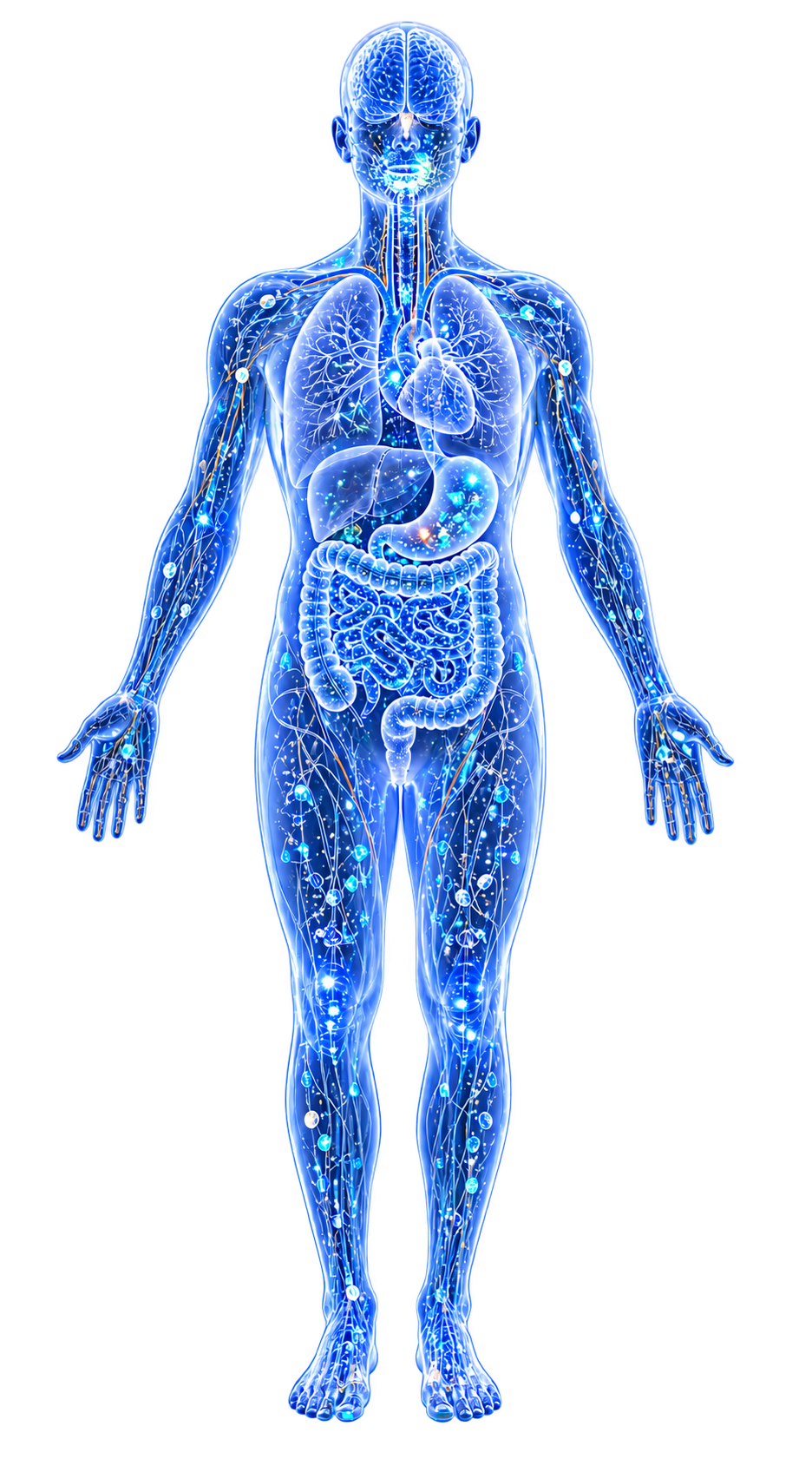
Non-digestible food substrates that selectively stimulate the growth and/or activity of beneficial gut microorganisms, conferring health benefits to the host. Distinct from Probiotics (live organisms) and postbiotics (microbial metabolic products), prebiotics act as fuel for the endogenous commensal community—particularly Bifidobacterium and SCFA-producing Firmicutes.
Evidence map3 cited passagesInspect provenance +
Promote Akkermansia, Bifidobacterium, and Lactobacillus growth.
CVD: Prebiotic fiber increases SCFA production and may reduce TMAO by shifting microbial metabolism away from choline/carnitine fermentation.
CRC: Dietary fiber consistently inversely associated with colorectal cancer risk; prebiotic fermentation products (butyrate) are anti-proliferative.
Major Prebiotic Types#
Fructo-oligosaccharides (FOS) and Inulin#
Fructose polymers found in chicory root, garlic, onion, asparagus, banana. Selectively fermented by Bifidobacterium and Lactobacillus; increase Butyrate production via cross-feeding (Bifidobacterium produces acetate, which Roseburia and Faecalibacterium convert to butyrate). Best-studied prebiotics with consistent bifidogenic effects.
Galacto-oligosaccharides (GOS)#
Lactose-derived oligosaccharides mimicking human milk oligosaccharides (HMOs). Strong bifidogenic effect; B-GOS (Bimuno) showed benefit in ASD (reduced anti-social behavior and improved GI symptoms in RCT) and in reducing traveler's diarrhea.
Resistant Starch#
Starch that escapes small intestinal digestion; found in cooled potatoes, green bananas, legumes, whole grains. Fermented in the colon primarily by Ruminococcus bromii, then cross-fed to butyrate producers. Increases fecal butyrate more consistently than other prebiotic types.
Polyphenols (Emerging Prebiotic)#
Plant compounds (flavonoids, tannins, anthocyanins) from tea, berries, cocoa, wine. Poorly absorbed in small intestine; metabolized by colonic bacteria into bioactive phenolic acids. Promote Akkermansia, Bifidobacterium, and Lactobacillus growth.[1]Synergic Interactions between Polyphenols and Gut Microbiota in Mitigating Inflammatory Bowel DiseasesLi H, Christman LM, Li R et al. · 2020Open reference 1 ↓
Mechanisms of Action#
Selective fermentation: Prebiotic fibers are metabolized by saccharolytic bacteria (especially Bifidobacterium), producing Short-Chain Fatty Acids (SCFAs) that lower colonic pH, inhibit pathogen growth, and fuel colonocytes.
Competitive exclusion: By boosting beneficial populations, prebiotics indirectly suppress pathobionts. Immune modulation: SCFA production drives Treg differentiation via HDAC inhibition and GPR109A signaling. Barrier reinforcement: Increased butyrate strengthens tight junctions; increased Akkermansia promotes mucus layer thickness.
Disease Evidence#
CVD: Prebiotic fiber increases SCFA production and may reduce TMAO by shifting microbial metabolism away from choline/carnitine fermentation.[2]Role of the intestinal microbiome and its therapeutic intervention in cardiovascular disorderAmeer Luqman, Adil Hassan, Mehtab Ullah et al. · 2024Open reference 2 ↓
PCOS: Synbiotic (prebiotic + probiotic) interventions improve hormonal profiles and insulin sensitivity. ASD: B-GOS RCT showed improvements in anti-social behavior; prebiotics may modify the microbial metabolite profile (reducing p-cresol, increasing SCFAs).
CRC: Dietary fiber consistently inversely associated with colorectal cancer risk; prebiotic fermentation products (butyrate) are anti-proliferative.[3]Prevention of Colon Cancer by Pre- and Probiotics: Evidence from Laboratory StudiesBandaru S. Reddy · 1998Open reference 3 ↓ IBD: High-fiber diets show benefit in some Crohn's cohorts, though individual tolerance varies.
Metal Angle#
Prebiotic fiber may reduce heavy metal absorption through multiple mechanisms.
Binding: Dietary fiber physically adsorbs metals (lead (Pb), cadmium (Cd)) in the gut lumen, reducing bioavailability. Microbiome restoration: By boosting metal-sensitive commensals, prebiotics help restore the microbial metal-handling capacity disrupted by Dysbiosis. pH reduction: SCFA-mediated colonic acidification alters metal speciation and may reduce absorption of certain metals.
Barrier repair: Increased butyrate production restores tight junctions, reducing paracellular metal uptake.
See Also#
- Probiotics—live microbial supplementation
- Short-Chain Fatty Acids (SCFAs)—primary prebiotic fermentation products
- butyrate—key end-product of prebiotic fermentation
- Mediterranean Diet—dietary pattern rich in prebiotic substrates
References 3
Numbered by first appearance in the article, then reconciled with its declared source list.
- 1
Li H, Christman LM, Li R et al. (2020). Synergic Interactions between Polyphenols and Gut Microbiota in Mitigating Inflammatory Bowel Diseases. Food & Function.
- 2
Ameer Luqman, Adil Hassan, Mehtab Ullah et al. (2024). Role of the intestinal microbiome and its therapeutic intervention in cardiovascular disorder. Frontiers in Immunology.
- 3
Bandaru S. Reddy (1998). Prevention of Colon Cancer by Pre- and Probiotics: Evidence from Laboratory Studies. British Journal of Nutrition.
Article network
Mentioned here 7
Pages linking here 13
Connect the evidence
Publicly readable discussion by ORCID-authenticated researchers. Questions, interpretation, methods, corrections, and new evidence stay attached to this record.
No discussion yet. Start with a precise question or a source-backed observation.
Activity and accepted changes
Accepted researcher context, editorial status, public discussion, and upstream Git revisions are shown together. Pending, declined, and withdrawn proposals remain private.
- published revision
Complete Tight junctions contextual coverage
Karen Pendergrass · +1 −1
Inspect exact Git diff ↗ - published revision
massive wiki expansion: 149 stubs fixed, 100+ new pages, Rule 15 scan, keystone papers
WikiBiome Deploy Bot · +13 −13
Inspect exact Git diff ↗ - published revision
nightly maintenance: 94 stub demotions, 181 source_count fixes, 22 auto-discovered stubs, 5 adversarial audits, 3 boundary fixes, 3 evidence-level corrections
WikiBiome Deploy Bot · +1 −0
Inspect exact Git diff ↗ - published revision
pre-overnight checkpoint 2026-04-18
WikiBiome Deploy Bot · +3 −1
Inspect exact Git diff ↗ - published revision
WikiBiome update — integrity fixes, metallomic diet pages, cross-condition analyses
WikiBiome Deploy Bot · +5 −3
Inspect exact Git diff ↗ - published revision
WikiBiome update — 2026-04-10 15:45
WikiBiome Deploy Bot · +63 −0
Inspect exact Git diff ↗