
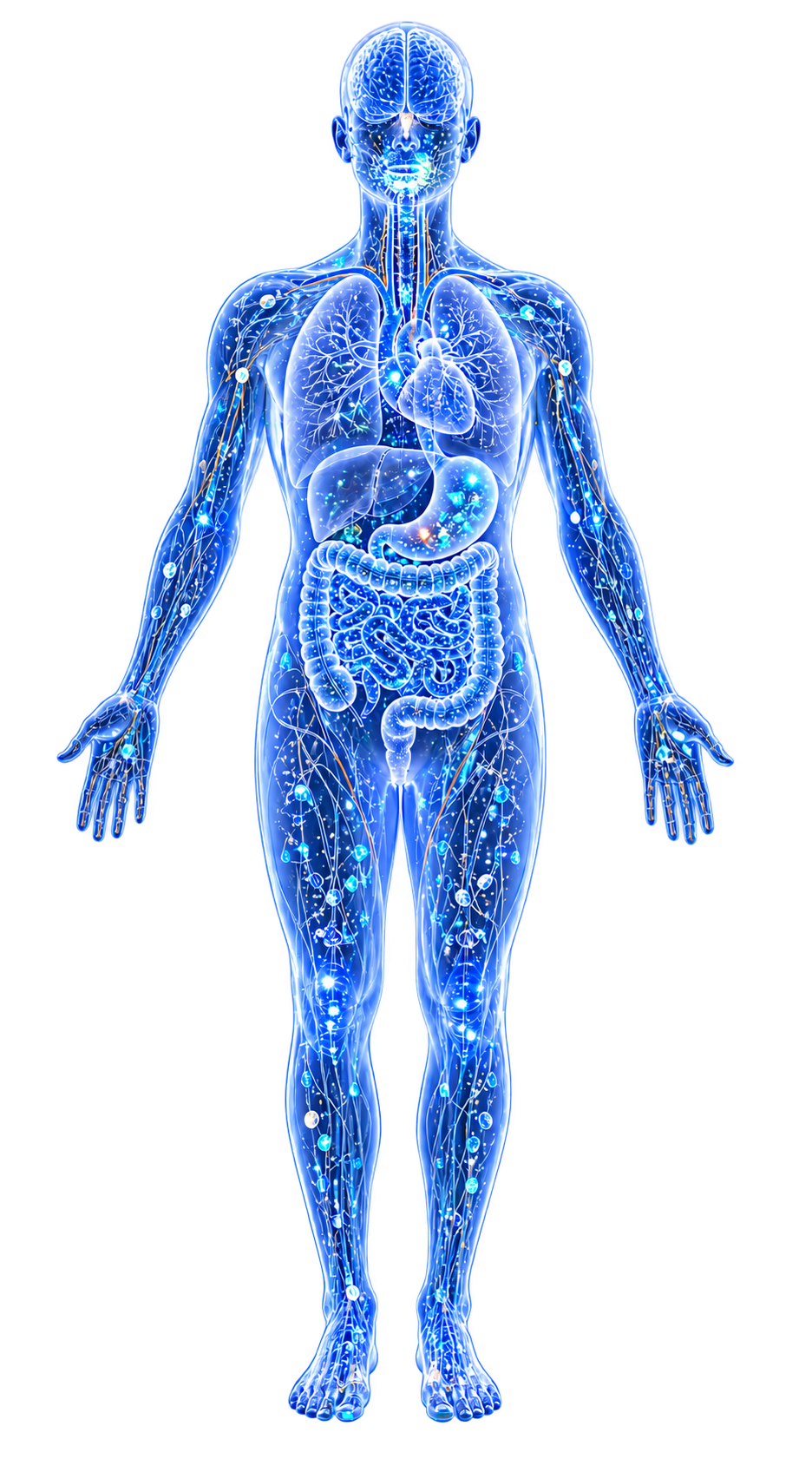
The co-occurrence of multiple diseases in the same individual at rates exceeding chance. Comorbidity patterns are a central puzzle in medicine—why do IBD patients develop CVD? Why does PCOS cluster with T2D?
Why do neurodegenerative diseases associate with depression? The Metallomics framework offers an explanation: shared upstream drivers (metal exposure) and shared mediators (Dysbiosis, Metal-Driven Inflammation) produce parallel downstream pathology across organ systems.
Evidence map1 cited passagesInspect provenance +
Because the microbiome produces metabolites that affect every organ (via portal circulation to liver, systemic circulation to heart and brain, vagal signaling to CNS), a single dysbiotic event radiates pathology system-wide.
Contents
1. Metal Exposure as Shared Upstream Driver2. The Microbiome as Shared Mediator3. Documented Comorbidity Clusters4. The Metallomics Framework for Comorbidity5. See AlsoDocumented Comorbidity Clusters#
IBD and CVD#
IBD patients have 20-25% increased risk of ischemic heart disease and stroke. Shared mechanisms: chronic inflammation, elevated Trimethylamine N-Oxide (TMAO), reduced SCFA production, gut barrier dysfunction allowing bacterial translocation. Fecal Calprotectin (S100A8/A9) (IBD marker) correlates with cardiovascular risk markers.
PCOS, T2D, and CVD#
PCOS increases T2D risk 4-8 fold and CVD risk 2-fold. Shared mechanisms: Insulin Resistance, gut dysbiosis, hyperandrogenism, chronic low-grade inflammation, Metabolic Syndrome and Metal Exposure. Metal connections: cadmium (Cd) and nickel (Ni) act as Metalloestrogens, disrupting hormonal balance; both PCOS and T2D feature altered gut microbial metal handling.
MS and Depression#
Depression prevalence in MS is 3x the general population. Shared mechanisms: Neuroinflammation, kynurenine pathway activation (tryptophan diverted from serotonin to neurotoxic quinolinic acid), gut dysbiosis, reduced Indoles and Butyrate. The Gut-Brain Axis mediates bidirectional effects.
RA and CVD#
RA doubles cardiovascular mortality risk. Shared mechanisms: systemic inflammation (TNF-alpha, IL-6), oral microbiome dysbiosis (Porphyromonas gingivalis in both periodontal disease and RA), Oxidative Stress.
Neurodegeneration and Metabolic Disease#
T2D increases AD risk 1.5-2 fold (sometimes called "type 3 diabetes"). Shared mechanisms: insulin resistance in brain, metal dyshomeostasis (iron (Fe), copper (Cu), zinc (Zn)), dysbiosis, gut-derived inflammation.
The Metallomics Framework for Comorbidity#
The metal-microbiome-inflammation triad explains comorbidity through convergent pathology:
- Metal exposure disrupts the Gut Microbiome.
- Dysbiosis reduces SCFA/indole production and increases LPS/TMAO.
- Barrier breakdown allows metal absorption, bacterial translocation, and endotoxemia.
- Systemic inflammation damages cardiovascular, neurological, metabolic, and immune systems simultaneously.
- Organ-specific vulnerability determines which disease manifests first, but the underlying disruption is shared.
This framework predicts that interventions targeting the shared mediator (microbiome restoration via Probiotics, Prebiotics, Fecal Microbiota Transplant (FMT), or metal exposure reduction) should benefit multiple comorbid conditions simultaneously.
See Also#
- Metabolic Syndrome and Metal Exposure—the prototypical comorbidity cluster
- dysbiosis—shared microbial mediator
- inflammation—shared pathological mechanism
- Gut-Brain Axis—mediator of neuro-metabolic comorbidity
References 3
Numbered by first appearance in the article, then reconciled with its declared source list.
- 1
Igor Spivak, Leviel Fluhr, Eran Elinav (2023). Local and systemic effects of microbiome-derived metabolites. EMBO Reports.
- 2
Ameer Luqman, Adil Hassan, Mehtab Ullah et al. (2024). Role of the intestinal microbiome and its therapeutic intervention in cardiovascular disorder. Frontiers in Immunology.
- 3
Hilde Herrema, Max Nieuwdorp, Albert K. Groen (2020). Microbiome and Cardiovascular Disease. Handbook of Experimental Pharmacology (Prevention and Treatment of Atherosclerosis).
Article network
Mentioned here 18
Pages linking here 3
Connect the evidence
Publicly readable discussion by ORCID-authenticated researchers. Questions, interpretation, methods, corrections, and new evidence stay attached to this record.
No discussion yet. Start with a precise question or a source-backed observation.
Activity and accepted changes
Accepted researcher context, editorial status, public discussion, and upstream Git revisions are shown together. Pending, declined, and withdrawn proposals remain private.
- published revision
Strengthen Metallomics and link high-leverage contexts
Karen Pendergrass · +1 −1
Inspect exact Git diff ↗ - published revision
Backfill gut microbiome concept links
Karen Pendergrass · +1 −1
Inspect exact Git diff ↗ - published revision
Backfill inflammation concept links
Karen Pendergrass · +2 −2
Inspect exact Git diff ↗ - published revision
Complete corpus-wide Dysbiosis linking
Karen Pendergrass · +5 −5
Inspect exact Git diff ↗ - published revision
massive wiki expansion: 149 stubs fixed, 100+ new pages, Rule 15 scan, keystone papers
WikiBiome Deploy Bot · +10 −10
Inspect exact Git diff ↗ - published revision
nightly maintenance: 94 stub demotions, 181 source_count fixes, 22 auto-discovered stubs, 5 adversarial audits, 3 boundary fixes, 3 evidence-level corrections
WikiBiome Deploy Bot · +1 −0
Inspect exact Git diff ↗ - published revision
pre-overnight checkpoint 2026-04-18
WikiBiome Deploy Bot · +3 −1
Inspect exact Git diff ↗ - published revision
WikiBiome update — integrity fixes, metallomic diet pages, cross-condition analyses
WikiBiome Deploy Bot · +8 −1
Inspect exact Git diff ↗ - published revision
WikiBiome update — 2026-04-10 15:45
WikiBiome Deploy Bot · +73 −0
Inspect exact Git diff ↗