
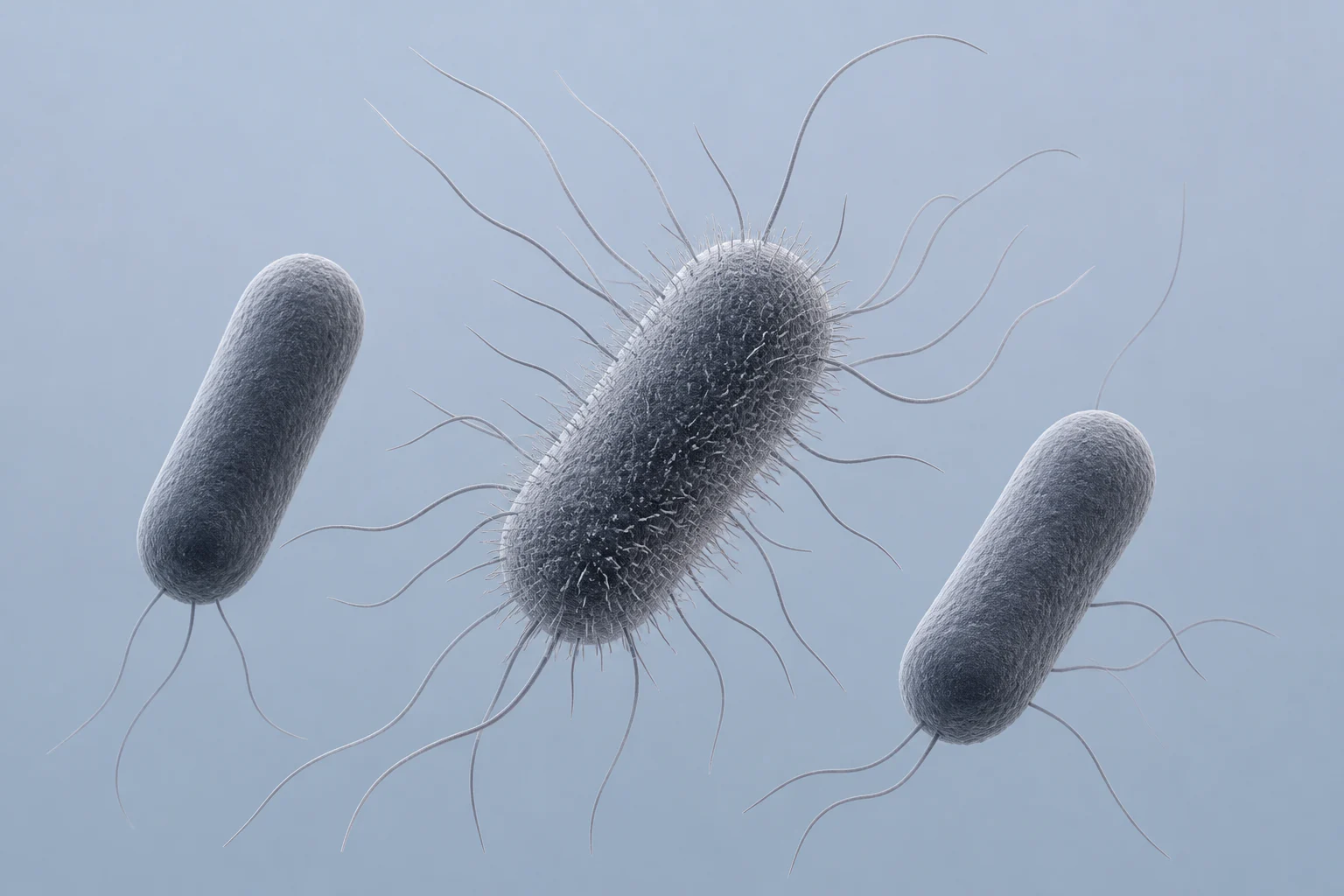
AIEC represented by ordinary E. coli bacilli with appendages reported for the reference strain LF82, including flagella and abundant type 1 pili. AIEC is defined functionally and cannot be identified by morphology alone.
Scientific media record2 verified identifiers
- Subject
- Escherichia colitaxon · species-level pathotype
- Review
- Editorial review completeIdentifiers authority-verified · Accessibility validated · · adherent-invasive-e-coli|adherent-invasive-e-coli-morphology-v1.webp
- Digital source
- Trained-algorithmic mediaCreated with a trained generative algorithm and reviewed by WikiBiome for subject identity, scientific framing, identifiers, provenance, and accessibility.
- Scientific basis
- Escherichia coli — NCBI TaxonomyPoint mutations in FimH adhesin of Crohn's disease-associated adherent-invasive Escherichia coli
- License
- CC BY-SA 4.0Created
A pathotype of Escherichia coli that adheres to and invades intestinal epithelial cells, survives and replicates within macrophages, and is strongly associated with ileal Crohn's disease.
Unlike classical diarrheagenic E. coli pathotypes (EPEC, ETEC, EHEC), AIEC does not carry canonical virulence genes but instead exploits host genetic susceptibility and an inflamed, metal-rich mucosal environment to establish chronic colonization.
Evidence map6 cited passagesInspect provenance +
Survival and replication within macrophages, inducing granuloma-like structures without triggering effective bacterial killing—a hallmark of Crohn's pathology.
AIEC's superior iron acquisition machinery gives it a competitive advantage over commensals in this contested environment.
NOD2 loss-of-function mutations, the strongest genetic risk factor for ileal Crohn's disease, impair defensin production and bacterial sensing, creating a defensin-depleted niche that favors AIEC expansion.
Drives a pro-inflammatory cascade: TNF-alpha, IL-6, IL-8 production by infected macrophages sustains mucosal inflammation.
Its expansion correlates with depletion of anti-inflammatory commensals, particularly faecalibacterium prausnitzii, whose loss removes butyrate-mediated NF-kappaB suppression.
Synbiotic approaches combining prebiotics with beneficial bacteria have been trialed to competitively exclude AIEC.
Contents
1. Defining Features2. Metal Dependencies3. Host Genetic Susceptibility4. Ecological Role in Crohn's Disease5. Cross-ReferencesDefining Features#
AIEC is defined by three functional properties rather than a single genetic marker:
- Adherence to intestinal epithelial cells, primarily via type-1 fimbriae (FimH adhesin) binding to CEACAM6 receptors, which are upregulated on inflamed ileal mucosa in Crohn's disease patients.
- Invasion of epithelial cells, enabling intracellular survival and evasion of luminal antimicrobials.
- Survival and replication within macrophages, inducing granuloma-like structures without triggering effective bacterial killing—a hallmark of Crohn's pathology.[1]Intestinal Microbiota and the Innate Immune System - a Crosstalk in Crohn's Disease PathogenesisHaag LM, Siegmund B · 2015Open reference 1 ↓
The reference strain LF82, isolated from a chronic ileal lesion, is the most studied AIEC isolate.
Metal Dependencies#
Iron Acquisition#
AIEC strains carry multiple siderophore systems (enterobactin, salmochelin, yersiniabactin, aerobactin) that enable aggressive iron scavenging in the inflamed gut.
The inflamed Crohn's mucosa paradoxically creates an iron-rich environment: tissue damage releases hemoglobin and intracellular iron, while host Nutritional Immunity (Metal Sequestration) responses (calprotectin, lactoferrin, lipocalin-2) attempt to re-sequester it.
AIEC's superior iron acquisition machinery gives it a competitive advantage over commensals in this contested environment.[1]Intestinal Microbiota and the Innate Immune System - a Crosstalk in Crohn's Disease PathogenesisHaag LM, Siegmund B · 2015Open reference 1 ↓
Siderophore Competition is central to AIEC ecology: the pathotype's siderophore diversity allows it to evade host lipocalin-2, which specifically neutralizes enterobactin but not salmochelin or yersiniabactin.
Zinc and Defensin Resistance#
Paneth cell defensins—zinc-dependent antimicrobial peptides—are the primary innate immune defense in the ileal niche where AIEC colonizes.
NOD2 loss-of-function mutations, the strongest genetic risk factor for ileal Crohn's disease, impair defensin production and bacterial sensing, creating a defensin-depleted niche that favors AIEC expansion.[1]Intestinal Microbiota and the Innate Immune System - a Crosstalk in Crohn's Disease PathogenesisHaag LM, Siegmund B · 2015Open reference 1 ↓
Nickel Enzymes#
- As an E. coli pathotype, AIEC possesses nickel-dependent NiFe-Hydrogenase enzymes and potentially nickel-glyoxalase, which provide metabolic advantages in the anaerobic, hydrogen-rich gut environment.
Host Genetic Susceptibility#
The AIEC-Crohn's connection depends on host genetic defects that create a permissive mucosal niche.
NOD2 mutations: Impair muramyl dipeptide sensing, reduce alpha-defensin secretion, and diminish bacterial clearance—allowing AIEC to persist on the mucosal surface. ATG16L1 variants: Impair Autophagy in Paneth cells, reducing intracellular bacterial killing and enabling AIEC replication within macrophages.
CEACAM6 upregulation: Inflammatory cytokines increase CEACAM6 expression on ileal epithelium, providing more adhesion sites for AIEC FimH fimbriae—a positive feedback loop.
Ecological Role in Crohn's Disease#
AIEC colonization is found in 21-63% of ileal Crohn's disease patients compared to 0-6% of healthy controls, depending on the study. Drives a pro-inflammatory cascade: TNF-alpha, IL-6, IL-8 production by infected macrophages sustains mucosal Metal-Driven Inflammation.[1]Intestinal Microbiota and the Innate Immune System - a Crosstalk in Crohn's Disease PathogenesisHaag LM, Siegmund B · 2015Open reference 1 ↓
Its expansion correlates with depletion of anti-inflammatory commensals, particularly Faecalibacterium prausnitzii, whose loss removes Butyrate-mediated NF-kappaB suppression.[2]Manipulation of Gut Microbiota as a Key Target for Crohn's DiseaseRashed R, Valcheva R, Dieleman LA · 2022Open reference 2 ↓ Synbiotic approaches combining prebiotics with beneficial bacteria have been trialed to competitively exclude AIEC.[3]Clinical Trial: The Microbiological and Immunological Effects of Synbiotic Consumption - A Randomised Double-Blind Placebo-Controlled Study in Active Crohn's DiseaseSteed H, Macfarlane GT, Blackett KL et al. · 2010Open reference 3 ↓
Cross-References#
- Escherichia coli—parent species
- Crohn's Disease—primary disease association
- Siderophore Competition—iron acquisition strategy
- Nutritional Immunity (Metal Sequestration)—host metal restriction AIEC must overcome
- Faecalibacterium prausnitzii—anti-inflammatory commensal depleted alongside AIEC expansion
- Autophagy—host defense mechanism impaired by ATG16L1 variants
- Biofilm—AIEC forms biofilms on ileal mucosa
References 5
Numbered by first appearance in the article, then reconciled with its declared source list.
- 1
Haag LM, Siegmund B (2015). Intestinal Microbiota and the Innate Immune System - a Crosstalk in Crohn's Disease Pathogenesis. Frontiers in Immunology.
- 2
Rashed R, Valcheva R, Dieleman LA (2022). Manipulation of Gut Microbiota as a Key Target for Crohn's Disease. Frontiers in Medicine.
- 3
Steed H, Macfarlane GT, Blackett KL et al. (2010). Clinical Trial: The Microbiological and Immunological Effects of Synbiotic Consumption - A Randomised Double-Blind Placebo-Controlled Study in Active Crohn's Disease. Alimentary Pharmacology & Therapeutics.
- 4
Kang DY, Park JL, Yeo MK et al. (2023). Diagnosis of Crohn's Disease and Ulcerative Colitis Using the Microbiome. BMC Microbiology.
- 5
Zhang M, Sun K, Wu Y et al. (2017). Interactions between Intestinal Microbiota and Host Immune Response in Inflammatory Bowel Disease. Frontiers in Immunology.
Article network
Mentioned here 10
Pages linking here 5
Connect the evidence
Publicly readable discussion by ORCID-authenticated researchers. Questions, interpretation, methods, corrections, and new evidence stay attached to this record.
No discussion yet. Start with a precise question or a source-backed observation.
Activity and accepted changes
Accepted researcher context, editorial status, public discussion, and upstream Git revisions are shown together. Pending, declined, and withdrawn proposals remain private.
- published revision
Backfill inflammation concept links
Karen Pendergrass · +1 −1
Inspect exact Git diff ↗ - published revision
massive wiki expansion: 149 stubs fixed, 100+ new pages, Rule 15 scan, keystone papers
WikiBiome Deploy Bot · +11 −11
Inspect exact Git diff ↗ - published revision
ingest: 87 papers (17 endometriosis, 67 erectile dysfunction, 3 cross-condition)
WikiBiome Deploy Bot · +1 −1
Inspect exact Git diff ↗ - published revision
pre-overnight checkpoint 2026-04-18
WikiBiome Deploy Bot · +78 −0
Inspect exact Git diff ↗