
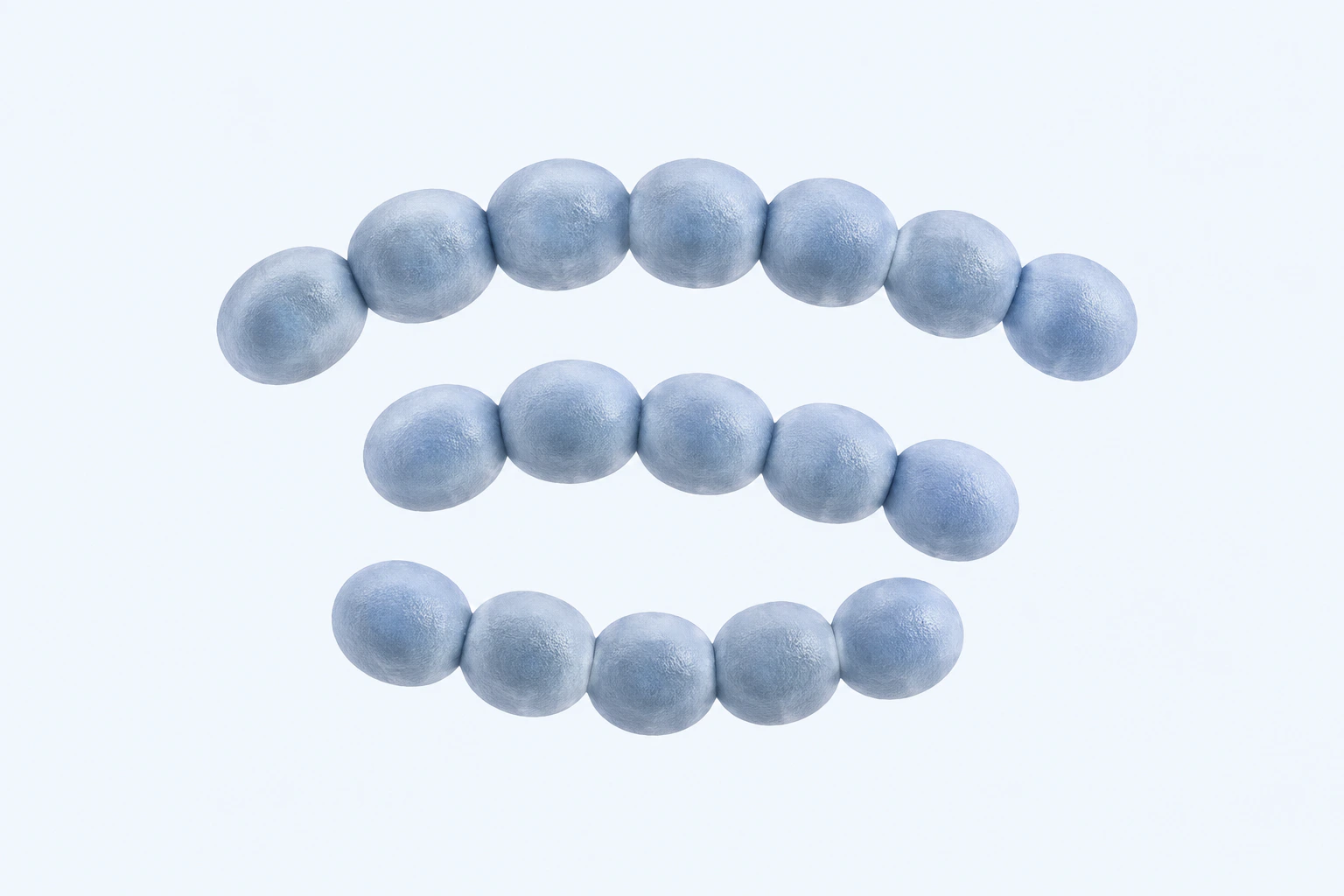
Type-strain-anchored Streptococcus thermophilus reconstruction with seventeen cocci in three chains. Representative, non-diagnostic, not visually separable from Streptococcus salivarius, and not a micrograph.
Scientific media record1 verified identifier
- Subject
- Streptococcus thermophilustaxon · species
- Identifiers
- NCBITaxon:1308
- Review
- Editorial review completeIdentifiers authority-verified · Accessibility validated · · streptococcus-thermophilus|streptococcus-thermophilus-morphology-v1.webp
- Digital source
- Trained-algorithmic mediaCreated with a trained generative algorithm and reviewed by WikiBiome for subject identity, scientific framing, identifiers, provenance, and accessibility.
- Scientific basis
- Streptococcus thermophilus — NCBI TaxonomyStreptococcus thermophilus — LPSNStreptococcus thermophilus type strain — BacDiveStreptococcus — Medical Microbiology
- License
- CC BY-SA 4.0Created
Streptococcus thermophilus is a Gram-positive, facultative anaerobic coccus that is the primary probiotic species used in commercial yogurt fermentation and thermophilic dairy fermentation worldwide. Distinct from pathogenic Streptococcus species, S. thermophilus produces β-galactosidase (lactase), enabling lactose digestion, and possesses inherent anti-inflammatory and immunomodulatory properties.
It has become one of the most extensively studied and clinically validated probiotic organisms, with demonstrated benefits in lactose intolerance, intestinal barrier function, and systemic immunomodulation.
Evidence map9 cited passagesInspect provenance +
Non-pathogenic: S. thermophilus lacks virulence factors present in pathogenic Streptococcus pyogenes and S. agalactiae (Delorme 2008 Int J Food Microbiol; )
In vitro and ex vivo studies demonstrate that S. thermophilus culture supernatants and isolated cell walls suppress IL-17 production by T cells ()
Promotes Foxp3+ Treg differentiation via IL-10 and TGF-β signaling in dendritic cells ()
Reduces pro-inflammatory TNF-α and IL-6 production ()
Manganese (Mn): Required for β-galactosidase and lactic acid dehydrogenase (LDH) cofactor; Mn2+ stabilizes enzyme active sites ()
Zinc (Zn): Zinc metalloenzymes in amino acid metabolism and cell wall synthesis ()
Intestinal barrier function: Studies show improved intestinal permeability (lactulose:mannitol ratio) and increased tight junction protein expression (claudins, occludin) ()
IBS and functional GI: Some strains show benefit in symptom reduction, though effect sizes are modest ()
Systemic immune function: Modest increases in IgA and reductions in fecal calprotectin (marker of intestinal inflammation) ()
Contents
1. Taxonomy2. Probiotic Origins and Safety3. Beta-Galactosidase and Lactose Digestion4. Lactic Acid Production and Intestinal Acidification5. Anti-Inflammatory and Immunomodulatory Properties6. Yogurt and Fermented Dairy Products7. Metal Dependencies8. Key Enzymes and Metabolic Functions9. Clinical and Research Evidence10. Persistence and Ecological Fate11. Interkingdom and Microbial Interactions12. Detection and Quantification13. Safety Monitoring in Clinical Use14. ConnectionsTaxonomy#
- Phylum: Firmicutes
- Class: Bacilli
- Order: Lactobacillales
- Family: Streptococcaceae
- Genus: Streptococcus
- Species: S. thermophilus
- Subspecies: Multiple subspecies with varying β-galactosidase activity (strains differ in lactase levels)
- Key characteristic: Gram-positive cocci in chains; facultative anaerobe; thermophilic (grows optimally at 40–45°C)
Probiotic Origins and Safety#
GRAS Status and Regulatory History#
Generally Recognized as Safe (GRAS) by the FDA (21 CFR 184.1683). Qualified Presumption of Safety (QPS) by the European Food Safety Authority (EFSA BIOHAZ Panel 2020). One of the longest-established food-grade microorganisms (used since 1930s in yogurt production).
Non-pathogenic: S. thermophilus lacks virulence factors present in pathogenic Streptococcus pyogenes and S. agalactiae (Delorme 2008 Int J Food Microbiol;[1]Metal Homeostasis in Pathogenic StreptococciAkbari MS, Doran KS, Burcham LR · 2022Open reference 1 ↓).
No antibiotic resistance genes; susceptible to penicillin and β-lactams (unlike many commensal bacteria). No toxin production; cannot cause invasive disease.
Beta-Galactosidase and Lactose Digestion#
Enzyme Properties and Mechanism#
S. thermophilus synthesizes constitutive β-galactosidase (lactase), an enzyme that cleaves the disaccharide lactose into glucose and galactose. Km: ~5 mmol/L (moderate affinity for lactose). Vmax: Variable by strain (correlates with enzyme copy number and expression level).
Activity: Remains stable at lower colonic pH (some strains retain activity at pH 4–5).
Heat stability: Enzyme is partially heat-stable; survives pasteurization of fermented products (yogurt with live cultures retains ~30–50% enzyme activity).
Clinical Benefit in Lactose Intolerance#
Ingestion of live yogurt containing S. thermophilus (>10^7 CFU per serving) reduces lactose malabsorption symptoms (Kolars et al. 1984 NEJM; EFSA Panel on Dietetic Products 2010).
β-galactosidase activity in the small intestine and colon breaks down lactose before colonic bacterial fermentation (Kolars et al. 1984 NEJM). Reduces hydrogen and methane production (bloating, flatulence) (Savaiano 2014 Am J Clin Nutr).
Enables lactose-intolerant individuals to tolerate dairy products (EFSA Panel on Dietetic Products 2010).
Effect is strain-dependent: High-lactase strains (e.g., ST-M6 variants) confer greater benefit than low-lactase strains.
Lactic Acid Production and Intestinal Acidification#
Fermentation Pathway#
S. thermophilus ferments lactose and glucose via homolactic fermentation, producing lactic acid as the primary end product. Lactose → Glucose + Galactose (via β-galactosidase). Glucose → Pyruvate → Lactate (Embden-Meyerhof pathway).
Lactic acid production: 0.5–1.5% (w/v) in yogurt fermentation.
Colonic Effects#
Lactic acid produced by S. thermophilus (and other lactic acid bacteria) acidifies the colon, lowering pH from ~7 toward 5.5–6.5 (Walker et al. 2005 Appl Environ Microbiol).
Acidification creates selective pressure favoring acid-tolerant commensals (Bifidobacteria, Lachnospiraceae) and inhibiting pathogens Clostridioides difficile, salmonella, pathogenic E. coli (Duncan et al. 2009 Environ Microbiol).
Enhanced colonic acidification also improves mineral absorption (especially calcium and magnesium).
Anti-Inflammatory and Immunomodulatory Properties#
Cell Wall Components and Pattern Recognition#
S. thermophilus possesses cell wall components that engage pattern recognition receptors (PRRs) and promote immune tolerance rather than pro-inflammatory responses.
Peptidoglycan and lipoteichoic acids: Recognized by TLR2/TLR6; promote IL-10 and Treg differentiation (unlike pathogenic Gram-positive species that trigger Th1/Th17). Lack of invasive capacity: Cannot cross epithelial barriers; signaling remains compartmentalized to gut-associated lymphoid tissue (GALT). Polysaccharide capsule: Engages C3 complement receptors; promotes anti-inflammatory C3 sensing.
Th1/Th17 Suppression and Treg Expansion#
In vitro and ex vivo studies demonstrate that S. thermophilus culture supernatants and isolated cell walls suppress IL-17 production by T cells ([2]Streptococcus thermophilus ST285 Alters Pro-Inflammatory to Anti-Inflammatory Cytokine Secretion against Multiple Sclerosis Peptide in MiceDargahi N, Matsoukas J, Apostolopoulos V · 2020Open reference 2 ↓).
Promotes Foxp3+ Treg differentiation via IL-10 and TGF-β signaling in dendritic cells ([2]Streptococcus thermophilus ST285 Alters Pro-Inflammatory to Anti-Inflammatory Cytokine Secretion against Multiple Sclerosis Peptide in MiceDargahi N, Matsoukas J, Apostolopoulos V · 2020Open reference 2 ↓). Reduces pro-inflammatory TNF-α and IL-6 production ([2]Streptococcus thermophilus ST285 Alters Pro-Inflammatory to Anti-Inflammatory Cytokine Secretion against Multiple Sclerosis Peptide in MiceDargahi N, Matsoukas J, Apostolopoulos V · 2020Open reference 2 ↓). These effects are strain-dependent: Some S. thermophilus strains show stronger Treg-promoting activity than others.
Short-Chain Fatty Acid Complementarity#
While S. thermophilus itself produces primarily lactate (not Butyrate or propionate), it creates acidic microenvironments that favor butyrate-producing bacteria Faecalibacterium prausnitzii, Roseburia. Cross-feeding dynamics: Lactate produced by S. thermophilus is converted to propionate by Veillonella and butyrate by Clostridium cluster IV species.
This creates a metabolic network where S. thermophilus plays an upstream role in SCFA production via ecological engineering.
Yogurt and Fermented Dairy Products#
Traditional and Commercial Sources#
Plain yogurt: Contains 10^8–10^9 CFU/mL of live S. thermophilus (and typically lactobacillus-bulgaricus). Greek yogurt: Concentrated cells (higher CFU per serving due to straining). Other fermented dairy: Kefir, lassi, some cheeses (retain viable cells if unpasteurized).
Probiotic yogurts: May contain additional species (e.g., Bifidobacterium, Lactobacillus rhamnosus).
Strain Selection for Probiotic Efficacy#
- ST-M6: High β-galactosidase activity; strong Treg-promoting properties in some studies
- LBB-12: Common commercial strain; good acid tolerance
- LLS1: High lactic acid production; enhanced acidification
- Clinical efficacy varies with strain selection; probiotic yogurts with high-activity strains show stronger effects
Metal Dependencies#
Manganese and Zinc Cofactors#
Manganese (manganese): Required for β-galactosidase and lactic acid dehydrogenase (LDH) cofactor; manganese(II) (Mn2+) stabilizes enzyme active sites ([1]Metal Homeostasis in Pathogenic StreptococciAkbari MS, Doran KS, Burcham LR · 2022Open reference 1 ↓). Zinc (zinc (Zn)): Zinc metalloenzymes in amino acid metabolism and cell wall synthesis ([1]Metal Homeostasis in Pathogenic StreptococciAkbari MS, Doran KS, Burcham LR · 2022Open reference 1 ↓).
Metal availability impacts fermentation rate and SCFA production in the broader probiotic ecosystem.
Key Enzymes and Metabolic Functions#
- β-galactosidase (lactase) – lactose hydrolysis; primary functional enzyme
- Lactic acid synthetase – lactate production from pyruvate
- Glucosyltransferase – synthesis of extracellular polysaccharides (EPS); biofilm formation
- Peptidases and proteases – casein hydrolysis; production of bioactive peptides
- Arginine deiminase – metabolizes arginine; reduces local Metal-Driven Inflammation
Clinical and Research Evidence#
Randomized Controlled Trials#
Lactose intolerance: RCTs demonstrate 50–70% symptom reduction with yogurt-based probiotic intervention (high-lactase strains most effective) (Savaiano 2014 Am J Clin Nutr; EFSA Panel on Dietetic Products 2010).
Intestinal barrier function: Studies show improved intestinal permeability (lactulose:mannitol ratio) and increased tight junction protein expression (claudins, occludin) ([2]Streptococcus thermophilus ST285 Alters Pro-Inflammatory to Anti-Inflammatory Cytokine Secretion against Multiple Sclerosis Peptide in MiceDargahi N, Matsoukas J, Apostolopoulos V · 2020Open reference 2 ↓). Antibiotic-associated diarrhea (AAD): Meta-analyses show modest risk reduction (~10–15% absolute risk reduction) when given during antibiotic course (Hempel et al. 2012 JAMA).
IBS and functional GI: Some strains show benefit in symptom reduction, though effect sizes are modest ([3]Effect of Probiotics on Inducing Remission and Maintaining Therapy in Ulcerative Colitis, Crohn's Disease, and Pouchitis: Meta-analysis of Randomized Controlled TrialsShen J, Zuo ZX, Mao AP · 2014Open reference 3 ↓).
Systemic immune function: Modest increases in IgA and reductions in fecal calprotectin (marker of intestinal inflammation) ([4]Tao 2020 — Effects of Probiotics on Type II Diabetes Mellitus: A Meta-AnalysisYun-Wen Tao, Ying-Luo Gu, Xin-Qi Mao et al. · 2020Open reference 4 ↓). Respiratory infections: Weak evidence for upper respiratory infection reduction in specific populations.
Important Caveats#
Transient colonization: S. thermophilus does not permanently establish in the colon; benefits disappear within days of discontinuation. Strain-dependent effects: Not all S. thermophilus strains show equivalent probiotic benefits; evidence is specific to tested strains. Variable individual response: Genetic and baseline microbiota factors predict responders vs. non-responders.
Persistence and Ecological Fate#
S. thermophilus survives gastric acid and bile salts better than most probiotics. Transits to the colon and produces lactic acid locally. Does not persist in the colonic microbiota after supplementation stops (unlike some other probiotics); cells are excreted.
Fermentation metabolites (lactate, peptides) provide lasting effects even after cells are cleared.
Interkingdom and Microbial Interactions#
Synbiotic Pairing with Fiber#
Inulin, FOS, and other prebiotics: Preferentially fermented by S. thermophilus and partner lactic acid bacteria. Resistant starch: Can serve as substrate for S. thermophilus in high-starch diets. Combination of S. thermophilus + prebiotic is more effective for SCFA production and pH reduction than either alone.
Cooperation with Butyrate Producers#
Lactate produced by S. thermophilus is the preferred substrate for cross-feeding Lachnospiraceae Faecalibacterium prausnitzii, Roseburia. This is a key ecosystem service: S. thermophilus primes the environment for beneficial SCFA producer enrichment.
Detection and Quantification#
Culture: Grows on M17 agar at 40–45°C; easily cultured from yogurt and commercial probiotics. 16S rRNA profiling: Genus-level identification; species-specific primers available for S. thermophilus. Species-specific qPCR: Quantifies viable S. thermophilus cells in probiotic products and fecal samples.
β-galactosidase activity assay: Functional measure of lactase activity in probiotic products. Typical abundance: <0.01% of fecal microbiota during supplementation; transient (persists 1–2 weeks post-supplementation).
Safety Monitoring in Clinical Use#
No systemic infection risk in immunocompetent individuals (even with very high CFU supplementation). Lactate production may be problematic in rare lactate-sensitive individuals; caution advised. Allergic reactions: Rare but documented (milk proteins, fermentation metabolites).
Drug interactions: None well-characterized; can be taken concurrently with antibiotics (though antibiotics may reduce CFU).
Connections#
- – β-galactosidase enables lactose digestion in dairy products
- – primary organism in yogurt production; key for food preservation
- – primary fermentation product; acidifies colon
- nutritional immunity – promotes tight junction protein expression and Treg differentiation
- – anti-inflammatory; promotes IL-10 and Treg responses
- Dysbiosis – transient therapeutic intervention; not a permanent colonizer
- – modest risk reduction when coadministered with antibiotics
- Short-Chain Fatty Acids (SCFAs) – indirect producer via lactate cross-feeding of butyrate-producing bacteria
- Faecalibacterium prausnitzii – lactate-consuming biofilm partner; synergistic ecosystem
- Roseburia – secondary consumer of S. thermophilus lactate; butyrate producer
- Manganese – metal cofactor for β-galactosidase activity
- Zinc – metalloenzyme cofactor; required for cell wall synthesis
- Probiotics – archetypal probiotic organism; GRAS-designated; oldest documented food probiotic
- – synbiotics with inulin/FOS enhance probiotic efficacy
References 4
Numbered by first appearance in the article, then reconciled with its declared source list.
- 1
Akbari MS, Doran KS, Burcham LR (2022). Metal Homeostasis in Pathogenic Streptococci. Microorganisms.
- 2
Dargahi N, Matsoukas J, Apostolopoulos V (2020). Streptococcus thermophilus ST285 Alters Pro-Inflammatory to Anti-Inflammatory Cytokine Secretion against Multiple Sclerosis Peptide in Mice. Brain Sciences.
- 3
Shen J, Zuo ZX, Mao AP (2014). Effect of Probiotics on Inducing Remission and Maintaining Therapy in Ulcerative Colitis, Crohn's Disease, and Pouchitis: Meta-analysis of Randomized Controlled Trials. Inflammatory Bowel Diseases.
- 4
Yun-Wen Tao, Ying-Luo Gu, Xin-Qi Mao et al. (2020). Tao 2020 — Effects of Probiotics on Type II Diabetes Mellitus: A Meta-Analysis. Journal of Translational Medicine.
Article network
Mentioned here 17
Pages linking here 6
Connect the evidence
Publicly readable discussion by ORCID-authenticated researchers. Questions, interpretation, methods, corrections, and new evidence stay attached to this record.
No discussion yet. Start with a precise question or a source-backed observation.
Activity and accepted changes
Accepted researcher context, editorial status, public discussion, and upstream Git revisions are shown together. Pending, declined, and withdrawn proposals remain private.
- published revision
Backfill inflammation concept links
Karen Pendergrass · +1 −1
Inspect exact Git diff ↗ - published revision
Complete Tight junctions contextual coverage
Karen Pendergrass · +1 −1
Inspect exact Git diff ↗ - published revision
massive wiki expansion: 149 stubs fixed, 100+ new pages, Rule 15 scan, keystone papers
WikiBiome Deploy Bot · +68 −68
Inspect exact Git diff ↗ - published revision
ingest: 87 papers (17 endometriosis, 67 erectile dysfunction, 3 cross-condition)
WikiBiome Deploy Bot · +1 −1
Inspect exact Git diff ↗ - published revision
nightly maintenance: 94 stub demotions, 181 source_count fixes, 22 auto-discovered stubs, 5 adversarial audits, 3 boundary fixes, 3 evidence-level corrections
WikiBiome Deploy Bot · +1 −0
Inspect exact Git diff ↗ - published revision
Deep content + citation pass: 10 entities enriched, 7 new sources, DOI integrity
WikiBiome Deploy Bot · +19 −19
Inspect exact Git diff ↗ - published revision
Citation integrity pass: 38 citations added, 24 parenthesized citations fixed
WikiBiome Deploy Bot · +3 −3
Inspect exact Git diff ↗ - published revision
WikiBiome update — 2026-04-15 17:23
WikiBiome Deploy Bot · +7 −7
Inspect exact Git diff ↗ - published revision
v2 migration Priority 3: 17 metal + 82 microbe entities upgraded with seo_target, wikipedia_differentiation, conditions data
WikiBiome Deploy Bot · +6 −0
Inspect exact Git diff ↗ - published revision
WikiBiome update — integrity fixes, metallomic diet pages, cross-condition analyses
WikiBiome Deploy Bot · +4 −2
Inspect exact Git diff ↗ - published revision
WikiBiome update — 2026-04-10 17:16
WikiBiome Deploy Bot · +198 −0
Inspect exact Git diff ↗