
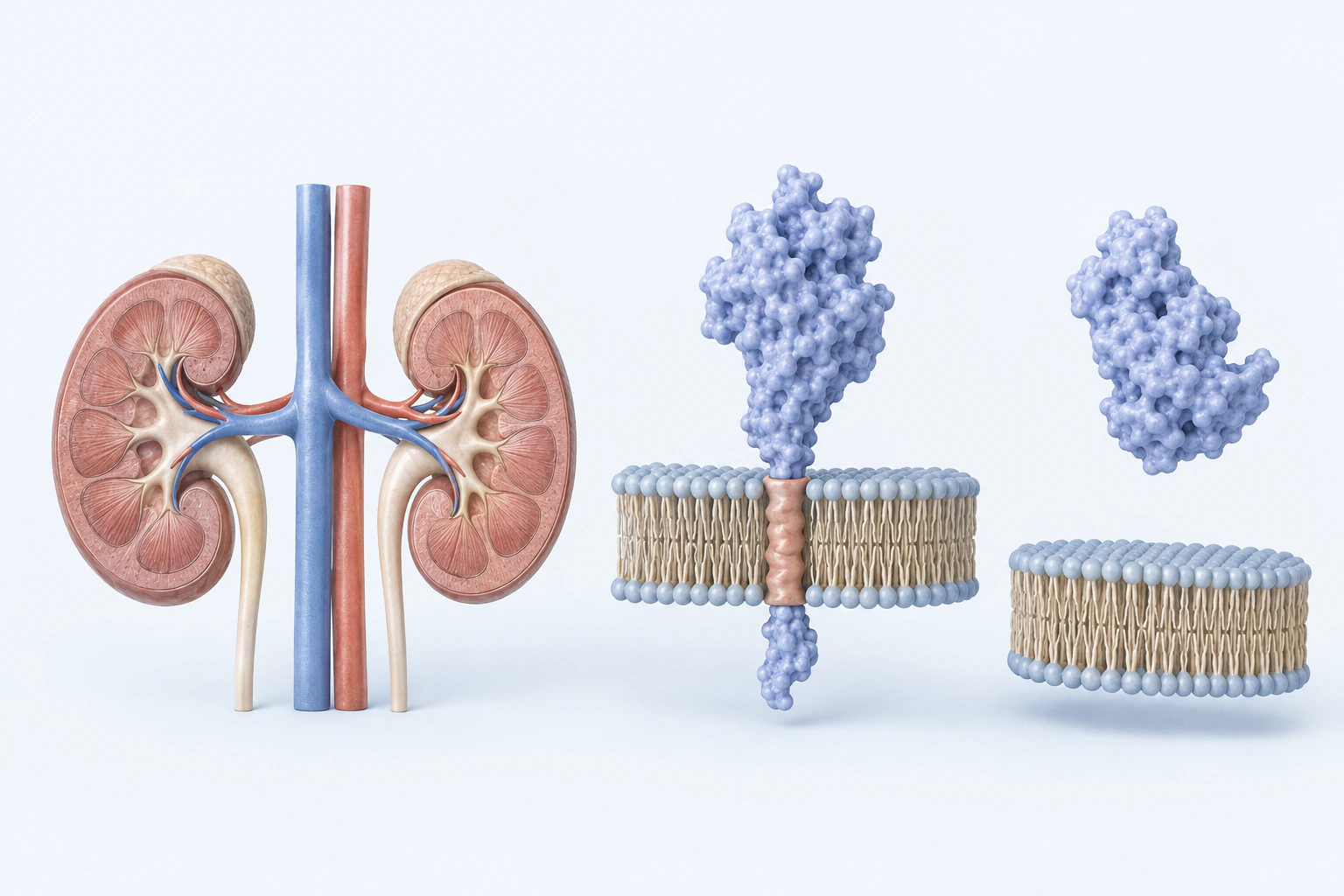
Human alpha-Klotho protein-and-renal-context orientation. Protein forms are generic abstractions, not measured conformations, cleavage, expression, activity, renal protection, anti-aging effect, biomarker, or diagnosis.
Scientific media record2 verified identifiers
- Subject
- Klothobiological-process
- Identifiers
- WikiBiome:alpha-klothoUniProt:Q9UEF7
- Review
- Editorial review completeIdentifiers authority-verified · Accessibility validated · · alpha-klotho|alpha-klotho-mechanism-v1.webp
- Digital source
- Trained-algorithmic mediaCreated with a trained generative algorithm and reviewed by WikiBiome for subject identity, scientific framing, identifiers, provenance, and accessibility.
- Scientific basis
- Klotho — UniProtKB Q9UEF7Alpha-Klotho
- License
- CC BY-SA 4.0Created
An anti-aging protein that has emerged as a critical mediator between heavy metal exposure and Chronic Kidney Disease progression.
Originally discovered as a gene whose mutation caused premature aging in mice, alpha-klotho is now understood to be a multifunctional protein with renal protective, antioxidant, and anti-inflammatory properties—and its suppression by toxic metals may be one of the key mechanisms through which low-dose environmental metal exposure translates into chronic kidney damage.
Evidence map3 cited passagesInspect provenance +
Alpha-klotho exerts renal and systemic protection through multiple mechanisms:
A machine learning analysis of 51 pollutants identified heavy metals (cadmium, thallium, lead, mercury) as the most impactful on CKD risk. Alpha-klotho sits at the center of this relationship:
Alpha-klotho decline is one of the earliest detectable changes in CKD progression, occurring before significant GFR reduction:
Contents
1. Biology2. The Metal-Klotho-CKD Axis3. CKD Context4. Microbiome Relevance5. Open Questions6. ConnectionsBiology#
Expression and Forms#
Primarily expressed in the kidney (distal convoluted tubule), with lower expression in brain choroid plexus and parathyroid glands. Exists in two forms. Membrane-bound: Functions as a co-receptor for fibroblast growth factor 23 (FGF23), regulating phosphate and calcium homeostasis.
Soluble (secreted/cleaved): Circulates in blood and CSF; acts as an endocrine factor with pleiotropic protective effects.
Protective Functions#
Alpha-klotho exerts renal and systemic protection through multiple mechanisms.[1]The association between low-concentration heavy metal exposure and chronic kidney disease risk through alpha-klothoLiu S, Wang H, Cao Y et al. · 2025Open reference 1 ↓
Antioxidant enzyme regulation: Upregulates superoxide dismutase (SOD), catalase (CAT), and glutathione peroxidase 4 (GPX-4)—the same enzyme whose loss triggers Ferroptosis. TLR4 signaling suppression: Inhibits toll-like receptor 4 activation, reducing innate immune inflammatory cascades. NF-kappaB inhibition: Blocks the master inflammatory transcription factor, reducing pro-inflammatory cytokine production.
Autophagy promotion: Facilitates cellular cleanup of damaged organelles and protein aggregates. Calcium/vitamin D homeostasis: Regulates mineral metabolism through FGF23 co-receptor function.
The Metal-Klotho-CKD Axis#
A machine learning analysis of 51 pollutants identified Heavy Metals (cadmium, Thallium, Lead, Mercury) as the most impactful on CKD risk.[1]The association between low-concentration heavy metal exposure and chronic kidney disease risk through alpha-klothoLiu S, Wang H, Cao Y et al. · 2025Open reference 1 ↓ Alpha-klotho sits at the center of this relationship:
Mediation Evidence#
Alpha-klotho mediates 34.55% of the mercury-CKD association. Mendelian randomization confirmed directionality: higher alpha-klotho levels causally reduce CKD risk (OR 0.9842, using 6 genetic instruments). Alpha-klotho levels are significantly lower in CKD patients (727.65 vs 798.80 pg/mL, p < 0.0001).
Proposed Mechanism#
The working model: toxic metals suppress alpha-klotho expression in renal tubular cells, which. Reduces antioxidant defenses (SOD, CAT, GPX-4 decline). Permits Oxidative Stress accumulation in kidney tissue.
Increases inflammatory signaling (NF-kappaB, TLR4 derepressed).
Impairs autophagy, allowing damaged cell components to accumulate. Progressive tubular injury leads to CKD.
This creates a vulnerability loop: as kidney function declines, metal clearance is impaired, further suppressing alpha-klotho, accelerating decline.
CKD Context#
Alpha-klotho decline is one of the earliest detectable changes in CKD progression, occurring before significant GFR reduction.[2]Molecular Mechanisms of Cellular Injury and Role of Toxic Heavy Metals in Chronic Kidney DiseaseManish Mishra, Larry Nichols, Aditi A. Dave et al. · 2022Open reference 2 ↓
Cadmium specifically targets proximal tubular cells, where it accumulates bound to Metallothionein; lysosomal degradation releases free cadmium (Cd), suppressing klotho. Mercury and lead contribute to tubular injury through oxidative mechanisms.
Thallium had the highest posterior inclusion probability (PIP = 1.0) in BKMR models, suggesting it may be particularly potent in suppressing klotho pathways.
Microbiome Relevance#
The alpha-klotho axis connects to the Gut Microbiome through several mechanisms. CKD-associated Dysbiosis produces uremic toxins (including p-Cresol and indoxyl sulfate) that further suppress klotho expression. Gut-brain-axis signaling may modulate central alpha-klotho expression in the choroid plexus. Intestinal Metal-Driven Inflammation from dysbiosis increases systemic metal absorption, potentially accelerating klotho suppression.
Open Questions#
Unresolved questions identified by the current evidence record.
01Do other metals beyond cadmium (Cd), mercury (Hg), lead (Pb), and thallium (Tl) suppress alpha-klotho?+
02Can klotho-enhancing interventions (e.g., soluble klotho supplementation) protect against metal-induced nephrotoxicity?+
The current WikiBiome record identifies this as an unresolved evidence gap.
03Does the gut microbiome modulate alpha-klotho expression through metabolite signaling?+
The current WikiBiome record identifies this as an unresolved evidence gap.
Connections#
- Chronic Kidney Disease—alpha-klotho decline is an early CKD biomarker
- Thallium—highest inclusion probability for CKD risk in BKMR models
- Cadmium—proximal tubular accumulation suppresses klotho
- oxidative stress—klotho loss derepresses ROS generation
- Ferroptosis—klotho upregulates GPX-4, the ferroptosis brake
- NF-kB Signaling Pathway—klotho inhibits this master inflammatory regulator
- Metallothionein—cadmium (Cd)-MT complexes in renal tubules release free cadmium that suppresses klotho
References 3
Numbered by first appearance in the article, then reconciled with its declared source list.
- 1
Liu S, Wang H, Cao Y et al. (2025). The association between low-concentration heavy metal exposure and chronic kidney disease risk through alpha-klotho. Scientific Reports.
- 2
★Manish Mishra, Larry Nichols, Aditi A. Dave et al. (2022). Molecular Mechanisms of Cellular Injury and Role of Toxic Heavy Metals in Chronic Kidney Disease. International Journal of Molecular Sciences.
- 3
Di Ciaula A, Garruti G, Lunardi Baccetto R et al. (2017). Bile acid physiology. Annals of Hepatology.
Article network
Mentioned here 17
Pages linking here 5
Connect the evidence
Publicly readable discussion by ORCID-authenticated researchers. Questions, interpretation, methods, corrections, and new evidence stay attached to this record.
No discussion yet. Start with a precise question or a source-backed observation.
Activity and accepted changes
Accepted researcher context, editorial status, public discussion, and upstream Git revisions are shown together. Pending, declined, and withdrawn proposals remain private.
- published revision
Backfill heavy metals concept links
Karen Pendergrass · +1 −1
Inspect exact Git diff ↗ - published revision
Backfill oxidative stress concept links
Karen Pendergrass · +1 −1
Inspect exact Git diff ↗ - published revision
Backfill gut microbiome concept links
Karen Pendergrass · +1 −1
Inspect exact Git diff ↗ - published revision
Backfill inflammation concept links
Karen Pendergrass · +1 −1
Inspect exact Git diff ↗ - published revision
Complete corpus-wide Dysbiosis linking
Karen Pendergrass · +1 −1
Inspect exact Git diff ↗ - published revision
massive wiki expansion: 149 stubs fixed, 100+ new pages, Rule 15 scan, keystone papers
WikiBiome Deploy Bot · +20 −19
Inspect exact Git diff ↗ - published revision
nightly maintenance: 94 stub demotions, 181 source_count fixes, 22 auto-discovered stubs, 5 adversarial audits, 3 boundary fixes, 3 evidence-level corrections
WikiBiome Deploy Bot · +2 −0
Inspect exact Git diff ↗ - published revision
pre-overnight checkpoint 2026-04-18
WikiBiome Deploy Bot · +92 −0
Inspect exact Git diff ↗