
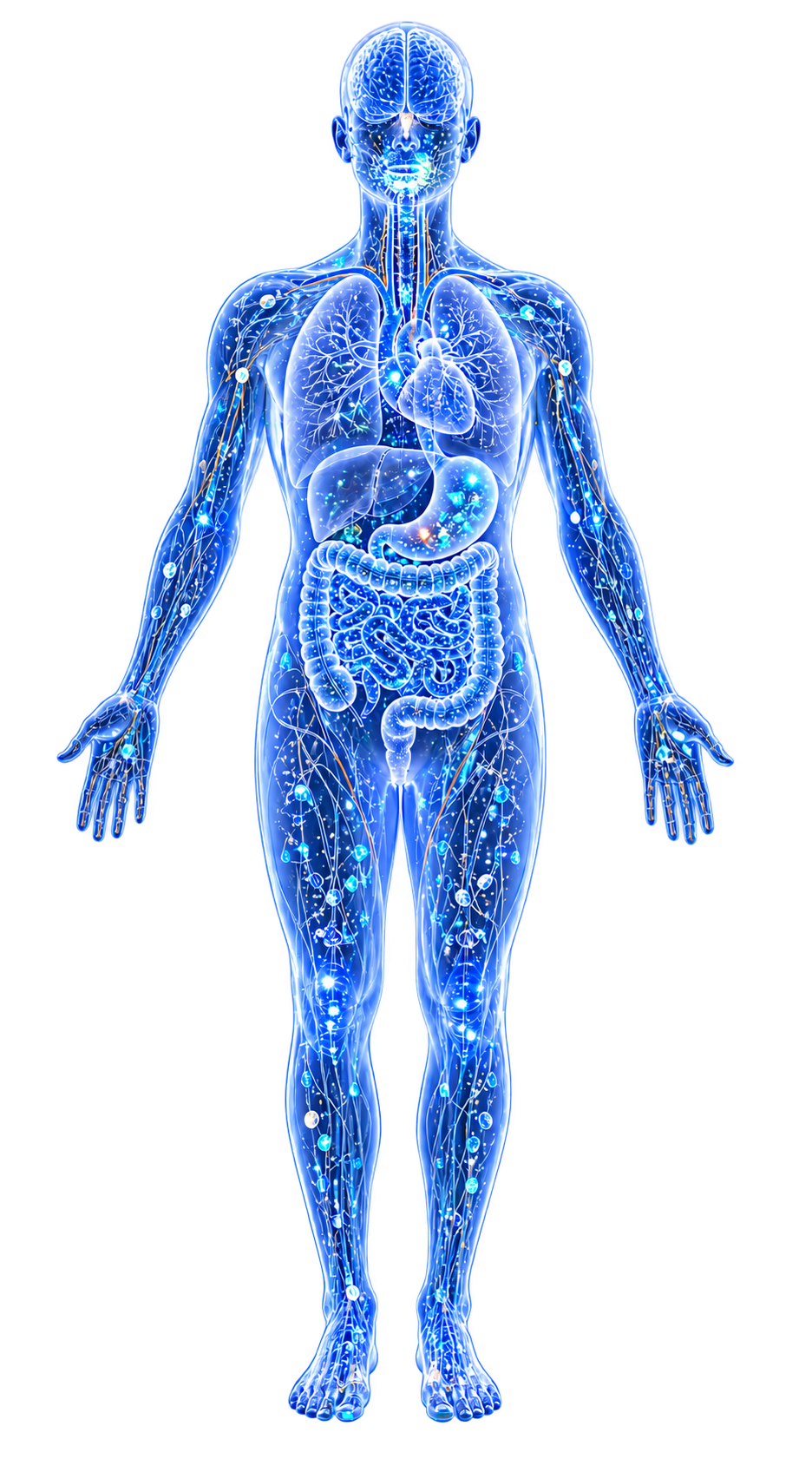
A family of small (6-7 kDa), cysteine-rich proteins that bind Heavy Metals with extraordinary affinity. Metallothioneins (MTs) are the cell's primary chemical defense against metal toxicity—they sequester cadmium, mercury, lead, and other toxic metals, preventing them from reaching sensitive enzyme targets.
But the metallothionein story is more nuanced than simple detoxification. These proteins also regulate the homeostasis of essential metals (zinc and copper), and in cancer biology, their protective role paradoxically enables tumor progression and drug resistance.
Evidence map2 cited passagesInspect provenance +
When cadmium enters the cell, MT is the primary defense:
In breast cancer, metallothionein plays a double-edged role:
Contents
1. Structure and Binding2. Dual Role in Metal Homeostasis3. The Cancer Paradox4. Disease Contexts5. ConnectionsStructure and Binding#
Cysteine content: ~30% of amino acid residues are cysteine, providing abundant thiol (-SH) groups for metal coordination. Two domains: Alpha domain binds 4 divalent metal ions; beta domain binds 3 divalent metal ions. A single MT molecule can bind 7 zinc or cadmium atoms, or 12 copper(I) atoms.
Binding hierarchy (affinity): mercury(II) (Hg2+) > copper (Cu)+ > cadmium(II) (Cd2+) > Zn2+—meaning toxic metals displace zinc when they arrive, which is both protective (sequestering the toxicant) and disruptive (liberating zinc).
Dual Role in Metal Homeostasis#
Zinc Buffering#
Under normal conditions, metallothionein functions as a zinc buffer:
- Stores zinc in a readily exchangeable form
- Releases zinc in response to Oxidative Stress (ROS oxidize MT cysteine residues, liberating bound zinc (Zn))
- Participates in zinc transfer to newly synthesized apoenzymes
- The MT zinc buffer system interfaces with the broader Metal Homeostasis network
Cadmium Detoxification#
When cadmium enters the cell, MT is the primary defense.[1]The Effects of Cadmium ToxicityGiuseppe Genchi, Maria Stefania Sinicropi, Graziantonio Lauria et al. · 2020Open reference 1 ↓ cadmium(II) (Cd2+) displaces zinc(II) (Zn2+) from MT due to higher binding affinity. cadmium-MT complex is thermodynamically stable, reducing free cadmium availability.
MT expression is strongly induced by cadmium exposure (positive feedback loop).
However, cadmium-MT is not permanently inactivated—it is filtered at the renal glomerulus and reabsorbed in proximal tubules, where lysosomal degradation (pH 4.5-5.5) releases free cadmium, causing tubular damage. This is the molecular basis of cadmium nephrotoxicity and its connection to Chronic Kidney Disease.
Copper Regulation#
MT binds copper (Cu)(I) with high affinity (12 atoms per molecule). Copper displaces zinc from MT due to higher affinity, creating copper-MT complexes. This copper-zinc (Zn) competition at MT binding sites contributes to the copper/zinc ratio distortion seen across cancer and inflammatory conditions.
Chronic high-dose zinc supplementation induces intestinal MT, which then binds dietary copper, reducing copper absorption—the basis for zinc-induced copper deficiency.
The Cancer Paradox#
In breast cancer, metallothionein plays a double-edged role:[2]Cadmium and breast cancer - Current state and research gaps in the underlying mechanismsTarhonska K, Lesicka M, Janasik B et al. · 2022Open reference 2 ↓
Protection (Initially)#
MT sequesters cadmium, reducing its availability to damage DNA, displace zinc from zinc-finger transcription factors, and activate estrogen receptors as a Metalloestrogen. MT induction is the cell's first-line defense against cadmium (Cd)-mediated genotoxicity.
Enabling Progression (Subsequently)#
Higher MT expression in breast tumors predicts cancer progression and drug resistance. MT sequesters platinum-based chemotherapy drugs (cisplatin, carboplatin) via the same thiol-binding mechanism used for cadmium, reducing drug efficacy.
cadmium (Cd) accumulates preferentially in mammary tissue bound to MT (0.053 ug/g malignant vs 0.02 ug/g normal)—MT enables the accumulation by preventing acute toxicity while permitting chronic estrogenic stimulation.
MT-mediated zinc release under oxidative stress may activate metalloproteinases and other zinc-dependent enzymes that promote invasion and metastasis.
Disease Contexts#
Chronic Kidney Disease#
cadmium (Cd)-MT complexes undergo renal tubular reabsorption and lysosomal degradation, releasing free cadmium in proximal tubule cells. This mechanism makes the kidney the primary chronic target organ for cadmium toxicity and connects MT-mediated "protection" to progressive renal injury.
Autism Spectrum Disorder#
Toxic metals (mercury (Hg), cadmium (Cd), lead (Pb)) compete with zinc for MT binding. In ASD, where toxic metal burdens are elevated and zinc is depleted, MT capacity may be overwhelmed—leaving both zinc-dependent enzymes unprotected and toxic metals unsequestered.
Neurodegeneration#
Brain MT isoforms (MT-I, MT-II, MT-III) regulate zinc and copper availability in neural tissue. MT-III is enriched in the brain and specifically modulates zinc-dependent neurotransmission. Altered MT-III expression in Alzheimer's disease may contribute to the copper/zinc redistribution that drives amyloid-beta-aggregation.
Connections#
- Zinc—MT is the primary intracellular zinc buffer
- Copper—copper (Cu) displaces zinc (Zn) from MT; chronic zinc supplementation induces MT to reduce copper absorption
- Cadmium—MT is the primary cadmium (Cd) detoxification mechanism; cadmium-MT paradox in cancer and kidney
- Chronic Kidney Disease—cadmium-MT tubular reabsorption causes nephrotoxicity
- Breast Cancer—MT predicts progression and drug resistance
- Metalloestrogen—MT sequestration modulates cadmium availability for ER activation
- Metal Homeostasis—MT is a core component of cellular metal buffering
- Mis-Metallation—MT binding hierarchy enables displacement cascades
- Alpha-Klotho—cadmium released from MT in renal tubules suppresses klotho
References 9
Numbered by first appearance in the article, then reconciled with its declared source list.
- 1
Giuseppe Genchi, Maria Stefania Sinicropi, Graziantonio Lauria et al. (2020). The Effects of Cadmium Toxicity. International Journal of Environmental Research and Public Health.
- 2
Tarhonska K, Lesicka M, Janasik B et al. (2022). Cadmium and breast cancer - Current state and research gaps in the underlying mechanisms. Toxicology Letters.
- 3
★Monisha Jaishankar, Tenzin Tseten, Naresh Anbalagan et al. (2014). Toxicity, Mechanism and Health Effects of Some Heavy Metals. Interdisciplinary Toxicology.
- 4
★Puthiyavalappil Rasin, Ashwathi A V, Sabeel M Basheer et al. (2025). Exposure to Cadmium and Its Impacts on Human Health: A Short Review. Journal of Hazardous Materials Advances.
- 5
Filippo Rosario, Almut Heinken, Ines Thiele (2019). Rosario 2019 -- Constraint-Based Modelling of Host-Microbiome Co-Metabolism in Alzheimer's and Parkinson's Disease. Microbiome.
- 6
Fakher Rahim, Karlygash Toguzbaeva, Nameer Hashim Qasim et al. (2023). Rahim 2023 — Probiotics, Prebiotics, and Synbiotics for ASD: Meta-Analysis and Umbrella Review. Frontiers in Nutrition.
- 7
★Saleh A. K. Saleh, Heba M. Adly, Altaf A. Abdelkhaliq et al. (2020). Serum Levels of Selenium, Zinc, Copper, Manganese, and Iron in Prostate Cancer Patients. Current Urology.
- 8
Bastian Blume, Philippe Schmitt-Kopplin, Bernhard Michalke (2026). Blume 2026 — Combined Metallomics and Metabolomics Reveal Impact of Metal Homeostasis on Biological Pathways in C. elegans. Analytical and Bioanalytical Chemistry.
- 9
Runqiu Chen, Huaijun Tu, Tingtao Chen (2022). Potential Application of Living Microorganisms in the Detoxification of Heavy Metals. Foods.
Article network
Connect the evidence
Publicly readable discussion by ORCID-authenticated researchers. Questions, interpretation, methods, corrections, and new evidence stay attached to this record.
No discussion yet. Start with a precise question or a source-backed observation.
Activity and accepted changes
Accepted researcher context, editorial status, public discussion, and upstream Git revisions are shown together. Pending, declined, and withdrawn proposals remain private.
- published revision
Backfill heavy metals concept links
Karen Pendergrass · +1 −1
Inspect exact Git diff ↗ - published revision
Backfill oxidative stress concept links
Karen Pendergrass · +1 −1
Inspect exact Git diff ↗ - published revision
massive wiki expansion: 149 stubs fixed, 100+ new pages, Rule 15 scan, keystone papers
WikiBiome Deploy Bot · +18 −12
Inspect exact Git diff ↗ - published revision
nightly maintenance: 94 stub demotions, 181 source_count fixes, 22 auto-discovered stubs, 5 adversarial audits, 3 boundary fixes, 3 evidence-level corrections
WikiBiome Deploy Bot · +2 −0
Inspect exact Git diff ↗ - published revision
pre-overnight checkpoint 2026-04-18
WikiBiome Deploy Bot · +93 −0
Inspect exact Git diff ↗