
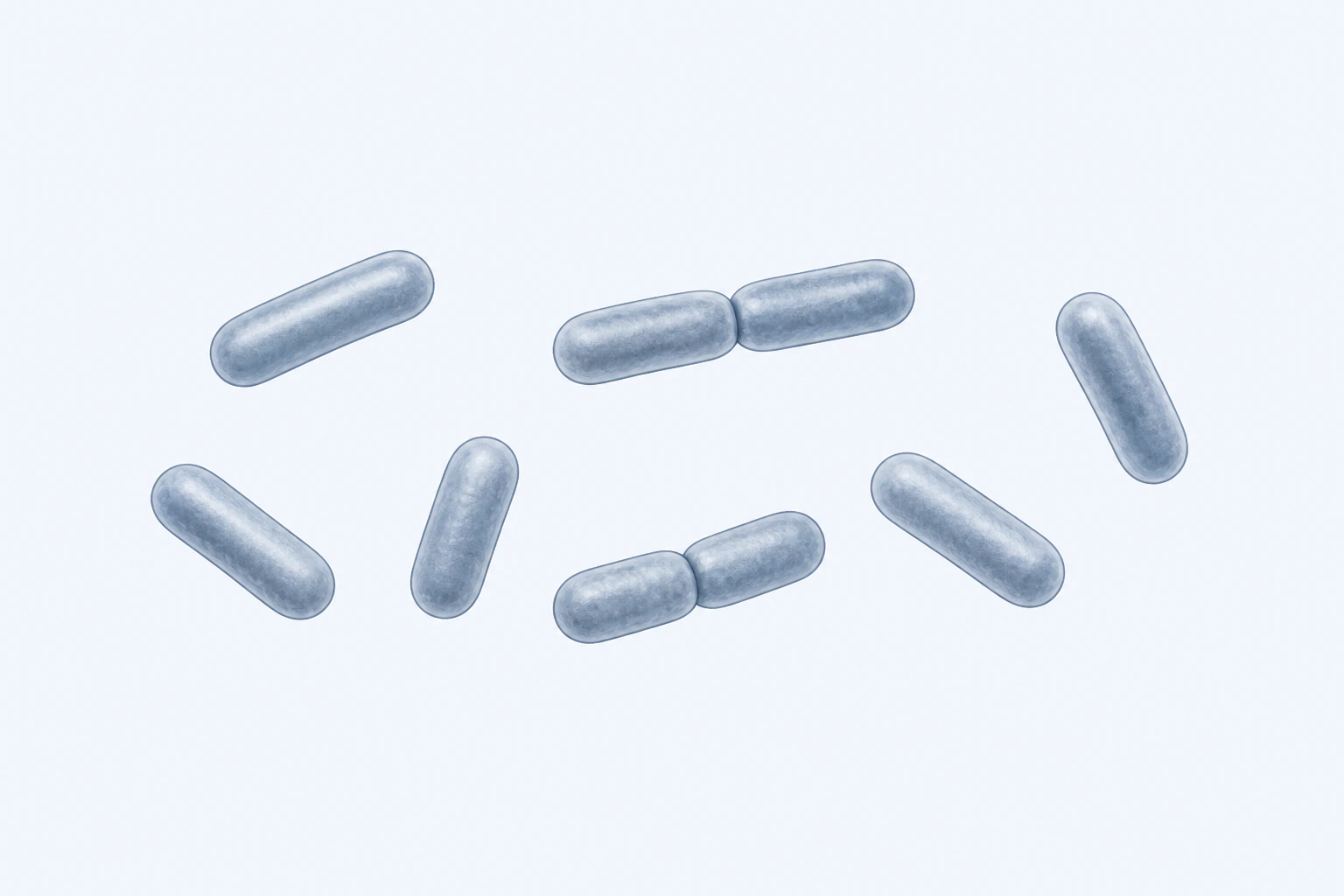
Type-strain-anchored Shigella flexneri reconstruction with nine rods. Representative, non-diagnostic, not visually separable from genus or Escherichia coli plates, and not a micrograph.
Scientific media record1 verified identifier
- Subject
- Shigella flexneritaxon · species
- Identifiers
- NCBITaxon:623
- Review
- Editorial review completeIdentifiers authority-verified · Accessibility validated · · shigella-flexneri|shigella-flexneri-morphology-v1.webp
- Digital source
- Trained-algorithmic mediaCreated with a trained generative algorithm and reviewed by WikiBiome for subject identity, scientific framing, identifiers, provenance, and accessibility.
- License
- CC BY-SA 4.0Created
A Gram-negative intracellular pathogen causing bacillary dysentery (shigellosis), responsible for approximately 165 million illness episodes and over 1 million deaths annually, predominantly in children under 5 in developing countries. S. flexneri relies on Nickel-dependent [NiFe] Hydrogenases for a specific and critical virulence function: surviving the acid assault within macrophage phagolysosomes.
Evidence map3 cited passagesInspect provenance +
Possesses H2-uptake hydrogenases Hya and Hyb that combat acid stress during intracellular survival in macrophages.
As a member of Enterobacteriaceae, S. flexneri is predicted to possess Ni-dependent glyoxalase for methylglyoxal detoxification during the high glycolytic flux of intracellular replication.
Metal exposure in endemic regions (contaminated water sources containing heavy metals) may promote Enterobacteriaceae enrichment in the gut, potentially favoring Shigella colonization.
Contents
1. Nickel-Dependent Virulence2. Iron Acquisition3. Pathogenesis4. Clinical Significance5. ConnectionsNickel-Dependent Virulence#
[NiFe] Hydrogenases—Phagolysosomal Acid Combat#
Possesses H2-uptake hydrogenases Hya and Hyb that combat acid stress during intracellular survival in macrophages.[1]Role of Nickel in Microbial PathogenesisRobert J. Maier, Stéphane L. Benoit · 2019Open reference 1 ↓
Hya activity is three-fold activated within minutes of acid exposure—a rapid-response defense mechanism that provides immediate energy for maintaining cytoplasmic pH homeostasis.
H2 oxidation generates PMF (proton motive force) that powers proton efflux pumps and ATP synthesis under the energy-limiting conditions of the phagolysosome.
This represents a distinct use of hydrogenase compared to Helicobacter pylori (gastric colonization energy) or Campylobacter jejuni (intestinal mucosal competition): Shigella uses H2 metabolism specifically to survive intracellular killing.
Predicted Ni-GloI#
- As a member of Enterobacteriaceae, S. flexneri is predicted to possess nickel (Ni)-dependent Glyoxalase I for methylglyoxal detoxification during the high glycolytic flux of intracellular replication.[1]Role of Nickel in Microbial PathogenesisRobert J. Maier, Stéphane L. Benoit · 2019Open reference 1 ↓
Iron Acquisition#
Produces aerobactin and enterobactin siderophores for iron scavenging. Iron acquisition is essential for intracellular replication within epithelial cells and macrophages. Host lactoferrin and transferrin restrict iron availability at the intestinal mucosal surface.
Pathogenesis#
Shigella invades colonic epithelial cells via a Type III secretion system (T3SS), then escapes the phagosome into the cytoplasm. Spreads cell-to-cell using actin-based motility (IcsA/VirG), avoiding extracellular immune surveillance. During initial uptake by macrophages, the bacterium must survive the phagolysosomal acid environment—this is where nickel (Ni)-hydrogenase is critical.
Induces massive inflammatory response with neutrophil infiltration, epithelial destruction, and bloody diarrhea.
Clinical Significance#
Bacillary dysentery: bloody diarrhea with mucus, fever, abdominal cramps. As few as 10 organisms can cause disease (extremely low infectious dose). Children under 5: bear the greatest burden; shigellosis is a leading cause of diarrheal death in this age group.
Antibiotic resistance: multidrug-resistant Shigella is increasingly common; WHO lists fluoroquinolone-resistant Shigella as a priority pathogen. Reactive arthritis: post-infectious joint Metal-Driven Inflammation, similar to Campylobacter jejuni.
Metal exposure in endemic regions (contaminated water sources containing Heavy Metals) may promote Enterobacteriaceae enrichment in the gut, potentially favoring Shigella colonization.[2]Toxic and Essential Metals: Metabolic Interactions with the Gut Microbiota and Health ImplicationsQinheng Zhu, Boyan Chen, Fu Zhang et al. · 2024Open reference 2 ↓
Connections#
- Glyoxalase I—predicted nickel (Ni)-GloI for metabolic stress detoxification
- Nickel—essential cofactor for hydrogenase maturation
- Iron—acquired via aerobactin and enterobactin
- Metal-Dependent Virulence—intracellular acid survival via nickel-hydrogenase
- Nutritional Immunity (Metal Sequestration)—host iron restriction at mucosal surfaces
- Salmonella enterica serovar Typhimurium—another intracellular Enterobacteriaceae using hydrogenase for macrophage survival
- Escherichia coli—closely related; shares nickel-enzyme complement
- Gut-Metal-Microbiome Interactions—metal-driven Enterobacteriaceae enrichment in endemic settings
References 3
Numbered by first appearance in the article, then reconciled with its declared source list.
- 1
★Robert J. Maier, Stéphane L. Benoit (2019). Role of Nickel in Microbial Pathogenesis. Inorganics.
- 2
★Qinheng Zhu, Boyan Chen, Fu Zhang et al. (2024). Toxic and Essential Metals: Metabolic Interactions with the Gut Microbiota and Health Implications. Frontiers in Nutrition.
- 3
Khatoon S, Kalam N, Rashid S et al. (2023). Effects of gut microbiota on neurodegenerative diseases. Frontiers in Aging Neuroscience.
Article network
Mentioned here 14
Pages linking here 6
Connect the evidence
Publicly readable discussion by ORCID-authenticated researchers. Questions, interpretation, methods, corrections, and new evidence stay attached to this record.
No discussion yet. Start with a precise question or a source-backed observation.
Activity and accepted changes
Accepted researcher context, editorial status, public discussion, and upstream Git revisions are shown together. Pending, declined, and withdrawn proposals remain private.
- published revision
Backfill heavy metals concept links
Karen Pendergrass · +1 −1
Inspect exact Git diff ↗ - published revision
Backfill inflammation concept links
Karen Pendergrass · +1 −1
Inspect exact Git diff ↗ - published revision
Keep Hydrogenase links contextual
Karen Pendergrass · +0 −1
Inspect exact Git diff ↗ - published revision
Remove repeated Hydrogenase links
Karen Pendergrass · +1 −1
Inspect exact Git diff ↗ - published revision
massive wiki expansion: 149 stubs fixed, 100+ new pages, Rule 15 scan, keystone papers
WikiBiome Deploy Bot · +8 −8
Inspect exact Git diff ↗ - published revision
nightly maintenance: 94 stub demotions, 181 source_count fixes, 22 auto-discovered stubs, 5 adversarial audits, 3 boundary fixes, 3 evidence-level corrections
WikiBiome Deploy Bot · +1 −0
Inspect exact Git diff ↗ - published revision
WikiBiome update — 2026-04-15 17:23
WikiBiome Deploy Bot · +0 −1
Inspect exact Git diff ↗ - published revision
v2 migration Priority 3: 17 metal + 82 microbe entities upgraded with seo_target, wikipedia_differentiation, conditions data
WikiBiome Deploy Bot · +6 −0
Inspect exact Git diff ↗ - published revision
WikiBiome update — integrity fixes, metallomic diet pages, cross-condition analyses
WikiBiome Deploy Bot · +10 −3
Inspect exact Git diff ↗ - published revision
WikiBiome v7 — interactive microbiome metallomics encyclopedia
Karen Pendergrass · +61 −0
Inspect exact Git diff ↗