
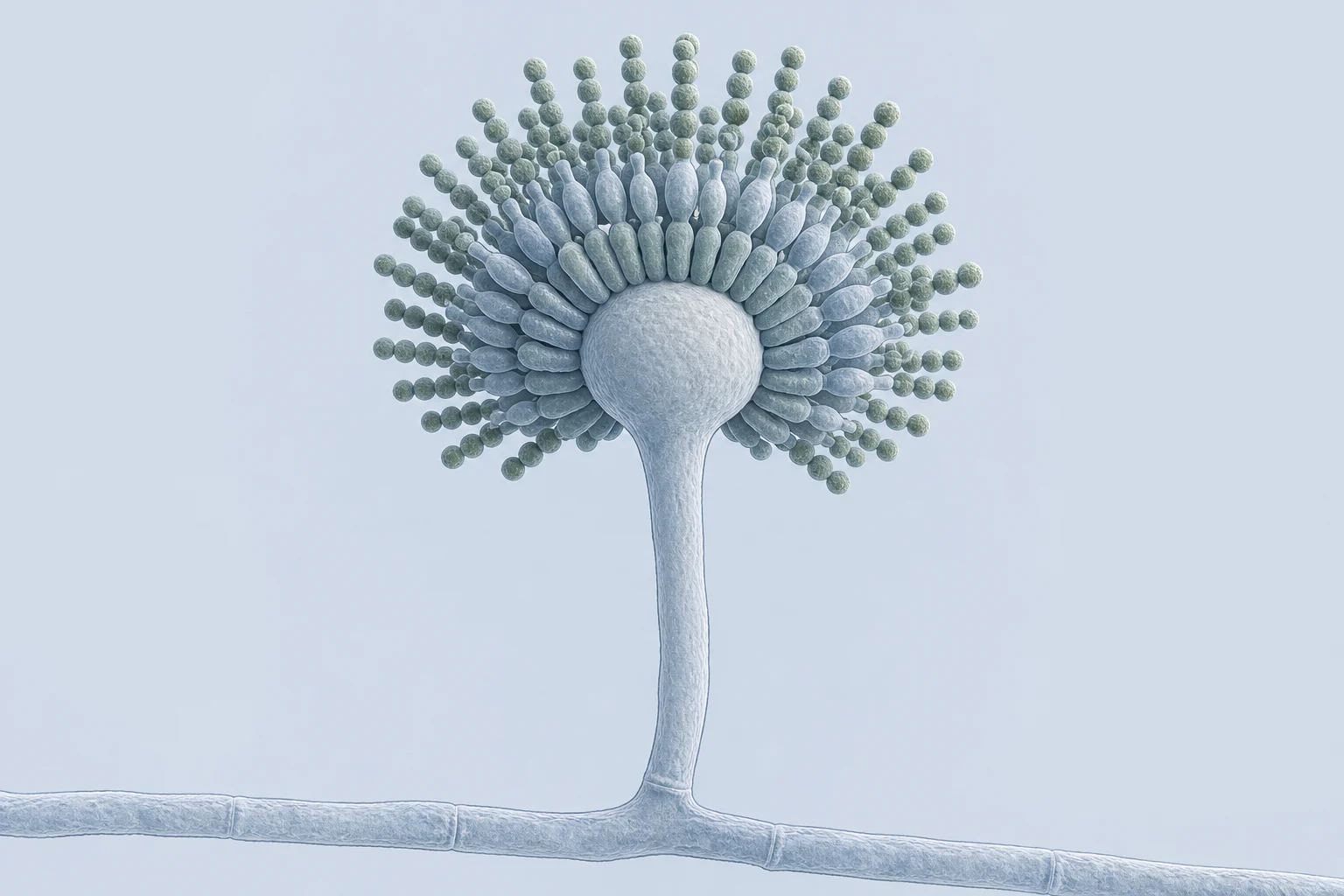
Representative biseriate Aspergillus conidial-head morphology. Vesicle shape, phialide arrangement, and conidial form vary across species; this reconstruction is genus-level and not diagnostic.
Scientific media record1 verified identifier
- Subject
- Aspergillustaxon · genus
- Identifiers
- NCBITaxon:5052
- Review
- Editorial review completeIdentifiers authority-verified · Accessibility validated · · aspergillus|aspergillus-morphology-v1.webp
- Digital source
- Trained-algorithmic mediaCreated with a trained generative algorithm and reviewed by WikiBiome for subject identity, scientific framing, identifiers, provenance, and accessibility.
- Scientific basis
- Aspergillus — NCBI TaxonomyAspergillus conidial-head morphologyAspergillus species-level morphological variation
- License
- CC BY-SA 4.0Created
A ubiquitous filamentous fungal genus that is both an environmental saprophyte and an opportunistic human pathogen. A. fumigatus is the primary cause of invasive aspergillosis in immunocompromised patients, while A. niger is relevant to food contamination.
The genus is strongly iron-dependent, producing multiple siderophores that serve as both virulence factors and emerging diagnostic biomarkers through the infection-metallomics framework.
Evidence map11 cited passagesInspect provenance +
Aspergillus species produce three major siderophore types for iron acquisition: - TAFC (triacetylfusarinine C)—extracellular siderophore secreted to scavenge environmental iron; detectable in serum and urine as a biomarker of invasive aspergillosis. - Ferricrocin—intracellular siderophore used for iron storage and distribution within hyphae. - Coprogen
TAFC is detected in urine within 4.5 hours of inoculation in animal models, making it a faster diagnostic marker than galactomannan (the current clinical standard).
Elevated Aspergillus abundance in the gut mycobiome is reported in multiple sclerosis, where patients show higher fungal alpha diversity and increased Aspergillus alongside Saccharomyces.
In the cancer mycobiome, Aspergillus species are detected in tumor tissues and may contribute to the tumor microenvironment through mycotoxin production and immune modulation.
Primarily affects immunocompromised patients: post-transplant, chemotherapy, prolonged corticosteroids, and critically ill ICU patients.
COVID-19-associated pulmonary aspergillosis (CAPA) emerged as a significant complication, with 19.4% mortality in critically ill patients.
Diagnosis via siderophore detection (TAFC in serum/urine by LC-MS) represents a paradigm shift from culture-based methods to infection-metallomics-based approaches.
Anti-Aspergillus antibodies detected in CSF of MS patients, suggesting CNS fungal exposure may contribute to neuroinflammation.
Elevated Aspergillus abundance in the gut mycobiome of MS patients alongside fungal alpha diversity increases.
Altered Aspergillus abundance reported in IBD and colorectal cancer mycobiome studies, though its role is less established than candida albicans.
Gut mycobiome alterations including Aspergillus shifts reported in cardiometabolic conditions, potentially mediated through fungal metabolite effects on host lipid metabolism.
Contents
1. Iron Dependency and Siderophores2. Role in the Mycobiome3. Disease Associations4. Key Metabolites5. ConnectionsIron Dependency and Siderophores#
Aspergillus species produce three major siderophore types for Iron acquisition.
TAFC (triacetylfusarinine C)—extracellular siderophore secreted to scavenge environmental iron; detectable in serum and urine as a biomarker of invasive aspergillosis.[1]Infection metallomics for critical care in the post-COVID eraPatil RH, Luptakova D, Havlicek V · 2021Open reference 1 ↓
Ferricrocin—intracellular siderophore used for iron storage and distribution within hyphae. Coprogen—additional extracellular siderophore contributing to iron piracy from the host.
TAFC is detected in urine within 4.5 hours of inoculation in animal models, making it a faster diagnostic marker than galactomannan (the current clinical standard).[1]Infection metallomics for critical care in the post-COVID eraPatil RH, Luptakova D, Havlicek V · 2021Open reference 1 ↓
Iron acquisition is essential for virulence: siderophore-deficient A. fumigatus mutants show dramatically attenuated pathogenicity, connecting iron availability directly to infection outcome. The host counters fungal iron piracy through Nutritional Immunity (Metal Sequestration) mechanisms including Lactoferrin and transferrin sequestration.
Role in the Mycobiome#
Part of the normal gut and respiratory mycobiome at low abundance; becomes pathogenic under immunosuppression.
Elevated Aspergillus abundance in the gut mycobiome is reported in Multiple Sclerosis, where patients show higher fungal alpha diversity and increased Aspergillus alongside Saccharomyces.[2]The Microbiome-Gut-Brain Axis in Multiple SclerosisDusan Radojevic, Svetlana Sokovic Bajic, Miroslav Dinic et al. · 2023Open reference 2 ↓
In the cancer mycobiome, Aspergillus species are detected in tumor tissues and may contribute to the tumor microenvironment through mycotoxin production and immune modulation.[3]The mycobiome in human cancer: analytical challenges, molecular mechanisms, and therapeutic implicationsTing Ding, Chang Liu, Zhengyu Li · 2025Open reference 3 ↓
Disease Associations#
Invasive Aspergillosis#
Primarily affects immunocompromised patients: post-transplant, chemotherapy, prolonged corticosteroids, and critically ill ICU patients.[1]Infection metallomics for critical care in the post-COVID eraPatil RH, Luptakova D, Havlicek V · 2021Open reference 1 ↓
COVID-19-associated pulmonary aspergillosis (CAPA) emerged as a significant complication, with 19.4% mortality in critically ill patients.[1]Infection metallomics for critical care in the post-COVID eraPatil RH, Luptakova D, Havlicek V · 2021Open reference 1 ↓[4]Patil 2021 — Infection Metallomics in the COVID EraPatil, A., Gholap et al. · 2021Open reference 4 ↓
Diagnosis via siderophore detection (TAFC in serum/urine by LC-MS) represents a paradigm shift from culture-based methods to infection-metallomics-based approaches.[1]Infection metallomics for critical care in the post-COVID eraPatil RH, Luptakova D, Havlicek V · 2021Open reference 1 ↓
Neurological Disease#
Anti-Aspergillus antibodies detected in CSF of MS patients, suggesting CNS fungal exposure may contribute to neuroinflammation.[5]A Fungal World: Could the Gut Mycobiome Be Involved in Neurological Disease?Jessica D. Forbes, Charles N. Bernstein, Helen Tremlett et al. · 2019Open reference 5 ↓ Elevated Aspergillus abundance in the gut mycobiome of MS patients alongside fungal alpha diversity increases.[2]The Microbiome-Gut-Brain Axis in Multiple SclerosisDusan Radojevic, Svetlana Sokovic Bajic, Miroslav Dinic et al. · 2023Open reference 2 ↓
Inflammatory Bowel Disease and CRC#
- Altered Aspergillus abundance reported in IBD and Colorectal Cancer mycobiome studies, though its role is less established than Candida albicans.[6]Unveiling the overlooked fungi: the vital of gut fungi in inflammatory bowel disease and colorectal cancerYilin Huang, Yang Wang, Xiaotian Huang et al. · 2024Open reference 6 ↓
Cardiometabolic Disease#
- Gut mycobiome alterations including Aspergillus shifts reported in cardiometabolic conditions, potentially mediated through fungal metabolite effects on host lipid metabolism.[7]Gut mycobiome in cardiometabolic disease progression: current evidence and future directionsXiaoyu Wei, Zixin Guo, Jingyang Wang et al. · 2025Open reference 7 ↓
Key Metabolites#
TAFC / ferricrocin / coprogen—iron-chelating siderophores; diagnostic biomarkers. Gliotoxin—immunosuppressive mycotoxin produced by A. fumigatus; inhibits NF-kB and induces apoptosis in immune cells. Aflatoxins—carcinogenic mycotoxins produced primarily by A. flavus and A. parasiticus.
Connections#
- Iron—essential growth requirement; siderophore-mediated acquisition is the primary virulence mechanism
- Nutritional Immunity (Metal Sequestration)—host iron restriction as defense against invasive aspergillosis
- Multiple Sclerosis—elevated in MS gut mycobiome; anti-Aspergillus CSF antibodies
- Colorectal Cancer—detected in tumor mycobiome
- Candida albicans—co-member of the gut mycobiome; both fungi expand under Dysbiosis
- Metal-Driven Inflammation—gliotoxin suppresses immune function; TAFC-mediated iron piracy triggers inflammatory responses
- Copper—copper (Cu)-dependent host defense mechanisms oppose fungal growth
- Staphylococcus aureus—both compete for iron in polymicrobial infections using distinct siderophore systems
References 7
Numbered by first appearance in the article, then reconciled with its declared source list.
- 1
★Patil RH, Luptakova D, Havlicek V (2021). Infection metallomics for critical care in the post-COVID era. Mass Spectrometry Reviews.
- 2
Dusan Radojevic, Svetlana Sokovic Bajic, Miroslav Dinic et al. (2023). The Microbiome-Gut-Brain Axis in Multiple Sclerosis. Arhiv za farmaciju.
- 3
Ting Ding, Chang Liu, Zhengyu Li (2025). The mycobiome in human cancer: analytical challenges, molecular mechanisms, and therapeutic implications. Molecular Cancer.
- 4
Patil, A., Gholap et al. (2021). Patil 2021 — Infection Metallomics in the COVID Era. Mass Spectrometry Reviews.
- 5
Jessica D. Forbes, Charles N. Bernstein, Helen Tremlett et al. (2019). A Fungal World: Could the Gut Mycobiome Be Involved in Neurological Disease?. Frontiers in Microbiology.
- 6
Yilin Huang, Yang Wang, Xiaotian Huang et al. (2024). Unveiling the overlooked fungi: the vital of gut fungi in inflammatory bowel disease and colorectal cancer. Gut Pathogens.
- 7
Xiaoyu Wei, Zixin Guo, Jingyang Wang et al. (2025). Gut mycobiome in cardiometabolic disease progression: current evidence and future directions. Frontiers in Microbiology.
Article network
Mentioned here 11
Pages linking here 9
Connect the evidence
Publicly readable discussion by ORCID-authenticated researchers. Questions, interpretation, methods, corrections, and new evidence stay attached to this record.
No discussion yet. Start with a precise question or a source-backed observation.
Activity and accepted changes
Accepted researcher context, editorial status, public discussion, and upstream Git revisions are shown together. Pending, declined, and withdrawn proposals remain private.
- published revision
Complete corpus-wide Dysbiosis linking
Karen Pendergrass · +1 −1
Inspect exact Git diff ↗ - published revision
massive wiki expansion: 149 stubs fixed, 100+ new pages, Rule 15 scan, keystone papers
WikiBiome Deploy Bot · +8 −8
Inspect exact Git diff ↗ - published revision
ingest: 87 papers (17 endometriosis, 67 erectile dysfunction, 3 cross-condition)
WikiBiome Deploy Bot · +2 −2
Inspect exact Git diff ↗ - published revision
nightly maintenance: 94 stub demotions, 181 source_count fixes, 22 auto-discovered stubs, 5 adversarial audits, 3 boundary fixes, 3 evidence-level corrections
WikiBiome Deploy Bot · +1 −0
Inspect exact Git diff ↗ - published revision
Add 11 deepened microbe entities and 9 new OC/CVD/infertility source pages
WikiBiome Deploy Bot · +5 −4
Inspect exact Git diff ↗ - published revision
WikiBiome update — 2026-04-15 17:23
WikiBiome Deploy Bot · +3 −3
Inspect exact Git diff ↗ - published revision
wiki: bulk entity upgrades, new article pages, and site regeneration
WikiBiome Deploy Bot · +6 −0
Inspect exact Git diff ↗ - published revision
WikiBiome update — integrity fixes, metallomic diet pages, cross-condition analyses
WikiBiome Deploy Bot · +12 −10
Inspect exact Git diff ↗ - published revision
WikiBiome update — 2026-04-10 13:49
WikiBiome Deploy Bot · +63 −0
Inspect exact Git diff ↗