

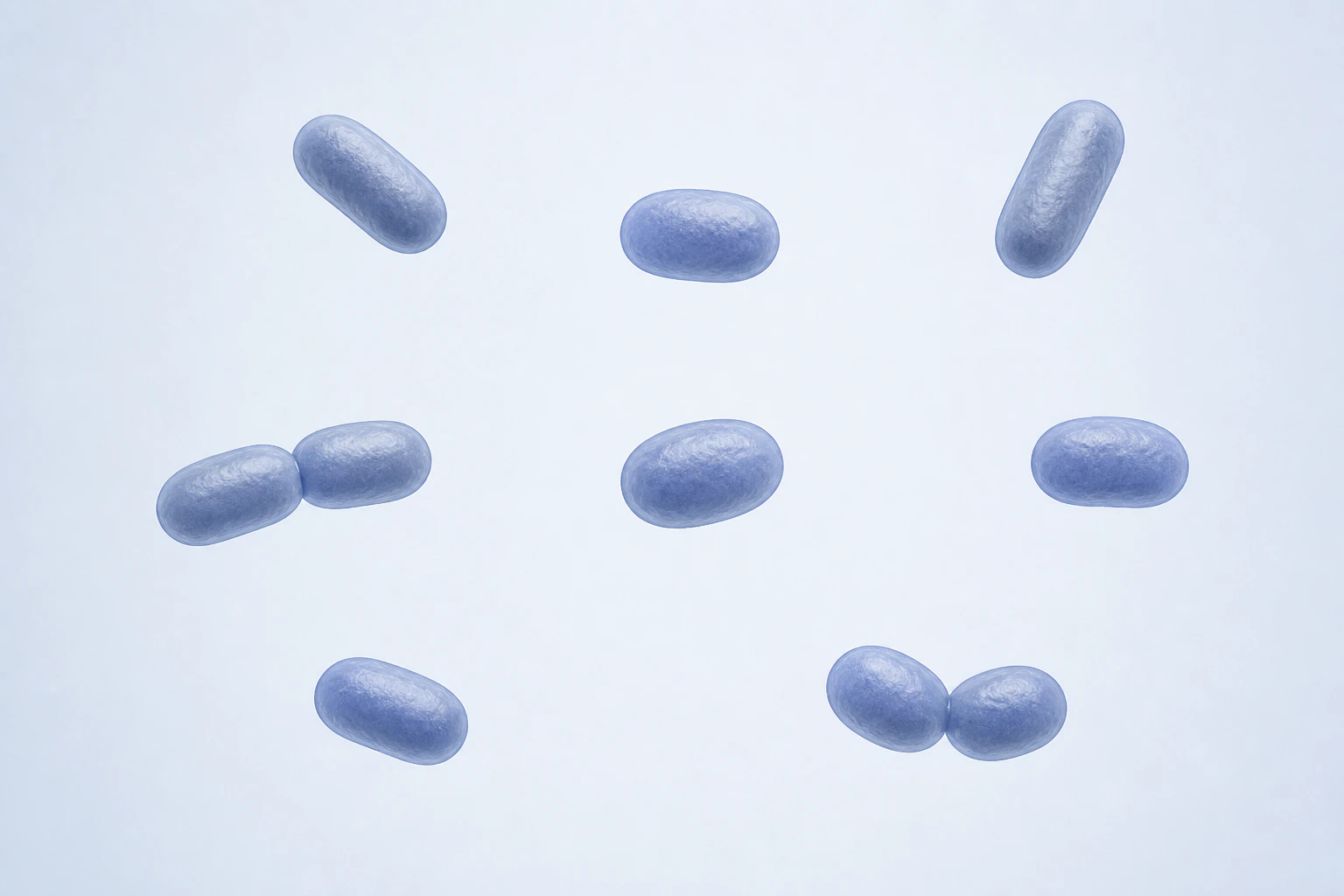
Representative G. vaginalis pleomorphic short rods and coccobacilli, shown as ten bodies in six single and two paired groupings. The current route retains its evolving nomenclatural boundary; this reconstruction does not imply visual separation from other Gardnerella species or diagnosis and is not a micrograph.
Scientific media record1 verified identifier
- Subject
- Gardnerella vaginalistaxon · species
- Identifiers
- NCBITaxon:2702
- Review
- Editorial review completeIdentifiers authority-verified · Accessibility validated · · gardnerella-vaginalis|gardnerella-vaginalis-morphology-v1.webp
- Digital source
- Trained-algorithmic mediaCreated with a trained generative algorithm and reviewed by WikiBiome for subject identity, scientific framing, identifiers, provenance, and accessibility.
- Scientific basis
- Gardnerella vaginalis — NCBI TaxonomyGardnerella vaginalis — LPSNGardnerella gen. nov.Emended description of Gardnerella vaginalisGardnerella vaginalis morphology study
- License
- CC BY-SA 4.0Created
See also the genus page: Gardnerella
Gardnerella vaginalis is the primary causative agent of bacterial vaginosis (BV), the most common vaginal infection worldwide. This species page focuses on the species-level biology—particularly the vaginolysin cytotoxin and biofilm architecture—that distinguish G. vaginalis from the broader genus.
Evidence map8 cited passagesInspect provenance +
VLY expression is iron-regulated—iron availability modulates vaginolysin production, connecting Gardnerella virulence to the mucosal iron landscape controlled by lactoferrin.
Statin repurposing: Because VLY requires membrane cholesterol for binding, statins (which deplete membrane cholesterol) can reduce vaginolysin cytotoxicity. Simvastatin at sub-antimicrobial doses significantly reduces G. vaginalis biofilm virulence in vitro. This is a Cureva-relevant drug repurposing lead.
BV: The defining organism—clue cells (vaginal epithelial cells coated with G. vaginalis) are a diagnostic criterion.
HPV persistence: G. vaginalis-dominant vaginal microbiomes associated with HPV16 persistence.
Preterm birth: BV and G. vaginalis abundance associated with preterm birth risk.
Male infertility: Detected in semen; associated with impaired sperm quality.
Prostatitis: Part of the prostatitis-associated urogenital microbiome.
PCOS: Part of PCOS-associated vaginal microbiome shifts.
Contents
1. Vaginolysin—An Iron-Regulated Toxin2. Biofilm Architecture3. Disease Associations4. Cross-ReferencesVaginolysin—An Iron-Regulated Toxin#
Vaginolysin (VLY) is a cholesterol-dependent cytolysin (CDC) that is G. vaginalis's primary virulence factor. VLY forms pores in human vaginal epithelial cells by binding to the cholesterol-rich membrane complement regulatory molecule CD59.
VLY expression is iron-regulated—iron availability modulates vaginolysin production, connecting Gardnerella virulence to the mucosal iron landscape controlled by Lactoferrin.[1]Roberts 2019 — Mucosal Lactoferrin Response to Genital Tract Infections Is Associated with Iron and Nutritional BiomarkersS. A. Roberts, L. Brabin, S. Diallo et al. · 2019Open reference 1 ↓
Statin repurposing: Because VLY requires membrane cholesterol for binding, statins (which deplete membrane cholesterol) can reduce vaginolysin cytotoxicity. Simvastatin at sub-antimicrobial doses significantly reduces G. vaginalis biofilm virulence in vitro.[2]Abdelmaksoud 2017 — Association between Statin Use, the Vaginal Microbiome, and Gardnerella vaginalis Vaginolysin-Mediated CytotoxicityAbdelmaksoud AA, Girerd PH, Garcia EM et al. · 2017Open reference 2 ↓ This is a Cureva-relevant drug repurposing lead.
Biofilm Architecture#
G. vaginalis initiates the polymicrobial biofilm that defines BV:
- G. vaginalis adheres to vaginal epithelial cells and forms the initial biofilm scaffold.
- Atopobium (A. vaginae) embeds within the Gardnerella biofilm, becoming protected from metronidazole.
- Sneathia, Megasphaera, and Prevotella colonize the biofilm surface.
This biofilm architecture explains BV recurrence: metronidazole kills planktonic bacteria but the biofilm persists, enabling rapid recolonization.
Disease Associations#
BV: The defining organism—clue cells (vaginal epithelial cells coated with G. vaginalis) are a diagnostic criterion.[3]Ughade 2024 — Navigating the Microbial Landscape: Understanding Dysbiosis in Human Genital Tracts and Its Impact on FertilityPrachi A. Ughade, Deepti Shrivastava, Kamlesh Chaudhari · 2024Open reference 3 ↓
HPV persistence: G. vaginalis-dominant vaginal microbiomes associated with HPV16 persistence.[4]Yang 2020 — Vaginal Microbiome Alterations in HPV16 Infection by Shotgun MetagenomicsQian Yang, Yaping Wang, Xinyi Wei et al. · 2020Open reference 4 ↓ Preterm birth: BV and G. vaginalis abundance associated with preterm birth risk.[5]Pruski & Correia 2021 — Direct On-Swab Metabolic Profiling of Vaginal Microbiome Host Interactions During Pregnancy and Preterm BirthPamela Pruski, Gonçalo D. S. Correia, Holly V. Lewis et al. · 2021Open reference 5 ↓
Male infertility: Detected in semen; associated with impaired sperm quality.[6]Magill 2023 — Male Infertility and the Human MicrobiomeMagill RG, MacDonald SM · 2023Open reference 6 ↓ Prostatitis: Part of the prostatitis-associated urogenital microbiome.[7]Magri 2018 — Multidisciplinary Approach to ProstatitisVittorio Magri, Matteo Boltri, Tommaso Cai et al. · 2018Open reference 7 ↓ PCOS: Part of PCOS-associated vaginal microbiome shifts.[8]Zheng 2024 — Differential enrichment of bacteria and phages in vaginal microbiomes in PCOS and obesity: shotgun sequencing analysisZheng S, Chen H, Yang H et al. · 2024Open reference 8 ↓
Endometriosis: Depleted in cervical samples (see genus page Gardnerella).
Cross-References#
- Gardnerella—genus page with broader ecological context
- Atopobium—biofilm partner
- vaginolysin—primary cytotoxin
- Lactoferrin—mucosal iron regulation affecting VLY expression
- Iron—iron-regulated virulence
- Lactobacillus crispatus—protective competitor
References 10
Numbered by first appearance in the article, then reconciled with its declared source list.
- 1
S. A. Roberts, L. Brabin, S. Diallo et al. (2019). Roberts 2019 — Mucosal Lactoferrin Response to Genital Tract Infections Is Associated with Iron and Nutritional Biomarkers. European Journal of Clinical Nutrition.
- 2
Abdelmaksoud AA, Girerd PH, Garcia EM et al. (2017). Abdelmaksoud 2017 — Association between Statin Use, the Vaginal Microbiome, and Gardnerella vaginalis Vaginolysin-Mediated Cytotoxicity. PLOS ONE.
- 3
Prachi A. Ughade, Deepti Shrivastava, Kamlesh Chaudhari (2024). Ughade 2024 — Navigating the Microbial Landscape: Understanding Dysbiosis in Human Genital Tracts and Its Impact on Fertility. Cureus.
- 4
Qian Yang, Yaping Wang, Xinyi Wei et al. (2020). Yang 2020 — Vaginal Microbiome Alterations in HPV16 Infection by Shotgun Metagenomics. Frontiers in Cellular and Infection Microbiology.
- 5
Pamela Pruski, Gonçalo D. S. Correia, Holly V. Lewis et al. (2021). Pruski & Correia 2021 — Direct On-Swab Metabolic Profiling of Vaginal Microbiome Host Interactions During Pregnancy and Preterm Birth. Nature Communications.
- 6
Magill RG, MacDonald SM (2023). Magill 2023 — Male Infertility and the Human Microbiome. Frontiers in Reproductive Health.
- 7
Vittorio Magri, Matteo Boltri, Tommaso Cai et al. (2018). Magri 2018 — Multidisciplinary Approach to Prostatitis. Archivio Italiano di Urologia e Andrologia.
- 8
Zheng S, Chen H, Yang H et al. (2024). Zheng 2024 — Differential enrichment of bacteria and phages in vaginal microbiomes in PCOS and obesity: shotgun sequencing analysis. Frontiers in Microbiomes.
- 9
John MacSharry, Zsuzsanna Kovacs, Yongjing Xie et al. (2024). MacSharry 2024 — Endometriosis Specific Vaginal Microbiota Links to Urine and Serum N-Glycome. Scientific Reports.
- 10
Georgina Quaranta, Mauro Pittiruti, Brunella Posteraro et al. (2019). Quaranta 2019 — FMT as a Potential Tool for Female Reproductive Tract Diseases (Review). Frontiers in Immunology.
Article network
Mentioned here 8
Pages linking here 1
Connect the evidence
Publicly readable discussion by ORCID-authenticated researchers. Questions, interpretation, methods, corrections, and new evidence stay attached to this record.
No discussion yet. Start with a precise question or a source-backed observation.
Activity and accepted changes
Accepted researcher context, editorial status, public discussion, and upstream Git revisions are shown together. Pending, declined, and withdrawn proposals remain private.
- published revision
massive wiki expansion: 149 stubs fixed, 100+ new pages, Rule 15 scan, keystone papers
WikiBiome Deploy Bot · +74 −0
Inspect exact Git diff ↗