

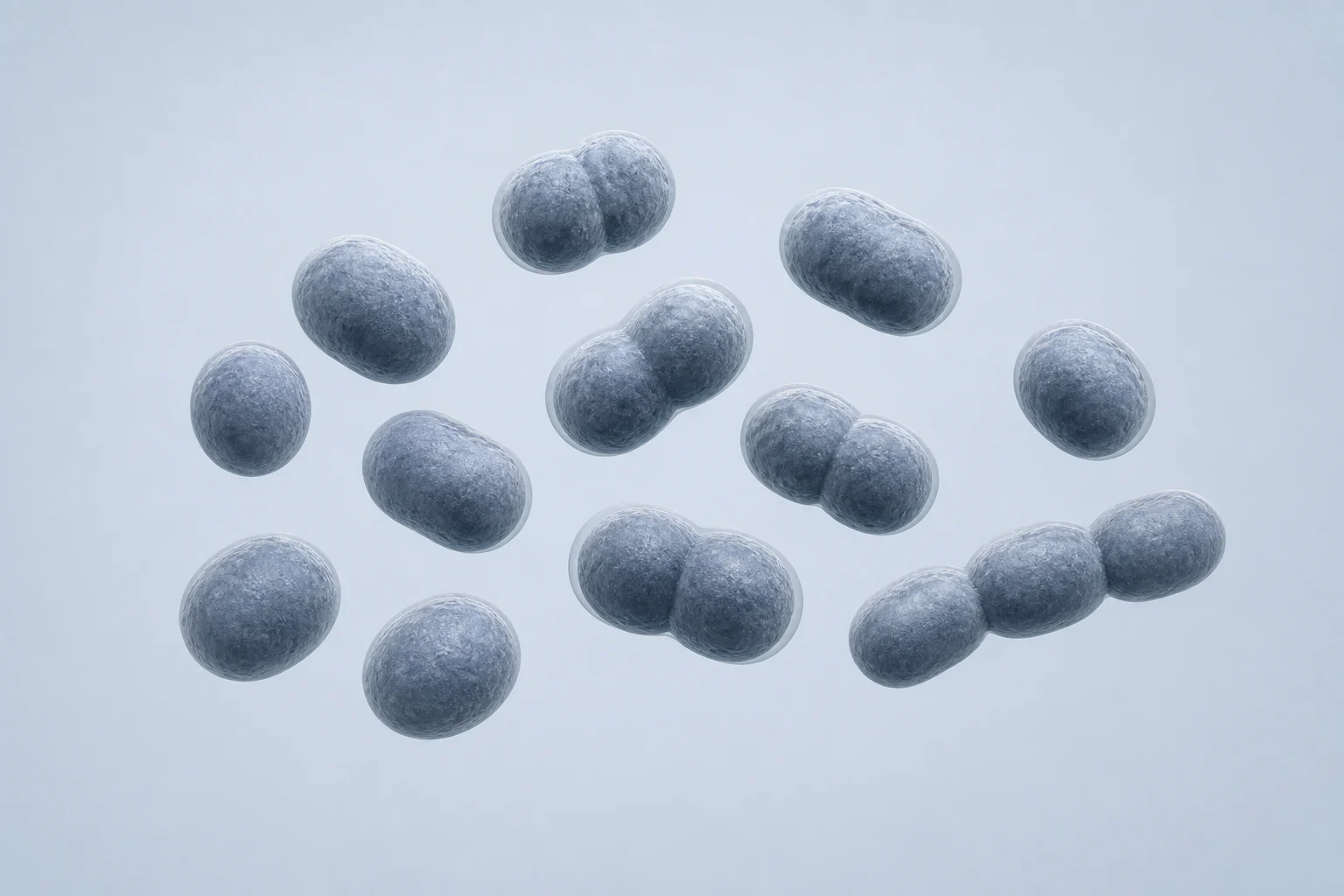
Representative Acinetobacter pleomorphism, ranging from short rods during active growth toward coccobacillary forms in stationary phase. The genus is nonmotile; this reconstruction intentionally shows no flagella.
Scientific media record1 verified identifier
- Subject
- Acinetobactertaxon · genus
- Identifiers
- NCBITaxon:469
- Review
- Editorial review completeIdentifiers authority-verified · Accessibility validated · · acinetobacter|acinetobacter-morphology-v1.webp
- Digital source
- Trained-algorithmic mediaCreated with a trained generative algorithm and reviewed by WikiBiome for subject identity, scientific framing, identifiers, provenance, and accessibility.
- Scientific basis
- Acinetobacter — NCBI TaxonomyAcinetobacter spp. as nosocomial pathogens: Epidemiology and resistance features
- License
- CC BY-SA 4.0Created
A Gram-negative, aerobic, non-fermenting coccobacillus and a member of the ESKAPE group of priority pathogens (Enterococcus, Staphylococcus, Klebsiella, Acinetobacter, Pseudomonas, Enterobacter). Acinetobacter baumannii is among the most problematic nosocomial pathogens worldwide, designated WHO Priority 1: Critical for antibiotic resistance.
Its ability to persist in hospital environments stems from a uniquely sophisticated integration of metal homeostasis, metal resistance, and antibiotic tolerance—systems that are simultaneously vulnerabilities exploitable for new therapeutic strategies.
Evidence map12 cited passagesInspect provenance +
A. baumannii possesses a two-stage cadmium translocation pathway that is one of the best-characterized Cd efflux systems in Gram-negative bacteria:
A newly characterized zinc-dependent mechanism connects nutritional immunity to antibiotic susceptibility:
Efflux systems like CzcCBA export both metal ions and certain antimicrobials; heavy metal exposure selects for multi-drug resistant clones in hospital wastewater and environmental reservoirs.
These species-specific siderophore uptake systems are exploitable for Trojan horse antibiotic delivery—conjugating antibiotics to siderophore scaffolds allows bacterial self-import of otherwise poorly penetrating antibiotics.
Disrupting metal homeostasis to disarm virulence rather than kill bacteria is a promising paradigm that A. baumannii's metal biology has helped define.
Enriched in the gut microbiome of acute coronary syndrome patients post-STEMI compared to healthy controls. Its presence in the gut—despite being an aerobic organism that prefers environmental over gut niches—suggests translocation or metabolic product-mediated systemic inflammation in cardiovascular disease.
Serum metal levels in infants correlate with Acinetobacter abundance, suggesting that early-life metal exposure shapes initial colonization. Elevated heavy metal burden in infants may select for metal-resistant Acinetobacter strains in the developing gut microbiome.
Acinetobacter is enriched in necrotizing enterocolitis (NEC) gut microbiomes and in ASD children with GI symptoms, where it correlates positively with autism severity (CARS score).
—CzcE/CzcCBA quantitative characterization
—MigC zinc metallochaperone, calprotectin sensitivity
—siderophore Trojan horse and metal-chelation strategies
—gut enrichment in ACS
Contents
1. Classification and Ecology2. Metal Resistance Mechanisms3. Metal-Antibiotic Co-Resistance4. Siderophore-Based Iron Acquisition and Therapeutic Targeting5. Role in Disease6. Environmental Persistence7. What Wikipedia Doesn't Cover8. Cross-ReferencesClassification and Ecology#
The genus Acinetobacter contains ~50 named species. A. baumannii is the primary clinical pathogen; A. lwoffii, A. pittii, and A. nosocomialis are also clinically significant. Acinetobacter species are ubiquitous in soil, water, and hospital environments.
Unlike many ESKAPE pathogens, A. baumannii is unusual in being a strict aerobe—a factor that limits its gut colonization potential but enhances its environmental persistence on dry surfaces.
Metal Resistance Mechanisms#
Cadmium Efflux System—CzcE/CzcCBA#
A. baumannii possesses a two-stage cadmium translocation pathway that is one of the best-characterized cadmium (Cd) efflux systems in Gram-negative bacteria.[1]The Molecular Basis of Acinetobacter baumannii Cadmium Toxicity and ResistanceAlquethamy SF, Adams FG, Maharjan R et al. · 2021Open reference 1 ↓
CzcE (CDF family transporter): exports Cadmium from cytoplasm to periplasm. Loss of CzcE renders the bacterium 30-fold more sensitive to cadmium, with 8-fold higher intracellular cadmium accumulation.
CzcCBA (HME-RND efflux system): exports cadmium from periplasm to extracellular space, completing the efflux pathway. Also contributes to Zinc resistance and exports certain antibiotics.
CadR (MerR-type regulator): a highly attuned cadmium sensor that activates czcE expression with approximately 480-fold upregulation upon cadmium exposure—one of the most sensitive metal-responsive regulatory systems known.
The cadmium resistome involves at least 67 genes with significant fitness changes under cadmium stress, indicating the breadth of the cellular response extends well beyond the efflux pump itself.
Cross-Metal Toxicity Cascade#
Cadmium exposure in A. baumannii causes cascading disruption of the cellular metallome. Zinc depletion below detection limits at 15 µM cadmium (Cd), triggering zinc starvation responses (znuA upregulation). Copper hyperaccumulation, likely from compensatory upregulation of copper import (oprC). Iron levels remain unaffected, suggesting metal-specific vulnerability rather than global metal dysregulation.
This cross-metal toxicity pattern is a model system for understanding how single-metal exposure can dysregulate the entire metallome—a principle with direct relevance to Mis-Metallation and to how environmental heavy metal contamination amplifies pathogen virulence.
MigC—Zinc Metallochaperone for Cell Wall Biogenesis#
A newly characterized zinc-dependent mechanism connects nutritional immunity to antibiotic susceptibility.[2]Critchlow 2025 — The Zinc Metalloprotein MigC Impacts Cell Wall Biogenesis Through Interactions with MurD in Acinetobacter baumanniiJeanette M. Critchlow, Joseph S. Rocchio, Melanie C. McKell et al. · 2025Open reference 2 ↓ MigC (A1S_0934) is a COG0523-family zinc-binding GTPase metallochaperone that interacts with and inhibits MurD, an essential Mur ligase required for peptidoglycan (cell wall) biosynthesis.
zinc (Zn)-MigC inhibits MurD with Ki = 32 ± 6 µM (noncompetitive/allosteric), creating a zinc-dependent regulatory switch on cell wall synthesis. MigC binds zinc with extremely high affinity (KZn₁ = 7.0 × 10¹⁰ M⁻¹), increasing ~40-fold with GTP bound.
When the host deploys calprotectin (the primary Nutritional Immunity (Metal Sequestration) zinc-chelating protein), zinc sequestration triggers loss of MigC function → elongated bacterial morphology, thinner peptidoglycan, increased HADA incorporation.
delta-migC cells are sensitized to ceftriaxone (beta-lactam), revealing that zinc starvation through nutritional immunity creates a window of enhanced antibiotic susceptibility. The delta-migC mutant shows reduced lung and heart colonization in murine pneumonia models, confirming in vivo relevance.
This finding establishes a direct mechanistic link between host zinc-sequestration and enhanced antibiotic killing—a potential basis for combination therapy strategies.
Metal-Antibiotic Co-Resistance#
The co-occurrence of metal resistance and antibiotic resistance genes on mobile genetic elements is a defining concern for Acinetobacter in clinical settings.
Efflux systems like CzcCBA export both metal ions and certain antimicrobials; heavy metal exposure selects for multi-drug resistant clones in hospital wastewater and environmental reservoirs.[3]Diversity of metal and antibiotic resistance genes in Enterococcus spp. from the last century reflects multiple pollution and genetic exchange among phyla from overlapping ecosystemsRebelo A, Mourao J, Freitas AR et al. · 2021Open reference 3 ↓
Metal resistance genes (cadmium (Cd), zinc (Zn), copper (Cu), mercury (Hg)) are frequently co-located with carbapenem resistance determinants on integrons and conjugative plasmids, enabling environmental metal selection to maintain antibiotic resistance.
This has direct public health relevance: agricultural and industrial zinc/copper use can maintain populations of carbapenem-resistant A. baumannii in environmental reservoirs even in the absence of antibiotic selection pressure.
Siderophore-Based Iron Acquisition and Therapeutic Targeting#
A. baumannii produces acinetobactin and baumannoferrin siderophores for iron acquisition under iron-limiting conditions. These species-specific siderophore uptake systems are exploitable for Trojan horse antibiotic delivery—conjugating antibiotics to siderophore scaffolds allows bacterial self-import of otherwise poorly penetrating antibiotics.[4]Golden et al. 2024 — Metal Chelation as Antibacterial Strategy Against Pseudomonas and AcinetobacterGolden, M., et al. · 2024Open reference 4 ↓
Competitive iron deprivation via chelators that outcompete acinetobactin offers a virulence-disarmament strategy distinct from conventional bactericidal approaches, with reduced resistance selection pressure.
Disrupting metal homeostasis to disarm virulence rather than kill bacteria is a promising paradigm that A. baumannii's metal biology has helped define.[4]Golden et al. 2024 — Metal Chelation as Antibacterial Strategy Against Pseudomonas and AcinetobacterGolden, M., et al. · 2024Open reference 4 ↓
Role in Disease#
Nosocomial Infections#
The primary clinical burden: ventilator-associated pneumonia (VAP), catheter-associated bloodstream infections (CLABSI), wound infections, and urinary tract infections—predominantly in ICU patients. Carbapenem-resistant A. baumannii (CRAB) is a WHO Priority 1 pathogen with limited treatment options.
Cardiovascular Associations#
Enriched in the Gut Microbiome of acute coronary syndrome patients post-STEMI compared to healthy controls.[5]Gut microbial taxa as potential predictive biomarkers for acute coronary syndrome and post-STEMI cardiovascular eventsJing Gao, Kun-Tao Yan, Ji-Xiang Wang et al. · 2020Open reference 5 ↓
Its presence in the gut—despite being an aerobic organism that prefers environmental over gut niches—suggests translocation or metabolic product-mediated systemic Metal-Driven Inflammation in cardiovascular disease.
Infant Gut and Metal Exposure#
Serum metal levels in infants correlate with Acinetobacter abundance, suggesting that early-life metal exposure shapes initial colonization.[6]Association between infants' serum levels of 26 metals and gut microbiota: a hospital-based cross-sectional study in ChinaYan X, Qiu J, Huang RW et al. · 2025Open reference 6 ↓ Elevated heavy metal burden in infants may select for metal-resistant Acinetobacter strains in the developing gut microbiome.
Neonatal Conditions and ASD#
Acinetobacter is enriched in necrotizing enterocolitis (NEC) gut microbiomes and in ASD children with GI symptoms, where it correlates positively with autism severity (CARS score).[7]Wang 2023 — Gut Microbiota Signature in Children with ASD Who Suffered from Chronic Gastrointestinal SymptomsHui Wang, Shu Liu, Liqing Xie et al. · 2023Open reference 7 ↓
Environmental Persistence#
A. baumannii survives on dry hospital surfaces for weeks to months—far longer than most Gram-negative pathogens—owing to. Desiccation tolerance mechanisms linked to biofilm formation. Metal efflux capacity enabling survival in zinc/copper-enriched disinfection environments.
Genetic plasticity via natural competence for transformation, allowing rapid acquisition of resistance genes.
What Wikipedia Doesn't Cover#
Wikipedia's Acinetobacter coverage focuses on antibiotic resistance and nosocomial infections.
This page adds: the quantified CzcE/CzcCBA cadmium efflux pathway with 30-fold sensitivity and 480-fold regulatory induction data; MigC zinc metallochaperone as a calprotectin-responsive cell wall regulator that creates antibiotic susceptibility windows; the cross-metal toxicity cascade from single-metal cadmium (Cd) exposure; and the mechanistic basis for metal-antibiotic co-resistance via mobile genetic elements.
Cross-References#
Cadmium—CzcE/CzcCBA is one of the best-characterized cadmium (Cd) efflux systems in Gram-negatives. Zinc—MigC metallochaperone; zinc (Zn) depletion sensitizes to beta-lactams; CzcCBA zinc resistance. Nutritional Immunity (Metal Sequestration)—calprotectin-mediated zinc starvation activates MigC pathway; cadmium-induced zinc depletion mimics host strategy.
Mis-Metallation—cadmium-induced cross-metal toxicity; manganese (Mn) mis-metallation of MurD disrupts peptidoglycan. Metal Homeostasis—demonstrates cross-metal toxicity cascades from single-metal exposure. Pseudomonas aeruginosa—shares siderophore-based metal acquisition strategies; co-target for metal-chelation therapeutics.
Antimicrobial Resistance—carbapenem-resistant A. baumannii is WHO Priority 1 critical pathogen. Cardiovascular Disease—enriched in ACS gut microbiome profiles. Iron—acinetobactin/baumannoferrin siderophores; Trojan horse delivery target.
References 9
Numbered by first appearance in the article, then reconciled with its declared source list.
- 1
Alquethamy SF, Adams FG, Maharjan R et al. (2021). The Molecular Basis of Acinetobacter baumannii Cadmium Toxicity and Resistance. Applied and Environmental Microbiology.
- 2
Jeanette M. Critchlow, Joseph S. Rocchio, Melanie C. McKell et al. (2025). Critchlow 2025 — The Zinc Metalloprotein MigC Impacts Cell Wall Biogenesis Through Interactions with MurD in Acinetobacter baumannii. PLOS Pathogens.
- 3
Rebelo A, Mourao J, Freitas AR et al. (2021). Diversity of metal and antibiotic resistance genes in Enterococcus spp. from the last century reflects multiple pollution and genetic exchange among phyla from overlapping ecosystems. Science of the Total Environment.
- 4
Golden, M., et al. (2024). Golden et al. 2024 — Metal Chelation as Antibacterial Strategy Against Pseudomonas and Acinetobacter. RSC Chemical Biology.
- 5
Jing Gao, Kun-Tao Yan, Ji-Xiang Wang et al. (2020). Gut microbial taxa as potential predictive biomarkers for acute coronary syndrome and post-STEMI cardiovascular events. Scientific Reports.
- 6
Yan X, Qiu J, Huang RW et al. (2025). Association between infants' serum levels of 26 metals and gut microbiota: a hospital-based cross-sectional study in China. Frontiers in Microbiology.
- 7
Hui Wang, Shu Liu, Liqing Xie et al. (2023). Wang 2023 — Gut Microbiota Signature in Children with ASD Who Suffered from Chronic Gastrointestinal Symptoms. BMC Pediatrics.
- 8
Braud A, Geoffroy V, Hoegy F et al. (2010). Presence of the siderophores pyoverdine and pyochelin in the extracellular medium reduces toxic metal accumulation in Pseudomonas aeruginosa and increases bacterial metal tolerance. Environmental Microbiology Reports.
- 9
Songqing Liu, Xin Deng, Zheng Li et al. (2023). Environmental cadmium exposure alters the internal microbiota and metabolome of Sprague-Dawley rats. Frontiers in Veterinary Science.
Article network
Mentioned here 12
Pages linking here 8
Connect the evidence
Publicly readable discussion by ORCID-authenticated researchers. Questions, interpretation, methods, corrections, and new evidence stay attached to this record.
No discussion yet. Start with a precise question or a source-backed observation.
Activity and accepted changes
Accepted researcher context, editorial status, public discussion, and upstream Git revisions are shown together. Pending, declined, and withdrawn proposals remain private.
- published revision
Backfill gut microbiome concept links
Karen Pendergrass · +1 −1
Inspect exact Git diff ↗ - published revision
Backfill inflammation concept links
Karen Pendergrass · +1 −1
Inspect exact Git diff ↗ - published revision
massive wiki expansion: 149 stubs fixed, 100+ new pages, Rule 15 scan, keystone papers
WikiBiome Deploy Bot · +14 −14
Inspect exact Git diff ↗ - published revision
Batch: fix 1025 broken wikilinks, wire 13 STOP pages, deepen PPD/GERD/T1D/8 microbes
WikiBiome Deploy Bot · +3 −3
Inspect exact Git diff ↗ - published revision
Deepen schizophrenia/CKD entities + 8 microbe entities; add 6 source pages
WikiBiome Deploy Bot · +88 −39
Inspect exact Git diff ↗ - published revision
WikiBiome update — 2026-04-15 17:23
WikiBiome Deploy Bot · +1 −2
Inspect exact Git diff ↗ - published revision
wiki: bulk entity upgrades, new article pages, and site regeneration
WikiBiome Deploy Bot · +6 −0
Inspect exact Git diff ↗ - published revision
WikiBiome v2 migration: signature pages + safety fixes + gap analysis
WikiBiome Deploy Bot · +2 −0
Inspect exact Git diff ↗ - published revision
WikiBiome update — integrity fixes, metallomic diet pages, cross-condition analyses
WikiBiome Deploy Bot · +14 −6
Inspect exact Git diff ↗ - published revision
WikiBiome update — 2026-04-10 13:49
WikiBiome Deploy Bot · +60 −0
Inspect exact Git diff ↗