

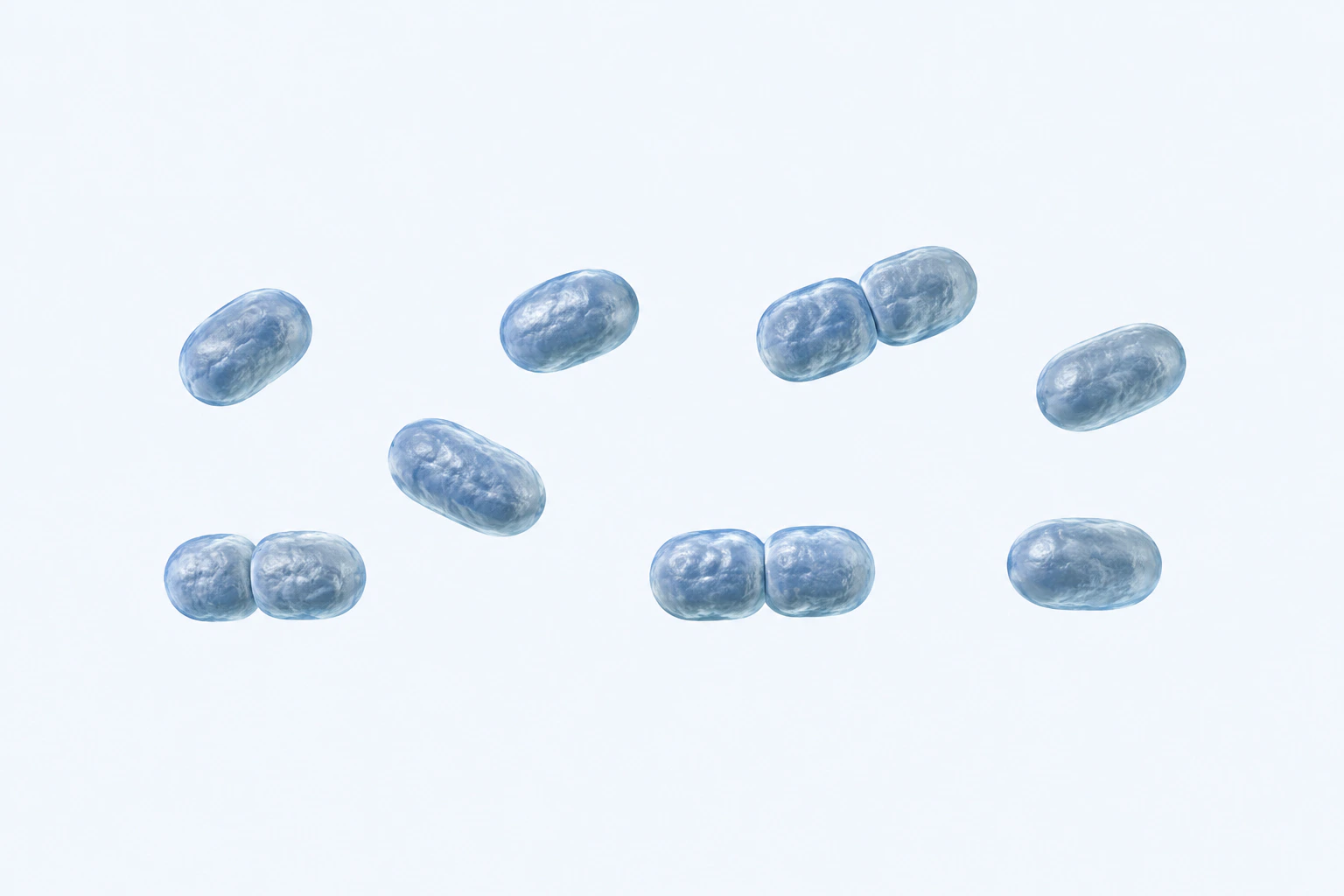
Type-species-anchored Porphyromonas reconstruction showing eleven short rod-to-coccobacillary bodies in five single and three paired groupings. This genus plate is representative, non-universal, non-diagnostic, and not a micrograph.
Scientific media record1 verified identifier
- Subject
- Porphyromonastaxon · genus
- Identifiers
- NCBITaxon:836
- Review
- Editorial review completeIdentifiers authority-verified · Accessibility validated · · porphyromonas|porphyromonas-morphology-v1.webp
- Digital source
- Trained-algorithmic mediaCreated with a trained generative algorithm and reviewed by WikiBiome for subject identity, scientific framing, identifiers, provenance, and accessibility.
- Scientific basis
- Porphyromonas — NCBI TaxonomyPorphyromonas — LPSNProposal for reclassification in the new genus Porphyromonas
- License
- CC BY-SA 4.0Created
A Gram-negative, obligate anaerobic genus with the keystone pathogen P. gingivalis at its center. Named for its porphyrin (heme) requirement, Porphyromonas is the prototypical periodontal pathogen and one of the most important organisms connecting oral health to systemic disease.
Its Zinc-dependent gingipain proteases and Iron-acquisition via hemin make it strongly metal-dependent, while its associations with Cardiovascular Disease, Alzheimer's Disease, and Colorectal Cancer position it at the nexus of the oral-gut-systemic disease axis.
Evidence map3 cited passagesInspect provenance +
P. gingivalis and gingipains detected in brain tissue of Alzheimer's patients, with gingipain levels correlating with tau and ubiquitin pathology.
Among the top consistently enriched genera in CRC across the Islam 2022 meta-analysis (found in 8 cancer studies), alongside fusobacterium and peptostreptococcus.
Significantly more abundant in the oral microbiota of MS patients compared to healthy controls.
Metal Dependencies#
Zinc—Gingipain Proteases#
P. gingivalis produces three major cysteine proteases collectively called gingipains: Arg-gingipain A (RgpA), Arg-gingipain B (RgpB), and Lys-gingipain (Kgp). Gingipains are zinc-dependent metalloproteinases that degrade host proteins including immunoglobulins, complement components, and cytokines, enabling immune evasion and tissue destruction.
These proteases also process and mature other virulence factors, making zinc availability critical for the full expression of P. gingivalis pathogenicity.
Iron—Hemin Acquisition#
Porphyromonas requires hemin (iron-protoporphyrin IX) as an essential growth factor—it cannot synthesize its own porphyrin ring. Acquires hemin from hemoglobin degradation using gingipain proteases that lyse erythrocytes and degrade hemoglobin at the gingival sulcus.
Stores hemin on its cell surface as a black pigment (mu-oxo bisheme), which also protects against Oxidative Stress—this pigmentation is the origin of the genus name.
Iron-limited conditions derepress virulence gene expression, increasing hemin acquisition and host tissue destruction.
Disease Associations#
Periodontal Disease#
P. gingivalis is a member of the "red complex" (with Treponema denticola and Tannerella forsythia), the most pathogenic consortium in chronic periodontitis. Acts as a keystone pathogen: even at low abundance, it restructures the entire oral microbial community from symbiotic to dysbiotic, amplifying Metal-Driven Inflammation.
Cardiovascular Disease and Atherosclerosis#
Strongly linked to Cardiovascular Disease and atherosclerosis. P. gingivalis DNA and viable organisms detected in atherosclerotic plaques. Gingipain proteases activate platelet aggregation and induce foam cell formation in macrophages.
Chronic periodontal infection maintains systemic inflammation (elevated CRP, IL-6) that promotes endothelial dysfunction and plaque instability.
Alzheimer's Disease#
P. gingivalis and gingipains detected in brain tissue of Alzheimer's patients, with gingipain levels correlating with tau and ubiquitin pathology.[1]Effects of gut microbiota on neurodegenerative diseasesKhatoon S, Kalam N, Rashid S et al. · 2023Open reference 1 ↓
Proposed mechanism: gingipains cleave tau protein and damage neurons; chronic oral infection provides ongoing bacterial seeding to the brain via bacteremia or neural routes.
The drug COR388 (atuzaginstat), a gingipain inhibitor, entered clinical trials for Alzheimer's.
Colorectal Cancer#
Among the top consistently enriched genera in CRC across the Islam 2022 meta-analysis (found in 8 cancer studies), alongside Fusobacterium and Peptostreptococcus.[2]Reproducible and opposing gut microbiome signatures distinguish autoimmune diseases and cancers: a systematic review and meta-analysisMd Zohorul Islam, Melissa Tran, Tao Xu et al. · 2022Open reference 2 ↓
Part of the oral-gut translocation story in CRC, where oral pathobionts colonize colorectal tumors.
Multiple Sclerosis#
- Significantly more abundant in the oral microbiota of MS patients compared to healthy controls.[3]Bacterial Variation in the Oral Microbiota in Multiple Sclerosis PatientsZangeneh Z, Abdi-Ali A, Khamooshian K et al. · 2021Open reference 3 ↓
Key Metabolites#
Gingipains (RgpA, RgpB, Kgp)—zinc (Zn)-dependent cysteine proteases; primary virulence factors. LPS—atypical lipopolysaccharide that modulates TLR4 and TLR2 signaling. Outer membrane vesicles—carry gingipains and LPS to distant sites; potential vehicle for brain colonization.
Connections#
- Zinc—gingipain proteases are zinc (Zn)-dependent metalloproteinases
- Iron—absolute requirement for hemin; iron limitation triggers virulence gene expression
- Cardiovascular Disease—detected in atherosclerotic plaques; drives systemic inflammation
- Alzheimer's Disease—gingipains detected in brain tissue; gingipain inhibitor in clinical trials
- Colorectal Cancer—enriched in CRC; oral-gut translocation pathway
- Multiple Sclerosis—enriched in oral microbiome of MS patients
- Peptostreptococcus—co-enriched in CRC; shared oral-gut translocation pathway
- Fusobacterium—fellow CRC-enriched oral pathobiont
- NF-kB Signaling Pathway—LPS and gingipains activate NF-kB inflammatory signaling
- Nutritional Immunity (Metal Sequestration)—host hemin restriction as defense; P. gingivalis overcomes via gingipain-mediated hemolysis
- inflammation—keystone pathogen driving chronic inflammation across multiple organ systems
References 6
Numbered by first appearance in the article, then reconciled with its declared source list.
- 1
Khatoon S, Kalam N, Rashid S et al. (2023). Effects of gut microbiota on neurodegenerative diseases. Frontiers in Aging Neuroscience.
- 2
Md Zohorul Islam, Melissa Tran, Tao Xu et al. (2022). Reproducible and opposing gut microbiome signatures distinguish autoimmune diseases and cancers: a systematic review and meta-analysis. Microbiome.
- 3
Zangeneh Z, Abdi-Ali A, Khamooshian K et al. (2021). Bacterial Variation in the Oral Microbiota in Multiple Sclerosis Patients. PLoS ONE.
- 4
Kudra A, Muszynski D, Sobocki BK et al. (2023). Insights into Oral Microbiome and Colorectal Cancer - On the Way of Searching New Perspectives. Frontiers in Cellular and Infection Microbiology.
- 5
Rachel L. Fitzjerrells, Leeann Aguilar Meza, Meeta Yadav et al. (2025). Multiple Sclerosis Patients Exhibit Oral Dysbiosis with Decreased Early Colonizers and Lower Hypotaurine Level. npj Biofilms and Microbiomes.
- 6
Norouzi-Beirami MH, Marashi SA, Banaei-Moghaddam AM et al. (2020). Beyond Taxonomic Analysis of Microbiomes: A Functional Approach for Revisiting Microbiome Changes in Colorectal Cancer. Frontiers in Microbiology.
Article network
Mentioned here 12
Pages linking here 12
Connect the evidence
Publicly readable discussion by ORCID-authenticated researchers. Questions, interpretation, methods, corrections, and new evidence stay attached to this record.
No discussion yet. Start with a precise question or a source-backed observation.
Activity and accepted changes
Accepted researcher context, editorial status, public discussion, and upstream Git revisions are shown together. Pending, declined, and withdrawn proposals remain private.
- published revision
Backfill oxidative stress concept links
Karen Pendergrass · +1 −1
Inspect exact Git diff ↗ - published revision
Backfill inflammation concept links
Karen Pendergrass · +2 −2
Inspect exact Git diff ↗ - published revision
massive wiki expansion: 149 stubs fixed, 100+ new pages, Rule 15 scan, keystone papers
WikiBiome Deploy Bot · +8 −8
Inspect exact Git diff ↗ - published revision
nightly maintenance: 94 stub demotions, 181 source_count fixes, 22 auto-discovered stubs, 5 adversarial audits, 3 boundary fixes, 3 evidence-level corrections
WikiBiome Deploy Bot · +1 −0
Inspect exact Git diff ↗ - published revision
WikiBiome update — 2026-04-15 17:23
WikiBiome Deploy Bot · +0 −1
Inspect exact Git diff ↗ - published revision
wiki: bulk entity upgrades, new article pages, and site regeneration
WikiBiome Deploy Bot · +6 −0
Inspect exact Git diff ↗ - published revision
WikiBiome update — integrity fixes, metallomic diet pages, cross-condition analyses
WikiBiome Deploy Bot · +15 −6
Inspect exact Git diff ↗ - published revision
WikiBiome update — 2026-04-10 13:49
WikiBiome Deploy Bot · +70 −0
Inspect exact Git diff ↗