
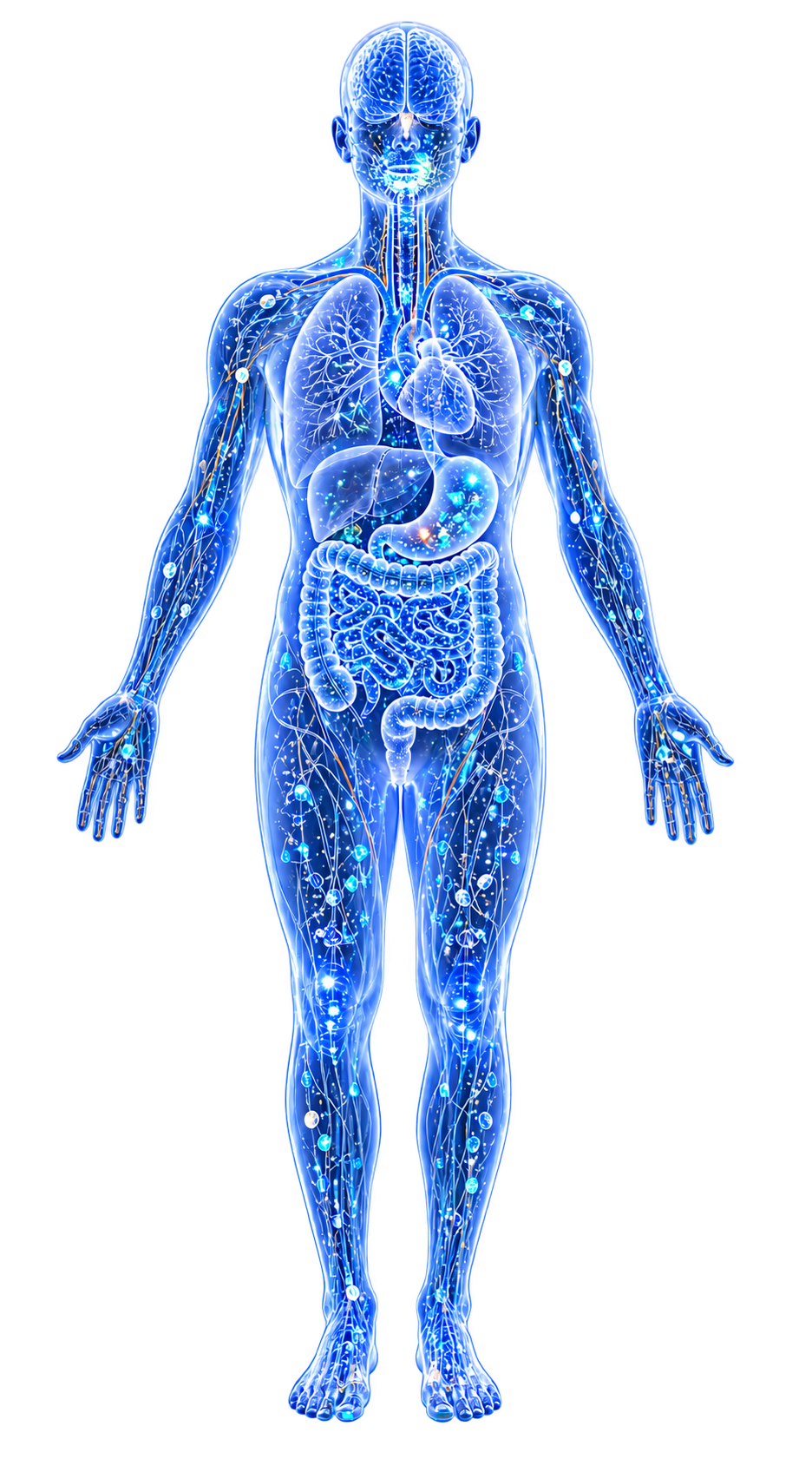
Innate immunity is the body's first-line, non-specific defense against pathogens—comprising physical barriers (epithelium, mucus), antimicrobial molecules (Calprotectin (S100A8/A9), Lactoferrin, defensins), pattern recognition receptors (TLRs, NOD-like receptors), and phagocytic cells (macrophages, neutrophils, dendritic cells).
In the WikiBiome framework, innate immunity is inseparable from Nutritional Immunity (Metal Sequestration)—the host strategy of restricting essential metals from pathogens.
Evidence map4 cited passagesInspect provenance +
TLR signaling: Microbial LPS (TLR4), lipoteichoic acid (TLR2), flagellin (TLR5), and CpG DNA (TLR9) train innate immune responses.
Peptidoglycan recognition proteins (PGRPs): Kill bacteria via metal-mediated oxidative, thiol, and osmotic stress—a direct intersection of innate immunity and metal toxicity.
Intestinal immunity: Iron homeostasis in the gut directly modulates innate immune cell function.
Crohn's disease: Defective innate immunity (NOD2 mutations) leads to impaired bacterial clearance and chronic inflammation.
Metal-Mediated Innate Defense#
The innate immune system deploys metals as weapons. Calprotectin (S100A8/A9): Released by neutrophils; sequesters zinc and manganese, starving pathogens of essential cofactors. Lactoferrin: Binds free iron at mucosal surfaces; denies iron to siderophore-dependent pathogens. Hepcidin: IL-6-induced master iron regulator; sequesters systemic iron during infection.
Lipocalin-2: Neutralizes bacterial enterobactin (the strongest known siderophore). Copper burst: Macrophages pump toxic copper into phagosomes to kill engulfed bacteria. Zinc intoxication: Macrophages deliver lethal zinc doses to Salmonella-containing vacuoles.
Microbiome Shaping#
The innate immune system shapes the microbiome, and the microbiome shapes innate immunity. TLR signaling: Microbial LPS (TLR4), lipoteichoic acid (TLR2), flagellin (TLR5), and CpG DNA (TLR9) train innate immune responses.[1]Esophageal microbial dysbiosis impairs mucosal barrier integrity via toll-like receptor 2 pathway in patients with gastroesophageal reflux symptomsChen S, Jiang D, Zhuang Q et al. · 2024Open reference 1 ↓
Peptidoglycan recognition proteins (PGRPs): Kill bacteria via metal-mediated oxidative, thiol, and osmotic stress—a direct intersection of innate immunity and metal toxicity.[2]Kashyap et al. 2014 — Peptidoglycan Recognition Proteins Kill Bacteria by Inducing Oxidative, Thiol, and Metal StressDipika R. Kashyap, Minhui Wang, Li-Hung Liu et al. · 2014Open reference 2 ↓
Intestinal immunity: Iron homeostasis in the gut directly modulates innate immune cell function.[3]Mechanism of Iron Ion Homeostasis in Intestinal Immunity and Gut Microbiota RemodelingHonghong Bao, Yi Wang, Hanlin Xiong et al. · 2024Open reference 3 ↓ Crohn's disease: Defective innate immunity (NOD2 mutations) leads to impaired bacterial clearance and chronic Metal-Driven Inflammation.[4]Intestinal Microbiota and the Innate Immune System - a Crosstalk in Crohn's Disease PathogenesisHaag LM, Siegmund B · 2015Open reference 4 ↓
Cross-References#
- Nutritional Immunity (Metal Sequestration)—metal restriction as innate antimicrobial strategy
- Calprotectin (S100A8/A9)—neutrophil-derived zinc (Zn)/manganese (Mn) sequestration
- Lactoferrin—mucosal iron sequestration
- Hepcidin—systemic iron regulation
- Toll-Like Receptors—pattern recognition driving innate responses
- NF-kB Signaling Pathway—downstream signaling from pattern recognition
- inflammation—innate immune activation driving chronic inflammation
References 6
Numbered by first appearance in the article, then reconciled with its declared source list.
- 1
Chen S, Jiang D, Zhuang Q et al. (2024). Esophageal microbial dysbiosis impairs mucosal barrier integrity via toll-like receptor 2 pathway in patients with gastroesophageal reflux symptoms. Journal of Translational Medicine.
- 2
Dipika R. Kashyap, Minhui Wang, Li-Hung Liu et al. (2014). Kashyap et al. 2014 — Peptidoglycan Recognition Proteins Kill Bacteria by Inducing Oxidative, Thiol, and Metal Stress. PLoS Pathogens.
- 3
★Honghong Bao, Yi Wang, Hanlin Xiong et al. (2024). Mechanism of Iron Ion Homeostasis in Intestinal Immunity and Gut Microbiota Remodeling. International Journal of Molecular Sciences.
- 4
Haag LM, Siegmund B (2015). Intestinal Microbiota and the Innate Immune System - a Crosstalk in Crohn's Disease Pathogenesis. Frontiers in Immunology.
- 5
Natalia A. Borges, Amanda F. Barros, Lia S. Nakao et al. (2016). Protein-Bound Uremic Toxins from Gut Microbiota and Inflammatory Markers in CKD. Journal of Renal Nutrition.
- 6
Chen, et al. (2026). Chen et al. 2026 — Metalloimmunology in the Tumor Microenvironment. Theranostics.
Article network
Connect the evidence
Publicly readable discussion by ORCID-authenticated researchers. Questions, interpretation, methods, corrections, and new evidence stay attached to this record.
No discussion yet. Start with a precise question or a source-backed observation.
Activity and accepted changes
Accepted researcher context, editorial status, public discussion, and upstream Git revisions are shown together. Pending, declined, and withdrawn proposals remain private.
- published revision
Backfill inflammation concept links
Karen Pendergrass · +2 −2
Inspect exact Git diff ↗ - published revision
massive wiki expansion: 149 stubs fixed, 100+ new pages, Rule 15 scan, keystone papers
WikiBiome Deploy Bot · +55 −0
Inspect exact Git diff ↗