
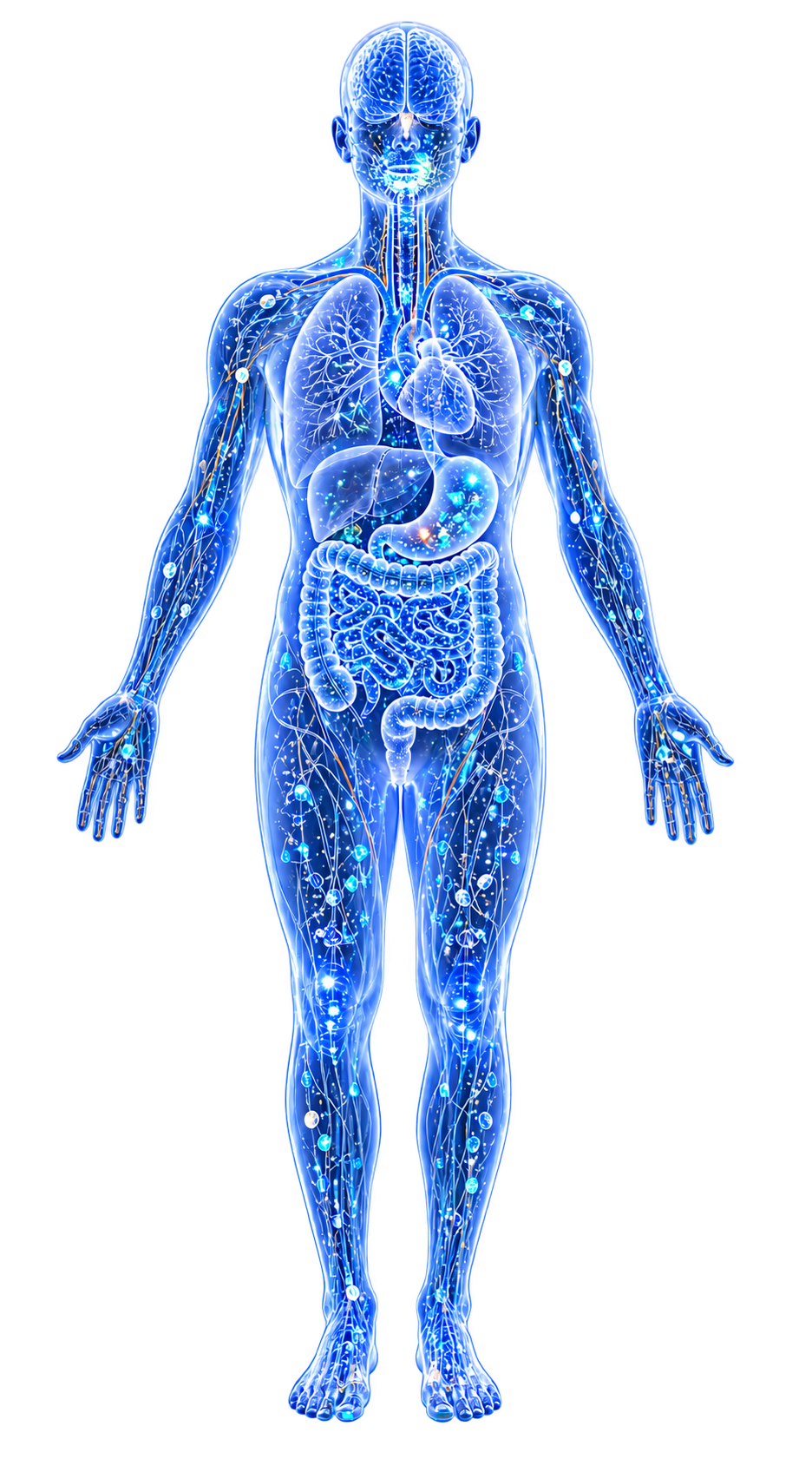
Tryptophan (Trp) is an essential amino acid metabolized via three competing pathways: the kynurenine pathway, the serotonin pathway, and the microbial indole pathway.
The balance among these pathways is profoundly influenced by the Gut Microbiome, Metal-Driven Inflammation, and metal cofactors, making tryptophan metabolism a critical node in the Gut-Brain Axis and a convergent disruption point across neurological, autoimmune, and metabolic diseases.
Evidence map10 cited passagesInspect provenance +
Kynurenic acid (KA): Neuroprotective; NMDA receptor antagonist. Depleted in ASD fecal samples.
ASD children show reduced fecal 5-HTP and altered serotonin metabolism.
Indole-3-propionic acid (IPA): Produced by Clostridium sporogenes; atheroprotective in cardiovascular disease; inversely correlated with arterial plaque size.
In the CNS, AhR activation on astrocytes is anti-neuroinflammatory.
However, excessive AhR activation may be pathological: in ASD mouse models (BTBR), elevated indole/IPA hyperactivated AhR, suppressing glutamate transporters and GABA receptors, worsening E/I imbalance.
Fecal kynurenate, indolelactate, and 5-HTP all significantly lower in ASD children.
Faecalibacterium hominis supplementation corrected indole-AhR dysregulation and restored social behavior in BTBR mice.
Dietary and microbial AhR ligands are therapeutic targets.
IPA is atheroprotective; Parabacteroides distasonis (indole-producing) inversely correlated with plaque size.
Metal-driven dysbiosis reduces indole-producing commensals: Loss of AhR ligand production impairs gut barrier integrity and removes anti-inflammatory signaling.
The Three Pathways#
1. Kynurenine Pathway (~95% of Trp)#
The dominant route of tryptophan catabolism, controlled by two iron-dependent rate-limiting enzymes. IDO1/IDO2 (indoleamine 2,3-dioxygenase): Expressed in immune cells and gut epithelium; induced by IFN-gamma and inflammation. Requires heme iron as a cofactor.
TDO (tryptophan 2,3-dioxygenase): Expressed primarily in the liver; constitutive. Also requires heme iron.
Downstream metabolites. Kynurenine (KYN): Immunomodulatory; activates the aryl hydrocarbon receptor (AhR). Kynurenic acid (KA): Neuroprotective; NMDA receptor antagonist.
Depleted in ASD fecal samples.[1]Aziz-Zadeh 2025 — Relationships Between Brain Activity, Tryptophan-Related Gut Metabolites, and Autism SymptomatologyLisa Aziz-Zadeh, Sofronia M. Ringold, Aditya Jayashankar et al. · 2025Open reference 1 ↓ 3-Hydroxykynurenine (3-HK): Neurotoxic; generates free radicals.
Quinolinic acid (QUIN): Potent neurotoxin; NMDA receptor agonist and excitotoxin. Elevated in neuroinflammatory conditions.
The KA/QUIN ratio reflects the neuroprotective-neurotoxic balance: inflammation shifts this ratio toward QUIN, driving Neuroinflammation.
2. Serotonin Pathway (~1-2% of Trp)#
TPH1/TPH2 (tryptophan hydroxylase): Rate-limiting enzymes; TPH1 in gut enterochromaffin cells, TPH2 in CNS neurons. Produces 5-hydroxytryptophan (5-HTP) then serotonin (5-HT). ~95% of body serotonin is produced in the gut by enterochromaffin cells, regulated by gut bacteria (Clostridia, spore-forming bacteria).
Gut serotonin regulates motility, secretion, and visceral sensation; does not cross the BBB. ASD children show reduced fecal 5-HTP and altered serotonin metabolism.[1]Aziz-Zadeh 2025 — Relationships Between Brain Activity, Tryptophan-Related Gut Metabolites, and Autism SymptomatologyLisa Aziz-Zadeh, Sofronia M. Ringold, Aditya Jayashankar et al. · 2025Open reference 1 ↓
3. Microbial Indole Pathway#
Gut bacteria directly metabolize tryptophan to produce indole derivatives. Indole: Produced by tryptophanase (TnaA) in E. coli, Bacteroides, Clostridium, Proteus.
Indole-3-propionic acid (IPA): Produced by Clostridium sporogenes; atheroprotective in Cardiovascular Disease; inversely correlated with arterial plaque size.[2]Emerging therapy targets to modulate microbiome-mediated effects evident in cardiovascular diseaseDorothea Katharina Hoffelner, Tim Hendrikx · 2025Open reference 2 ↓
Indole-3-acetic acid (IAA): Produced by multiple genera; AhR ligand. Indole-3-aldehyde (IAld): Produced by Lactobacillus; potent AhR activator driving IL-22 production. Tryptamine: Produced by Clostridium and Ruminococcus; serotonin receptor agonist.
AhR Activation: The Therapeutic Target#
Indole derivatives activate the aryl hydrocarbon receptor (AhR) on intestinal epithelial cells, immune cells, and astrocytes.
Drives IL-22 production, which strengthens gut barrier integrity and stimulates antimicrobial peptide production. Promotes Treg differentiation and suppresses Th17 responses—directly relevant to Multiple Sclerosis and autoimmunity. In the CNS, AhR activation on astrocytes is anti-neuroinflammatory.[3]Gut-oriented interventions in patients with multiple sclerosis: fact or fiction?V. Martinelli, M. Albanese, M. Altieri et al. · 2022Open reference 3 ↓
However, excessive AhR activation may be pathological: in ASD mouse models (BTBR), elevated indole/IPA hyperactivated AhR, suppressing glutamate transporters and GABA receptors, worsening E/I imbalance.[4]Yu 2025 — The Gut Commensal Faecalibacterium hominis Attenuates Indole-AhR Signaling and Restores ASD-Like Behaviors with BTBR MiceYou Yu, Yujing Wang, Jie Zhang et al. · 2025Open reference 4 ↓
Disease Relevance#
Autism Spectrum Disorder#
Fecal kynurenate, indolelactate, and 5-HTP all significantly lower in ASD children.[1]Aziz-Zadeh 2025 — Relationships Between Brain Activity, Tryptophan-Related Gut Metabolites, and Autism SymptomatologyLisa Aziz-Zadeh, Sofronia M. Ringold, Aditya Jayashankar et al. · 2025Open reference 1 ↓ Brain activity in insula and cingulate cortex mediates the relationship between indolelactate levels and ASD severity.
Faecalibacterium hominis supplementation corrected indole-AhR dysregulation and restored social behavior in BTBR mice.[4]Yu 2025 — The Gut Commensal Faecalibacterium hominis Attenuates Indole-AhR Signaling and Restores ASD-Like Behaviors with BTBR MiceYou Yu, Yujing Wang, Jie Zhang et al. · 2025Open reference 4 ↓ Tryptophan metabolite profiles are among the most consistent ASD biomarkers.
Multiple Sclerosis#
AhR ligand depletion contributes to unchecked Th17-mediated neuroinflammation. Dietary and microbial AhR ligands are therapeutic targets.[3]Gut-oriented interventions in patients with multiple sclerosis: fact or fiction?V. Martinelli, M. Albanese, M. Altieri et al. · 2022Open reference 3 ↓
Depression#
IDO1 induction by inflammatory cytokines shunts tryptophan away from serotonin toward kynurenine, producing the "serotonin depletion" of inflammatory depression. Quinolinic acid accumulation contributes to NMDA-mediated excitotoxicity in depressive states.
Cardiovascular Disease#
- IPA is atheroprotective; Parabacteroides distasonis (indole-producing) inversely correlated with plaque size.[2]Emerging therapy targets to modulate microbiome-mediated effects evident in cardiovascular diseaseDorothea Katharina Hoffelner, Tim Hendrikx · 2025Open reference 2 ↓
Metal Connections#
Iron dependence of IDO/TDO: Both rate-limiting kynurenine pathway enzymes require heme iron. Iron dyshomeostasis directly alters the kynurenine/serotonin balance. Metal-induced inflammation upregulates IDO1: Via IFN-gamma induction, metals shift tryptophan catabolism toward the neurotoxic kynurenine arm.
Metal-driven Dysbiosis reduces indole-producing commensals: Loss of AhR ligand production impairs gut barrier integrity and removes anti-inflammatory signaling.[5]Heavy Metals, Microbial Metallomics, and the US Obesity Epidemic: A Mechanistic Examination of a Population-Level Metabolic DisruptionKaren Pendergrass · 2026Open reference 5 ↓
The net effect of metal exposure is a triple hit: more neurotoxic QUIN, less serotonin, and fewer protective AhR ligands.
Connections#
- Gut-Brain Axis—tryptophan metabolites are key mediators of gut-brain communication
- Neuroinflammation—kynurenine pathway products drive and modulate neuroinflammation
- Short-Chain Fatty Acids (SCFAs)—co-depleted with indole producers in dysbiosis
- inflammation—IDO1 induction by inflammation redirects tryptophan catabolism
- Iron—heme iron cofactor for IDO and TDO
- Faecalibacterium prausnitzii—F. hominis corrects indole-AhR dysregulation in ASD models
- Autism Spectrum Disorder—tryptophan metabolites among most consistent ASD biomarkers
- Multiple Sclerosis—AhR ligand depletion contributes to Th17-driven neuroinflammation
- Indoles—indole and indole-3-aldehyde are key tryptophan-derived AhR ligands produced by gut bacteria
References 9
Numbered by first appearance in the article, then reconciled with its declared source list.
- 1
Lisa Aziz-Zadeh, Sofronia M. Ringold, Aditya Jayashankar et al. (2025). Aziz-Zadeh 2025 — Relationships Between Brain Activity, Tryptophan-Related Gut Metabolites, and Autism Symptomatology. Nature Communications.
- 2
Dorothea Katharina Hoffelner, Tim Hendrikx (2025). Emerging therapy targets to modulate microbiome-mediated effects evident in cardiovascular disease. Frontiers in Cardiovascular Medicine.
- 3
V. Martinelli, M. Albanese, M. Altieri et al. (2022). Gut-oriented interventions in patients with multiple sclerosis: fact or fiction?. European Review for Medical and Pharmacological Sciences.
- 4
You Yu, Yujing Wang, Jie Zhang et al. (2025). Yu 2025 — The Gut Commensal Faecalibacterium hominis Attenuates Indole-AhR Signaling and Restores ASD-Like Behaviors with BTBR Mice. Frontiers in Microbiology.
- 5
★Karen Pendergrass (2026). Heavy Metals, Microbial Metallomics, and the US Obesity Epidemic: A Mechanistic Examination of a Population-Level Metabolic Disruption. Zenodo Preprint.
- 6
Tingting Wang, Beidi Chen, Mingcui Luo et al. (2023). Wang 2023 — Microbiota-Indole 3-Propionic Acid-Brain Axis Mediates Abnormal Synaptic Pruning of Hippocampal Microglia and Susceptibility to ASD in IUGR Offspring. Microbiome.
- 7
Federica Gevi, Lello Zolla, Stefano Gabriele et al. (2016). Gevi 2016 — Urinary Metabolomics of Young Italian Autistic Children Supports Abnormal Tryptophan and Purine Metabolism. Molecular Autism.
- 8
Pamela Vernocchi, Chiara Marangelo, Silvia Guerrera et al. (2023). Vernocchi 2023 — Gut Microbiota Functional Profiling in ASD: Bacterial VOCs and Related Metabolic Pathways Acting as Disease Biomarkers and Predictors. Frontiers in Microbiology.
- 9
Yuanpeng Zheng, Marie K. Bek, Naika Z. Prince et al. (2021). Zheng 2021 -- The Role of Bacterial-Derived Aromatic Amino Acids Metabolites Relevant in Autism Spectrum Disorders: A Comprehensive Review. Frontiers in Neuroscience.
Article network
Mentioned here 13
Pages linking here 24
Connect the evidence
Publicly readable discussion by ORCID-authenticated researchers. Questions, interpretation, methods, corrections, and new evidence stay attached to this record.
No discussion yet. Start with a precise question or a source-backed observation.
Activity and accepted changes
Accepted researcher context, editorial status, public discussion, and upstream Git revisions are shown together. Pending, declined, and withdrawn proposals remain private.
- published revision
Backfill gut microbiome concept links
Karen Pendergrass · +1 −1
Inspect exact Git diff ↗ - published revision
Backfill inflammation concept links
Karen Pendergrass · +2 −2
Inspect exact Git diff ↗ - published revision
Complete corpus-wide Dysbiosis linking
Karen Pendergrass · +1 −1
Inspect exact Git diff ↗ - published revision
Add Interleukin-22 concept and contextual links
Karen Pendergrass · +1 −1
Inspect exact Git diff ↗ - published revision
massive wiki expansion: 149 stubs fixed, 100+ new pages, Rule 15 scan, keystone papers
WikiBiome Deploy Bot · +17 −17
Inspect exact Git diff ↗ - published revision
nightly maintenance: 94 stub demotions, 181 source_count fixes, 22 auto-discovered stubs, 5 adversarial audits, 3 boundary fixes, 3 evidence-level corrections
WikiBiome Deploy Bot · +1 −0
Inspect exact Git diff ↗ - published revision
pre-overnight checkpoint 2026-04-18
WikiBiome Deploy Bot · +3 −1
Inspect exact Git diff ↗ - published revision
WikiBiome update — 2026-04-15 17:23
WikiBiome Deploy Bot · +0 −1
Inspect exact Git diff ↗ - published revision
WikiBiome v2 migration: signature pages + safety fixes + gap analysis
WikiBiome Deploy Bot · +1 −0
Inspect exact Git diff ↗ - published revision
WikiBiome update — integrity fixes, metallomic diet pages, cross-condition analyses
WikiBiome Deploy Bot · +20 −10
Inspect exact Git diff ↗ - published revision
WikiBiome update — 2026-04-10 15:45
WikiBiome Deploy Bot · +86 −0
Inspect exact Git diff ↗