
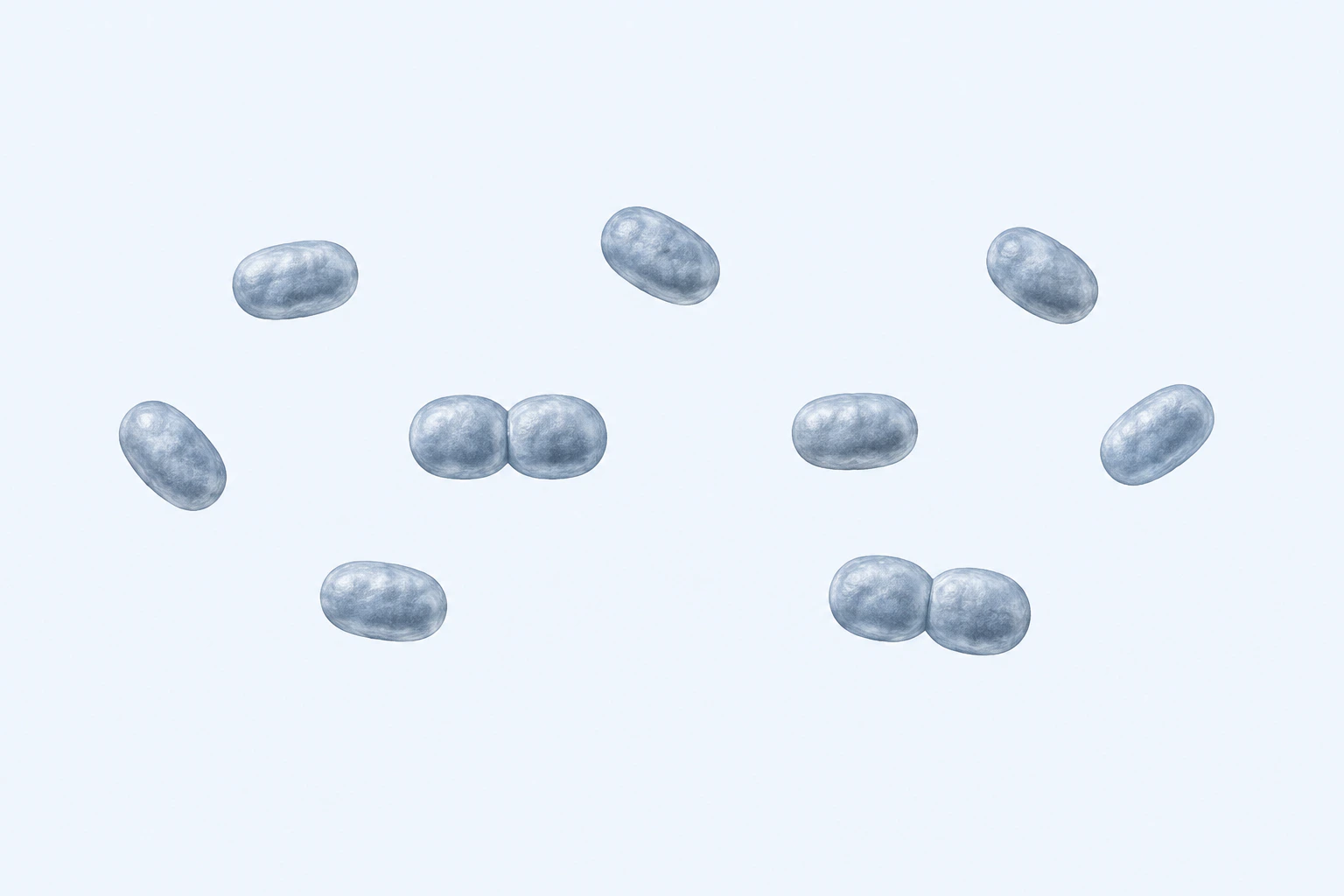
Type-species-anchored Parasutterella reconstruction showing ten compact coccobacillary bodies in six single and two paired groupings. This genus plate is representative, non-universal, non-diagnostic, and not a micrograph.
Scientific media record1 verified identifier
- Subject
- Parasutterellataxon · genus
- Identifiers
- NCBITaxon:577310
- Review
- Editorial review completeIdentifiers authority-verified · Accessibility validated · · parasutterella|parasutterella-morphology-v1.webp
- Digital source
- Trained-algorithmic mediaCreated with a trained generative algorithm and reviewed by WikiBiome for subject identity, scientific framing, identifiers, provenance, and accessibility.
- Scientific basis
- Parasutterella — NCBI TaxonomyParasutterella — LPSNParasutterella excrementihominis gen. nov., sp. nov.Parasutterella excrementihominis type strain
- License
- CC BY-SA 4.0Created
Parasutterella excrementihominis is a Gram-negative, obligate anaerobic bacterium within the Betaproteobacteria class that has gained attention as an emerging biomarker across metabolic, inflammatory, and endocrine conditions. Despite its relatively recent characterization, Parasutterella appears prominently in MR studies and dietary intervention trials.
Evidence map9 cited passagesInspect provenance +
MR analyses link Parasutterella to higher ApoB and LDL-cholesterol levels, suggesting a causal role in lipid metabolism.
Decreased following ketogenic diet intervention in CRC models, consistent with dietary fat composition influencing its abundance.
MR evidence identifies Parasutterella as protective against coronary artery disease (OR=0.936).
Enriched in mouse models of endometriosis, identified as one of ten characteristic bacteria with high LDA scores in endometriotic mice.
Also enriched alongside Bifidobacterium in endometriosis mouse models.
Significantly increased after 4 weeks of gluten-free diet in autoimmune thyroiditis patients (p=0.008), alongside increases in Desulfobacterota and Proteobacteria.
Decreased by lactobacillus supplementation.
Decreased by ketogenic diet.
Increased by gluten-free diet.
Metabolic Functions#
Succinate Production#
P. excrementihominis is a succinate producer rather than a classical SCFA (Butyrate/propionate) producer. Succinate serves as both a metabolic intermediate and an immune signaling molecule, activating succinate receptor 1 (SUCNR1/GPR91) on dendritic cells and macrophages. This positions Parasutterella as a modulator of innate immune responses through its metabolic output.
Bile Acid Metabolism#
Implicated in bile acid transformation pathways, potentially influencing the enterohepatic circulation of bile acids. Its role in bile acid metabolism connects to broader effects on cholesterol handling and lipid homeostasis.
Lipid Associations#
MR analyses link Parasutterella to higher ApoB and LDL-cholesterol levels,[1]Causality of the gut microbiome and atherosclerosis-related lipids: a bidirectional Mendelian Randomization studyDa Teng, Wenjuan Jia, Wenlong Wang et al. · 2024Open reference 1 ↓ suggesting a causal role in lipid metabolism. Decreased following ketogenic diet intervention in CRC models,[2]Ketogenic diet suppresses colorectal cancer through reshaping gut microbiota and modulating the intestinal FXR/NF-kB signaling pathwayQinhan Gao, Yuwen Liu, Fayu Su et al. · 2026Open reference 2 ↓ consistent with dietary fat composition influencing its abundance.
Disease Associations#
Cardiovascular Disease#
MR evidence identifies Parasutterella as protective against coronary artery disease (OR=0.936).[3]Assessment of the causal relationship between gut microbiota and cardiovascular diseases: a bidirectional Mendelian randomization analysisXiao-Ce Dai, Yi Yu, Si-Yu Zhou et al. · 2024Open reference 3 ↓ This protective CVD association exists despite its positive correlation with LDL-C, suggesting complex mechanisms beyond simple lipid effects.
Endometriosis#
Enriched in mouse models of Endometriosis, identified as one of ten characteristic bacteria with high LDA scores in endometriotic mice.[4]Ni 2020 — Fecal Metabolomics and Gut Microbiota Correlation in Endometriosis MiceZhexin Ni, Shuai Sun, Yanli Bi et al. · 2020Open reference 4 ↓
Also enriched alongside Bifidobacterium in endometriosis mouse models.[5]Yuan 2018 — Endometriosis Induces Gut Microbiota Alterations in MiceMing Yuan, Dong Li, Zhe Zhang et al. · 2018Open reference 5 ↓
Autoimmune Thyroiditis#
Significantly increased after 4 weeks of gluten-free diet in autoimmune thyroiditis patients (p=0.008), alongside increases in Desulfobacterota and Proteobacteria.[6]Rodziewicz et al. 2024 — Gluten-Free Diet Alters the Gut Microbiome in Women with Autoimmune ThyroiditisRodziewicz A, Szewczyk A, Bryl E · 2024Open reference 6 ↓
Its increase on GFD connects to emerging roles in Tryptophan Metabolism metabolism and gut-immune interactions.
IBD#
Altered in Inflammatory Bowel Disease (IBD), with context-dependent changes in Crohn's disease versus ulcerative colitis. Its Proteobacteria lineage places it in a phylum that is generally expanded in IBD-associated Dysbiosis.
Dietary Responsiveness#
Parasutterella is notably responsive to dietary interventions. Decreased by Lactobacillus supplementation.[7]Cholesterol-induced colorectal cancer progression and its mitigation through gut microbiota remodeling and simvastatin treatmentXiaoliang Xie, Wenjing Wang, Haiming Zhang et al. · 2025Open reference 7 ↓ Decreased by ketogenic diet.[2]Ketogenic diet suppresses colorectal cancer through reshaping gut microbiota and modulating the intestinal FXR/NF-kB signaling pathwayQinhan Gao, Yuwen Liu, Fayu Su et al. · 2026Open reference 2 ↓
Increased by gluten-free diet.[6]Rodziewicz et al. 2024 — Gluten-Free Diet Alters the Gut Microbiome in Women with Autoimmune ThyroiditisRodziewicz A, Szewczyk A, Bryl E · 2024Open reference 6 ↓
Connections#
- Cardiovascular Disease—MR-identified protective factor against CAD
- Endometriosis—enriched in endometriosis mouse models
- Inflammatory Bowel Disease (IBD)—altered in IBD as a Proteobacteria member
- involved in bile acid transformation pathways
- dysbiosis—responsive to dietary interventions and probiotic supplementation
- emerging role in tryptophan metabolism and immune modulation
- MR-linked to ApoB and LDL-C levels
References 7
Numbered by first appearance in the article, then reconciled with its declared source list.
- 1
Da Teng, Wenjuan Jia, Wenlong Wang et al. (2024). Causality of the gut microbiome and atherosclerosis-related lipids: a bidirectional Mendelian Randomization study. BMC Cardiovascular Disorders.
- 2
Qinhan Gao, Yuwen Liu, Fayu Su et al. (2026). Ketogenic diet suppresses colorectal cancer through reshaping gut microbiota and modulating the intestinal FXR/NF-kB signaling pathway. Food Science and Human Wellness.
- 3
Xiao-Ce Dai, Yi Yu, Si-Yu Zhou et al. (2024). Assessment of the causal relationship between gut microbiota and cardiovascular diseases: a bidirectional Mendelian randomization analysis. BioData Mining.
- 4
Zhexin Ni, Shuai Sun, Yanli Bi et al. (2020). Ni 2020 — Fecal Metabolomics and Gut Microbiota Correlation in Endometriosis Mice. American Journal of Reproductive Immunology.
- 5
Ming Yuan, Dong Li, Zhe Zhang et al. (2018). Yuan 2018 — Endometriosis Induces Gut Microbiota Alterations in Mice. Human Reproduction.
- 6
Rodziewicz A, Szewczyk A, Bryl E (2024). Rodziewicz et al. 2024 — Gluten-Free Diet Alters the Gut Microbiome in Women with Autoimmune Thyroiditis. Nutrients.
- 7
Xiaoliang Xie, Wenjing Wang, Haiming Zhang et al. (2025). Cholesterol-induced colorectal cancer progression and its mitigation through gut microbiota remodeling and simvastatin treatment. BMC Cancer.
Article network
Connect the evidence
Publicly readable discussion by ORCID-authenticated researchers. Questions, interpretation, methods, corrections, and new evidence stay attached to this record.
No discussion yet. Start with a precise question or a source-backed observation.
Activity and accepted changes
Accepted researcher context, editorial status, public discussion, and upstream Git revisions are shown together. Pending, declined, and withdrawn proposals remain private.
- published revision
Complete corpus-wide Dysbiosis linking
Karen Pendergrass · +1 −1
Inspect exact Git diff ↗ - published revision
massive wiki expansion: 149 stubs fixed, 100+ new pages, Rule 15 scan, keystone papers
WikiBiome Deploy Bot · +2 −2
Inspect exact Git diff ↗ - published revision
nightly maintenance: 94 stub demotions, 181 source_count fixes, 22 auto-discovered stubs, 5 adversarial audits, 3 boundary fixes, 3 evidence-level corrections
WikiBiome Deploy Bot · +1 −0
Inspect exact Git diff ↗ - published revision
pre-overnight checkpoint 2026-04-18
WikiBiome Deploy Bot · +1 −1
Inspect exact Git diff ↗ - published revision
WikiBiome update — 2026-04-15 17:23
WikiBiome Deploy Bot · +3 −3
Inspect exact Git diff ↗ - published revision
wiki: bulk entity upgrades, new article pages, and site regeneration
WikiBiome Deploy Bot · +6 −0
Inspect exact Git diff ↗ - published revision
WikiBiome update — integrity fixes, metallomic diet pages, cross-condition analyses
WikiBiome Deploy Bot · +13 −11
Inspect exact Git diff ↗ - published revision
WikiBiome update — 2026-04-10 13:49
WikiBiome Deploy Bot · +65 −0
Inspect exact Git diff ↗