

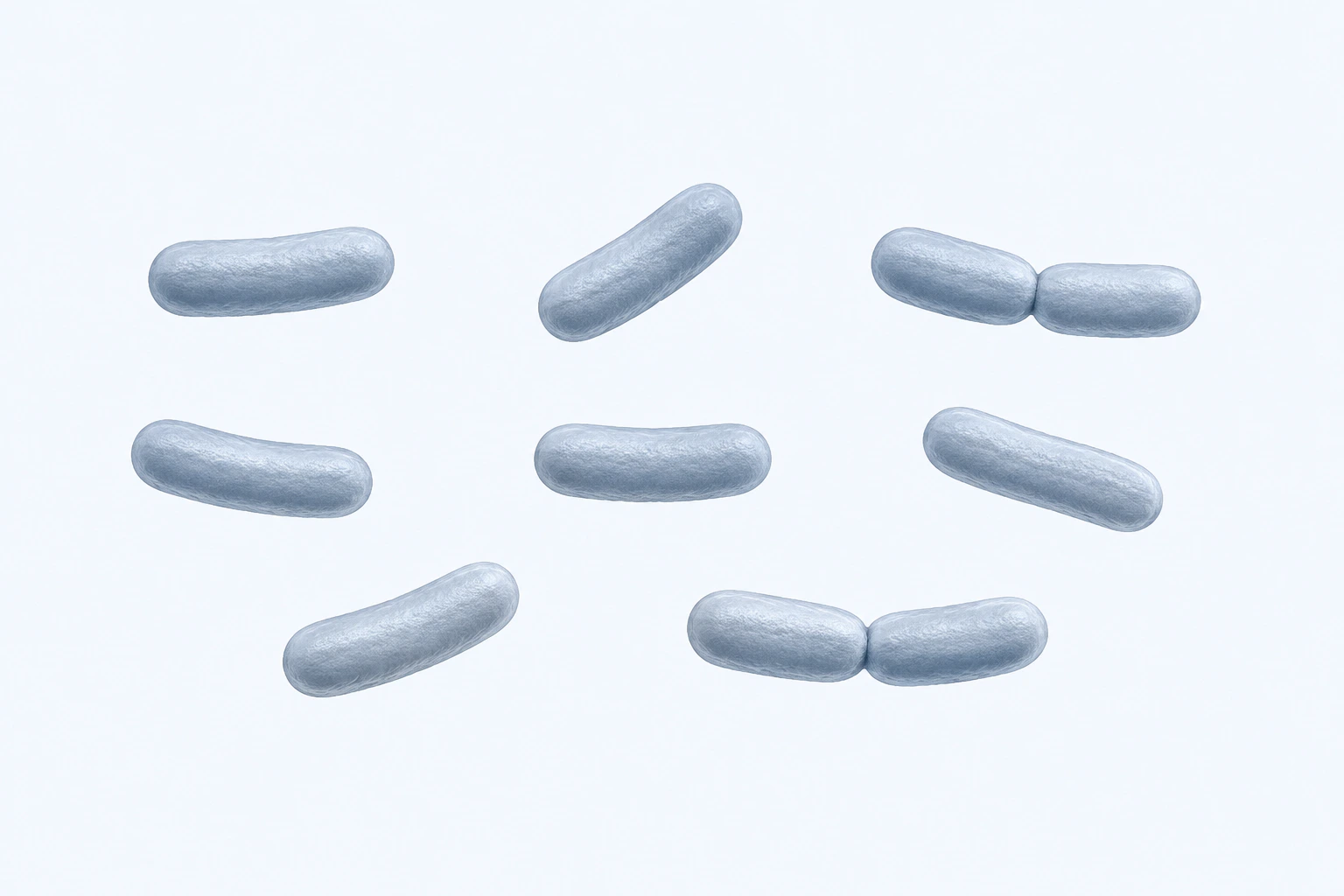
Type-species-anchored Odoribacter short rods, shown as ten bodies in six single and two paired groupings. This genus-level scientific reconstruction is representative, non-universal, non-diagnostic, and not a micrograph.
Scientific media record1 verified identifier
- Subject
- Odoribactertaxon · genus
- Identifiers
- NCBITaxon:283168
- Review
- Editorial review completeIdentifiers authority-verified · Accessibility validated · · odoribacter|odoribacter-morphology-v1.webp
- Digital source
- Trained-algorithmic mediaCreated with a trained generative algorithm and reviewed by WikiBiome for subject identity, scientific framing, identifiers, provenance, and accessibility.
- Scientific basis
- Odoribacter — NCBI TaxonomyOdoribacter — LPSNOdoribacter gen. nov.Odoribacter splanchnicus genome
- License
- CC BY-SA 4.0Created
Odoribacter splanchnicus is a Gram-negative, obligate anaerobic bacterium belonging to the family Odoribacteraceae within the phylum Bacteroidota (formerly Bacteroidetes).
It is a commensal resident of the human colon recognized primarily as a producer of Short-Chain Fatty Acids (SCFAs)—particularly Butyrate and propionate—with complex and sometimes paradoxical associations across multiple disease states.
Odoribacter is one of a small number of gut genera confirmed to show true opposing directionality between cancer and autoimmune disease microbiome signatures.
Evidence map16 cited passagesInspect provenance +
Anti-inflammatory mechanism: Odoribacter-derived butyrate specifically attenuates LPS-induced NF-κB activation, with butyrate from Odoribacter cited as a mechanism for lessening endotoxin-driven systemic inflammation. This direct anti-inflammatory mechanism through NF-κB inhibition links Odoribacter's metabolic function to cardiovascular protection.
Odoribacter is one of only six genera confirmed with true opposite directionality in the systematic meta-analysis of cancer versus autoimmune microbiome signatures: increased in cancer studies and decreased in autoimmune cohorts.
Mendelian randomization identifies Odoribacter as a causal risk factor for coronary artery disease (OR=1.206) and myocardial infarction. This contrasts with the expected cardioprotective role of butyrate producers, suggesting:
Depleted in hypertension—listed among butyrate-producing commensals reduced in hypertensive patients. The protective vs. risk-associated cardiovascular signals likely reflect different disease states and mechanisms.
Depleted alongside other commensal anaerobes in viral myocarditis (CVB3 model), suggesting that the metabolic disruption of acute viral infection displaces Odoribacter from its niche.
MR analysis identifies Odoribacter (OR=1.899, p=0.011) as a causal risk factor for pancreatic cancer. The proposed mechanism involves Odoribacter's role in bile acid transformation—the altered bile acid pool in the duodenum and pancreatic duct may create a pro-carcinogenic environment. This represents the second major cancer risk association alongside CRC
Odoribacter splanchnicus is among the top discriminating biomarkers for PDAC vs. healthy controls and autoimmune pancreatitis, achieving AUC 88.89–90.74% in shotgun metagenomics analysis. Its fecal abundance is decreased in PDAC, alongside Eubacterium rectale and E. ventricosum, with significantly reduced gut butyrate content in PDAC—establishing that PDAC
Found in tissue-associated bacterial communities of rectal carcinoma and altered following fecal microbiota transplantation in CRC progression models, consistent with the opposing-signature enrichment in CRC.
Implicated in extraintestinal manifestations of inflammatory bowel disease through MR analyses, suggesting that Odoribacter's metabolic products have systemic effects extending beyond the gut lumen. Its depletion in IBD is consistent with the broader loss of SCFA-producing Bacteroidetes commensals.
Depleted in MS patients—specifically, decreased Barnesiellaceae, Barnesiella, and Odoribacter in the bacterial microbiome, while Eggerthellaceae and Blautia increase. The MS gut microbiome also shows an increased fungal-to-bacterial richness ratio, suggesting that Odoribacter depletion may facilitate fungal expansion through reduced butyrate production.
Odoribacter abundance at baseline predicts metformin treatment response in type 2 diabetes: enriched in Responders along with Enterococcus faecium, Lactococcus lactis, and Dialister. This predictive value positions Odoribacter as a potential baseline biomarker for metabolic therapy selection, adding clinical utility beyond its disease association roles.
—opposing directionality; one of 6 genera with true opposite signatures
—MR CAD risk (OR=1.206)
—PC causal risk (OR=1.899)
—PDAC biomarker AUC 88-91%
—metformin response predictor
Contents
1. Classification and Ecology2. SCFA Production and Primary Gut Health Function3. Metal Dependencies4. Opposing Directionality—The Cancer-Autoimmune Paradox5. Cardiovascular Disease—Risk Despite SCFA Production6. Cancer Associations7. IBD and Autoimmune Disease—Depletion8. Metformin Treatment Response Prediction9. Context-Dependent Effects—Interpretive Framework10. What Wikipedia Doesn't Cover11. Cross-ReferencesClassification and Ecology#
Odoribacter is the sole genus in the family Odoribacteraceae, phylogenetically distinct from the major Bacteroidetes families (Bacteroidaceae, Prevotellaceae, Rikenellaceae). The primary clinical species is O. splanchnicus.
As an obligate anaerobe within the Bacteroidetes phylum, it occupies a different ecological and metabolic niche from Firmicutes-derived butyrate producers like Faecalibacterium prausnitzii and Roseburia, reflecting the functional redundancy built into the gut's SCFA-producing capacity.
SCFA Production and Primary Gut Health Function#
O. splanchnicus ferments complex carbohydrates to produce butyrate, propionate, and succinate.
Butyrate supports colonocyte energy metabolism (the primary fuel for colonocytes), gut barrier integrity through tight junction protein upregulation, and systemic immune regulation via HDAC inhibition and GPR109a signaling.
Propionate contributes to hepatic gluconeogenesis regulation, appetite suppression via free fatty acid receptor signaling, and Treg differentiation.
Anti-inflammatory mechanism: Odoribacter-derived butyrate specifically attenuates LPS-induced NF-κB activation, with butyrate from Odoribacter cited as a mechanism for lessening endotoxin-driven systemic Metal-Driven Inflammation.[1]Role of Gut Microbiome in Cardiovascular Events: A Systematic ReviewNaushad M. Mansuri, Neelam K. Mann, Shariqa Rizwan et al. · 2022Open reference 1 ↓ This direct anti-inflammatory mechanism through NF-κB inhibition links Odoribacter's metabolic function to cardiovascular protection.
Bile salt hydrolase activity contributes to secondary bile acid pool formation, influencing FXR and TGR5 signaling in the gut-liver axis.
Metal Dependencies#
Iron dependency exists through iron-sulfur cluster enzymes in anaerobic fermentation pathways. As a Bacteroidetes member, Odoribacter has distinct iron utilization strategies compared to Firmicutes, relying on outer membrane iron transporters and TonB-dependent receptors rather than siderophores.
The Bacteroidetes phylum has adapted to operate in the iron-limited colonic environment through high-affinity iron binding rather than siderophore secretion.
Opposing Directionality—The Cancer-Autoimmune Paradox#
Odoribacter is one of only six genera confirmed with true opposite directionality in the systematic meta-analysis of cancer versus autoimmune microbiome signatures: increased in cancer studies and decreased in autoimmune cohorts.[2]Reproducible and opposing gut microbiome signatures distinguish autoimmune diseases and cancers: a systematic review and meta-analysisMd Zohorul Islam, Melissa Tran, Tao Xu et al. · 2022Open reference 2 ↓
This opposing pattern positions Odoribacter as a marker of divergent immune environments rather than a simple beneficial or harmful taxon. In autoimmune conditions (IBD, MS): its SCFA production would be immunosuppressive and anti-inflammatory—loss of this capacity disinhibits autoimmune inflammation.
In cancer conditions (CRC): its enrichment may reflect a tumor microenvironment that favors SCFA-producing commensals, or alternatively, Odoribacter may contribute to the immunosuppressive tumor microenvironment through SCFA-mediated Treg induction.
This context-dependence is a fundamental challenge for microbiome therapeutics: the same organism is lost where its presence would help and enriched where its presence may facilitate immune evasion.
Cardiovascular Disease—Risk Despite SCFA Production#
One of the most counter-intuitive findings in the Odoribacter literature:
CAD and MI Risk#
Mendelian randomization identifies Odoribacter as a causal risk factor for coronary artery disease (OR=1.206) and myocardial infarction.[3]Assessment of the causal relationship between gut microbiota and cardiovascular diseases: a bidirectional Mendelian randomization analysisXiao-Ce Dai, Yi Yu, Si-Yu Zhou et al. · 2024Open reference 3 ↓ This contrasts with the expected cardioprotective role of butyrate producers, suggesting.
Odoribacter's specific butyrate profile or co-metabolites may have distinct cardiovascular effects vs. other butyrate producers. The MR finding may reflect bacterial metabolites beyond SCFA (bile acid metabolites, succinate, or other Bacteroidetes-specific products) contributing to cardiovascular risk. Confounding by dietary patterns that simultaneously enrich Odoribacter and cardiovascular risk factors.
Hypertension#
Depleted in hypertension—listed among butyrate-producing commensals reduced in hypertensive patients.[4]Role of the intestinal microbiome and its therapeutic intervention in cardiovascular disorderAmeer Luqman, Adil Hassan, Mehtab Ullah et al. · 2024Open reference 4 ↓ The protective vs. risk-associated cardiovascular signals likely reflect different disease states and mechanisms.
Viral Myocarditis#
Depleted alongside other commensal anaerobes in viral myocarditis (CVB3 model), suggesting that the metabolic disruption of acute viral infection displaces Odoribacter from its niche.[5]Altered colonic microflora and its metabolic profile in mice with acute viral myocarditis induced by coxsackievirus B3Yimin Xue, Shirong Lin, Mingguang Chen et al. · 2024Open reference 5 ↓
Cancer Associations#
Pancreatic Cancer—Causal Risk Factor#
MR analysis identifies Odoribacter (OR=1.899, p=0.011) as a causal risk factor for pancreatic cancer.[6]Causal effect between gut microbiota and pancreatic cancer: a two-sample Mendelian randomization studyZhichen Jiang, Yiping Mou, Huiju Wang et al. · 2023Open reference 6 ↓ The proposed mechanism involves Odoribacter's role in bile acid transformation—the altered bile acid pool in the duodenum and pancreatic duct may create a pro-carcinogenic environment.
This represents the second major cancer risk association alongside CRC enrichment.
Pancreatic Ductal Adenocarcinoma (PDAC)—Discriminating Biomarker#
Odoribacter splanchnicus is among the top discriminating biomarkers for PDAC vs. healthy controls and autoimmune pancreatitis, achieving AUC 88.89–90.74% in shotgun metagenomics analysis.[7]The fecal microbiota of patients with pancreatic ductal adenocarcinoma and autoimmune pancreatitis characterized by metagenomic sequencingWenli Zhou, De Zhang, Zhengpeng Li et al. · 2021Open reference 7 ↓
Its fecal abundance is decreased in PDAC, alongside Eubacterium rectale and E. ventricosum, with significantly reduced gut butyrate content in PDAC—establishing that PDAC creates a SCFA-deficient gut environment.
Colorectal Cancer#
Found in tissue-associated bacterial communities of rectal carcinoma[8]Tissue-Associated Bacterial Alterations in Rectal Carcinoma Patients Revealed by 16S rRNA Community ProfilingThomas AM, Jesus EC, Lopes A et al. · 2016Open reference 8 ↓ and altered following fecal microbiota transplantation in CRC progression models,[9]Fecal Microbiota Transplantation Inhibits Colorectal Cancer Progression: Reversing Intestinal Microbial Dysbiosis to Enhance Anti-Cancer Immune ResponsesHao Yu, Xing-Xiu Li, Xing Han et al. · 2023Open reference 9 ↓ consistent with the opposing-signature enrichment in CRC.
IBD and Autoimmune Disease—Depletion#
Inflammatory Bowel Disease#
Implicated in extraintestinal manifestations of Inflammatory Bowel Disease (IBD) through MR analyses, suggesting that Odoribacter's metabolic products have systemic effects extending beyond the gut lumen.[10]Gut Microbiota Does Not Play a Mediating Role in the Causal Association Between Inflammatory Bowel Disease and Several Its Associated Extraintestinal ManifestationsLu W, Cen J, Dai Q et al. · 2024Open reference 10 ↓ Its depletion in IBD is consistent with the broader loss of SCFA-producing Bacteroidetes commensals.
Multiple Sclerosis#
Depleted in MS patients—specifically, decreased Barnesiellaceae, Barnesiella, and Odoribacter in the bacterial microbiome, while Eggerthellaceae and Blautia increase.[11]Multiple Sclerosis Patients Have an Altered Gut Mycobiome and Increased Fungal to Bacterial RichnessMeeta Yadav, Soham Ali, Rachel L. Shrode et al. · 2022Open reference 11 ↓ The MS Gut Microbiome also shows an increased fungal-to-bacterial richness ratio, suggesting that Odoribacter depletion may facilitate fungal expansion through reduced butyrate production.
Metformin Treatment Response Prediction#
Odoribacter abundance at baseline predicts metformin treatment response in type 2 diabetes: enriched in Responders along with Enterococcus faecium, Lactococcus lactis, and Dialister.[12]Elbere 2020 — Baseline Gut Microbiome Composition Predicts Metformin Therapy Short-Term Efficacy in Newly Diagnosed Type 2 Diabetes PatientsIlze Elbere, Ivars Silamikelis, Ilze Izabella Dindune et al. · 2020Open reference 12 ↓
This predictive value positions Odoribacter as a potential baseline biomarker for metabolic therapy selection, adding clinical utility beyond its disease association roles.
Context-Dependent Effects—Interpretive Framework#
The wide spectrum of Odoribacter associations—protective in some cardiovascular and autoimmune contexts, risk-associated in CAD and pancreatic cancer—reflects:
- Metabolite diversity: Odoribacter produces butyrate, propionate, AND succinate. Different metabolites dominate under different conditions. Succinate at high levels is pro-inflammatory (SUCNR1 signaling); the balance shifts by substrate availability and microbial community context.
- Bile acid metabolism: Its bile salt hydrolase activity generates secondary bile acids that have complex context-dependent effects on epithelial proliferation vs. immune modulation.
- Disease-specific immune framing: In autoimmune disease, SCFA production provides needed immunosuppression (protective). In cancer, the same immunosuppression facilitates tumor immune evasion (harmful). The bacterium hasn't changed; the host immune context has.
What Wikipedia Doesn't Cover#
Wikipedia lacks an Odoribacter entry.
This page provides: the opposing-directionality cancer-autoimmune paradox as one of 6 confirmed genera with this signature; the specific NF-κB inhibition mechanism for cardiovascular protection; MR-established CAD causal risk (OR=1.206) despite SCFA production; PDAC biomarker status with AUC data; metformin response prediction; and pancreatic cancer causal risk (OR=1.899) with bile acid transformation as proposed mechanism.
Cross-References#
- Short-Chain Fatty Acids (SCFAs)—produces butyrate, propionate, and succinate
- Cardiovascular Disease—NF-κB inhibition via butyrate; MR evidence as CAD risk factor despite SCFA
- Colorectal Cancer—enriched in cancer cohorts; opposing-signature analysis
- Pancreatic Cancer—MR causal risk factor; PDAC fecal biomarker with AUC 88-91%
- Inflammatory Bowel Disease (IBD)—depleted in autoimmune conditions; MR extraintestinal manifestations
- Multiple Sclerosis—depleted; co-depletion with Barnesiella; fungal expansion implications
- Dysbiosis—opposite-directionality genus bridging cancer and autoimmune signatures
- Bile Acid Metabolism—bile salt hydrolase activity; bile acid transformation linked to PC risk
- Iron—iron (Fe)-S dependent anaerobic fermentation; TonB-dependent iron transport
- Candida albicans—reduced butyrate from Odoribacter depletion may facilitate fungal expansion in MS
References 12
Numbered by first appearance in the article, then reconciled with its declared source list.
- 1
Naushad M. Mansuri, Neelam K. Mann, Shariqa Rizwan et al. (2022). Role of Gut Microbiome in Cardiovascular Events: A Systematic Review. Cureus.
- 2
Md Zohorul Islam, Melissa Tran, Tao Xu et al. (2022). Reproducible and opposing gut microbiome signatures distinguish autoimmune diseases and cancers: a systematic review and meta-analysis. Microbiome.
- 3
Xiao-Ce Dai, Yi Yu, Si-Yu Zhou et al. (2024). Assessment of the causal relationship between gut microbiota and cardiovascular diseases: a bidirectional Mendelian randomization analysis. BioData Mining.
- 4
Ameer Luqman, Adil Hassan, Mehtab Ullah et al. (2024). Role of the intestinal microbiome and its therapeutic intervention in cardiovascular disorder. Frontiers in Immunology.
- 5
Yimin Xue, Shirong Lin, Mingguang Chen et al. (2024). Altered colonic microflora and its metabolic profile in mice with acute viral myocarditis induced by coxsackievirus B3. Virology Journal.
- 6
Zhichen Jiang, Yiping Mou, Huiju Wang et al. (2023). Causal effect between gut microbiota and pancreatic cancer: a two-sample Mendelian randomization study. BMC Cancer.
- 7
Wenli Zhou, De Zhang, Zhengpeng Li et al. (2021). The fecal microbiota of patients with pancreatic ductal adenocarcinoma and autoimmune pancreatitis characterized by metagenomic sequencing. Journal of Translational Medicine.
- 8
Thomas AM, Jesus EC, Lopes A et al. (2016). Tissue-Associated Bacterial Alterations in Rectal Carcinoma Patients Revealed by 16S rRNA Community Profiling. Frontiers in Cellular and Infection Microbiology.
- 9
Hao Yu, Xing-Xiu Li, Xing Han et al. (2023). Fecal Microbiota Transplantation Inhibits Colorectal Cancer Progression: Reversing Intestinal Microbial Dysbiosis to Enhance Anti-Cancer Immune Responses. Frontiers in Microbiology.
- 10
Lu W, Cen J, Dai Q et al. (2024). Gut Microbiota Does Not Play a Mediating Role in the Causal Association Between Inflammatory Bowel Disease and Several Its Associated Extraintestinal Manifestations. Frontiers in Immunology.
- 11
Meeta Yadav, Soham Ali, Rachel L. Shrode et al. (2022). Multiple Sclerosis Patients Have an Altered Gut Mycobiome and Increased Fungal to Bacterial Richness. PLOS ONE.
- 12
Ilze Elbere, Ivars Silamikelis, Ilze Izabella Dindune et al. (2020). Elbere 2020 — Baseline Gut Microbiome Composition Predicts Metformin Therapy Short-Term Efficacy in Newly Diagnosed Type 2 Diabetes Patients. PLoS ONE.
Article network
Mentioned here 16
Pages linking here 4
Connect the evidence
Publicly readable discussion by ORCID-authenticated researchers. Questions, interpretation, methods, corrections, and new evidence stay attached to this record.
No discussion yet. Start with a precise question or a source-backed observation.
Activity and accepted changes
Accepted researcher context, editorial status, public discussion, and upstream Git revisions are shown together. Pending, declined, and withdrawn proposals remain private.
- published revision
Backfill gut microbiome concept links
Karen Pendergrass · +1 −1
Inspect exact Git diff ↗ - published revision
Backfill inflammation concept links
Karen Pendergrass · +1 −1
Inspect exact Git diff ↗ - published revision
Complete Tight junctions contextual coverage
Karen Pendergrass · +1 −1
Inspect exact Git diff ↗ - published revision
massive wiki expansion: 149 stubs fixed, 100+ new pages, Rule 15 scan, keystone papers
WikiBiome Deploy Bot · +15 −15
Inspect exact Git diff ↗ - published revision
Deepen schizophrenia/CKD entities + 8 microbe entities; add 6 source pages
WikiBiome Deploy Bot · +90 −37
Inspect exact Git diff ↗ - published revision
WikiBiome update — 2026-04-15 17:23
WikiBiome Deploy Bot · +0 −1
Inspect exact Git diff ↗ - published revision
wiki: bulk entity upgrades, new article pages, and site regeneration
WikiBiome Deploy Bot · +6 −0
Inspect exact Git diff ↗ - published revision
WikiBiome update — integrity fixes, metallomic diet pages, cross-condition analyses
WikiBiome Deploy Bot · +17 −10
Inspect exact Git diff ↗ - published revision
WikiBiome update — 2026-04-10 13:49
WikiBiome Deploy Bot · +59 −0
Inspect exact Git diff ↗